Second Generation (Alexander Want-To-Be)
I was already familiar, at least as a history hobbyist, with the Wars of the Diadochi (the Wars of the Successors) over control of the Greek empire after the death of Alexander thanks to another book by James Romm, ‘Ghost on the Throne’ from 2011. I knew the five major players in the four-act drama of all-against-all, viz., Ptolemy in Egypt, Seleucus in East Asia, and Antigonus (one-Eyed) with Demetrius in West Asia, Cassander in Macedonia, and Lysimachus in Thrace. These were the five initial factions, not unlike the five families of the New York underworld. Demetrius I Poliocretes (aka The Besieger of Cities) was the son of Antigonus and thus a member of the next generation of would-be world conquerors and aspiring second-generation want-to-be Alexanders.
The First World War
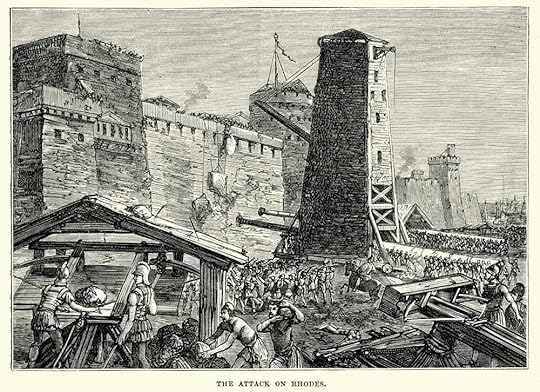
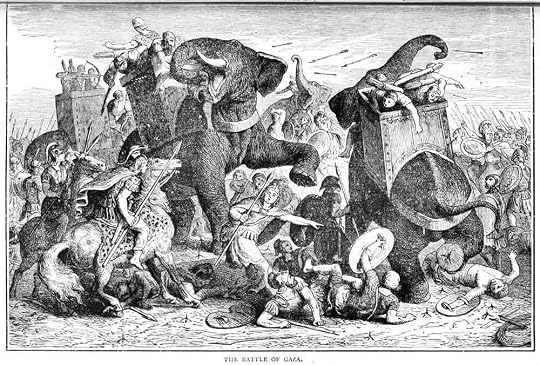
This conflict spanned three continents and was effectively a world conflict in terms of the ancient world. This was a messy war in which Demetrius played the role of inveterate besieger, constantly charging at cities like Don Quixote tilting at windmills. As James Romm points out, Demetrius, and many of his fellow would-be world conquerors, were addicted to war and campaigning and preferred it to governing or reigning. These actors, these warlords, these would-be successors to Alexander’s empire fought each other on a continuous basis. These partitions notwithstanding, there was no effective ‘state’ as such in place. This working arrangement was more analogous to mafia turfs and warring gangs than to organized states or functioning governments. This was a history of people and personalities, not states and wars.
In-Between
This is a period of history that has always fascinated me, viz., the Hellenistic Age. This is the period beginning with the death of Alexander and ending with the death of Cleopatra. It begins with the end of the classical age but prior to the new world order of Rome. Greek dominance was becoming fragmented and stagnant, but Rome was not yet dominant. This was one of those rare periods of transition from one paradigm to another, an interregnum or a state of unsure in-betweeness, if I can put it that way. This period produced its own unique philosophy, art, and politics which I find both attractive and fascinating.
Counterfactuals
An obvious counterfactual embraces the death of Alexander. If Alexander did not die, it is likely that his empire would have held together under his leadership. But then what? Possibly the conquest of the west? This would have likely defeated Rome before it became powerful and thus prevented its eventual dominance. As such, perhaps Greek suppression of the Maccabees (radical Jewish cult) thus no Christianity and no Islam, all very desirable alternative outcomes in my opinion. The world could have avoided the three Abrahamic monsters. Perhaps Greek would have become the lingua franca in place of Latin in a Hellenistic world from the Atlantic Ocean in the west to the Punjab region of India in the east. No Jewish wars, No Christianization of Europe or the Americas, no Muslim conquest of the Middle East. It is also likely that Alexander would have conquered Arabia as well and I would have never been born to write this review – a good thing according to some Christians I know.
However, the counterfactual more relevant to this book is what would have happened if Antigonus and Demetrius won the battle of Ipsus in 301BC. This would have meant the defeat of Seleucus, Cassander, and Lysimachus. This would have given Antigonus and Demetrius a considerable force to then turn against Ptolemy in Egypt. A defeat of Ptolemy would have reunified Alexander’s empire under the still young and dashing Demetrius as the new Alexander.
Alcibiades rather than Alexander
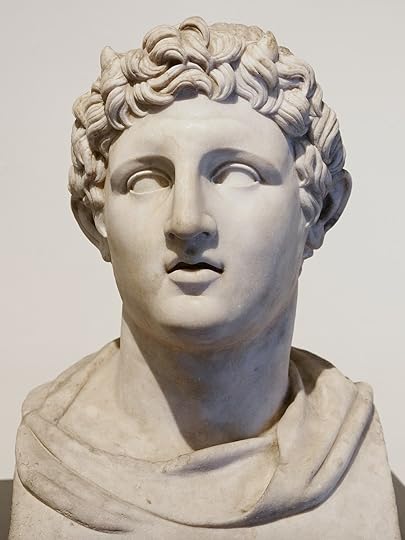
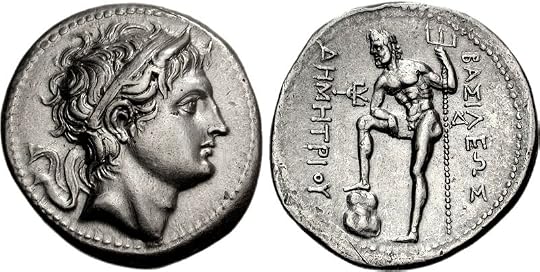
Demetrius, putting together youth, dashing good looks, flowing hair, a faraway gaze and sexual prowess (important qualifications for leadership) was scheduled to be the new Alexander, but he was no Alexander, just an Alexander imitator. Alexander linked himself to the legend of Dionysus, and in imitation, the young and handsome Demetrius too had a turn at becoming the new Dionysus. But Demetrius stumbled, was stymied, and stalemated first in Egypt by Ptolemy, then in Rhodes, and again against Cassander in Thessaly and finally at the decisive battle of Ipsus in ways Alexander would not have been stopped. Alas, his failures were often a matter of hours and inches one way or the other. Demetrius was closer to being a new Alcibiades rather than a new Alexander. Plutarch paired Demetrius with Mark Antony in his ‘Parallel Lives’, not Alexander notably, because both squandered wealth, power and time in wine-soaked drinking binges, riotous behavior, and sex orgies, even if understandably with alluring and remarkable women, e.g., Antony with Cleopatra and Demetrius with Cratesipolis. Demetrius even tried to name a city after himself, but it didn’t stick. Both Antony and Demetrius became predatory, arrogant, and filled with a hubris that led to violence in pursuit of narcissistic ambitions. But then again, how else does one become be a god?
Liberty and Justice for All
This was a time when the Greeks started to embrace father and son savior gods and the deification of human beings. The once rational Athenians recognized Antigonus and Demetrius as their father and son Savior Gods in a leader cult along with Dionysus and Demeter – a new blurring and combining of terrestrial and celestial power - a portent of things to come in the ancient world still with us today. In much the same fashion American Christians worship Trump in a leader cult along with their Jesus as Savior Gods. American Christians do not understand that God cannot safeguard liberty and democracy because an all-powerful God is by definition an absolute ruler. The phrase from the U.S. Pledge of Allegiance “One nation under God, indivisible, with liberty and justice for all” is a prima facie contradiction, belief in an all-powerful God is inimical to human wellbeing. Current American politics is the result of this deep cultural contradiction and irreconcilable paradox. We live in a country craving cult leadership, not human liberty. At the least the Athenians had enough wits about them to occasionally through off their Savior Gods, not so with Christians, it pains me to say.