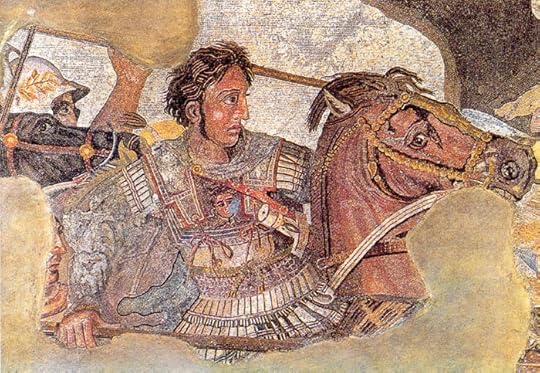
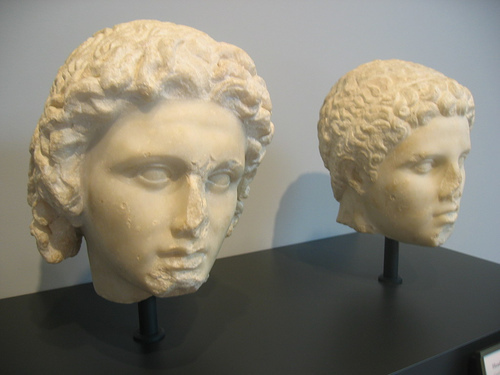
What an incredible story!--if you stop to think a moment about it. A brave youth sets out with his army, wins victory after victory, conquers a great empire, and all this by the age of 33, when he dies suddenly (planning yet another campaign). I may be wrong, but I think anyone who is a little familiar with "world history" at least knows the name of Alexander the Great. There have been a number of films made about him after all.
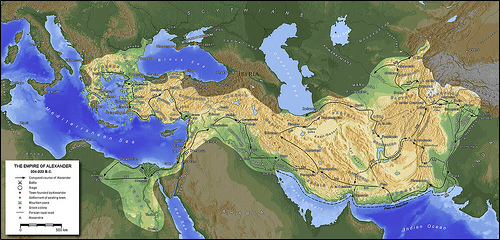
I wanted to read this book about the great leader of Macedon because it was written by a fine novelist, Mary Renault. I have read her novels about Alexander and Ancient Greece and wanted to read this biography of Alexander that she wrote in 1975. She did her research, going back to ancient sources, and she wrote the story like a novel which moves at a swift pace. One problem--NO MAPS, but I've read other books about Alexander- and an excellent National Geographic article about him- and I had a general idea of where he went (I did also look at a Nat'l. Geo. map of Iran ).
Renault focuses on the character of Alexander. He believed he was descended from the great hero of the Trojan War, Achilles, and, also, Zeus, the King of the gods. It helps to have that much confidence! He believed in winning glory, gaining immortality through everlasting fame. I'm most impressed by his charisma, his magnetic quality, that attracted men to want to follow him, fight for him, and, of course, die for him. And, of course, all the great military commanders had that quality--Napoleon comes readily to mind, but there are others...Rommel? Patton? What amazes me the most about Alexander is that he was usually in the forefront of battle, risking his life alongside his men. It was expected of commanders in ancient times...but, still, he was wounded repeatedly and it's incredible that he was able to recover and keep pushing on.
For Renault, there's no doubt that Alexander was a great hero. Today, we would say he was a bloodstained imperialist, needlessly causing death and destruction in the lands that he invaded. But, as Renault points out, the great Persian Empire which had tried to conquer Greece, remained a threat to the Greeks. The Persians also controlled Greek cities in what has been called Asia Minor, in today's Turkey. Alexander's father, Philip II, king of Macedonia, had unified the Greeks under him and planned to liberate those Greek cities in Asia Minor when he was assassinated. Alexander, seen as just a mere youth at first, was able to take over the disciplined army that his father had built and then proceed to carry out his father's plans. But that wasn't enough for him-- he kept going...he took Judea, where he was welcomed as a liberator from Persian rule, and then Egypt, where he was proclaimed a Pharoah, a divinity. In the Battle of Gaugamela, Alexander defeated the Persian Emperor Darius decisively and became effectively the new emperor of Persia. Did he stop there? No way. He wanted to push on to the mysterious land of India--and he did so, defeating an Indian king who used war elephants against him--to no avail.
He would have kept going--but, finally!, there was one thing that could stop him--his own men. They were exhausted and had had enough. They wanted to return to their families, not keep going on and on into unknown lands...Had Alexander gone too far? In my opinion, Yes. I can see him building an empire based on a unified Greek Empire, being dominant in the Med, and I would think promoting and spreading Greek learning, the arts and philosophy (Alexander had been the student of Aristotle). He did not need to go into the interior of Asia as he did. What he needed to do was consolidate his empire and set up a succession that would keep it from all falling apart following his death--which is what happened. Alexander got sick and died in Babylon--Renault believes he was poisoned. His son Alexander and his wife Roxanne were murdered-- and the Macedonian generals had a falling- out and fought among themselves over the remnants of Alexander's empire. It would be the much bloodthirstier Romans who would come along and build a great empire, including Greece..
In sum, it certainly is a great story and also there's a great what-if. What if Alexander had lived longer, just ten years longer, AND he had set his mind on building the peace and not keep conquering and conquering.....?