

What do you think?

England's Medieval Queens #3
Queens of the Age of Chivalry: England's Medieval Queens, Volume Three
Packed with dramatic true stories from one of European history’s most romantic and turbulent eras, this epic narrative chronicles the five vividly rendered queens of the Plantagenet kings who ruled England between 1299 and 1399.
The Age of Chivalry describes a period of medieval history dominated by the social, religious, and moral code of knighthood that prized noble deeds, military greatness and the game of courtly love between aristocratic men and women. It was also a period of high drama in English history, which included the toppling of two kings, the Hundred Years’ War, the Black Death, and the Peasants’ Revolt. Feudalism was breaking down, resulting in social and political turmoil.
Against this dramatic backdrop, Alison Weir describes the lives and reigns of five queen consorts: Marguerite of France was seventeen when she became the second wife of sixty-year-old King Edward I. Isabella of France, later known as “the She Wolf,” dethroned her husband Edward II and ruled England with her lover. In contrast, Philippa of Hainault was a popular queen to the deposed king’s son, Edward III. Anne of Bohemia was queen to Richard II, but she died young and childless. Isabella of Valois became Richard’s second wife when she was only six years old, but was caught up in events when he was violently overthrown.
This was a turbulent and brutal age, despite its chivalric color and ethos, and it stands as a vivid backdrop to the extraordinary stories of these queens’ lives.
The Age of Chivalry describes a period of medieval history dominated by the social, religious, and moral code of knighthood that prized noble deeds, military greatness and the game of courtly love between aristocratic men and women. It was also a period of high drama in English history, which included the toppling of two kings, the Hundred Years’ War, the Black Death, and the Peasants’ Revolt. Feudalism was breaking down, resulting in social and political turmoil.
Against this dramatic backdrop, Alison Weir describes the lives and reigns of five queen consorts: Marguerite of France was seventeen when she became the second wife of sixty-year-old King Edward I. Isabella of France, later known as “the She Wolf,” dethroned her husband Edward II and ruled England with her lover. In contrast, Philippa of Hainault was a popular queen to the deposed king’s son, Edward III. Anne of Bohemia was queen to Richard II, but she died young and childless. Isabella of Valois became Richard’s second wife when she was only six years old, but was caught up in events when he was violently overthrown.
This was a turbulent and brutal age, despite its chivalric color and ethos, and it stands as a vivid backdrop to the extraordinary stories of these queens’ lives.
576 pages, Kindle Edition
First published December 6, 2022
About the author
Alison Weir
96 books8,723 followersLibrarian Note: There is more than one author in the GoodReads database with this name.
Alison Weir is an English writer of history books for the general public, mostly in the form of biographies about British kings and queens, and of historical fiction. Before becoming an author, Weir worked as a teacher of children with special needs. She received her formal training in history at teacher training college. She currently lives in Surrey, England, with her two children.
Alison Weir is an English writer of history books for the general public, mostly in the form of biographies about British kings and queens, and of historical fiction. Before becoming an author, Weir worked as a teacher of children with special needs. She received her formal training in history at teacher training college. She currently lives in Surrey, England, with her two children.
Ratings & Reviews
Friends & Following
Create a free account to discover what your friends think of this book!
Community Reviews
Displaying 1 - 30 of 159 reviews

December 6, 2022
It’s customary for the medieval history to be presented through the viewpoint of men, as it was a time of even noble and royal women being little but chattel, men’s property, and the wombs to propagate dynasties. They were who history happened to, not the makers of it. In Queens of the Age of Chivalry, however, Alison Weir tries to bring them from the shadows behind the throne into the spotlight, with varying success.
Out of five queens — Marguerite of France (wife of Edward I), Isabella of France (wife of Edward II), Philippa of Hainault (wife of Edward III), Anne of Bohemia and Isabella of Valois (first and second wives of Richard II) — only Isabella of France really succeeded in leaving a strong mark on history as anything but a wife and mother but as a power in her own right. So no wonder that it is Isabella’s story (and the tumultuous years of history of that part of the world during her reign) that takes up the bulk of the book and its most interesting pages.
I admit I was also primed to like Isabella’s story even before this book, as once upon a time I used to be a preteen obsessed with Maurice Druon’s The Accursed Kings book series — the seven-book epic chronicling the events that lead to a 100-year conflicts between England and France, the end of the Capet dynasty and the riee of the Valois dynasty in France, the end of Edward II reign in England, supplanted by his unhappy wife Queen Isabella, and the start of Edward III reign. Isabella and both Edwards, the Despensers, Roger Mortimer — all those names to me already felt familiar and I was invested from the beginning.
But as for the other four (well, maybe with the exception of Philippa of Hainault, Isabella’s daughter-in-law), I was a bit more lukewarm as their stories were just less interesting and impactful and they remained mostly relegated to the shadows of men throughout their lives. At least they seemed to have happy marriages, unlike Isabella, so at least there’s that.
This book took me a while to get through, being very long and quite dense — although still enjoyable. Weir does not skimp on details or historical background, and why the sheer amount of details/names/events binging on it was pretty much impossible as we saw one Plantagenet succeeded by another and another and another, and another. But Weir still manages to keep it interesting, avoiding dry and stuffy tone, and does something that I quite appreciated — giving equivalents to the 14th century sums of money in modern amounts of money, which certainly underscored the disgustingly lavish lifestyles of royalty.
I feel much better versed in the English royalty of the 14th century now. Maybe I still have a chance at being erudite enough?
4 stars.
——————
Thanks to NetGalley and Ballantine Books for providing me with a digital ARC in exchange for an honest review.
——————
Also posted on my blog.
Out of five queens — Marguerite of France (wife of Edward I), Isabella of France (wife of Edward II), Philippa of Hainault (wife of Edward III), Anne of Bohemia and Isabella of Valois (first and second wives of Richard II) — only Isabella of France really succeeded in leaving a strong mark on history as anything but a wife and mother but as a power in her own right. So no wonder that it is Isabella’s story (and the tumultuous years of history of that part of the world during her reign) that takes up the bulk of the book and its most interesting pages.
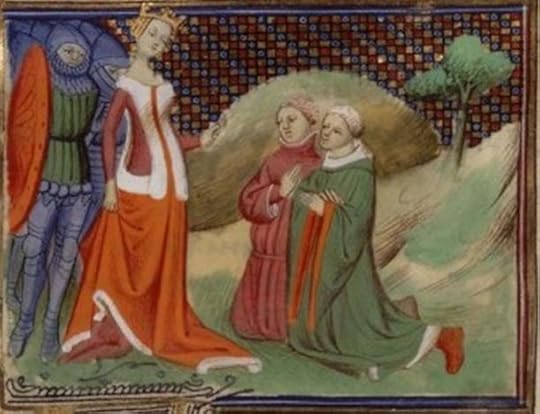
I admit I was also primed to like Isabella’s story even before this book, as once upon a time I used to be a preteen obsessed with Maurice Druon’s The Accursed Kings book series — the seven-book epic chronicling the events that lead to a 100-year conflicts between England and France, the end of the Capet dynasty and the riee of the Valois dynasty in France, the end of Edward II reign in England, supplanted by his unhappy wife Queen Isabella, and the start of Edward III reign. Isabella and both Edwards, the Despensers, Roger Mortimer — all those names to me already felt familiar and I was invested from the beginning.
But as for the other four (well, maybe with the exception of Philippa of Hainault, Isabella’s daughter-in-law), I was a bit more lukewarm as their stories were just less interesting and impactful and they remained mostly relegated to the shadows of men throughout their lives. At least they seemed to have happy marriages, unlike Isabella, so at least there’s that.
This book took me a while to get through, being very long and quite dense — although still enjoyable. Weir does not skimp on details or historical background, and why the sheer amount of details/names/events binging on it was pretty much impossible as we saw one Plantagenet succeeded by another and another and another, and another. But Weir still manages to keep it interesting, avoiding dry and stuffy tone, and does something that I quite appreciated — giving equivalents to the 14th century sums of money in modern amounts of money, which certainly underscored the disgustingly lavish lifestyles of royalty.
I feel much better versed in the English royalty of the 14th century now. Maybe I still have a chance at being erudite enough?
4 stars.
——————
Thanks to NetGalley and Ballantine Books for providing me with a digital ARC in exchange for an honest review.
——————
Also posted on my blog.

November 20, 2022
The final book in a trilogy, it is the only one that I have read. The author was recommended to me by a fellow Bookstagrammer.
This book recounts the stories of five queen consorts of Plantagenet period, during the age of chivalry in the fourteenth century . They are Marguerite of France, wife of Edward I, Isabella of France (Edward II), Philippa of Hainault (Edward III), Anne of Bohemia, first wife of Richard II, and his second wife, Isabella of Valois
In this meticulously researched tome we learn not only of these five women, but also quite a bit about their royal spouses. and the importance of these unions.
Although there is a lot of information, no stuffy nonfiction chronicle is this. Rather it reads more like a novel. I really liked that when Weir cited money, she gave the equivalent in today’s price; this provided a meaningful perspective on the costs.
If you are interested in English royal history, particularly medieval, this will be a very satisfying read.
Thanks to #netgalley and #randomhouse #Ballantine books for the ARC
This book recounts the stories of five queen consorts of Plantagenet period, during the age of chivalry in the fourteenth century . They are Marguerite of France, wife of Edward I, Isabella of France (Edward II), Philippa of Hainault (Edward III), Anne of Bohemia, first wife of Richard II, and his second wife, Isabella of Valois
In this meticulously researched tome we learn not only of these five women, but also quite a bit about their royal spouses. and the importance of these unions.
Although there is a lot of information, no stuffy nonfiction chronicle is this. Rather it reads more like a novel. I really liked that when Weir cited money, she gave the equivalent in today’s price; this provided a meaningful perspective on the costs.
If you are interested in English royal history, particularly medieval, this will be a very satisfying read.
Thanks to #netgalley and #randomhouse #Ballantine books for the ARC

June 10, 2022
Close your eyes. Listen to my voice, its ups and downs, how my words flow to your ears. Imagine something for me. IMAGINE ENGLAND CONSTANTLY GOING TO BATTLE WITH 90,000 MEN - EVERY.SINGLE.TIME. where in the hell are they all coming from because the word MERCENARIES has definitely not been spoken by my lips.
ROYALTY READS PROJECT
ROYALTY READS PROJECT

September 20, 2022
Alison Weir writes the history of five English queens. I mainly read historical fiction but my go to for facts is always Antonia Fraser and Alison Weir. Alison never misses any details and what I love is that she saves you the trouble of reading countless books. You will learn everything you need to from her writings. I rated it four stars instead of five as I would have loved to have seen some of the pictures she references throughout. Thank you to the author, publishers and Netgalley for an e-arc in exchange for my honest opinion.

January 3, 2023
A detailed look at the queens of England in the 14th century from Marguerite, Edward 1’s second wife; Isabella (easily the most interesting!), wife of Edward II; Philippa of Hainult, EdwardIII (the most productive with 12 children); and the two wives of Richard the second, Anne of Bohemia and poor child bride Isabella of Valois. It was an interesting and informative read about medieval life and the lives of the royal families.

March 8, 2023
Medieval queens (actually, queens of any period) were typically thought of as a man’s property and submissive to the King, her husband. Although exhibiting some power in her own name; it was mostly in conjunction with the King and she was not to bring any difficulty into his personal life or kingdom. To hell with that notion! These women were fierce, formidable, intelligent, independent, and NOT to be reckoned with by anyone: the true purveyors of feminism. Alison Weir strives to give these women their rightful place in the spotlight with, “England’s Medieval Queens” starting with “Queens of the Conquest”, following with “Queens of the Conquest” and presenting Book Three, “Queens of the Age of Chivalry”.
“Queens of the Age of Chivalry” targets the beginning of the Plantagenet era from 1299 to 1409 that saw the gripping drama of not one but two overthrown kings, wars, a Peasant’s Revolt and the Black Death, to top it off. This violent and tumultuous period encompassed the lives of five queen consorts who often had their own hand in the milieu: Marquerite of France (King Edward I’s second wife), Queen Isabella of France (King Edward II), Philippa of Hainault (King Edward III), Anne of Bohemia (King Richard II) and Isabella of Valois (King Richard II’s second wife).
Even though the formatting Weir’s “England’s Medieval Queens” strives to forgo individual biographies and rather show some of the causal effects of each woman on another; “Queens of the Age of Chivalry” fails in that regard and is simply a volume with sections highlighting each individual queen’s life before moving onto the next. As such, each queen doesn’t receive equal coverage with Marquerite of France only receiving 30-some pages in comparison to Isabella’s almost 200, for instance. This most possibly mirrors the amount of resource material and actual life events surrounding each queen; but it also gives the impression that one is more important than the other. In fact, the first section (Marquerite) is slow, tedious, and bluntly: boring; which makes readers skeptical about the entire book immediately.
The prominent issue with “Queens of the Age of Chivalry” is the absence of truly bringing the lives and psyches of the five women to the eyes of readers. Much of the text is simply a political history retelling in the structure of, “Event A happened, B and then Event C followed”. Not to mention, each section focuses mostly on the kings and men of the period rather than the queens! In usual Weir fashion, logistics, ledgers, account books, purchases and travel itineraries make up the cusp of the discussion which to some degree gives an insight into the queens but not to the distinction that Weir aims for in the books of “England’s Medieval Queens”.
Most readers know to take Weir’s works with a grain of salt as her output has thinned out throughout the years in regard to historical merit. Weir has presented more and more biases over time, a wide range of speculative statements and ‘facts’ not properly sourced or just simply ‘wrong’ and already proven thus by many contemporary historians with “Queens of the Age of Chivalry” being no exception. For example, Weir asserts that Phillipa of Hainault begged King Edward III to forgo the execution of the Calais burghers while this has been proven as conjecture. In another example, Marquerite of France is said to be illiterate but her letters are extant. This is not to say that Weir doesn’t exhibit some of the sleuth work and debunking of myths she is famous for among the pages of “Queens of the Age of Chivalry”; but certainly not as much as it should.
It is crystal clear that Weir’s favorite queen is Queen Isabella (she is one of my favorites, as well) due to her owning the majority of the text and detail. This isn’t a horrible flaw, per se, but this isn’t an Isabella sole biography and “Queens of the Age of Chivalry” is supposed to focus on the other women, as well.
Weir does gain some traction and speed as “Queens of the Age of Chivalry” progresses but it is inconsistent with spurts of energy tangled among repetitive historical discourse. The text is better described as an overview of the period tentatively through the eyes of the queens but hardly so. There is no effective insight on the pages of “Queens of the Age of Chivalry” and those readers with knowledge on the subject will not experience the reveal of any new information.
“Queens of the Age of Chivalry” is also somewhat muddled by its heavy dependency on the chronicles of Froissart. Although a credible primary source; it results in a one-note piece and doesn’t feel well-rounded or with enough viewpoints/perspectives.
The concluding chapters of “Queens of the Age of Chivalry” surrounding the wives of King Richard II revert back to the first chapters in that they are abrupt, rushed, shallow, and don’t magnetically draw the women away from the male-dominated history. Readers simply come away with little learned from “Queens of the Age of Chivalry”.
Weir fortifies “Queens of the Age of Chivalry” with a section of photo plates, bibliography (which is actually impressive with its extensive lengthy list) and notes (not annotated).
Book Three of “England’s Medieval Queens” is best suited for introductory readers as it is somewhat dry, doesn’t actually focus on the queens as claimed, contains speculative statements and thereby is far from riveting or informative. “Queens of the Age of Chivalry” isn’t awful and is indeed recommended for readers of English history interested in queens; but it is certainly not a groundbreaking or exemplary text.
“Queens of the Age of Chivalry” targets the beginning of the Plantagenet era from 1299 to 1409 that saw the gripping drama of not one but two overthrown kings, wars, a Peasant’s Revolt and the Black Death, to top it off. This violent and tumultuous period encompassed the lives of five queen consorts who often had their own hand in the milieu: Marquerite of France (King Edward I’s second wife), Queen Isabella of France (King Edward II), Philippa of Hainault (King Edward III), Anne of Bohemia (King Richard II) and Isabella of Valois (King Richard II’s second wife).
Even though the formatting Weir’s “England’s Medieval Queens” strives to forgo individual biographies and rather show some of the causal effects of each woman on another; “Queens of the Age of Chivalry” fails in that regard and is simply a volume with sections highlighting each individual queen’s life before moving onto the next. As such, each queen doesn’t receive equal coverage with Marquerite of France only receiving 30-some pages in comparison to Isabella’s almost 200, for instance. This most possibly mirrors the amount of resource material and actual life events surrounding each queen; but it also gives the impression that one is more important than the other. In fact, the first section (Marquerite) is slow, tedious, and bluntly: boring; which makes readers skeptical about the entire book immediately.
The prominent issue with “Queens of the Age of Chivalry” is the absence of truly bringing the lives and psyches of the five women to the eyes of readers. Much of the text is simply a political history retelling in the structure of, “Event A happened, B and then Event C followed”. Not to mention, each section focuses mostly on the kings and men of the period rather than the queens! In usual Weir fashion, logistics, ledgers, account books, purchases and travel itineraries make up the cusp of the discussion which to some degree gives an insight into the queens but not to the distinction that Weir aims for in the books of “England’s Medieval Queens”.
Most readers know to take Weir’s works with a grain of salt as her output has thinned out throughout the years in regard to historical merit. Weir has presented more and more biases over time, a wide range of speculative statements and ‘facts’ not properly sourced or just simply ‘wrong’ and already proven thus by many contemporary historians with “Queens of the Age of Chivalry” being no exception. For example, Weir asserts that Phillipa of Hainault begged King Edward III to forgo the execution of the Calais burghers while this has been proven as conjecture. In another example, Marquerite of France is said to be illiterate but her letters are extant. This is not to say that Weir doesn’t exhibit some of the sleuth work and debunking of myths she is famous for among the pages of “Queens of the Age of Chivalry”; but certainly not as much as it should.
It is crystal clear that Weir’s favorite queen is Queen Isabella (she is one of my favorites, as well) due to her owning the majority of the text and detail. This isn’t a horrible flaw, per se, but this isn’t an Isabella sole biography and “Queens of the Age of Chivalry” is supposed to focus on the other women, as well.
Weir does gain some traction and speed as “Queens of the Age of Chivalry” progresses but it is inconsistent with spurts of energy tangled among repetitive historical discourse. The text is better described as an overview of the period tentatively through the eyes of the queens but hardly so. There is no effective insight on the pages of “Queens of the Age of Chivalry” and those readers with knowledge on the subject will not experience the reveal of any new information.
“Queens of the Age of Chivalry” is also somewhat muddled by its heavy dependency on the chronicles of Froissart. Although a credible primary source; it results in a one-note piece and doesn’t feel well-rounded or with enough viewpoints/perspectives.
The concluding chapters of “Queens of the Age of Chivalry” surrounding the wives of King Richard II revert back to the first chapters in that they are abrupt, rushed, shallow, and don’t magnetically draw the women away from the male-dominated history. Readers simply come away with little learned from “Queens of the Age of Chivalry”.
Weir fortifies “Queens of the Age of Chivalry” with a section of photo plates, bibliography (which is actually impressive with its extensive lengthy list) and notes (not annotated).
Book Three of “England’s Medieval Queens” is best suited for introductory readers as it is somewhat dry, doesn’t actually focus on the queens as claimed, contains speculative statements and thereby is far from riveting or informative. “Queens of the Age of Chivalry” isn’t awful and is indeed recommended for readers of English history interested in queens; but it is certainly not a groundbreaking or exemplary text.

December 20, 2023
England’s Age of Chivalry was a surprisingly turbulent period marked by coups, civil unrest, and outright war on multiple fronts. We meet five queens in this book, including one of the most reviled and one of the most beloved in all of English history.
This is the third book in Alison Weir’s England’s Medieval Queens, in which she profiles the queens of medieval England from the Conquest to (I believe) the end of the War of the Roses. In this book, we meet the queens of Edward I, II, and III, as well as the two queens of Richard II. Of these queens, I was only familiar with Isabella the so-called She Wolf of France, so I was excited to dig into their stories.
This is a surprisingly sad and strange collection of queens, and I enjoyed getting to know all their stories in turn, seeing how their fortunes were tied to the men they wed and how well they managed to rule. Weir makes a good case for how the queens managed to influence England’s politics, whether it was done visibly or behind the scenes. She does a good job of bringing their personalities and the dynamics of their relationships with their husbands to light.
However, Weir does have a bad habit of falling back on lists and letters to demonstrate her points in some places – did I really have to struggle through so much of Isabella of France’s flowery correspondence to understand what was going on? I also thought that sometimes we spent too much time with the men in time periods where historical references run thin, with the queens only popping up with their clothes or presents documented. I wished we might have gone deeper into an analysis of their actions or the like in such cases.
Disclaimer: I received an ARC of this book from NetGalley. This is my honest and voluntary review.
This is the third book in Alison Weir’s England’s Medieval Queens, in which she profiles the queens of medieval England from the Conquest to (I believe) the end of the War of the Roses. In this book, we meet the queens of Edward I, II, and III, as well as the two queens of Richard II. Of these queens, I was only familiar with Isabella the so-called She Wolf of France, so I was excited to dig into their stories.
This is a surprisingly sad and strange collection of queens, and I enjoyed getting to know all their stories in turn, seeing how their fortunes were tied to the men they wed and how well they managed to rule. Weir makes a good case for how the queens managed to influence England’s politics, whether it was done visibly or behind the scenes. She does a good job of bringing their personalities and the dynamics of their relationships with their husbands to light.
However, Weir does have a bad habit of falling back on lists and letters to demonstrate her points in some places – did I really have to struggle through so much of Isabella of France’s flowery correspondence to understand what was going on? I also thought that sometimes we spent too much time with the men in time periods where historical references run thin, with the queens only popping up with their clothes or presents documented. I wished we might have gone deeper into an analysis of their actions or the like in such cases.
Disclaimer: I received an ARC of this book from NetGalley. This is my honest and voluntary review.

January 19, 2023
This is a well written and detailed (sometimes a bit too detailed) description of the lives of five queens from the fourteenth century. Naturally some of the queens were more interesting than others, I didn't really get much of a sense of who Marguerite of France was. Isabella was by far the most interesting, and had the largest part of the book dedicated to her. I was a child when I visited Berkeley Castle for the first time, and learnt of the gruesome fate that Edward 11 met there, it made a strong impression on me, so I found the details leading up to this, and the part she may have played in it fascinating.
The other Queens covered are Philippa of Hainault, Anne of Bohemia, and Isabella of Valois.
*Many thanks to Netgalley and the publishers for a review copy in exchange for an honest opinion.*
The other Queens covered are Philippa of Hainault, Anne of Bohemia, and Isabella of Valois.
*Many thanks to Netgalley and the publishers for a review copy in exchange for an honest opinion.*

March 25, 2023
3.75 stars rounded up
2025 Reread: I reread this over the summer as part of a women's history group. I feel the same upon my reread as I did on my original review.
Original Review:
This was well done and flowed well.
I don't agree with the author in a few areas.
This is a much condensed version of this history.
This is a fascinating period in both England and France and worthy of a deeper look if you like this kinda thing.
Either way I'll definitely read the next installment in this series. Even when I don't agree with the author I appreciate this view of English history.
2025 Reread: I reread this over the summer as part of a women's history group. I feel the same upon my reread as I did on my original review.
Original Review:
This was well done and flowed well.
I don't agree with the author in a few areas.
This is a much condensed version of this history.
This is a fascinating period in both England and France and worthy of a deeper look if you like this kinda thing.
Either way I'll definitely read the next installment in this series. Even when I don't agree with the author I appreciate this view of English history.

December 12, 2022
Well researched and very interesting!

November 8, 2022
Like, I suspect, many lovers of English royal history, I'm pretty good up until Richard the Lionheart & King John, then things get a bit hazy until the Tudors arrive. I'd heard of some names: Edward II supposedly killed by a hot poker somewhere unmentionable, Richard II....Peasants' Revolt..something...something..., Henry Bolingbroke...not a scooby. So this was an ideal book for me, & the fourteenth century makes much more sense now. It's taken me just over a week to finish this, but it wasn't because it was struggling to keep my interest, it was due to the fact that there is just so much information packed into these pages. I had to keep recapping family trees in my head to ensure I had the 'who was who/who was related to who' correct, & I spent some time in merry diversions such as looking at re-creations of medieval dress - chin barbes, anyone?
As the title suggests, this book examines the reigns of Edward I, Edward II, Edward III, & Richard II via their marriage partners. In order: Marguerite of France, Isabella of France, Philippa of Hainault, Anne of Bohemia & Isabella of Valois (last two both married to Richard II, at different times of course). At a time when most important marriages were arranged for strategic & alliance purposes, the majority of these marriages seemed to have been genuinely happy. Most of them tended to live as Queen Consorts were expected to, but the standout was Isabella of France, wife of Edward II. Not content to be sidelined by a royal favourite, Isabella schemed to replace her husband with their eldest son, & actually succeeded. Her alliance & (rumoured but probably true) love affair with Roger Mortimer has earned her the scorn of historians for many years, but perhaps Isabella felt she had no option but to do what she did. Weir also notes that the deposing of a reigning monarch had repercussions down through the years culminating in Charles I's execution & the eventual loss of complete monarchical power in England. The poker thing though - probably not true. In fact there is some evidence to suggest Edward II may not have died in England at all, but fled overseas.
I haven't read the previous two books in this series (Queens of the Conquest, & Queens of the Crusades) but they are definitely on my TBR list now. Overall, it's a fantastic read, it never gets academically dry, there's lots of information, & I actually have a much better understanding of this time period now. Absolutely recommended. 5 stars
My thanks to NetGalley & publishers, Random House UK/Vintage Digital, for the opportunity to read an ARC.
As the title suggests, this book examines the reigns of Edward I, Edward II, Edward III, & Richard II via their marriage partners. In order: Marguerite of France, Isabella of France, Philippa of Hainault, Anne of Bohemia & Isabella of Valois (last two both married to Richard II, at different times of course). At a time when most important marriages were arranged for strategic & alliance purposes, the majority of these marriages seemed to have been genuinely happy. Most of them tended to live as Queen Consorts were expected to, but the standout was Isabella of France, wife of Edward II. Not content to be sidelined by a royal favourite, Isabella schemed to replace her husband with their eldest son, & actually succeeded. Her alliance & (rumoured but probably true) love affair with Roger Mortimer has earned her the scorn of historians for many years, but perhaps Isabella felt she had no option but to do what she did. Weir also notes that the deposing of a reigning monarch had repercussions down through the years culminating in Charles I's execution & the eventual loss of complete monarchical power in England. The poker thing though - probably not true. In fact there is some evidence to suggest Edward II may not have died in England at all, but fled overseas.
I haven't read the previous two books in this series (Queens of the Conquest, & Queens of the Crusades) but they are definitely on my TBR list now. Overall, it's a fantastic read, it never gets academically dry, there's lots of information, & I actually have a much better understanding of this time period now. Absolutely recommended. 5 stars
My thanks to NetGalley & publishers, Random House UK/Vintage Digital, for the opportunity to read an ARC.

August 4, 2022
576 pages
5 stars
Ms. Weir does it again! She writes an exceptionally well researched book about the Queens of England in the age of chivalry. This was a time of upheaval in England with wars, rebellion and disease. This in contrast to the games of courtly love between the upper echelon of British aristocrats.
I have read all of Alison Weir’s books and she hasn’t disappointed yet. Her writing style is almost conversational and not at all dry. She makes history especially interesting and is careful to attend to whomever is speaking at any given time. The reader has a clear idea about whom she is speaking. (Unlike some other authors I have read.)
I anxiously await her next offering.
I want to thank NetGalley and Random House Publishing Group - Ballantine/Ballantine
for forwarding to me a copy of this book so that I may read, enjoy and review it. The opinions expressed in this review are solely my own.
5 stars
Ms. Weir does it again! She writes an exceptionally well researched book about the Queens of England in the age of chivalry. This was a time of upheaval in England with wars, rebellion and disease. This in contrast to the games of courtly love between the upper echelon of British aristocrats.
I have read all of Alison Weir’s books and she hasn’t disappointed yet. Her writing style is almost conversational and not at all dry. She makes history especially interesting and is careful to attend to whomever is speaking at any given time. The reader has a clear idea about whom she is speaking. (Unlike some other authors I have read.)
I anxiously await her next offering.
I want to thank NetGalley and Random House Publishing Group - Ballantine/Ballantine
for forwarding to me a copy of this book so that I may read, enjoy and review it. The opinions expressed in this review are solely my own.

March 30, 2024
Queens of the Age of Chivalry is the third installment in Alison Weir's medieval queens series. It focuses on Marguerite of France, the second wife of Edward I; Isabella of France, wife of Edward II; Philippa of Hainault, wife of Edward III; and Anne of Bohemia and Isabella of Valois, both wives to Richard II. It's a richly detailed book, though sometimes feels like more of a general medieval history.
This is actually my first Alison Weir book. I've been reading medieval history for a few years now, and though Weir is quite a prolific author of both fiction and non-fiction I had yet to read any of her work. The writing is good, and Weir has filled this book with the perfect research to really bring the 14th century to life. I also loved that the chapters flowed into one another, even when going from one queen to the next. It made the book feel seamless.
And I think the approach here of grouping several queens together was the right choice. Often times there sadly just isn't enough information for a woman - even a queen - to fill out the length of a biography. But when you have a handful of women in a single book, you don't have to worry about padding out your account so much. Still, I couldn't help feeling that at times this does indeed come across more as a 14th century history than a strict focus on the queens themselves. You of course have to expect some of that - you need context, you need to understand the world these women were living in. And these women's husbands were the kings, the most important person in the country. There's no way you could ever leave them out, but sometimes the women took a backseat in the narrative.
The other thing I didn't love is more of a personal issue: I've just read some of these stories too many times. The book opens with Edward I's second wife, Marguerite of France. Her section is relatively short, as they wed when Edward was already quite old, but Weir still provides enough to get a good sense of their marriage and what she was like as a person. Edward II and Isabella... that is a story. Unbelievable from start to finish. But I'm well aware of the tale, and felt her section dragged a bit. And although I absolutely love Philippa and Edward III, I felt the same for her section. I've read less about Richard II, so it was nice to learn more about his two wives, but they felt sort of overshadowed by his own story.
Weir has a pretty balanced view of these women, I think. For example, there's much to be said about the relationship between Edward II and Isabella, and it's not hard to understand her feelings of being slighted and pretty much in second position to Edward's favourite Piers Gaveston (and later the younger Hugh Despenser). However, Weir writes that "The King could hardly be blamed for preferring the company of a man of his own age above that of a mere child." That's a very reasonable statement to make, yet does not negate the issue of Edward's favouritism, especially as Isabella aged. She also provides a nuanced summation of Isabella's character, very much welcomed given the complexity of her circumstances. Even Philippa; sweet, sweet Philippa, the ideal English queen. The woman loved to spend and live life with all its luxuries, and so was always in debt.
A takeaway from the book is that, although made for political connections, these marriages were largely happy; Isabella and Edward II being the exception. Edward III and Philippa's marriage is legendary for its success. They cherished each other's company right until Philippa's death, and were both absolutely doting parents to their children. Even Richard II, although he was a failure as a king, loved Anne of Bohemia immensely and was distraught after she died an early death. His second wife, Isabella of Valois, was a child when they wed, but he seems to have loved her in a fatherly sort of way. Even some of the side relationships are interesting, though they obviously don't get much detail. When talking about Anne of Bohemia's mother, Empress Elizabeth, Weir writes: "She was an unusually strong woman who could tear apart thick wads of parchment and break blocks of wood with her bare hands, feats in which her husband had taken great pride." We love to see it!
I picked up Queens of the Age of Chivalry before the previous two volumes because I really love this time period. The 14th century has some of my favourite figures in English royalty. But having read some of these stories multiple times in other books, I felt like I wasn't always getting a lot of new information. But that's on me and not Weir. I will happily be checking out the other books in this series.
This is actually my first Alison Weir book. I've been reading medieval history for a few years now, and though Weir is quite a prolific author of both fiction and non-fiction I had yet to read any of her work. The writing is good, and Weir has filled this book with the perfect research to really bring the 14th century to life. I also loved that the chapters flowed into one another, even when going from one queen to the next. It made the book feel seamless.
And I think the approach here of grouping several queens together was the right choice. Often times there sadly just isn't enough information for a woman - even a queen - to fill out the length of a biography. But when you have a handful of women in a single book, you don't have to worry about padding out your account so much. Still, I couldn't help feeling that at times this does indeed come across more as a 14th century history than a strict focus on the queens themselves. You of course have to expect some of that - you need context, you need to understand the world these women were living in. And these women's husbands were the kings, the most important person in the country. There's no way you could ever leave them out, but sometimes the women took a backseat in the narrative.
The other thing I didn't love is more of a personal issue: I've just read some of these stories too many times. The book opens with Edward I's second wife, Marguerite of France. Her section is relatively short, as they wed when Edward was already quite old, but Weir still provides enough to get a good sense of their marriage and what she was like as a person. Edward II and Isabella... that is a story. Unbelievable from start to finish. But I'm well aware of the tale, and felt her section dragged a bit. And although I absolutely love Philippa and Edward III, I felt the same for her section. I've read less about Richard II, so it was nice to learn more about his two wives, but they felt sort of overshadowed by his own story.
Weir has a pretty balanced view of these women, I think. For example, there's much to be said about the relationship between Edward II and Isabella, and it's not hard to understand her feelings of being slighted and pretty much in second position to Edward's favourite Piers Gaveston (and later the younger Hugh Despenser). However, Weir writes that "The King could hardly be blamed for preferring the company of a man of his own age above that of a mere child." That's a very reasonable statement to make, yet does not negate the issue of Edward's favouritism, especially as Isabella aged. She also provides a nuanced summation of Isabella's character, very much welcomed given the complexity of her circumstances. Even Philippa; sweet, sweet Philippa, the ideal English queen. The woman loved to spend and live life with all its luxuries, and so was always in debt.
A takeaway from the book is that, although made for political connections, these marriages were largely happy; Isabella and Edward II being the exception. Edward III and Philippa's marriage is legendary for its success. They cherished each other's company right until Philippa's death, and were both absolutely doting parents to their children. Even Richard II, although he was a failure as a king, loved Anne of Bohemia immensely and was distraught after she died an early death. His second wife, Isabella of Valois, was a child when they wed, but he seems to have loved her in a fatherly sort of way. Even some of the side relationships are interesting, though they obviously don't get much detail. When talking about Anne of Bohemia's mother, Empress Elizabeth, Weir writes: "She was an unusually strong woman who could tear apart thick wads of parchment and break blocks of wood with her bare hands, feats in which her husband had taken great pride." We love to see it!
I picked up Queens of the Age of Chivalry before the previous two volumes because I really love this time period. The 14th century has some of my favourite figures in English royalty. But having read some of these stories multiple times in other books, I felt like I wasn't always getting a lot of new information. But that's on me and not Weir. I will happily be checking out the other books in this series.

December 6, 2022
I’ve previously read at least seven books from Alison Weir. Weir writes about British royal history and she and Philippa Gregory are my two favorites sources writing both non-fiction and fiction books. This book covers five queens from 1299 to 1399. They were the wives of four kings. Marguerite of France (wife of Edward I), Isabella of France (Edward II), Philippa of Hainault (Edward III), Anne of Bohemia (Richard II), and Isabella of Valois (second queen of Richard II). Weir makes history readable and accessible. I can always count on her books to be well researched with sources documented. There is a lot of information to absorb from how money was spent on clothing and entertaining to alliances during turbulent times. These are not familiar queens like Elizabeth I but they all played a part in shaping England. This is the third in Weir's Medieval Queen series. Thank you to NetGalley and Random House Publishing Group, Ballantine Books for the ARC in exchange for an honest review.

December 3, 2022
This was a good and well researched book covering Marguerite of France, wife of Edward I; Isabella of France, wife of Edward II; Philippa of Hainault, wife of Edward III; Anne of Bohemia, first wife of Richard II; and Isabella of Valois, the second wife of Richard II. Of all the women, I found Isabella of France the most fascinating- she worked to raise armies, fight to put her son on the throne over her husband, and was incredibly strong against most conventions of the day, which is probably why contemporary chroniclers disliked her so much. You get the chance to learn a great deal about the time period these women lived in: what society was like, what role religion played in daily life as well as politics, the politics of the time, etc.
An interesting book that will fascinate readers, an excellent continuation of Weir's Medieval Queens series.
I received an ARC of this book from NetGalley in exchange for an honest review
An interesting book that will fascinate readers, an excellent continuation of Weir's Medieval Queens series.
I received an ARC of this book from NetGalley in exchange for an honest review

January 3, 2023
I'm always impressed by just how much information Weir is able to gather about these medieval queens. This took me a bit longer to finish than the other two books in the series despite being roughly the same size. Every chapter is brimming with details about expenditures, gifts, clothing, and travel. Sometimes the numbers can feel daunting, but I thought that particularly in the sections about Isabella of France and Philippa of Hainault that Weir helped add broader context around how their interactions shaped both the court and the flow of history.
I would recommend this to anyone looking for more information about Marguerite & Isabella of France, Philippa of Hainault, Anne of Bohemia, and Isabella of Valois. This was my first time reading about most of these women and I felt this was a thorough introduction to who they were, how they lived, and how they navigated the many turbulent events of their times.
See more of my reviews: Instagram
I would recommend this to anyone looking for more information about Marguerite & Isabella of France, Philippa of Hainault, Anne of Bohemia, and Isabella of Valois. This was my first time reading about most of these women and I felt this was a thorough introduction to who they were, how they lived, and how they navigated the many turbulent events of their times.
See more of my reviews: Instagram
November 13, 2022
The third and final book in Weir's queens trilogy and for me her best. Set during the age of courtly love and troubadours, this excellent read shows that at times there wasn't much love shown to some queens. Isabella of France is forced to align with Roger Mortimer to overthrow her husband's favourite. Most queens of this period took much more control within their realms than ever before but were still bound to the conventions that dictated a queen was still subordinate to her king. Excellent read.

November 2, 2022
How does Alison Weir do it?! I’m fairly new to her books and have read about three of them so far, but with each and every single one, she’s had the ability to absolutely hook me.
I find I’m enthralled by her writings and literally can’t get enough. Her retellings of history and portrayal of historical figures are out of this world and she really gives you a feel and sense for who they were and might have been. I haven’t known much about medieval queens before, in fact, I’m drawing from my well of nothing when it comes to knowledge of these queens so I not only learnt a lot, but enjoyed doing so too!
Her books on the Tudor queens and Elizabeth of York were first to get me hooked and I had no idea I’d get so into other queens and historical events like the others, but I did. Fully convinced now I could read anything by this author and enjoy it to the max.
I just love the way she writes and sends the reader back to whichever historical period and time she regales us with. There’s so much drama in history and it makes for great reading. I loved learning about these queens and I’m going to have to go back now and read everything she’s ever written because I think by this stage, I know I’m guaranteed to enjoy them!
You can tell how much effort and work she puts into these books. The overwhelming amount of research she includes really portrays in these masterpieces of historical writing. I mean, the detail! Insane. I need a bookshelf of them!
Thank you to the author and publisher for a copy of this on NetGalley in return for my honest thoughts and review.
I find I’m enthralled by her writings and literally can’t get enough. Her retellings of history and portrayal of historical figures are out of this world and she really gives you a feel and sense for who they were and might have been. I haven’t known much about medieval queens before, in fact, I’m drawing from my well of nothing when it comes to knowledge of these queens so I not only learnt a lot, but enjoyed doing so too!
Her books on the Tudor queens and Elizabeth of York were first to get me hooked and I had no idea I’d get so into other queens and historical events like the others, but I did. Fully convinced now I could read anything by this author and enjoy it to the max.
I just love the way she writes and sends the reader back to whichever historical period and time she regales us with. There’s so much drama in history and it makes for great reading. I loved learning about these queens and I’m going to have to go back now and read everything she’s ever written because I think by this stage, I know I’m guaranteed to enjoy them!
You can tell how much effort and work she puts into these books. The overwhelming amount of research she includes really portrays in these masterpieces of historical writing. I mean, the detail! Insane. I need a bookshelf of them!
Thank you to the author and publisher for a copy of this on NetGalley in return for my honest thoughts and review.
March 24, 2024
Rating: 2.5 stars
The third in the series of Alison Weir's examinations of the Queens Consort of England from 1066, this volume focuses on the Queens of Edwards I, II and III, and the two Queens of Richard II.
I need to preface this by saying I think Alison Weir is an amazing historian and author; she is authoritative, knowledgeable and yet her works are easily digestible by a lay person. While this book absolutely does fit with that, unfortunately it fails to actually focus on the subject at hand; the women. I found that, throughout, it read like more of a general history of the period; the women are definitely there, and probably do appear more than in a traditional narrative of the period, but nevertheless it didn't tell their story so much as just slotted them into their place in history. I don't feel I learned very much about the women at all, and on numerous occasions found myself 'zoning out' as the book did not live up to what I was expecting from its pages. It almost feels like the author has had a loss of confidence in her own abilities to bring women's history to life.
When I reviewed the first book in this series, I commented that this issue was there too, but in that case I could sort of understand it given that primary source material from the 11th and 12th centuries is exceptionally rare. But, even in that book with little source material to rely upon, the author quoted such sources and pinpointed where a Queen was, and perhaps why she was there. In this book, it is clear that there is more primary source material to draw from, but it is the more mundane kind; accounts. As such, she is able to tell us what the Queen ate or wore wherever she might have been, but there is a complete lack of depth given to them as people. I appreciate that a historian deals in facts, but usually there are at least inferences made as to what the subject's motivations and thoughts may have been and this felt totally missing in this case.
The amount of time dedicated to each Queen also felt uneven to me. I vaguely recall the author making a comment at the outset of this series that, because she had already published standalone books on Eleanor of Aquitaine and Isabella of France, she would not be dedicating that much space to them in these pages. However, Isabella's entry is roughly a third to a half of the length of this book. Her daugher-in-law, Philippa of Hainault, is vastly overshadowed, with much of her life being shoehorned into Isabella's entry due to their overlapping lives. Given the vast amount that has been written about Isabella, I would have preferred that the author stuck with her original plan and tell us more about the 'lesser known' Queens.
There is a small part of me that wonders whether the author has found that she enjoys writing fictionalised history more than the real thing. Although I certainly applaud the effort and the sheer amount of work that she must be putting into this much needed series to bring these women's stories to the masses, at the same time I cannot help but think this is far from her best work. I will definitely still keep buying and keep reading the series as new ones are released, particularly as we are due to enter the era for which the author is better known in the next book, but for now this one will simply sit in my bookshelf as a nice reference guide, but nothing more.
The third in the series of Alison Weir's examinations of the Queens Consort of England from 1066, this volume focuses on the Queens of Edwards I, II and III, and the two Queens of Richard II.
I need to preface this by saying I think Alison Weir is an amazing historian and author; she is authoritative, knowledgeable and yet her works are easily digestible by a lay person. While this book absolutely does fit with that, unfortunately it fails to actually focus on the subject at hand; the women. I found that, throughout, it read like more of a general history of the period; the women are definitely there, and probably do appear more than in a traditional narrative of the period, but nevertheless it didn't tell their story so much as just slotted them into their place in history. I don't feel I learned very much about the women at all, and on numerous occasions found myself 'zoning out' as the book did not live up to what I was expecting from its pages. It almost feels like the author has had a loss of confidence in her own abilities to bring women's history to life.
When I reviewed the first book in this series, I commented that this issue was there too, but in that case I could sort of understand it given that primary source material from the 11th and 12th centuries is exceptionally rare. But, even in that book with little source material to rely upon, the author quoted such sources and pinpointed where a Queen was, and perhaps why she was there. In this book, it is clear that there is more primary source material to draw from, but it is the more mundane kind; accounts. As such, she is able to tell us what the Queen ate or wore wherever she might have been, but there is a complete lack of depth given to them as people. I appreciate that a historian deals in facts, but usually there are at least inferences made as to what the subject's motivations and thoughts may have been and this felt totally missing in this case.
The amount of time dedicated to each Queen also felt uneven to me. I vaguely recall the author making a comment at the outset of this series that, because she had already published standalone books on Eleanor of Aquitaine and Isabella of France, she would not be dedicating that much space to them in these pages. However, Isabella's entry is roughly a third to a half of the length of this book. Her daugher-in-law, Philippa of Hainault, is vastly overshadowed, with much of her life being shoehorned into Isabella's entry due to their overlapping lives. Given the vast amount that has been written about Isabella, I would have preferred that the author stuck with her original plan and tell us more about the 'lesser known' Queens.
There is a small part of me that wonders whether the author has found that she enjoys writing fictionalised history more than the real thing. Although I certainly applaud the effort and the sheer amount of work that she must be putting into this much needed series to bring these women's stories to the masses, at the same time I cannot help but think this is far from her best work. I will definitely still keep buying and keep reading the series as new ones are released, particularly as we are due to enter the era for which the author is better known in the next book, but for now this one will simply sit in my bookshelf as a nice reference guide, but nothing more.

July 21, 2024
I'm giving this book 4 stars because Alison Weir deserves no less. Her research has my absolute trust. History isn't necessarily the truth. It's simply the story the winners tell.
There is a tonnage of documentation from English history, but much of it is spiteful rumor-mongering by disgruntled individuals, false gossip passed via written communication, and -- let's face it -- the unreliability of eye-witness accounts. Weir is fantastic about pointing out rumors that are unsubstantiated or unlikely, and explains why. She is thorough and creditable.
She is also a freaking great writer, converting dry data into living, breathing human experiences.
That said, this book was NOT a pleasant read for me. Despite Weir's obvious love and commitment to English loyalty, I fail to understand why we honor these people and why the Enhlush throne still exists. Over and over and over, with each generation, we see individuals living in excess, spending money they didn't have. Hard-working people, in a parasitic hierarchy, feed off each other to create the revenue for these individuals to "rule."
And what does this "rule" entail? The acquisition of personal riches. Not for the realm or the common citizen, only for themselves. The brutal murder of individuals who threaten their power. The self-entitled behavior based on the belief of God-given authority to behave without consequence or responsibility.
They apparently had no obligation or duty to their people. They demanded soldiers, sacrifice, and taxes from the citizens, but really gave them nothing in return. And we're always surprised at the "fickle" love of the people.
Honestly, the loyalty of the British/English to royalty, both then and now, baffles me. Why cling to a tradition of abuse, violence, and agrandizement?
Following the lines, it was history repeating itself again and again. Always considering the people as a resource to live outside their means, but giving nothing back in return. I know it wasn't Weir's intent, but each chapter only served to feed my disgust and incredulity.
There is a tonnage of documentation from English history, but much of it is spiteful rumor-mongering by disgruntled individuals, false gossip passed via written communication, and -- let's face it -- the unreliability of eye-witness accounts. Weir is fantastic about pointing out rumors that are unsubstantiated or unlikely, and explains why. She is thorough and creditable.
She is also a freaking great writer, converting dry data into living, breathing human experiences.
That said, this book was NOT a pleasant read for me. Despite Weir's obvious love and commitment to English loyalty, I fail to understand why we honor these people and why the Enhlush throne still exists. Over and over and over, with each generation, we see individuals living in excess, spending money they didn't have. Hard-working people, in a parasitic hierarchy, feed off each other to create the revenue for these individuals to "rule."
And what does this "rule" entail? The acquisition of personal riches. Not for the realm or the common citizen, only for themselves. The brutal murder of individuals who threaten their power. The self-entitled behavior based on the belief of God-given authority to behave without consequence or responsibility.
They apparently had no obligation or duty to their people. They demanded soldiers, sacrifice, and taxes from the citizens, but really gave them nothing in return. And we're always surprised at the "fickle" love of the people.
Honestly, the loyalty of the British/English to royalty, both then and now, baffles me. Why cling to a tradition of abuse, violence, and agrandizement?
Following the lines, it was history repeating itself again and again. Always considering the people as a resource to live outside their means, but giving nothing back in return. I know it wasn't Weir's intent, but each chapter only served to feed my disgust and incredulity.

February 24, 2026
For some reason whenever I update on the app it deletes the review I've written on the web platform. *Cries in Olde English*
Let's try to reconstruct my reading notes so far:
Marguerite of France - 2nd wife of Edward I
Sister to the king of France.
After Edward's true love Eleanor of Castille dies, he remarries the very young Marguerite because he has only 1 male heir and you need a spare.
She is 17 to his nearly 60. Yikes. Despite this they seem pretty happy together. She seems pretty chill and contented. She doesn't remarry after he dies.
She has 2 sons by Edward. She is close friends with his children (who are the same age as her). She advocates as best she can for the future Edward II.
Sadly I feel like we don't know much about her. She seems placid and pliable.
Isabella of France - Married to Edward II
Marguerite of France's niece. Daughter to the king of France.
Married at 12 to Edward's 24
Edward pretty much ignores her at first (I mean, he's twice her age, it's like a little sister) in favor of his favorite and lover Piers Gaveston.
Isabella complaints quite a bit about her treathment, lack of funds, and lack of an independent household to her father.
Eventually Isabella, Edward and Piers learn to coexist. After Pier's death, Isabella and Edward seem to have a decent marriage / partnership. They seem to support each other and work well together. She is reknowned as a peace maker - brokering deals between kingdoms and smoothing out diputes.
Then Edward does not learn his lesson and takes on a new favorite - Hugh the Despenser. Over time Hugh & his supporters essentially put Isabella on house arrest. She convinces them to let her go to France and she takes the heir with her. There she refuses to return based on the poor treatment she has received at Hugh's hands. In France she meets Roger Mortimer and they start an affair. They come back to England and depose Edward.
Things really take a turn and Isabella - lauded for removing corrupt Hugh & Edward, becomes super greedy. The crowd turns against her.
Her son throws off her regency and she lives the rest of her life in luxury but relatively quietly.
During this time:
Edward creates the first English Duke
The affair of the Tour de Nesle
Salic law makes a comeback in France
Philippa of Hainault - Married to Edward III
A pretty bland woman - supposedly the model medieval queen. Probably b/c she was bland. She had the babies, made her husband look good, and chilled in the background.
Philippa and Edward met when they were both young teenagers when Edward was in France with his mother. There was an instant attraction. They married a few years later at ages 14 and 16. They seemed to have a very happy marriage. Edward stayed (almost) entirely faithful to her. She was pregnant almost constantly - she had at least 12 children. Edward wanted Philippa to go everywhere with him and demanded good treatment for her esp when his mother wasn't handing over any of the Queen's rights.
During this time:
The Burghers of Calais story happens (happy to finally know!)
Black Plague arrives in England
Capitalism replaces feudalism in the vacuum of labor created by the Black Plague
Order of the garter created
Start to the tradition of naming the heir to the crown the prince of Wales
Started the 100 year war
England won Calais
Anne of Bohemia / Anne of Luxembourg - Married to Richard II
They married when they were 15 and 16. Richard was a much better husband than he was a king. He was devoted to Anne. Anne and Philippa kind of blend together in my mind - both kind of docile and bland (at least what is recorded in history)
Isabella of Valois - 2nd wife of Richard II
The queen that never really was. She married Richard when she was 6 and he was 29 (YIKES). People told him she was too young and it didn't make sense and he said something along the lines of "it's best to have a wife when she is young and you can mold her into whatever you want and she doesn't have time to make up her own mind about anything". ICK. George III had a similar POV if I recall.
In reality I think Richard just wasn't ready to remarry after Anne's death and wanted to buy himself time. I also wonder if he was sad he & Anne didnt have children and this was some sort of pseudo-parenthood? He doted on her and even when he became a megalomaniac he was kind and attentive to Isabella.
When Richard died / was killed, Isabella couldn't believe it. She was eventually sent back to France WITHOUT HER JEWELS and remarried. She was unhappy to remarry but they seemed to make the best of it. They seemed relatively happy together and then of course, because this lady isn't allowed to be happy, she dies at age 20 in childbed.
Let's try to reconstruct my reading notes so far:
Marguerite of France - 2nd wife of Edward I
Sister to the king of France.
After Edward's true love Eleanor of Castille dies, he remarries the very young Marguerite because he has only 1 male heir and you need a spare.
She is 17 to his nearly 60. Yikes. Despite this they seem pretty happy together. She seems pretty chill and contented. She doesn't remarry after he dies.
She has 2 sons by Edward. She is close friends with his children (who are the same age as her). She advocates as best she can for the future Edward II.
Sadly I feel like we don't know much about her. She seems placid and pliable.
Isabella of France - Married to Edward II
Marguerite of France's niece. Daughter to the king of France.
Married at 12 to Edward's 24
Edward pretty much ignores her at first (I mean, he's twice her age, it's like a little sister) in favor of his favorite and lover Piers Gaveston.
Isabella complaints quite a bit about her treathment, lack of funds, and lack of an independent household to her father.
Eventually Isabella, Edward and Piers learn to coexist. After Pier's death, Isabella and Edward seem to have a decent marriage / partnership. They seem to support each other and work well together. She is reknowned as a peace maker - brokering deals between kingdoms and smoothing out diputes.
Then Edward does not learn his lesson and takes on a new favorite - Hugh the Despenser. Over time Hugh & his supporters essentially put Isabella on house arrest. She convinces them to let her go to France and she takes the heir with her. There she refuses to return based on the poor treatment she has received at Hugh's hands. In France she meets Roger Mortimer and they start an affair. They come back to England and depose Edward.
Things really take a turn and Isabella - lauded for removing corrupt Hugh & Edward, becomes super greedy. The crowd turns against her.
Her son throws off her regency and she lives the rest of her life in luxury but relatively quietly.
During this time:
Edward creates the first English Duke
The affair of the Tour de Nesle
Salic law makes a comeback in France
Philippa of Hainault - Married to Edward III
A pretty bland woman - supposedly the model medieval queen. Probably b/c she was bland. She had the babies, made her husband look good, and chilled in the background.
Philippa and Edward met when they were both young teenagers when Edward was in France with his mother. There was an instant attraction. They married a few years later at ages 14 and 16. They seemed to have a very happy marriage. Edward stayed (almost) entirely faithful to her. She was pregnant almost constantly - she had at least 12 children. Edward wanted Philippa to go everywhere with him and demanded good treatment for her esp when his mother wasn't handing over any of the Queen's rights.
During this time:
The Burghers of Calais story happens (happy to finally know!)
Black Plague arrives in England
Capitalism replaces feudalism in the vacuum of labor created by the Black Plague
Order of the garter created
Start to the tradition of naming the heir to the crown the prince of Wales
Started the 100 year war
England won Calais
Anne of Bohemia / Anne of Luxembourg - Married to Richard II
They married when they were 15 and 16. Richard was a much better husband than he was a king. He was devoted to Anne. Anne and Philippa kind of blend together in my mind - both kind of docile and bland (at least what is recorded in history)
Isabella of Valois - 2nd wife of Richard II
The queen that never really was. She married Richard when she was 6 and he was 29 (YIKES). People told him she was too young and it didn't make sense and he said something along the lines of "it's best to have a wife when she is young and you can mold her into whatever you want and she doesn't have time to make up her own mind about anything". ICK. George III had a similar POV if I recall.
In reality I think Richard just wasn't ready to remarry after Anne's death and wanted to buy himself time. I also wonder if he was sad he & Anne didnt have children and this was some sort of pseudo-parenthood? He doted on her and even when he became a megalomaniac he was kind and attentive to Isabella.
When Richard died / was killed, Isabella couldn't believe it. She was eventually sent back to France WITHOUT HER JEWELS and remarried. She was unhappy to remarry but they seemed to make the best of it. They seemed relatively happy together and then of course, because this lady isn't allowed to be happy, she dies at age 20 in childbed.

December 4, 2022
I received an ARC from the publisher via NetGalley. All opinions are my own.
Another solid installment in Weir’s nonfiction “Queens” series. I love how it explores a time I know a little about from the different women’s perspectives. While some were influential, like Edward II’s Queen Isabella, there are others, like the Queens of Richard II, whose stories get lost in the chaos that was his reign, or Philippa, who was a steadying influence on Edward III.
Another solid installment in Weir’s nonfiction “Queens” series. I love how it explores a time I know a little about from the different women’s perspectives. While some were influential, like Edward II’s Queen Isabella, there are others, like the Queens of Richard II, whose stories get lost in the chaos that was his reign, or Philippa, who was a steadying influence on Edward III.
July 20, 2023
I'll admit to not knowing to much about Queens during the age of Chivalry, and that I'd only heard of Isabella of France before I picked up this book in audiobook form. But I loved the idea of history being presented from the other side of the bed. Almost always history is presented through the eyes of men, through the deeds of Kings and Lords and Soldiers. Seldom are women the centre of the story, and I love that Weir decided to tell their stories.
It's just unfortunate that few Queens during the age of Chivalry left a mark.
Only Isabella of France made her own story, and as such, most of the book is dedicated to her. Marguerite of France and Anne of Bohemia seemed to have had happy marriages and little to no scandal surrounding them. They were remembered fondly, but seemed to not have any lasting effect on the country their husbands ruled. Philippa of Hainault had some interesting tidbits to her, such as her spending and securing of matches, and Isabella of Valois was more of a tragic child than a Queen in her own right.
The book would have been just as interesting if it had just been about Isabella of France, about how she is often portrayed as a villain, but not in Weir's eyes. Weir describes her as a woman with agency, who did the best with the hand she was dealt. The Isabella from the pages of this book is quite arrogant, raised to know she is more than most others. But she is also ruled by Mortimer, almost a pawn in his grasp for power. And yet, in the end, welcomed back by her son. Which shows her to be at least a decent mother. She's not evil, and that's refreshing.
I'll definitely pick up another of her books!
It's just unfortunate that few Queens during the age of Chivalry left a mark.
Only Isabella of France made her own story, and as such, most of the book is dedicated to her. Marguerite of France and Anne of Bohemia seemed to have had happy marriages and little to no scandal surrounding them. They were remembered fondly, but seemed to not have any lasting effect on the country their husbands ruled. Philippa of Hainault had some interesting tidbits to her, such as her spending and securing of matches, and Isabella of Valois was more of a tragic child than a Queen in her own right.
The book would have been just as interesting if it had just been about Isabella of France, about how she is often portrayed as a villain, but not in Weir's eyes. Weir describes her as a woman with agency, who did the best with the hand she was dealt. The Isabella from the pages of this book is quite arrogant, raised to know she is more than most others. But she is also ruled by Mortimer, almost a pawn in his grasp for power. And yet, in the end, welcomed back by her son. Which shows her to be at least a decent mother. She's not evil, and that's refreshing.
I'll definitely pick up another of her books!
May 6, 2023
I’ve seen a lot of critiques of Allison Weir, but this book seemed well researched to me. I only side-eyed a couple comments. Overall, it was an enjoyable read despite the fact most of the queens it focused on were very boring!

August 8, 2024
An excellently written history book that focuses on the lives of long ago queens. I have read other books about some of these queens, but this compilation was engrossing and informative. I love this series and hope that another is in the works.
December 2, 2024
This was straight-up a history book, no fiction at all, but I actually really enjoyed it. I didn’t quite follow ALL of the political back-stabbing, and I checked the family tree diagram every ten pages BUT I learned things and was entertained and engrossed.

January 15, 2026
Really Absorbing Read
I was engrossed in this book about Queens of the Age of Chivalry. The women did great jobs as Queen Consort and moderated their husbands while they were alive.
I was engrossed in this book about Queens of the Age of Chivalry. The women did great jobs as Queen Consort and moderated their husbands while they were alive.

September 25, 2024
I finally know who was responsible for the horn-like headdresses becoming popular in medieval times! Thanks, Anne of Bohemia!
This was another great history written by Alison Weir about the medieval queens of England. It read like a novel!
Philippa was a paragon of a model queen, Isabella and Mortimer's campaign to depose Edward and the Despensers, and the lovers' subsequent downfall was a real-life soap opera. And poor little queen Isabella of Valois! What a rough life at such a young age.
4/5 stars
This was another great history written by Alison Weir about the medieval queens of England. It read like a novel!
Philippa was a paragon of a model queen, Isabella and Mortimer's campaign to depose Edward and the Despensers, and the lovers' subsequent downfall was a real-life soap opera. And poor little queen Isabella of Valois! What a rough life at such a young age.
4/5 stars

November 13, 2025
לסקירה מפורטת בעברית ואנגלית, קישור לבלוג שלי-
https://sivi-the-avid-reader.com/quee...
https://sivi-the-avid-reader.com/quee...

April 11, 2023
Definitely engaging. Some of the queens get more attention than others but it’s interesting nonetheless. Might have to check out more of the author’s work.
Displaying 1 - 30 of 159 reviews