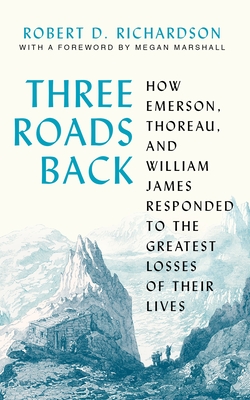
From their acclaimed biographer, a final, powerful book about how Emerson, Thoreau, and William James forged resilience from devastating loss, changing the course of American thought
In Three Roads Back , Robert Richardson, the author of magisterial biographies of Ralph Waldo Emerson, Henry David Thoreau, and William James, tells the connected stories of how these foundational American writers and thinkers dealt with personal tragedies early in their careers. For Emerson, it was the death of his young wife and, eleven years later, his five-year-old son; for Thoreau, it was the death of his brother; and for James, it was the death of his beloved cousin Minnie Temple. Filled with rich biographical detail and unforgettable passages from the journals and letters of Emerson, Thoreau, and James, these vivid and moving stories of loss and hard-fought resilience show how the writers’ responses to these deaths helped spur them on to their greatest work, influencing the birth and course of American literature and philosophy.
In reaction to his traumatic loss, Emerson lost his Unitarian faith and found solace in nature. Thoreau, too, leaned on nature and its regenerative power, discovering that “death is the law of new life,” an insight that would find expression in Walden . And James, following a period of panic and despair, experienced a redemptive conversion and new ideas that would drive his work as a psychologist and philosopher. As Richardson shows, all three emerged from their grief with a new way of seeing, one shaped by a belief in what Emerson called “the deep remedial force that underlies all facts.”
An inspiring book about resilience and the new growth and creativity that can stem from devastating loss, Three Roads Back is also an extraordinary account of the hidden wellsprings of American thought.
The son of a Unitarian minister, Robert Dale Richardson III grew up in Massachusetts and earned his bachelor's and doctorate degrees in English at Harvard University. Richardson taught at a number of colleges, including the University of Denver and Wesleyan University.
3.5 Everyone will experience the grief of losing something or someone. it will manifest in each of us in different ways, but there is little doubt that grief will `cause a change in the way we view the world. In this book the author highlights three famous men and the way the grief from their losses, not only changes their lives, but propelled them to greatness. Emerson lost the most, understandably too the longest to recover and did a 360 in his life plans.
Thoreau's loss had him becoming more entrenched in his view that all is to be found in nature. The closer to nature we are, the better served we will be. Henry James would use the loss of his cousin in his fiction, in various characters in his most well known novels.
The author uses their own words to show the reader their individual manifestations of grief and how this effected their future plans, as well as their relationships. interesting if brief reading.
In this melancholic yet soothing book, the late Robert. D. Richardson describes how Henry David Thoreau, Ralph Waldo Emerson and William James 'recovered' from specifically heart wrenching losses in. their lives. Though recover might not be the right word. A better description might be how they came to accept the pain as a part of who they now were, and move with it to still be able to find beauty in the world. After the death of his friend Emerson's five year old son Waldo, Thoreau wrote the following in his journal:".......soon the note of the lark will be heard down in the meadows and fresh dandelions will spring from the old stocks where he plucked them last summer". This statement is manifest in its depiction of what this book encompasses. To put it personally, and apply it to my greatest loss thus far in my life: It is alright to be both sad and happy by the sight of a cow in the field.
Richardson studies an American culture of inane spirituality and self-help: nature as self-indulgence, positivity as wishful thinking. He wallows in it instead of critiquing it.
His use of the concept of resilience is illustrative. He ignores its association with specific psychological traits and social resources. He turns it into vacuous positivity and spirituality. And he thereby detaches it from social policies to help vulnerable and underprivileged people.
More like 3.5. I really liked what was written about Emerson. Thoreau, not so much, and I’m not sure why. I’ve been a fan of James since my schooldays. Okay, 3.75 stars.
What a little gem. This is Bob Richardson's last published work, I guess, as he died in 2020 and this lovely book (what a beautiful design by Princeton Press!) came out in 2023. It has a forward by another illustrious biographer of the Transcendentalists, Megan Marshall, tucks into the reader's hand comfortably and can be read in short time over tea.
I read it with pencil in hand and a box of Kleenex nearby, as it contains many deeply touching reflections by Emerson, Thoreau, James and Richardson. If you cherish any of these authors, this is a must-have and must-read. I think I'll be giving it as a Christmas gift to several people.
This is less of a book and more of a thesis essay. I don’t care for the author’s style- it’s pretty dry. I most enjoyed the real quotes from diary entries or letters from Thoreau, and found the most engaging piece in the postscript. I bought this on a recommendation from a family member after someone in our family passed away, and hoped to get a bit more “balm for the soul” out of it. It’s very academic, but an interesting read.
If anything, this book is too short to fully realize the author’s intentions. If one has experience with Emerson, Thoreau or James, one will get more out of this book. Yet, there are helpful realizations shared when it comes to grief. Yes, none of these authors are Christians in the proper sense. Indeed, they tend to reject any sense of atonement or salvation through Christ. Still, for those who struggle with faith or as a adjunct understanding to Christianity, one might find value. The author looks for the subjects’ responses to grief; particularly what helped them be resilient after loss. He has come to understand that resilience is available to all of us. He concludes, “Resilience is built into us and into things” (p. 96). At some level, one can find strength outside oneself through friends. One can find strength and healing understanding death is part of life (“nature”), and we go on through it. Much as the death that comes with autumn is needed for another spring. Even our free will to act in the face of death can perhaps change our attitudes about life. Death is all around us and in us. We experience small deaths with every loss, and in the deaths of those we love, we die a bit too. Yet these authors found in surrender some freedom. In others, they found hope. Observing nature, they discovered something greater than themselves. As a Christian, I believe that this way of seeing would not be enough. These attitudes may (will?) fail us at some level, but there’s some truth to them. They could help us heal and find what the author calls resilience. Indeed, I’d argue one can find some of the same “truths” in the Hebrew. and Christian scriptures, as well as other faith traditions. In this secular approach to grief, people of faith might yet find some helpful insights. I’d recommend this text to chaplains who serve multiple faith traditions and humanists.
Buckle up because I did NOT like this book! I am usually one to DNF if I'm not enjoying it. But we're discussing bereavement, here.
This book is very, very dry and reads more like a thesis than anything else. And that would be fine if it wasn't fundamentally flawed.
I disagree that Emerson's regeneration would be akin to resilience now. Resilience is the ability to withstand or recover from hardship with ease. Nothing about Emerson's experience (quitting the church, abandoning his faith, fleeing the country, etc.) displays an easy "recovery." After loss like this, transformation is the only option. The person Emerson was died with his wife, Ellen. The person who existed in the wake of her loss is not the same Christian minister who lived before.
At the root of this book, the author's question is "how did these men 'get over' their losses?" For example, in Thoreau's section, he often uses the phrase "back on track" and others like it when discussing Henry's journal entries after his brother died suddenly.
I was under the impression that this book would more intimately investigate three great American writers' experience with tragedy, not reassuring the reader that these men "ended up fine" (which, from the quoted text and journal entries in this book, did not happen).
Overall, I wish I was more surprised. Tragedy, loss, and grief are uncomfortable topics to discuss, and it's easier (and lazy writing) to focus on a person's perceived "full recovery" from it. And I really wish I'd just read these writer's works instead.
I wish this was a little longer. It really did not go very deep at all. How can you talk about loss without mentioning James' child's death and how he and his wife looked to seances and trying to communicate with him in the afterlife?
I spend so much time reading and not so much writing reviews. Instead of a review, here’s what my personal rating system means:
5 stars = In this moment, I love this book more than almost anything. I have absolutely nothing to complain about in this book except for the fact that I never wanted it to end and it, of course, had a finite amount of pages. I would reread it again immediately if I didn’t have (literally) thousands of other books on my TBR. It’s possible I couldn’t stop thinking about this book and its characters any time I wasn’t reading it. It’s possible this book is my new favorite. If I don’t already own a copy of this book, I will likely buy one and reread it at some point in the future. If it’s part of a series, I’m planning on reading every other book in the series and every other book by this same author I can get my hands on. I might even read fanfic based on this book, because I can’t get enough of the story/characters/world. This book has carved out a special place for itself in my heart’s bookshelf. I will recommend this book to anyone and will thrust any extra copies I find of it at people I love, insisting they read it immediately if not sooner.
4 stars = I loved this book and will recommend it highly to anybody, but there wasn’t a special something in it that made me want to buy a ring and propose marriage to it. I wouldn’t mind rereading it one day, but I don’t feel a compelling urge to restart it the moment I finish it. This book made me think and/or feel deeply, however it didn’t completely consume my every waking moment. I will still likely search out anything else by this same author. And I will feel so lucky and glad to have read this book.
3 stars = I really liked this book, but something fell short for me. It was great—wonderful, even—but I didn’t fall in love with it. There was nothing below the surface for me. I had a good time reading it, but that’s where I’m happy for my relationship with the book to stop. If it’s part of a series, I will probably read more one day, but I haven’t already put those books on hold or in my shopping cart. I’m glad to have read this book and will recommend it to others who like this sort of book but not with the deep passion and excitement I have for higher starred books.
2 stars = I did not like this book. I’m glad to have read it and even gladder to be done with it so I can move on with my life and find a book better suited for me. Something in this book probably made me feel uncomfortable or icky. Some part of the book did not ring true or disturbed me in some way. Other parts of the book were probably just fine though overshadowed by the parts I disliked. I felt relieved to be done with it, but I appreciate the author sharing the story with the world. I might take a chance on other books by this author someday… but not right away.
1 star = I wish upon a shooting star and all my birthday cake candles that I hadn’t read this book. I respect the author for having written it, because writing a book is difficult and a big deal. But I wish I could erase my entire experience with this particular book, because it was not for me. There’s absolutely nothing in it that I liked or I actively felt offended or insulted by the book, as if its purpose was to cause me distress and pain. I would like to get as far away from this book as possible. Thanks, but no thanks. I will likely actively avoid other books by this author in the future. I hated my experience of reading this book and might have physically thrown it across the room if reading a physical copy. I might even have *gasp* stopped reading this book without finishing it.
I plucked this off the shelves of the wonderful Eighth Day Books of Wichita, Kansas while I was there on a visit last summer and have been reading it in dribs and drabs until finally finishing last night. Three Roads Back is a beautifully published little book and I was instantly attracted to its mesmerizing cover. Even though I majored in American literature as an undergraduate, I didn't learn much about Emerson or Thoreau because my American literature professors were too busy assigning crap like Steve Abee's The Bus: Cosmic Ejaculations of the Daily Mind in Transit . So it felt worthwhile to sample some classic American writing on the topic of resilience and adversity for myself.
Much of what I read from Emerson and Thoreau here didn't really resonate, to be honest. Both men found beauty and reassurance in death and decay and not because they had hope of a bodily resurrection in the Christian sense, but because they saw death as "a law, and not an an accident—It is as common as life...Every blade in the field—every leaf in the forest—lays down its life in its season as beautifully as it was taken up" (Thoreau 44). Despite their encouragement, I struggle to find the thought of my own death and bodily decomposition a comfort, without following that realization with the hope that I have in Christ and the life to come.
On the whole, I found this book a little boring, but two passages really stood out. The first is an excerpt from a letter that William James's cousin Minny wrote to him, in which she grapples with the purpose of Christ's death—a once-for-all atonement for sin or just an example of how we ought to live? I found her wrestling with this question fascinating. The other is a quote from William James himself on changing one's attitude that I'll reproduce here because it's really interesting and quite a departure from the way we are currently taught to think about our feelings, even in evangelical Christian circles. In fact, I wouldn't be surprised if many today might call James's advice here "harmful." But, I find something profoundly true in what he says, even if it's not quite the full picture of how people change:
"Everyone knows how panic is increased by flight, and how the giving way to the symptoms of grief or anger increases those passions themselves. Each fit of sobbing makes the sorrow more acute, and calls forth another fit stronger still, until at last repose only ensues with lassitude and with the apparent exhaustion of the machinery. In rage it is notorious how we 'work ourselves up' to a climax by repeated outbreaks of expression. Refuse to express a passion and it dies. Count to ten before venting your anger and its occasion seems ridiculous. Whistling to keep up courage is no mere figure of speech. On the other hand, sit all day in a moping posture, sigh, and reply to everything in a dismal voice, and your melancholy lingers. There is no more valuable precept in moral education than this, as all who have experience know. If we wish to conquer undesirable emotional tendencies in ourselves, we must assiduously, and in the first instance cold-bloodedly, go through the outward movements of those contrary dispositions which we prefer to cultivate. The reward of persistency will infallibly come, in the fading out of the sullenness or depression and the advent of real cheerfulness and kindliness in their stead. Smooth the brow, brighten the eye, contract the dorsal rather than the ventral aspect of the frame, and speak in a major key, pass the genial compliment, and your heart must be frigid indeed if it do not gradually thaw!" (94).
A small but mighty little book. I particulary enjoyed Part ll: Thoreau, especially chapter 13- Our Own Limits Transgressed...
"Thoreau arrived at and expressed three crucial ingredients of his mature vision of the world. All three of these realizations cut against the sentimentalism of his day- and ours-and they help account for the stiffness some readers still find in Thoreau's writing. First, he realized that our intellectual connections and our friendships actually matter more than family. Thoreau's disindividualizing a brother's death coincided with recognizing a bond stronger than brother- hood, namely friendship. We do not choose our kin; we can and do choose our friends. What looks at first like Thoreau's coldest shoulder- accepting the deaths of John and Waldo-is somehow answered or completed by his realization and acceptance that "my friend is my real brother." Second, during this time he also saw that despite the death and disease and decay of the individual, the natural world as a whole, and at its microscopic level, is fundamentally healthy. People die and life goes on. Death is a necessary part of life The third realization, now first fully articulated is that we need an anti-anthropomorphic, nature- centered vision of how things are."
"But what had been a more or less conventional romantic approach to nature quickly became, after John's death, a profoundly felt emotional acceptance- not just an intellectual assent-of death as an inescapable part of living, and an acceptance that at some level, there is no death. The very process of decay is a life process. The consequences of this view- of believing, not just mouthing- is to understand and accept a disindividualized view of life. The individual may die, but the materials that make up the individual do not. They are subsumed into new forms and so live on. This view, if one can grasp and hold it, means that in a general or communal sense, there is no death."
"On the 29th of April, as I was fishing from the bank of the river near the Nine-Acre- Corner bridge, standing on the quaking grass and wilk low roots, where the muskrats lurk, I heard a singular rattling sound, somewhat like that of the sticks which boys play with their fingers when, looking up, I observed a very slight and graceful hawk, like a night-hawk, alternately soaring like a ripple and tumbling a rod or two over and over, showing the underside of its wings, which gleamed like a satin ribbon in the sun, or like the pearly inside of a shell.... It was the most ethereal flight I had ever witnessed. It did not simply flutter like a butter- fly, nor soar like the larger hawks, but it sported with proud reliance in the fields of air; mounting again and again with its strange chuckle, it repeated its free and beautiful fall turning over and over like a kite, and then recovering from its lofty tumbling, as if it had never set its foot on terra firma. It appeared to have no companion in the universe,---sporting there alone, - and to need none but the morning and the ether with which it played. It was not lonely but made all the earth lonely beneath it."
These losses were the deaths of close family members. , For Emerson it was the loss of his younger brother, and just a few years later, the loss of his young son, Waldo. For Thoreau, it was the sudden death of his brother, John, and for James it was the death of a cousin, Minnie. Each responded differently, but what they had in common was a determination, haed and painful as it was, to get on with their lives, the business of living.
Emerson was at first a Unitarian minister, but he began to dismiss conventional Christianity, and found his way to “redemption” through “action proportioned to nature,” Nature for him had a power and wonder that always included death, as well as life. He came to see that his losses were part of a universal experience that all living creatures go through; death for some comes sooner than for others.
Thoreau was greatly influenced by Emerson’s thoughts, particularly as expressed in his NATURE and as he began to recover from his despondency and depression over his brother’s death, he was able to write in one of his journals; ”Death is beautiful when seen to be a law and not an accident – it is as common life. . . every blade in the field, every leaf in the forest, lays down its life in its season as beautifully as it was taken up. Interestingly, and no reason is given except to suggest that each person is different, Emerson’s full recovery took more than a year while Thoreau's recovery was much faster, possibly because he had obviously been thinking about these matters before his broter’s death.
William James, the pioneering psychologist, as well as his novelist brother, Henry, were both devastated by the death of their 24 year old cousin, a sparkling young woman whose intelligence and cheerful outlook they found irresistible. James’ reaction, after a relatively short period of deep mourning, was to throw himself into his work. He would will himself to recover, and wrote in his diary, “My belief can’t be optimistic, but I will posit it, life (the real, the good) in the self-governing resistance of the ego to the world. Life shall be built on doing and creating and suffering.” He is suggesting that while it may be natural to be sadly pessimistic, the individual can overcome t his tendency by force of will and effort.
This very short work (99 pages) is a good introduction to how three 19th century New England seminal figures reacted to these tragedies in their lives, how they were swallowed by grief, but managed to emerge from it, stronger and wiser men.
I heard about this book on a podcast, The History of Literature, so decided to give it a try. Megan Marshall, who wrote the forward of the book, was interviewed on this podcast. I have not read any of Emerson, Thoreau or James and thought it would give me some exposure to them. I am glad the author of this book explained what the authors were saying, as I am not adept at reading the works of people of this era. The premise is how they respond to losses, but it's so much more.
Here's some quotes I liked: "Three Roads Back How Emerson, Thoreau, and William James Responded to the Greatest Losses of Their Lives" Preface: Emerson taught his readers self-reliance, which he understood to mean self-trust, not self-sufficiency. Thoreau taught his readers to look to nature-the green world-rather than to political party, country, family or religion for guidance on how to live. William James taught us to look at actual human experience, case by case, rather than to dogma or theory, and showed us how truth is not an abstract or absolute quality, but a process. Experience-testing-either validates or invalidates our assumptions. Further, James says, attention and belief are the same thing. What you give your attention to is the key to what you believe. Whoever or whatever commands your attention also controls what you believe. What all three of these writers and thinkers teach, through their lives as much as their writings, is resilience-that is, how to recover from losses, how to get back up after being knocked down, how to construct prosperity out of the wreckage of disaster. Pg. 10: Emerson addressing why he's making a break with the church Re: communion: What he does not object to is communion with a small c, the bonds between people. No longer interested in the religion of people who lived many centuries ago, he very much wanted "a religion by revelation to us and not the history of theirs."
Emerson's imagined conversation with Thomas Carlyle: "You must be humble because Christ says 'Be humble.'" "But why must I obey Christ?" "Because God sent him." "But how do I know God sent him?" "Because your own heart teaches the same thing he taught." "Why then should I not go to my own heart first?"
Pg. 11: Emerson resigning as their pastor: "I rejoiced to believe, my ceasing to exercise the pastoral office among you, does not make any real change in our spiritual relation to each other."
Pg. 59 Walden's next to last chapter, "Spring" where he describes his observatioin of a hawk in flight. "What makes this scene work is the long, detailed, and completely believable description of the hawk from the point of view of the man on the riverbank, followed by the single breathtaking sentence that leaps up to see the earth from the hawk's point of view. For a moment, man is not the lord of creation; the hawk is."
Pg. 60: "....Thoreau arrived at and expressed three crucial ingredients of his mature vision of the world. All three of his realizations cut against the sentamentalism of the day-and ours-and they help account for the stiffness some readers still find in Thoreau's writing. First, he realized that our intellectual connections and our friendships actually matter more than family..... Second, during this time he also saw that despite the death and disease and decay of the individual, the natural world as a whole, and at its microscopic level, is fundamentally healthy. People die and life goes on. Death is a necessary part of life. The third realization, now first fully articulated, is that we need an anti-anthropomorphic, nature-centered vision of how things are. Thoreau's growing friendship with Emerson was the direct cause of the first of these realizations, and it was likely the catalyst for the other two. The result is nothing less than the sudden emergence of the greatest American voice yet for the natural world, and world including-but not centered on-us."
Page 90: "This sentence about the self-governing resistance of the ego to the world is Jame's bedrock philosophical position, from which his central psychological convictions would follow. If we are free to choose one path over another, free to change some things (not all things), then it follows that we can change our attitude as well. And attitude, as they psychologist Mary Pipher has said, 'may not be everything, but it is almost everything.'"
We lost Richardson just a couple of years ago rather suddenly. He wrote the greatest book we have on Emerson Emerson: The Mind on Fire, the greatest book on the intellect of Thoreau Henry Thoreau: A Life of the Mind, and the definitive book on William James William James: In the Maelstrom of American Modernism. He wrote with great perception on these titans of Nineteenth century American thought, especially more impressive since they are intellectual biographies, which require not just mastery of the external mechanics of narrative biography, but a profound understanding of mental processes and evolution.
This brief elegiac book on life, love, and loss rather seems like Richardson could see his own end coming (while in his early eighties, he did not - which makes this book more precious). This book can easily be read in one sitting, but it reflects a distillation of thoughts on mortality. When Emerson, Thoreau, and James lost a deeply beloved soul - a young wife, idolized brother, and vivacious close cousin respectively, they were forced to face mortality and remake themselves internally. Richardson masterfully and lucidly brings those lessons home to the reader. How do we face such a deeply personal loss and find the resilience to go on?
Like his subjects, we find it in the wisdom of the ages: in books and their reflection in the humanity around us. Only then do we find the sagacity and the hard won emotional knowledge to see the larger pattern in existence: that loss is also a part of the process of living, that the subtraction of our loved ones ends up enlarging us until it is our time as well. A beautiful and heartfelt brief book, one that serves its own purpose in making us appreciative for Richardson's body of work.
Nice, breezy book about grief and putting yourself back together after it.
It was interesting reading a bit about James - who I'm much less familiar with, and I quite liked some of his quotes. It probably won't play as well for people going in blind, and it is mostly a collection of quotes pointing to each other, but that's fine with me, as I'm a big transcendentalist fan.
Marked a couple quotes that truly did make me interested in reading more -seems like a compelling feeler, even if his conclusions - without totally reading the reasoning yet - seem a little odd.
"Whoever or whatever commands your attention also controls what you believe."
"I wish I could console you with religion or philosophy. But I can’t. Why you should have been picked out to swell the billions on whom fate has laid her rough hand, who can say? But one thing is certain, that through abridgement and deprivation we learn of resources within us, of whose existence we should else have remained ignorant; of power to resist pain, to rely on our own hearts alone, to do without sympathy and generally to keep our heads up under circumstances where nothing but pure courage will suffice. Death sits at the heart of each one of us; some she takes all at once, some she takes possession of step by step, but sooner or later we forfeit to her all that nature ever gave us. Instead of skulking to escape her all our days and being run down by her at last, let us submit beforehand. We shall regret less the loss of temporal happiness and be able more undistractedly to think of that alone which seems to belong to us—to our w ills—in life, namely the keeping up of a true and courageous spirit. Bitter though truth may be, it seems better to know it than not, and in that inner solitary room of communion with his own good will, there lies for every man comfort."
Hay lecturas que se escogen y otras que te escogen a ti. Quizás bajo la influencia de un sesgo de frecuencia ilusoria, esta me ha escogido en un momento vital significativo. Por este motivo no creo que sea una lectura fácil ni que pueda servir para cualquier momento. Por todo esto el resultado de la lectura ha sido profundo y valioso.
El libro es breve, se lee en dos tardes, pero creo que no es un libro de una sola lectura. Estoy convencido que ganará enteros y se enriquecerá en posteriores revisiones.
El autor nos cuenta las respuestas resilientes frente a la muerte de sus seres queridos de tres figuras clave en la filosofía, literatura y psicología del S. XIX: Emerson, Thoureau y James Williams. Se trata de reflexiones profundas, en ocasiones crípticas, por lo que no fácilmente accesibles. Para una mejor compresión de algunas ideas ayudará conocer previamente el pensamiento de, sobre todo, R. W. Emerson y H. D. Thoureau. El resultado de una lectura atenta y profunda es iluminador y liberador a la vez. No es un libro fácil ni, como digo, para cualquier momento. Pero ayuda a abrir el campo de visión, a establecer nuevos parámetros de pensamiento y perspectivas más amables y reconciliadoras en momentos en los que la vida se vuelve inevitable e irremediablemente pesarosa.
Me ha parecido interesante este libro cortito si bien en algunas partes le ha faltado solidez . Comparto frases:
“Constituye una causa de asombro que sigan vivos quienes han perdido a muchos amigos . Después de una larga vigilia junto al lecho de un amigo enfermo, también nosotros morimos en parte con él y nos sentimos menos identificados con este estado presente de las cosas .”
“ Después de tanto imaginar, ¿ no se sentirán los dioses con la obligación de mostrarme algo tan bueno?”
“Solo necesitamos ser tan auténticos con los demás como lo somos con nosotros mismos y habrá terreno para la amistad. “
“ Si somos libres para elegir un camino en vez de otro o de cambiar algunas cosas ( no todas), también podemos cambiar nuestra actitud.”
“ Carlyle escribió sobre Emerson a su amigo el filósofo John Stuart Mill:’ Lo que me ha gustado de él es su integridad, su armonía para consigo mismo: en él todas las personas y todas las cosas parecían hallar una apacible acomodación.”
“Hay un solo nacimiento, un solo bautismo y un solo primer amor , los afectos no pueden conservar su juventud más que las personas.”
“ En la sociedad no hallarás la salud, en la naturaleza sí.”
“ Con seguridad, la alegría es la condición misma de la vida.”
From the library catalog: Summary: "This book explores resilience by tracing the linked stories of how Ralph Waldo Emerson, Henry David Thoreau, and William James dealt with personal tragedy: for Emerson, the death of his young wife and, eleven years later, his five-year-old son; for Thoreau, the death of his brother; and for James, the death of his beloved cousin Minny. Weaving together biographical detail with quotations from the writers' journals and letters, Richardson shows readers how each of these writers grappled with loss and grief and ultimately achieved a level of resilience. Emerson lost his Unitarian faith but found solace in the study of nature; Thoreau leaned on the natural world's capacity for regeneration, and the comparatively small role played by individual persons; James lit upon a notion of self-governance and emotional malleability that would underwrite much of his work as a psychologist and philosopher. All three, Richardson suggests, emerged from their grief with a new way of seeing, one shaped by a belief in, as Emerson would write, "the deep remedial force that underlies all facts.""-- Provided by publisher.
Three Roads Back by Robert Richardson is a brief but fascinating look into the lives of Ralph Waldo Emerson, Henry David Thoreau, and William James. Specifically, it explores how these three towering intellectual figures navigated the profound grief of losing dear loved ones. Richardson provides intimate insight into their states of mind through their personal letters, journals, and, when available, correspondence from the very people they lost.
It is important to note what this book is not. Richardson doesn't connect their personal grief to broader research theories of the time regarding mourning. If you are looking for a heavily research-based analysis that incorporates multiple case studies and expert critique, you won't find that here.
That said, as someone who has read two of these authors at different points in my life, I found this deeply personal glimpse into their private sorrow to be a fascinating aspect of their lives that I was previously unaware of. At under 100 pages, it isn't a profoundly exhaustive experience, but it is a beautifully written, quick read that will certainly pique your interest.
Three Roads Back is a short, but succinct look at how three men responded to devastating loss. Richardson, in his introduction, self-labels this work "documentary biography," which lets his subjects “tell their stories in their own words as much as possible". This format works perfectly, as many of of the included passages are soul-stirringly beautiful, needing no further
I imagine that fans of Emerson, Thoreau and/or James will undoubtedly enjoy this book, but Richardson's structure makes this work much more universal. Examining how these men responded to grief, not only gives us a glimpse into them, as men, but to us, as human beings. For such a short little book, there is a lot of depth and much to cherish.
We will all experience grief many times throughout our lives. Reading about how these three responded to their own grief may help readers process their own loss.
Strong Voices of Resilience Shared Here. Following Megan Marshall's informative "Foreword," we dive into the lives and lessons of three of America's outstanding voices of reason and perspective. In focused sections on Ralph Waldo Emerson, Henry David Thoreau, and William James we gain an understanding of how each dealt with struggle and loss. These shared themes make the book universal in appeal. Richardson has brought so much insight to these writers in his other books, we can only be grateful for his last effort to share their essence. A bonus is his portrait of the remarkable Minny Templeton in the section on William James, including how brother Henry James modeled many characters in his fiction after her. This book is also a portrait of Richardson, who passed away before the book came to press. His depth can be read in his wise selection of quotes from these fathers of modern thought. It's a short yet compelling read.
I had drifted too far away from reading and re-reading these three foundational authors, Emerson, Thoreau, and William James, and this brief account of their intimate knowledge of loss helped keep me tethered to reality.
My review here will be as short as words on a tombstone. It comes from a journal entry of William James, written a few months after the loss of his cousin, Minnie Temple, age 24. James used the Sanskrit to summarize his feelings: "tat tvam asi." Or, the Ultimate Reality (Brahman) and my reality (Atman) are the same.
Richardson collected writings from the three titans that focused on changes forced upon them from the loss of loved ones. May I be so resilient.
No tengo mucho que decir, en realidad, acerca de este libro. Lo considero imprescindible para aquellos que disfrutan la lectura de Emerson y Thoreau, ya que cambia por completo la forma de entender su pensamiento. Descubre una visión mucho más profunda de sus ideas y permite empatizar con estos autores. Además, a través de sus relatos biográficos la obra también funciona como una pequeña guía para afrontar esas difíciles situaciones de perdida de seres, con quienes quizá se nos va una parte de nosotros, a veces, un mundo.
Fue un regalo de un gran amigo, el cuál además me introdujo en el pensamiento Thoreau y creo que eso siempre le aporta mucho más a la lectura.
I chose this book after hearing a review. I was currently grieving the sudden loss of a young relative and trying to figure out how to process my grief. This short book was challenging for me to read. It seemed like I didn’t have a context for the journal passages chosen. I felt like I was reading Middle English. This is not the problem of the author but of myself. I did find a few nuggets to help me try to pull myself out of my grief but I honestly struggled with reading it. This could be related to my state of mind.
This book had potential, given the topic, but it was very disappointing. It felt sloppily pieced together. I never read Richardson's biographies of these three men but it felt like he extracted bits from these previous works to create this common tread and theme. It felt repetitive and not substantial enough to comprise a book.
Provides an account, biographically and intellectually, of the history of mourning in the life and thought of three great American writers. From individual cases and works comes a broader narrative about the nature of grief, life, and nature that can serve as a balm of sorts for those dealing with the most human of emotions — grief.