A dejected soldier makes a pact with the devil in this haunting, ultimately hopeful fairy tale, masterfully retold and vividly illustrated.
Man or bear? When a person gives up hope, is he still human? Such is the story of a soldier who has lost everything to war: his childhood home, his family and friends, his youth, and his innocence. Enter that sly opportunist, the devil, who wraps the soldier in the armor of a dead bear’s skin, fills its pockets with gold, and makes a dangerous and horrible wager. An unforgettable retelling of a classic Grimm tale, THE BEARSKINNER is a story about the struggle between the two sides of our selves, and the heroic strength it takes to claim a victory.
Laura Amy Schlitz is an American author of children's literature. She is a librarian and storyteller at The Park School in Brooklandville, Maryland.
She received the 2008 Newbery Medal for her children's book entitled Good Masters! Sweet Ladies! Voices from a Medieval Village,[1] and the 2013 Newbery Honor for her children's book, Splendors and Glooms.[2] She also won the 2016 Scott O'Dell Award for Historical Fiction, the 2016 National Jewish Book Award, and the Sydney Taylor Book Award for her young adult book, The Hired Girl. Her other published books are The Hero Schliemann: The Dreamer Who Dug For Troy (2006), A Drowned Maiden's Hair: A Melodrama (2006), which won a Cybils Award that year, The Bearskinner: A Tale of the Brothers Grimm (2007), The Night Fairy (2010).
Schlitz attended Goucher College in Towson, Maryland, and graduated in 1977.
This adaptation of the Grimm's fairy tale "Bearskin" is at the same time a bit more brutal yet slightly sanitised version. Brutal in the sense that the PTSD and anguish of the soldier that makes the pact with the Devil is made all the more stark and is placed upfront here whilst in the tale it's more subdued. This is one of the very few tales that deal with war PTSD, and I liked that this aspect was highlighted here. The one aspect that is sanitised is the sisters of the girl that redeems the soldier, who in the tale are selfish and disagreeable, meeting a bad end when they're rejected by the now rich and restored soldier, which is avoided in this adaptation.
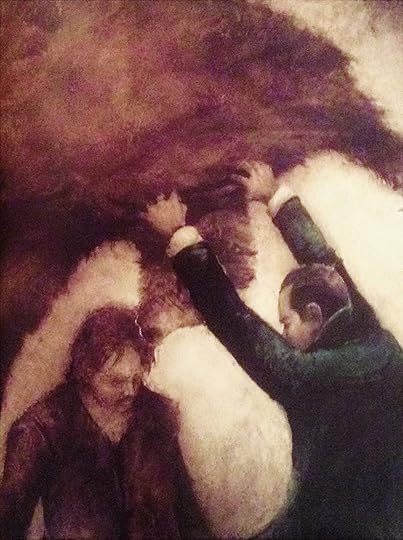
The artwork is moody, dark, and very fitting for the storyline. Overall, this is vastly better than The Bearskinner by Felix Hoffmann, which also adapts the same tale but doesn't have the same psychological depth and doesn't highlight the PTSD aspect, focusing instead on the deal and getting out of it.
This is a really enjoyable fairy tale, surprisingly not as well known as some of the other Brothers Grimm stories. A soldier returns from war having lost all his family, he has nothing and dreams of a meal and a bed for the night. The devil appears and makes him a deal, he has to wear a bear skin, not wash, pray to God or take his own life. His pockets will be filled with gold and if he keeps to these rules for seven years he will be rich for the rest of his life, but if he breaks the rules his soul will belong to the devil.
The illustrations suit the book, they are subtle and atmospheric and some nice ideas about happiness, helping others and judging people by their appearance.
Thank you so much to goodreads friend Canadian reader for recommending this wonderful tale.
This has a fable-like quality that makes it seem like a very old tale handed down from the generations. Which I suppose it is... but there are some tales that seem like they're written recently and there are some that just feel ancient and worldly.
The Bearskinner makes a deal with the devil and suffers through some extremely trying circumstances. It's a quick fun read!
The devil comes to a poor soldier with an offer he can't refuse. If the man wears the skin of a bear for seven years without washing, bathing, or praying to God, then he will be rich beyond his wildest dreams. Better still, during that time he will have all the money he desires. The man accepts the deal, but soon finds it hard to handle. His body disgusts him and society abhors him (though not, of course, his money). Yet when the man starts giving his money away to the poor, he finds that their prayers carry him through the worst of his trials. One day he helps a gambler and the man promises the solider one of his three daughters. The middle daughter looks deep into his eyes and promises to marry him whenever he returns. Three years later his time is up and he triumphantly puts the devil in his place, cleans up, and returns to the gambler's home. There, the daughter waits for him, he reveals himself to her, and they live happily ever after (except perhaps for the devil, but that's only to be expected).
Interesting Brothers Grimm stories are most certainly NOT the rule. Adapting one into a readable text takes time and effort and an ear for a cutting turn of phrase. Ms. Schlitz, to the infinite relief of any reader, shows her prestigious skill in such matters by not merely rendering "The Bearskinner" into something palatable for the youth of America, but also something worth reading again and again. Check out this opening: "They say that when a man gives up hope, the devil walks at his side. So begins this story. A soldier marched through a dark wood, and he did not march alone."
What is it about this tale that sucks us in so completely? On the bookflap, illustrator Max Grafe describes being drawn to this story due to the tale's visceral qualities. "The grit, the grime, and the quintessential antagonist, the devil . . . combine for an exciting yet challenging story to bring to life on the printed page." I think he's right about that part of the book. The idea of a guy not bathing or doing any kind of bodily maintenance for years and years at a time is an instant lure. Schlitz plays this up too with sentences like, "Lice gnawed at his flesh, and he raked himself until he was covered with scabs," or, "his bearskin crawled with maggots, and he reeked." That's the more obvious hook to this book. Schlitz explains too, though, that there is much more to be taken away from "The Bearskinner" than just the disgusting qualities. "I went in search of a story that would tell students that no matter how bad things get, you hold on." And that, of course, is the key to the tale. On an initial reading a person might wonder why the devil stipulates that the Bearskinner is never to pray to God during his 7 year trials, as it seems a little random as a request. Yet thinking about it, prayer gives people hope. The Bearskinner finds a way around this requirement by asking the poor to pray in his stead, and it is that fact that saves him in the end. Ms. Schlitz not only recognizes the intriguing premise, but the true heart behind the story. She then plies both with magnificent wordplay.
The first few sentences caught my eye and the image of the soldier and the middle daughter looking at one another for the first time sealed the deal. I don't know how well fairy tales sell on the open market. I don't know how many library systems appreciate them fully, or how many families know how important they are to a child's development and growth, both emotionally and socially. What I do know is that "The Bearskinner" as written by Laura Amy Schlitz and as illustrated by Max Grafe is a piece of fine art. A book that deserves love, attention, and more. Worth seeking out, to say the least.
Gracefully told, masterfully illustrated, a classic tale with a great message for all ages. Before you read too far in, think about it? Could you make this deal with the devil? --- Reread. Review stands.
”They say that when a man gives up hope, the devil walks at his side. So begins this story: A soldier marched through a dark wood, and he did not march alone...”
I’ve always had a soft spot for lesser known fairy tales. We all know the tales of Snow White, Cinderella, Sleeping Beauty and what not. But what about the hundreds of other tales that are out there? I often find that these tales are just a little bit darker, just a little bit more twisted than the bright, cheery fairy tale lore that we like to hear. Then again, I’ve never been one to do the whole normal thing.
Based off the Brothers Grimm fairy tale of the same name, The Bearskinner starts off with a simple premise; how much would you sacrifice to get what you want? An unnamed soldier comes home from war to nothing; no home, no family, no food, nada. In an act of desperation, he gives in to the devil who walks beside him on one condition; he’ll have all the money in the world, but he must wear a bearskin for seven years and not groom or pray. If he succeeds, he’ll be free of the Devil’s work. If he fails, his soul is damned. But how can the soldier possibly keep his end of the bargain when he feels less than human?
I found this retelling to be rather affecting. The story is retold gently with a child’s perspective in mind, but still manages to retain the somewhat dark and haunting feel of the original. Some parts were toned down (such as the ending, where ). While I believe in keeping some things from the innocent mind of a child, I also don’t like it when it’s done so drastically, little or none of the original material or theme of the story is still intact.
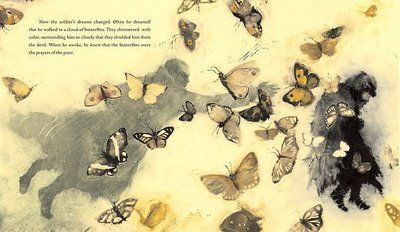
Max Grafe’s artwork wonderfully fits the mood of the story as well. I’m not the biggest fan of minimalist art in the entire world, not am I a fan of a monochromatic palette. In this case, however, I thought it was rather fitting and I ended up really enjoying the pictures. His art fit the mood of the story perfectly. I especially liked how there was no color except for the devil’s coat, further characterizing his deviousness and greed.
Or how the devil always seems to be chasing the Bearskinner, no matter where he foes or how well he his upholding his bargain.
If you like fairy tales of a darker nature (but aren’t quite ready to go full throttle), I’d recommend this book. It’s dark but not too dark, with an air of hope woven throughout. And if you have children and want to also introduce them to the lesser known fairy tales but don’t want to pay for years of therapy afterwards, this is the perfect place to start.
Man or Bear. When a person gives up hope, is he still human?
A retelling of the Grimms' "Bearskin." Not being a religious person I read "the devil" as greed and despair. I liked that Schlitz switched it up from being the youngest sister to the middle sister. In my mind, a middle sister would be more likely to accept her father's wishes than the baby sister. And I wasn't at all surprised that Schlitz chose to leave out the two sisters' suicides in response to their sister's happily-ever-after. In my opinion, the message or moral remained faithful to the original: true wealth comes not from having it all but sharing it with those who have less or nothing at all. (Additional or alternate message or moral could be that character (internal quality) is more important than external qualities; e.g., beauty.) The artwork, while dark and eerie, complemented the story perfectly.
I had never heard of this book before but the title intrigued me and that is why I read it. When I found the book the cover looked scary and as I read the book my prediction was correct! It definitely was a very dark book. The full title of this book is called The Bearskinner A Tale of the Brothers Grimm. In chapter 4 of our text I remember reading that originally the brothers Grimm books were not intended for children but through the ages those tales changed to be more appropriate for them. Now I primarily work with younger children and I can safely say I would not share this book with them. This book was about a man who was poor and the devil made a deal with him; he was to wear the skin of a bear for 7 years and have all the money in the world but there was a list of things he could not do during those 7 years. Years went by the bearskin made him look grotesque but it didn't matter to him because he was wealthy. He used all the money he had to help other poor people. Eventually the 7 years is over and he did everything the devil asked him to do and he essentially won. He was able to marry a beautiful girl and lived happily the rest of his life. I feel that a story like this has a much deeper meaning and moral especially because it is considered a traditional tale. I would recommend this book to much older students, possibly middle school or beyond. Now I am not as familiar with standards in those grades but I am sure there is a great deal you could do with this book in the upper grades. The least it could do is spark a rich deep discussion on the choices the poor man made. I was very drawn into the story maybe because it was such a dark story, I had never experienced a picture book like that before. I would recommend it to everyone, it was a great read!
I had a conversation with some parents just last week about how the original Brothers Grimm stories were not like the Disney versions; they were much more graphic. Details about one of Cinderella's sisters cutting off her toes, and the other, her heel, to make the glass slipper fit, and the blood dripping from the slipper as each rode along with the prince grossed them out, to say the least.
Here's another example of a BG story that might be classified as "not for the faint of heart". Graphic descriptions of Bearskinner as the years progress describe how he reeks and and the bearskin crawls with maggots. Graphic enough for you? And the whole idea of the devil being after someone, that's frightening. But then again, how can you have a book featuring the devil without it being a little scary?
For me, the beauty of this "deal with the devil" tale is in Max Grafe's mixed media illustrations. The one that stands out the most to me is the very first one. The soldier is walking away from the reader and the devil, with claws and tail of a lion and hooves of a goat, is pouncing behind him. Very creepy and really sets the tone of the book nicely.
I discovered Laura Amy Schlitz last year (Good Masters! Sweet Ladies!) and immediately read this and A Drowned Maiden's Hair. Schlitz has a great gift for probing the soul behind a story, and I recommend all of her books wholeheartedly.
Title: The Bearskinner: A Tale of the Brothers Grimm Author: Laura Amy Schlitz Illustrator: Max Grafe Genre: European Folktale Theme(s): Patience, Love, Acceptance, Giving, Good v. Evil Opening line/sentence: They say that when a man gives up hope, the devil walks at his side. Brief Book Summary: A soldier with nothing makes a deal with a devil that requires him to wear bearskin for seven years, and, in return the devil will give him riches. The soldier lives these years at first using his riches for only himself, then realizes he is happier giving his riches to others. He meets a gambler who promises the soldier one of his daughters and, at the end of the seven years, the soldier returns to marry the daughter and live a happy life. Professional Recommendation/Review #1: (1) 4-6 Illustrated by Max Grafe. An ex-soldier accepts a hard bargain: he'll be rich forever if, for seven years, he wears the skin of a bear; failure means eternal perdition. Schlitz narrates with clarity and grace. Except for the devil's green coat, Grafe's atmospheric full-page illustrations are almost monochromatic, composed of grays and browns with an occasional wash of blue, gleam of gold, or sunset hue. Professional Recommendation/Review #2: Gillian Engberg (Booklist, Nov. 15, 2007 (Vol. 104, No. 6)) The author of The Drowned Maiden's Hair (2006) and Good Masters! Sweet Ladies! (2007) offers and accomplished retelling of the Brothers Grimm tale The Bearskin. An impoverished, desperate soldier makes an unusual bargain with the devil: if the man agrees not to bathe or groom himself for seven years, cloak himself in a bearskin, and stay alive, he will receive unlimited riches. If he fails, the devil will keep his soul. Despite deep misery, the man complies, bests the furious devil, and finds love and wealth. Schlitz gracefully distills the original text, softens its harsh ending, and emphasizes the message about enduring and overcoming great personal challenges. Figures and backgrounds blur together in Grafe's textured, atmospheric illustrations, rendered in heavily shadowed, muted earth tones, and viewers may wish for more distinction in individual characters faces. The scenes ably extend the dark mood and dramatic themes of soul bargaining and personal torment, though, and Schlitz's skillful words present a tale that is rarely retold for youth. Share this with an older audience than the usual picture-book crowd. Grades 3-5. Response to Two Professional Reviews: The illustrations in this book are a bit bland, with most pictures only composed of a shaded gray and other muted colors. The scenes are elaborate and set the dark mood of the story. This is certainly a book to be shared with an older audience, and not to younger readers. Evaluation of Literary Elements: Overall, the book is well written, and is most definitely for older readers. The amount of text on each page, and the vocabulary of the book would be much too intimidating for beginner/younger readers. The illustrations, bland and colorless as they are, do set the tone of the story, making them appropriate for the book. The themes of the story are well-established and the ending wraps up the tale in a happy, light-hearted manner. Consideration of Instructional Application: This book could be used for teaching folktales. It is adopted from the Grimm's Brothers tale, The Bearskin. Students can use this book as an example of a folktale, then write their own tale. Additionally, older students could analyze this book as a means of exploring the European culture at the time the tale was written.
This book is so psychologically, so visually and symbolically rich that it's stunning. What really set this Brothers Grimm tale apart for me was the vague and slightly disturbing artwork. Almost all painted in shades of brown and black, the monochromatism illustrates the message perfectly: Things don't always go well. Sometimes we bargain with the devil and realize later we've made stupid mistakes. Sometimes we feel like all hope is lost. The beautiful theme running through this story is that no matter what, no matter how bad it gets, no matter how badly you mess up, you keep your integrity with you and never give up. I read this book to my small children over and over while we had it from the library. They didn't ask a lot of questions, but they loved the story, and it was interesting to me from a linguistic point of view that they seemed to intuit so much of the meaning of the book without understanding all the nuances or having the life experiences. The height of masterful storytelling. I will put this in my personal collection.
The Bearskinner: A Tale of the Brothers Grimm is an amazing legend created by Brothers Grimm about a man trying to survive. In order to do so, he believes he must make a bargain with the Devil. This involves wearing a bear skin without ever bathing while having continuous money and fortune. Lessons about what is truly important in life will arise as the man observes other families and their lives. Other themes will be exemplified throughout the book with religious and romantic aspects. The religious aspects do not overshadow the book however, no matter a person’s faith, they would be able to relate to the book and other themes. I personally loved this book. The illustrations were magical, the story kept me on the edge of my seat, and the life lessons are so important and apply to everyone’s life. Laura Amy Schlitz has created many books and even has another book published within the same year that won the Newbery Award Medal which shows the amazing content and literary techniques within the story.
A soldier who has lost everything to war is approached by the devil who makes him an offer he can't refuse. The soldier must wear the skin of a bear for seven years, but he will never want for anything, as his pockets are filled with gold. As the soldier begins his seven years, he is initially relieved at his newfound wealth, but that soon gives way to hopelessness and despair. The story illustrates the struggle between our "two selves" and demonstrates the strength it takes to claim victory. I found the illustrations in the book to perfectly suit this eerie and haunting tale. The intriguing story kept me engaged as I prayed the soldier would overcome his deal with the devil, and I imagine students would feel the same way if it were presented in the classroom. I enjoyed this tale and would recommend it to others.
Bearskinner is a nice retelling of the various stories that involve men making deals with the devil, agreeing not to bathe for 7 years in exchange for untold wealth and putting their souls on the line for the deal. The illustrations are lovely and the story is rather dark and full of despair -which is probably appropriate given the subject. I thought the addition of the term "you may not pray to God" was interesting, as well as the Bearskinner's method for working around it.
The story - like most fairy tales - has lots of room for expansion and character development that would make for a good book.
I'm absolutely in love with this new-to-me Beauty and the Beast variation and this particular presentation of it. First off: BEARS. Second: this is a picture book for the most discerning eye. Grafe's art is dark, sinister, and mysterious in all the right ways, but he manages to capture the light in a girl's face or the green of a coat to perfectly drive the story. Third: Schlitz's retelling is capable and starts off like gangbusters: "They say that when a man gives up hope, the devil walks at his side. So begins this story: A soldier marched through a dark wood, and he did not march alone." Hoping to add this to my personal library someday.
I worked in the children's book industry for years, in several different capacities, and today I still actively collect the very best in illustrated children's books. I consider The Bearskinner to be the most powerful picture book I own. Never have I seen a picture book so honestly portray the darkness life can bring, while still championing hope and driving home the message, "No matter how hard things get, choose life. There will be a way out." What a valuable book to share with a (slightly older) child audience! I read it to 8 to 12 year-olds and they are always spellbound by Laura Amy Schlitz's rendering of this timeless Grimms' tale. And yes, there is a happy ending.
I thought I had never read this story in Grimms, but I now see that I had. Laura Amy Schlitz's rendition is that of a true storyteller. She keeps the story but...rather than adding to the story, she sees what is behind the story and makes it manifest. The only true change - and it doesn't change the message of the story - is that the daughter with the true and compaasionate sight is the middle daughter. Hurrah for the middle child (for a change.) This would make a great story forthe slightly older child - not a nursery tale, for sure.
A grim Grimm fairy tale, beautifully told, about a soldier who makes a bargain with the devil and wins, with shades of "Beauty and the Beast" thrown in. Laura Amy Schlitz is a fantastic storyteller. Highly recommended for older (upper elementary) children.
A Beauty and the Beast variation adapted from the Grimm Brothers' version of the tale, The Bearskinner recounts a desperate soldier's game with the devil.
Though it's definitely aimed at an older audience of picture-book readers, The Bearskinner is beautifully written and even more beautifully illustrated. It has many philosophical underpinnings and is likely to be an enjoyable challenge to upper-elementary school readers that enjoy fairy tales.
The text flows beautifully and the illustrations are evocative. I love the middle daughter's face and eyes! Someone did point out, though, that Bearskinner, although in the text gets more beast-like, the illustrations do not quite progress in that direction -- he still looked like a man with a bearskin coat even when the 7 years were almost over, facing the gambler's daughters.
The text is polished and excellent for reading aloud. The illustrations are dark with rare flashes of color and indistinct faces, but they set the mood perfectly. However, there is no source note and several reviewers mention that Schlitz has changed the ending slightly so a source note should have been included.
I really liked this tale. Now I understand why Tender Morsels is a retelling. It all makes sense now!
The Illustrations are really gorgeous in this story. The text is probably entirely too long for a read aloud especially for beginner or intermediate language learners. Advanced ELLs may handle it well though.
An unusual picture book, and not a typical choice for the classroom. This story is fairly dark, featuring a man and his deal with the devil to wear a bearskin suite for seven years in exchange for wealth. Their are many morals embedded within the story, leaving the reader with much to discuss at the close of the tale.