Bigger, bolder, and louder than ever before, neo-manga artist Yokoyama Yuichi is back with PLAZA! Inspired by Carnaval in Brazil, PLAZA offers a maniacal extravaganza of marching, dancing, leaping, firing, cheering, smashing, and exploding over the course of 225 eye-and-eardrum-confounding pages. Originally published in Japan in 2019, this oversize English edition of PLAZA brings to full, hyper-animated life the spectacular graphic art of this genre-defying work of avant-garde comics.
Yuichi Yokoyama is a Japanese cartoonist and visual artist. Yokoyama was born in 1967 in Miyazaki. He graduated from the Oil Painting Department of Musashino Art University in 1990 and initially pursued a career in fine arts. Towards the end of the 90's Yokoyama turned his focus to manga. His cartooning style, blending modernist abstraction and comics, has been described as "neo-manga". His work has appeared in the alternative magazines Comic Cue, Mizue and Saizô. Among his books are New Engineering (2004), Travel (2006), Garden (2007), Outdoors (2009), Baby Boom (2009), World Map Room (2013), Iceland (2016) and Plaza (2019). Many of his manga have been translated in English and French. Presently, Yokoyama is also active as a contemporary artist and an illustrator for the press and publishing houses in various countries.
Probably the first book I rate highly that has more or less dissolved my eyes and made my brain cry. I can literally not read this book for more than ten pages at a time, my eyes start protesting, something in my brain runs out through one of my ears.
And it's also magnificent. It's pages and pages and pages of a seemingly endless parade and it's mad. There is no story here. But it also has the laser-sharp intention behind it of an artist who knows exactly what he wants to do.
There's a lovely interview in the back with the artist, and he has an excellent sense of humour, and gives real insight in his creative process.
Interviewer: Your manga are quite different from most. Sometimes they don't have speech balloons, sometimes they're just filled with onomatopeia.
Yokoyama: Yes. That's precisely why they don't sell!
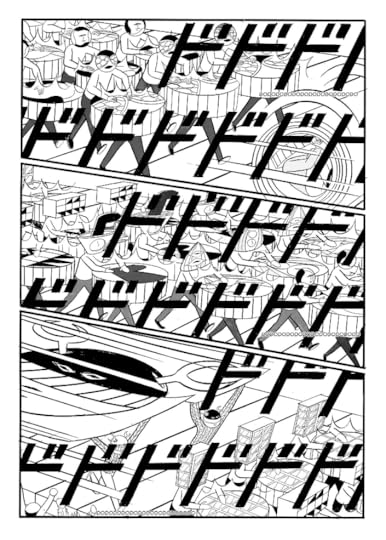
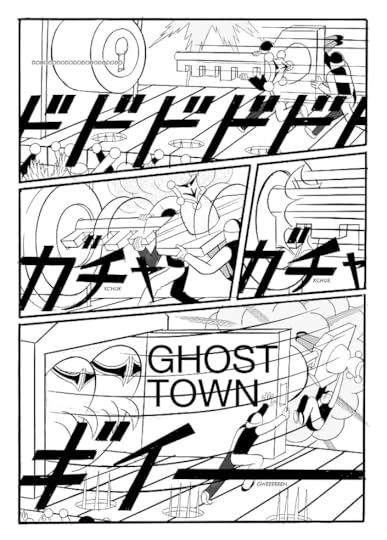
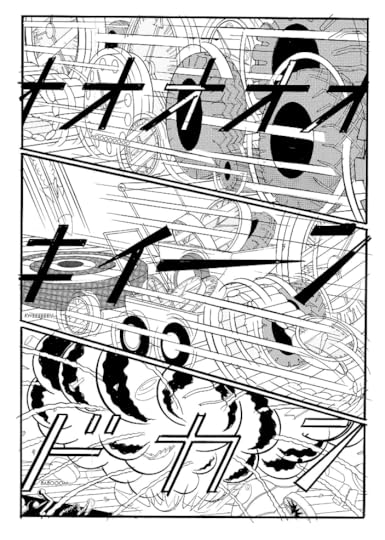
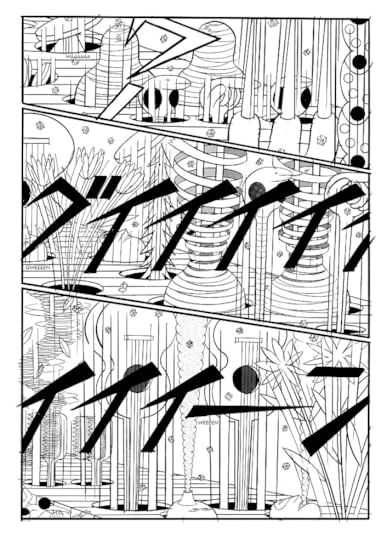
Test your eyes/brain/soul on these randomly picked pages:
If you're still alive - what are you waiting for!!
Yokoyama Yuichi jest jednym z najbardziej nieprzewidywalnych twórców komiksowych naszych czasów, a jego kolejne prace tylko to potwierdzają. „Plaza” jest realizacją szalonego pomysłu, by na 225 stronach przedstawić coś na kształt parady, która ma cechy brazylijskiego karnawału z jego pomysłowością i różnorodnością. Ten ciąg wypływających z siebie zdarzeń zdaje się nie mieć początku ani końca i może być traktowany jak potwierdzenie banalnej prawdy, że jedyną stałą jest wszechobecna zmienność.
Autor faktycznie inspirował się południowoamerykańską tradycją świętowania, ale rzeczywistość, jaką prezentuje ma również (a może przede wszystkim) mroczną stronę. Przedstawione wydarzenia angażują widzów i robią to często w sposób okrutny (choć scen krwawych autor generalnie w swoich pracach unika). Pochód to prezentacja idei, postaci, pomysłów, ale również potencjału militarnego. W tym sensie sporo tu odniesień do pokazowych parad, które są tak charakterystyczne dla reżimów i które w założeniu mają stanowić manifestację siły danego kraju. W niektórych scenach aktorzy w jednorodnych uniformach na scenie zdają się hajlować i epatować bojowymi gestami. Blichtr i radosny festyn przeplata się ze złowieszczym przemarszem, prezentacją śmiercionośnej broni i destrukcją fanatycznej publiczności.
„Plaza” sprawia, że czuję się przytłoczony, zmęczony, ale również zafascynowany. Autor przyznaje, że raczej nie rozpisuje swoich scenariuszy, zaczyna od przypadkowego kadru i obserwuje jak historia się rozrasta. W tym przypadku trudno w ogóle mówić o fabule. Ten komiks jest jak walec, który przygniata czytelnika bodźcami, starając się utrzymać jego uwagę stale na najwyższym poziomie. Yokoyama posługuje się kubistyczną stylistyką, tworząc obrazy, które są jednocześnie bardzo płaskie i przestrzenne. Jego rysunki pełne są ostrych kątów, szaleńczego ruchu i przede wszystkim dźwięków. To twórczość, którą w równym stopniu słychać co widać, choć większość onomatopei nie potrzebuje tu w ogóle tłumaczenia. Wystarczy spojrzeć na planszę i wrażenie hałasu jest pierwszą rzeczą, jaka się nasuwa przy odbiorze.
Autor jest bardzo świadomy swojej niszowości, ale również wyjątkowości. Na podstawie wywiadów i artykułów o nim wnioskuję, że kluczem jest tu ironia i poczucie humoru, choć tak naprawdę jest to twórczość, która nie istnieje bez bardzo zaangażowanego odbiorcy i prawdopodobnie właśnie dla takiego czytelnika jest tworzona.
(Tekst ukazał się na facebookowej stronie "Magazynu Kreski")
This was honestly difficult for me to get through. Others have described it as Yokoyama at his most extreme – the most Yokayamish of his comics, if you will – and that seems about right. More than 200 pages of weird stuff happening for no discernible reason, basically.
In the postface to my edition, Yokoyama celebrates the idea that many people around the world have traditions and practices that they don’t understand themselves – doing things just to do them, rather than for a real reason. He makes it clear that his intention with Plaza was to create a comic without any apparent meaning – something for readers to experience viscerally rather than grasp intellectually. This is a cool concept, and I appreciate the work’s originality and ambition, but I can’t say I loved reading it. There are a few passages where I got into the flow and could properly appreciate what Yokoyama was going for, but more often I found my attention wandering. It doesn’t help that it’s often difficult to parse what’s even happening in a given panel – I don’t have much motivation to decipher the action when I know there’ll be no reward for doing so.
I’m happy to have read this, but I’m very glad it wasn’t my first Yokoyama comic, as it might’ve led me to write his work off as too out-there for me.
Presented as a parade of figures across a stage, PLAZA, like many of Yokoyama's manga, has no real narrative. In fact, it may have even less narrative than any other works of his I've seen. It's also one of his longest and biggest works, I believe.
For those not familiar with Yokoyama's work, this is probably the last place to start. I would recommend Garden. In it, a group of seemingly endless figures explore a..."garden". Yokoyama's figures are normally nameless and characterless, as far as I can tell. They are each originally designed visually: one might have a star for his head, another a crescent moon-shape on his crown. (Yokoyama states in an interview in Plaza that he only knows how to draw males). The narrative is simple: they explore their surroundings, remarking in descriptions (that I find rather droll) upon what they find: "This house is larger than the others." They interact with the things they find and move on. What is the appeal, you may ask? I don't know. All I know is, upon reading Garden, I felt something profound. I have proceeded to get everything of Yokoyama's I can, including a t-shirt and now a tote bag. One could say I am a big fan.
I had to take Plaza slowly. Like I said, it has even less of a narrative than his other books. Increasingly bizarre beings and floats cross a stage. That is it. You can see the audience, typical Yokoyama figures, who respond sometimes. Sometimes they will all hold up their hands, for example. Each panel, as Yokoyama describes in the longest interview I have ever seen with him, has about a two or three second interval between each frame. At 225 pages, this amounts to, according to Yokoyama's math, about 24 minutes of a procession. Yokoyama began the "underdrawings" for this in the middle of 2014. He finished it entirely near the end of 2018. Four years for 24 minutes.
The panels are so dense they are difficult to understand. I myself had to limit my viewing of it to 25 pages at most a night. And I'm sure I missed things. In my mind I had to catalog all that was happening. For example, on page 24, I'd say to myself: ok, in the first panel, the "7" observation tower's floor has collapsed, spilling the two figures inside on to the stage. The "8" block following it has two pairs of octopus legs, totaling sixteen legs. The number "8" is shown three times, once on its side, and twice on its front. The audience is raising its hands--wait, actually, a giant ball has also dropped out of the collapsing "7" tower and bounced out onto the crowd. That looks to make a GORO noise, while the collapsing floor made a ZDOOF noise. Ok, on to the next panel. (2 seconds perhaps). Ah, I see, the "8" block actually has 8 *four* times on its side, now that it has come fully in to view: the 8 panels have dropped to reveal behind each what looks likea face per panel with a pipe as their nose, with no mouth. The panel-dropping has made a KCHUK noise. This is all that happens here. Next panel. (again, 2 seconds?) The pipe noses of each of these faces has protruded longer, to make them look like cannons, with a GWEEEEEN noise. Out of their eye holes now tiny cones have emerged. On to the next page.
As you can see, such a way of reading takes time, but I don't think you could read it otherwise. Perhaps you could, but I can't process all that's happening on the page so fast. Even with this method, I'm sure I missed certain things. It was work.
What did I gain from this? At some points, I felt like I was glimpsing the universe. At other times, just a crazy procession.
I think what Yokoyama says here is very interesting about his manga: "It's not designed to entertain you, but if that's what you're looking for, you'll have plenty of fun. But really it's up to you, the reader. I think that's what fine art originally was like. Museums didn't use to be so approachable. You'd go there, no one else would be there, and there'd just be some paintings hanging on the walls, with nothing to make it easier for you. 'I'm sorry if you don't understand art. You only have yourself to blame.' That was their attitude."
To me, Yokoyama is an artist, and, in fact, he is one of the most moving artists around today. Again, perhaps don't start with this. Or do. If you don't enjoy it, you only have yourself to blame.
Plaza’s story is all action, no plot or dialogue, but lots of transliterated onomatopoeia. The setting appears to be something like a conveyor belt set at just above head level. About the width of a suburban side street, the conveyor belt’s length would seem to be infinite. Below it is a scrim of standing audience, humanoid in form but lacking discernable gender difference, with heads/masks/helmets that are spherical with a black cone attached where a nose might be. Depending on the actions occurring on the conveyor belt, the audience either seems to be cheering, beating each other up, or ducking from being struck by a deadly instrument coming from the conveyor belt. And what is on the conveyor belt? What appears constantly changes, like a parade, but bodies rise, descend, or swoop out of holes in the floor of the conveyor belt, projectiles are shot, explosions occur, long knives are swept across the audience, swinging long knives, and so forth —organized chaos, in other words, in which the challenge the artist set for himself seems to have been to design as many costumes, devices, maneuvers and actions he can with without repeating himself.
Making the busy, chaotic action on the conveyor belt visually denser are lines indicating movement (horizontal, vertical, and spin) and overlain characters indicating onomatopoeia that take up about a third of each panel. In short, Yuichi turns manga into abstract art. Readers who like conventional manga will probably avoid this book. Readers, like me, who are indifferent to manga are likelier to enjoy the chaos.
The book includes an interview with Yuichi translated by Ryan Holmberg about the making of Plaza and Yuichi’s career in general.
Thanks to Edelweiss and the publisher for an eARC in exchange for an honest review.
I have no idea what was happening here, but it seemed glorious and looked like a celebration.
Yes, I know this is somewhat based on Carnaval in Brazil. But here, you see, we're treated to giant Plinko, exploding green beans the size of gazebos, and enormous tires running over tubes of paste, all to the utter ebullience of the masked parade attendees. Yokoyama says in a fascinating Q&A at the end of this edition that he likes to tell stories as if viewing the events through the eyes of an animal or insect. The main characters wouldn't have names, and what transpires would confuse and delight, not to mention be interpreted as something alien.
This is evident in PLAZA. Whatever was going on, beats the hell out of me. It brought to mind the Katamari video game series, which are weird and madcap and just off-the-wall nuts. But it's so distinctly Japanese that you'd be hard pressed to not find something whimsical in it.
A lot of love is obviously poured into the line work, and though I don't understand a lot of Japanese, the use of each katakana character is deliberate. If you're into the weird and avantgarde of graphic novels, this is for you.
Plaza is a wild ride in graphic story telling. As the reader you watch a spectacular parade unfold in front of you which could never be replicated in real life. The visuals are a tour de force in thinking how to make one concept flow into another.
This was a fantastic read and one which I will definitely come back to. My only issue if I can call it one is that since there is little plot unfolding therefore I recommend digesting this book in a couple different setting so that you don't feel inoculated to the stunning visuals. Check this out!
I think this book is genius, even though trying to read it makes by eyes hurt and my brain ache. Not a narrative book at all, but a visual representation of the chaos of Carnival. Heavy, geometrical soundeffects, in large hiragana that covers most of the art, with small typeset English translations. Angular art that is very representational. Nothing logically leads from page to page. I've never been able to read more than three pages at a time. But it is doing something spectacular, and so I praise it.
Yuichi Yokoyama's baffling and bombastic artwork should be experienced at this large of a size. There isn't so much of a story in here as there is a lot of noise, but it comes together very nicely. It's a chaotic reading experience at first, but about midway through I started to feel like I was synchronizing with Yokoyama's bizarre rhythm and it clicked. Despite the lack of words, I'd encourage the reader to really take the time to soak in the sheer craziness of the artwork in order to really digest it.
The art in this book holds its own charm - it's something I want to revisit some day soon and read at a completely different pace absorbing each frame that depicts 2 -3 seconds at a time. What a novel way of drawing. It definitely set my brain on fire - it was more exciting in some ways that seeing a carnival on TV, and embodied what it might feel like to be in a carnival in Brazil, except you see everything in the black and white drawings of Yuchi Yokoyama.
Legitimately paradigm-shifting work from one of the most exciting working comic artists. Nice edition printed at a large enough scale to appreciate the intensity of the drawing. One of those rare experiences with comics where you come away from the book feeling both happier for having been exposed and depressed that the next drawing you see will feel staid and dull by comparison.
Let me start by saying that anything translated by Ryan Holmberg is worth checking out. Plaza by Yokoyama Yuichi is no exception and delivers on the kaleidoscopic frenzy and madness that YY fans expect of YY, a mangaka very much paving his own path. The oversized edition from Living the Line is particularly nice given the high level of detail in YY's work.
gracias Edelweiss+ por la copia, Yuichi esta mas potenciado que nunca en este comic, es una verdadera locura y una maravilla lo que logra, creo que es su mejor comic hasta la fecha al menos es mi favorito.
You know when you go to see fireworks, the whole show is just a buildup to the final crescendo? PLAZA is this crescendo, sustained for 225 pages. It’s a relentless spectacle. A total maximalist assault of pop fever dream explosions.
Mind melting - I've never been so overwhelmed reading a comic before - especially for something that has zero words. Plaza is a visual feast that never lets up. It's fun to just pick it up and look at a few pages at random. It's both art book and comic.
In brief a Japanese alphabet dances with Brazilian carnival in black and white calagrahy movement lines figures objects all overlapping one another breaking out of the manga frame!!!! A controlled chaos! Love it
An explosion of motion, depicting an endless parade of strange performers operating complex contraptions to the delight and panic of numerous observers.
Plaza deserves praise for its singular artistic focus and ample craft, yet constructed a product which I just didn't enjoy at all. The work reads like a complex array of doodles and visual gags overlayed with sound effects, seemingly intended to hypnotize the reader into a sort of experiential stupor.
To me it felt like an ill-conceived, concept-forward exercise in making a "comic of sound" by depicting a nonstop parade of wacky scenarios painfully obscured by gigantic sound effect lettering. From my perspective it has just as much merit as a contrived concept like "food you can read"; I find it highfalutin and the concept uninteresting.
There is certainly a lot to look at and the compositions develop an interesting approach to motion but the overall effect just feels busy and tiresome. While a work devoid of narrative and characterization is already not my jam, I also found this particular expression of visual experimentalism underwhelming and rather laborious to read.