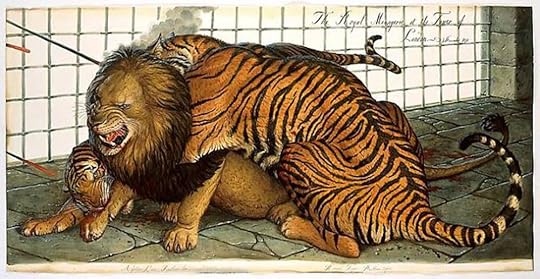
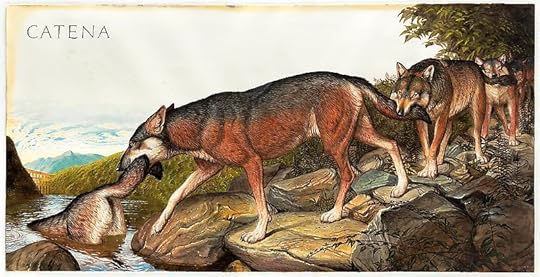
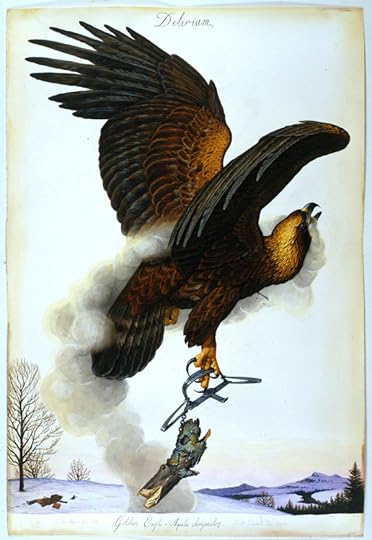
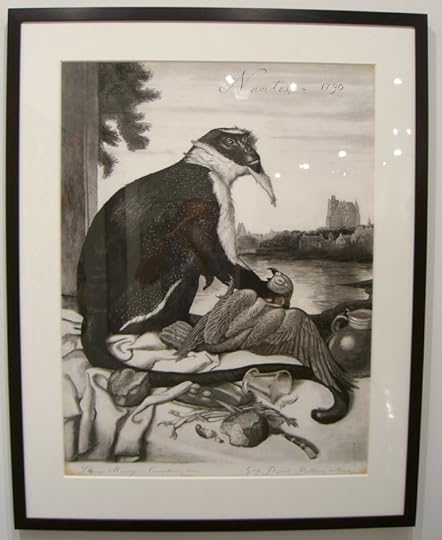
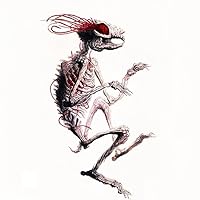
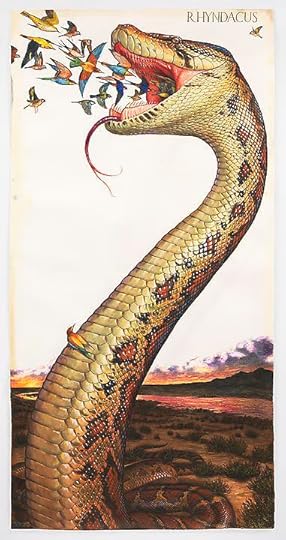
Fantastic The sinister majesty of Walton Ford's wildlife At first glance, Walton Ford ’s large-scale, highly-detailed watercolors of animals may recall the prints of 19th century illustrators John James Audubon and Edward Lear , and others of the colonial era. But a closer look reveals a complex and disturbingly anthropomorphic universe, full of symbols, sly jokes, and allusions to the ’operatic’ nature of traditional natural history themes. The beasts and birds populating this contemporary artist’s life-size paintings are never mere objects, but dynamic actors in allegorical struggles : a wild turkey crushes a small parrot in its claw; a troupe of monkeys wreak havoc on a formal dinner table, an American buffalo is surrounded by bloodied white wolves. The book’s title derives from The Pancha Tantra , an ancient Indian book of animal tales considered the precursor to Aesop’s Fables .
This large-format edition includes an in-depth exploration of Walton Ford’s oeuvre, a complete biography, and excerpts from his textual Vietnamese folktales and the letters of Benjamin Franklin, the Autobiography of Benvenuto Cellini and Audubon’s Ornithological Biography .
First published in TASCHEN’s limited collector’s edition — now available in this standard hardcover edition! Text in English, French, and German
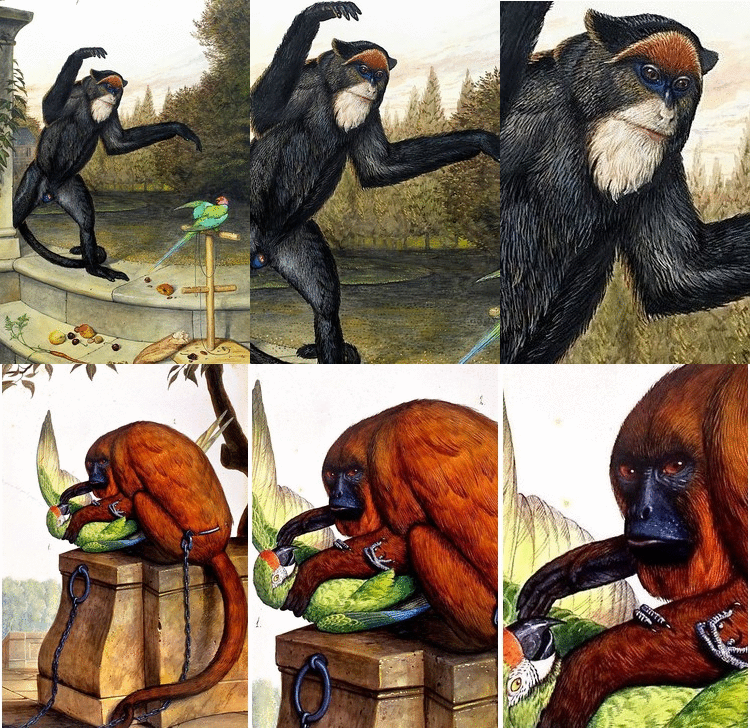
Gah! WTF? Monkeys with bad intentions... & the colorful parrots who inspire murderous jealousy in lower primates, especially ones shackled to stone obelisks with iron manacles.
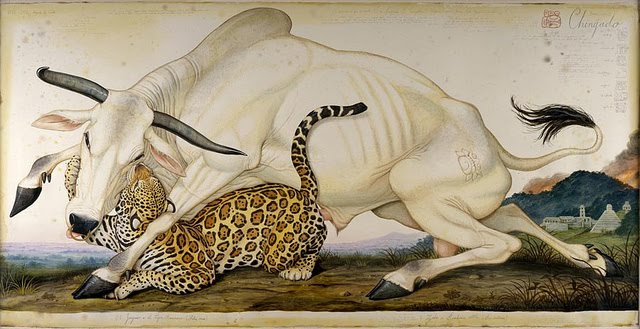
This is the glorious fucking realm of contemporary artist Walton Ford, who has made a careful study & practice of the Natural History art - from the hundreds of often inaccurate & imaginary 17th century engravings cataloging the stuffed & bottled zoological specimens collected by Albertus Seba, to the conscientious precision & microscopic detail found in the 19th-century monographs of pioneering evolutionary biologist & artist Ernst Haeckel - combining it with subtle and subversive influences, using his prodigious artistic and illustrative gifts to tell of the long and tragic tale of the relationship between man and beast. Sometimes the books we love the most are the hardest reviews to write. I've found that to be true. Fortunately, the art of Walton Ford, the name at the very top of a long list of favorites, speaks with a terrible and beautiful clarity that could make a Komodo Dragon weep. It ain't subtle: a big white Spanish Bull raping a New World Jaguar, with a ziggurat in the background, just in case the imagery wasn't clear enough. Cross-species sex crimes... finally, someone is breaking the silence.
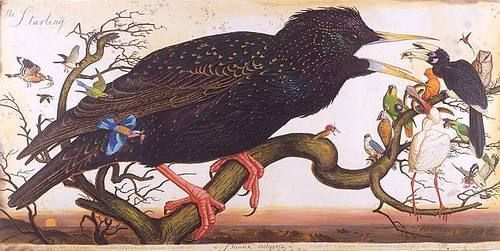
This collection of Ford's large-scale paintings covers most of his work from the past 20 years. It's amazing how consistent his vision has remained over this period, owing not to artistic stagnancy, but instead to a passionate vision that is both unique and powerful. The observation comparing Ford's paintings to a meeting of J.J. Audubon and Hieronymus Bosch is apt enough. In the world of modern & post-modern contemporary art, Ford is a pleasant anomaly, making art that is accessible and thought-provoking, incorporating elements from the masters of the Renaissance & the Baroque, the Symbolists & Surrealists, all filtered through the Natural History lens of Audubon's watercolor field studies, to make something that feels unique. Thankfully, Taschen has released a book that is worthy of the art it depicts; it's a huge tome - part of their Italian-made 'XL/XXL' line - weighing in around 3.5 kg, 350 pages long, about 12" wide by 16" tall, and printed on a thick, coated, archival paper-stock. 'Pancha Tantra' is the perfect showcase for one of the world's best living artists... and I've paid literally three times as much for books of this quality. Compared with his last monograph, the well-designed but slim 'Tigers of Wrath, Horses of Instruction' -- which is only about 80 pages long and features much smaller reproductions, making details hard to examine -- 'Pancha Tantra' feels like a treasure trove of art, every page revealing another incredible, stunning work. As the paintings are presented in chronological order, the reader becomes a kind of naturalist, following the evolutionary development of Ford's vision, as various birds and mammals take on complex metaphorical significance. The European Starling becomes his favorite ornithological avatar, taking on it's tiny wings the weight of English colonialism in the 18th and 19th century. It reappears again and again, in oriental and African locales it doesn't belong, singing in a Rhino's ear, harassing an elephant already in a frenzied state of must, and blown up to fantastic dimensions, fed ridiculous amounts by dozens of other species, all indentured to it's oppressive bulk, dedicated entirely to further fattening a bloated empire.
His newer works move away from predominantly depicting birds, just as Audubon moved on to his less famous 'Quadrupeds of North America' after completing the 'Birds of America'. His scope becomes wider, taking in the entire history of humanity's relationship with the animal kingdom. They have been our nightmares, hunting us in the darkness before we discovered the Promethean qualities of flint, and mastered both fire and spear-point. They've also been our gods -- the Egyptian pantheon in particular, with the cat-headed Bast, jackal-headed Anubis, and falcon-headed Horus perhaps being indicative of our earliest deities, as are the totem-gods of the Native American peoples. And then they became a living resource around which our lives revolved, depending on cattle as the Masai tribe still does, or as the Huns and Mongols and the other Steppe nomads once relied on the horse (worshiping a primitive horse-god, making alcoholic beverages from fermented horse-milk, hunting and conquering on horseback, going so far as to drink their mounts' blood and urine when water was unavailable; and when they died, eating them, using their skins for warmth and finding purpose for every part of their anatomy). Dogs and cats have been loved as family members for thousands of years, even as their wild cousins, wolves and tigers, have been cursed as mankillers and pests that slaughter livestock, hunted to near extinction. There are few artists who are so clear-eyed in their vision, with this level of talent and technical acumen. His ambitious course is charted in great detail, but besides a brief introduction, critical essays are omitted... but they're not really necessary. What is included is an appendix that for once isn't dull ephemera, providing annotations by the artist on particular works, as well as the many texts that Ford uses for inspiration; these are the factual, historical and mythological foundations that his oeuvre is built upon.
'Pancha Tantra' is essential and endlessly rewarding; I don't know how many times I've gone back to it, and will continue to go back to it. Among the hundreds of art-books in my collection, this is certainly one of my absolute favorites. There is also a revised and updated new edition, which includes the 40 to 50 paintings Ford has completed since the original release in 2010. It's a smaller format, but still generous at 10" x 13". I own both, and the more affordable revised edition is nearly as stunning as the over-sized original.
This artist monograph collects all the paintings Walton Ford has created over the past 25 years, and it's a massive tome of a book. Ford depicts animals from various generally harmful human perspectives, integrating symbols, jokes, as well as references to travel guides and colonial literature. Each picture tells a complex story, and the reader can spend a lot of time discovering all kinds of hidden meanings.
In many cases, the depicted animals do not behave appropriate to their species, but instead live out human thoughts and desires. The results aren't pretty, as even the most majestic animals experience a tragic fall from grace when guided by human intellect - what does that tell us about humanity’s role on this planet?
In his introduction, Bill Buford argues that “Ford isn’t political.” To my mind, though, his often disturbing, sometimes shocking watercolor paintings deliver a potent political critique of the ways in which colonialism, science, industrialization and globalization have alienated us from our environment, with fatal consequences.
Eisnein's No.1 Favorite Artist/Artbook. Check Out No.2 Right HERE. Go Nowhere At All By Clicking HERE.
[NOTE: This is the Revised 2nd Edition. It's a smaller version of the (roughly) 16 x 12-inch 1st edition, but it's still fairly large, at 12.5 x 10 inches. It also includes a few dozen paintings Ford has completed in the interim... which is why I own both. I prefer the larger format, but this is still a great way to see his work. The review below was for the original book, but the new one is otherwise identical.]
Gah! WTF? Monkeys with bad intentions... aaaand the birds who love them. ;-)
Whatever, some may be thinking, another book of 'natural history', celebrating some 19th-century stuffed-shirt aristo who fancied himself an artist and scientist while he went on his kill-happy safari rampages.
Well firstly, that makes for some awesome books; but secondly, and more importantly -- that's not what this is. This is the glorious fucking realm of contemporary artist Walton Ford, who has made his own the natural history style of prints and paintings, everything from Albertus Seba to Ernst Haeckel, and combined it with subtle and subversive post-modern influences -- using his prodigious artistic and illustrative gifts to tell of the long and tragic tale of the relationship between man and beast. As Jan mentioned recently, sometimes the books we love the most are the hardest reviews to write. I've found that to be true. Fortunately, the art of Walton Ford, the name at the very top of my long list, speaks with a terrible and beautiful clarity that could make a Komodo Dragon weep. Look on his works, ye mighty nerdy, and despair! It ain't subtle: a big white Spanish Bull raping a New World Jaguar, with a ziggurat in the background, just in case the imagery wasn't clear enough. Cross-species sex crimes -- finally, someone is breaking the silence!
This collection of Ford's large-scale paintings covers most of his work from the past 20 years. It's amazing how consistent his vision has remained over this period, owing not to artistic stagnancy, but instead to a passionate vision that is both unique and powerful. The comparison made is that Walton Ford's paintings resemble a meeting of J.J. Audubon and Hieronymus Bosch, and I would say it's very apt... in some respects. But it's much more than that. In the world of modern contemporary art Ford is something of a pleasant anomaly, making art that is accessible and thought-provoking, incorporating elements from the masters of the Renaissance, the Baroque period, the Surrealists and, of course, Audubon, to make something that still feels original. Thankfully, Taschen has released a book that is worthy of the art it depicts; It a huge tome, weighing in around 3.5 kg, 350 pages long, about 12" wide by 16" tall, and is printed on a thick, semi-glossy paper stock. 'Pancha Tantra' is the perfect showcase for one of the world's best living artists... and I've paid literally three times as much for books of this quality. Compared with his last monograph, the well-designed but slim 'Tigers of Wrath, Horses of Instruction' -- which is only about 80 pages long and features much smaller reproductions, making details hard to examine -- 'Pancha Tantra' feels like a treasure trove of art, every page revealing another incredible, stunning work. As the paintings are presented in chronological order, the reader becomes a kind of naturalist, following the evolutionary development of Ford's vision, as various birds and mammals take on complex metaphorical significance. The European Starling becomes his favorite ornithological avatar, taking on it's tiny wings the weight of English colonialism in the 18th and 19th century. It reappears again and again, in oriental and African locales it doesn't belong, singing in a Rhino's ear, harassing an elephant already in a frenzied state of must, and blown up to fantastic dimensions, fed ridiculous amounts by dozens of other species, all indentured to it's oppressive bulk, dedicated entirely to further fattening a bloated empire. An apocryphal episode from the life of the prototypical 'Renaissance Man' -- Leonardo Da Vinci is the infant:
His newer works move away from predominantly depicting birds, just as Audubon moved on to his less famous 'Quadrupeds of North America' after completing the 'Birds of America'. His scope becomes wider, taking in the entire history of humanity's relationship with the animal kingdom. They have been our nightmares, hunting us in the darkness before we discovered the Promethean qualities of flint, and mastered both fire and spear-point. They've also been our gods -- the Egyptian pantheon in particular, with the cat-headed Bast, jackal-headed Anubis, and falcon-headed Horus perhaps being indicative of our earliest deities, as are the totem-gods of the Native American peoples. And then they became a living resource around which our lives revolved, depending on cattle as the Masai tribe still does, or as the Huns and Mongols and the other Steppe nomads once relied on the horse (worshiping a primitive horse-god, making alcoholic beverages from fermented horse-milk, hunting and conquering on horseback, going so far as to drink their mounts' blood and urine when water was unavailable; and when they died, eating them, using their skins for warmth and finding purpose for every part of their anatomy). Dogs and cats have been loved as family members for thousands of years, even as their wild cousins, wolves and tigers, have been cursed as mankillers and pests that slaughter livestock, hunted to near extinction. There are few artists who are so clear-eyed in their vision, with this level of talent and technical acumen. His ambitious course is charted in great detail, but besides a brief introduction, critical essays are omitted... but they're not really necessary. What is included is an appendix that for once isn't dull ephemera, providing annotations by the artist on particular works, as well as the many texts that Ford uses for inspiration; these are the factual, historical and mythological foundations that his oeuvre is built upon.
Before and after... I kept watching this video for hours, and he spent all of it on one stupid fucking piece of fruit. It's amazing it ever got finished, given his trance-like focus and perfectionism... it must have taken years... ;-)
Eisnein's No.1 Favorite Artist/Artbook. Check Out No.2 Right HERE.
I can't add much of anything to Eisnein's great review. If you are at all curious just from the cover art, check out his review. I only read this and only heard of Ford because of his review, and I am grateful. I in the past year have taught a YA course, reading Gary Schmidt's Okay For Now, which features a young man's encounter with Audubon's Birds of America. I knew that work from my own youth, or thought I did. I was familiar with it as it seemed everyone was. It's Americana. It's like photographs of Ansel Adams. Ubiquitous.
But Audubon has a certain quality in his paintings that Schmidt ascribes to a kind of humane anthromorphism. When his character--the boy--sees into Audubon's paintings, he sees his own life. There is violence in Audubon's natural world, as Schmidt and his kid helped me see in the paintings, but there is a kind of vulnerability, too, and sometimes sadness, anxiety, terror, even joy. And the precision and majesty of his art, especially in the rare large book format. . . well, you can see how Audubon became a household name.
Ford is an (amazingly) contemporary artist who takes this view of violence in nature to an extreme. He's like Audubon meets Hieronymous Bosch, a back cover quote from Vogue says. He's like Audubon two or three screws too tight. Or after a little wine (or something), maybe. It's kill or be killed, yes, but it's also playful, it's (I only imagine) in conversation with Audubon and other Colonial painters of nature. With the same technical skill.
I highly recommend you check this volume out of your library, read it through, and then read Eisnein's review. You will be grateful to just begin to know Ford's work.
I discovered this magnificent book several years ago in the small bookshop section of a Provincetown gallery. Initially I thought I was looking at a modern version of an Audubon book, but as I started to turn the pages, I realized that something was not quite right in the animal scenes depicted here. At the time, I had never heard of the Indian Panchatantra, so I was really not prepared for what I was seeing, and I was amazed at the intensity of those drawings. So, it was that at the next opportunity, I purchased the book. I looked, and looked, and looked, and watched, and scrutinized each scene: what is compelling in this book, what makes for this "intensity" I just alluded to, is the simple fact that those animals are acting out human flaws as they are wont to do in fables. Only this time, we do not just hear; we see...
Well, I finally got my hands on this while browsing through a small bookshop. A massive book at a price of $70, I decided to sit down awhile and finally look through it. A beautiful book filled with Walton Ford Audubon-style paintings and prints. At first glance the pieces may seem very old-style and ordinary Audubon, but take a closer look and you will find darkness, oddities and brilliant humor. Ford is a great artist, with such an interesting perspective. I wish I could swim around in his brain for awhile. I dream of owning this book. I'm lusting over it. I was practically salivating on the one at the bookstore.
I first saw Walton Ford's enormous and unsettling paintings at the Louisiana Museum of Modern Art outside of Copenhagen. I was unprepared to be so overwhelmed by the drama and detail of Ford's outsized paintings, many of which also lead the viewer to confront uncomfortable scenes of orientalism and colonialism through his anthropomorphized animal characters.
Nothing will equal that experience of viewing the life-size paintings, but this book comes much closer than Google Images is able to do, so I excitedly snatched up this book when I was able to get it for just $25. I have no idea where I'll put it, but it lives up to all my expectations.
This artist is amazing. I had the good fortune to see one of his paintings in real life, and it's incredible to see - it was so big, and so detailed, wonderfully realistic and whimsical at the same time. I haven't read the whole book (mainly because it's very expensive, but it's certainly worth it) but I have spent hours perusing his work online, so I can imagine how great it would be to have this book in person. He's just incredible. . .
Gelesen: David Levithan: Das Wörterbuch der Liebenden In Form eines Wörterbuchs wird die Liebesgeschichte eines Paares erzählt: Die vorsichtige Annäherung, die Unsicherheiten, die Sehnsucht, die Verschränkung mit den Beziehungen der jeweiligen Freunde und Familie, Verletzungen, Betrug... Sehr berührend!
След поне 3 опита на Боби да ми я купи, накрая реших, че и без това струва прекалено скъпо (50 евро корична цена + още 20-25 за доставка) и я "прочетох" онлайн. Ето легален линк - http://www.taschen.com/lookinside/050...
Just had a quick look in the store but I was really amazed. I always loved Audubon's work in its own right, but Ford adds so much color, mystery, visceral feeling and utter weirdness to his aesthetic.
Walton Ford is just an amazing artist and this book is actually big enough (the approximate dimensions of a backpack and a solid 3 inches thick) to show the detail in some of his larger works.
Discovered Walton Ford at the Morgan Library today and was instantly compelled to buy this collection of his artwork. I’ve always loved the illustrations of old natural history books (Audubon being the most famous of this genre) but I had no idea there was a contemporary working artist who not only shared this love but had elevated this rather staid but elegant genre into something alternatively funny, moving, terrifying, grotesque, obscene, and absurd.
You'll know I've won the lottery when I have a print of a monkey choking a parrot on the wall. Unfortunately his etchings weren't in this great collection of paintings.