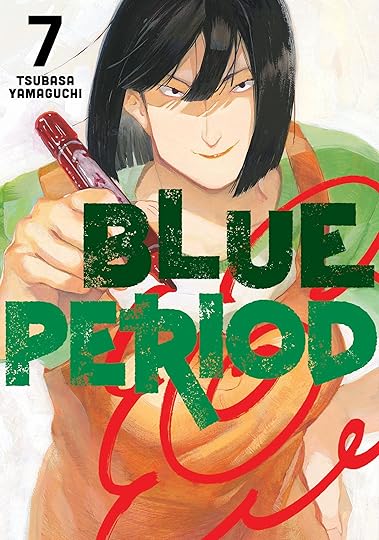
Tokyo University of the Arts is now Yatora's campus, where each new encounter with colleagues, professors, and assignments challenges everything he's ever known! Self-doubt and life's hardships still lurk around every corner, but running into an old friend may just turn things around.
I wanna write a great comprehensive review about this volume because honestly the dialogue here really hurts. It genuinely hurts because it's soooo real. I don't draw or do anything art related but Yatora's passion and how hard he's working and trying just really hits hard. I love this volume I really do. As what I've said before, this series continues to really hit me hard. Thank you Yamaguchi-sensei
This shit was so real. نمیدونم ایده خوبی بود که از حیطه کاری خودم چیزی انقدر نزدیک به واقعیت و سختی های موجودش بخونم اما واقعا طوری با یاتورا احساس نزدیکی میکنم که این جلد تمومش برام قابل لمس و درک بود و با هربار شکستن یاتورا من هم باهاش شکستم.
I genuinely love this series. It’s a testament to how art that you make is hard fucking work and how overwhelmingly that can be. It’s a little too real at times, but in the best way. I wish there were more series like this!!
Yatora's sense of being unworthy of his status at TUA is the highlight of this volume, because it's absolutely spot-on in terms of any creative field. That's true of the mix of deliberately eclectic people making up his cohort; I definitely encountered all of them in my MFA program, including the guy who's already had a major show (been published in my case) and makes you wonder why he's even there.
What drags this volume down for me, surprising no one I suspect, is Hanakage, the horrible doctorate student. She goes beyond "trashy" (as Yatora calls her) and hops right into "predatory;" I don't care how quirky your BFA program is, that woman would be out on her ass within seconds of taking underage students out drinking and groping another student. Also not fond of the prof with the snaky eyes, who certainly is a type of art professor that exists - the worst kind.
3.5. This is very well done, but I hate those two characters with the fire of a thousand suns.
Now that he’s at TUA, Yaguchi’s got it made. He’s reached the school of his dreams and the thing he’s been striving for all this time. Like a dog chasing its tail, however, now that he’s caught it, Yaguchi is at a loss and, because he’s a human being with existential dread, this is a problem that’s going to take more than a bag of Kibbles ‘n Bits to fix.
You train hard. You practice. You hone your skills and your ability to the utmost. You scale to the top of Mount Everest, the pinnacle of the climbing world. At that precise moment of triumph, the clouds part and there is another, higher mountain right next to it and none of your equipment will avail you any more. That is the hell that is Yaguchi’s university experience.
For many, many people who think they’ve achieved a lot in life, arriving at university can be a harsh slap of reality that lets them know that other people have achieved things too and, in some cases, better things. Your accomplishments no longer exist in the small pond they once did and comparing them to others is the path of madness.
And the freedom that university offers, especially an art one like TUA, is a lot to reckon with, doubly so when the goal that drove all of the previous art that Yaguchi did is no longer in front of him, and his profs are telling the class that what they did to get here means essentially nothing.
There’s a very interesting celebration of failure in this volume, as the book makes a strong case that those who fail the entrance exams wind up better prepared for the shift to university courses and the argument is well presented. Many of us will fail at countless things in our lives and learning from that is just as important as the successes. Our hero has struggled, sure, but in the end he got what he wanted and where that leaves him is the crux of this.
Yaguchi’s problem in the moment is that he can’t actually recognize that his current failures are also part of this, entrance exam or not, and he winds up with one of the most uncomfortably realistic portrayals of imposter syndrome ever put forth in a manga.
This is easily the most depressing this series has ever been. It is a lot and it is a little too much, which is generally the point, but doesn’t make for the most enjoyable read (not that books should be buoyant joy constantly, but this one pours it on thick). It’s hard - this is great at conveying this feeling, but possibly too good at its job, which is heck of a thing to ding a story for, but this won’t be for everybody for that reason.
If anything, it feels like a soft reboot for the core concept right now as new students are introduced (the muscular girl who messed with Yaguchi by accident during his exam returns and she’s probably the best new character) and old ones slowly fade away. There’s zero Yuka in this volume and that’s a crying shame.
Still, we do get some tagalongs in the form of Takahashi, whose continued unintended attachment to Yaguchi is pretty funny, and the return of Maki (plus her sister showing up out of nowhere), who gets the most hopeful scene with Yaguchi and also uses it to push herself in a whole new direction.
It’s wrong to pick on a book for being too effective a portrait of despair, but this needs a lot more to leaven this to be more especially tolerable. For some this will be relatable, for others it could be full-on triggering. What comic relief is attempted happens to come from the worst character the series has introduced yet.
The “first-year” the guys meet winds up being the drunken prof trope from every other generic manga and while she has her moments, they also give her the ‘likes to grope the women’ trope at the same time. It’s just the biggest sour note since it introduces cliches into a series that had so far been refreshingly unreliant on them.
Her and many of the new characters being so intolerable or inscrutable just compounds poor Yaguchi’s misery. And the reader’s. Partially, this strikes excruciatingly close to home and this isn’t a period of my life I’m ever especially excited to ever revisit and that is completely affecting my reaction to what is, I assure you, a strong portrayal of what it’s going for.
4 actual stars, but, like life, this is complicated - for most of you, this is likely 4 stars and please be aware of that potentiality. For me, a storyline that just goes from unhappiness to unhappiness with nary a glimmer of hope and a really unwelcome turn to the cliché in its characters? Not my most enjoyable time with this story.
I absolutely love this manga but this volume especially was outstanding. I may not be an art student myself but I still found Yatora and his struggles with adapting to university incredibly relatable.
The mangaka really managed to capture that first year experience. That sense of feeling lost and a little bit like an imposter, like everyone around you is much better than you. All that is something that quite a lot of people go through when they first attend university and it was portrayed perfectly in this volume. Yatora's struggles hit a little too close to home at times and I felt genuinely anxious while reading but at the same time I was absolutely amazed that a manga managed to evoke such emotions.
I'm speechless and absolutely in love with Blue Period and I can't wait to see how Yatora's story continues.
tak bardzo kocham blue period bo mogę odnosić wszystkie przeżycia yatory do własnych. mimo, że cała seria jest o sztuce uważam że pewne sytuacje są uniwersalne i dosłownie czuję się jak yatora
Ahh por fin !!! Empezamos con las clases en la Gedai y honestamente sufrí con Yatora, entiendo por qué se siente tan perdido, e incluso otros lo comentan en el tomo, pero espero el logre encontrar la respuesta y seguir adelante.
Siempre que empieza uno algo nuevo es normal sentirse fuera de lugar
Das ist der erste Band, von dem ich noch nicht die Handlung kannte, weil diese noch nicht animiert wurde. Ich freue mich schon, es im Anime zu sehen, denn!
Es war wieder mal so tiefsinnig und authentisch. Ich habe oft mitfühlen können, als es um das Selbstwertgefühl bezogen auf das Können und Schaffen von Kunst ging. Mir hat auch gefallen, dass die Hauptfiguren aus der Vorbereitungsschule wieder vorkommen und dass ihr Weg noch thematisiert wird :)
This is the first volume of Blue Period that goes 'beyond' the anime adaptation available on Netflix. It is a painful book that looks at imposter syndrome in a university setting. Yatora, who passed the entrance examinations on his first try, is struggling. Unlike many of his other classmates who have failed multiple times -- Yatora has created art in a supportive and goal-directed environment. He has not yet found a clear point of view. When met by professors who are intending to give him a wide freedom to explore, he finds himself struggling with the impulse to find a 'perfect' approach to satisfy them.
Yamaguchi does an incredible job with her lining and shadowing to capture an overshadowed look to her characters. Yatora's feelings that he doesn't fit in would be relatable to many who have been to university: the adjustment process of becoming a self-directed artist isn't easy. But rather than confine Yatora's story within the university studio, Yamaguchi draws Yatora outside with friends and family -- meeting for drinks or having a chance encounter. This is a wise choice as it provides breathing space for readers, allowing us to reconnect with familiar characters we are already attached to. These lighthearted moments cut through an otherwise sombre volume.
It's a feat to have unique designs for every character and Yamaguchi does not disappoint here either. I like the three professors that are teaching the 1st years, they seem to each have a contrasting viewpoint. However, I am unhappy that one of the teaching assistants in Yatora's class was characterized like they came from a shonen manga. A minor character, their appearance blunted my enjoyment of an otherwise insightful and beautifully drawn manga. Still, I'm really looking forward to seeing more ways Yatora will approach his art and where his interests will lead.
Aviso: esta reseña contiene spoilers de los 6 primeros tomos de este manga, ya reseñados. Recomendamos esta obra encarecidamente, merece mucho la pena acompañar a Yaguchi en su viaje de autodescubrimiento a través del arte.
Yaguchi ha aprobado el examen de ingreso de la Universidad Nacional de Bellas Artes y Música de Tokio. Lleno de inquietud y esperanza, en la ceremonia de ingreso le esperan nuevas amistades y retos.
En este tomo, Yaguchi comienza como un niño pequeño, lleno de ilusión y sin acabar de creerse todavía el haber aprobado el examen. Sin embargo, también afloran sus miedos e inseguridad, que tanto le lastran desde el inicio de la historia. Sin entrar en spoilers, esto se agravará cuando conozca a sus compañeros y descubra que no es especial, sino que es, posiblemente, el peor de su clase.
Es muy curioso cómo se introducen los nuevos personajes. En este primer momento, ninguno se presenta en profundidad, pero a través de sus obras es posible empezar a entrever su personalidad y sus gustos. Que la mangaka sea capaz de lograr esto demuestra un gran talento y te deja con muchas ganas de saber más de ellos.
El final es estresante y te deja en vilo para continuar con el siguiente tomo. Esta historia que simplemente parece el slice-of-life de un estudiante de artes consigue atraparte a través de sus personajes tan bien construidos, de su interesante visión del mundo artístico y de un dibujo y composición que quita el aliento. Uno de mis mangas favoritos de los últimos años sin duda.
Yatora has, against all odds, gotten into TUA on his first try. Now, however, he must figure out how to actually be a university student. He must also, once more, deal with his own insecurities, as his initial encounter with his fellow students further convinces him that he is the poorest artist there. When the instructors proceed to tell them that they must all throw out everything they learned leading up to the exams, Yatora's fragile artistic confidence is shattered.
This was probably the best volume so far.
I found it difficult to come to grips with the idea that an artist as inexperienced as Yatora should get into TUA at all, but Yamaguchi handles that problem well in this instalment by making it clear just how little Yatora knows.
He is, once again, forced to face his artistic shortcomings, and he grapples intensely with his self confidence; this is portrayed very well.
I also really appreciate his circle of friends, and how Koi in particular handles Yatora's crisis and, without judgment, attempts to motivate him.
I am also growing to appreciate more and more of the supporting characters, and I'm excited to read on!
Empecé por este tras ver la primera temporada en Netflix y... lo disfruté más que el anime, sin duda alguna. Y el anime ya tenía un listón alto. Yaguchi puede parecer un penas en algunos fragmentos, pero es fácil identificarse con ciertos aspectos de su presión, síndrome de impostor y cómo está de perdido. Además, está rodeado de secundarios potentísimos y ambienta muy bien.
Lo mejor del tomo: Murai. QUE SE BESEN YA, digooo, me ha caído bien xDDDDD
Oh boy, this series... I consistently struggle to read it because it is so dramatic and at the same time so relatable. It makes me think about, remember, and feel so many things. Yatora being such a ball of anxiety and self-doubt does not help, haha. This volume is especially fun because Yatora has to move past the technical side of how to create art to pass exams and consider what it is he actually wants to create/say with his work. Hoo boy, 10/10.
P.S. This artist consistently designs such beautiful characters; thank you so much Tsubasa Yamaguchi!
First read of 2023, this shattered my soul tbh. Yatora practically having a mini relapse was so relatable bc of the amount of pressure he was under in both school work and art work. I relate to him in his fear of “not being enough” or being a “phony” was really touching bc I’ve felt that way recently :,)
Still setting things up since this is the first volume of a new arc. Very interesting so far but I can tell it might be a bumpy ride. Both for our protagonist, Yatora, and for readers. Next volume will be very telling.
Yatora's first experience with university- this gives a good overview of the way classes are set up and also shows Yatora struggling with an artist rut, and his emotional struggles as well. I'm really enjoying this series so far, though I do feel like Yatora kinda gets stuck in the same ruts. The art that the students create and the cityscapes are beautiful. Check out my YouTube channel for bookish videos and monthly wrap ups!
The path of life is ever changing, once you think you start to understand what’s going on, the game’s rules change, and yeah… I love this, I stopped reading for a while, life got busy… and now I’m back here and this feels comforting in a: you are not alone, kind of way, thankyou 🩵