Jump to ratings and reviews
Rate this book

Warnings!:AI、基因編輯、瘟疫、駭客、暖化……全球災難警告,用科學方法洞悉真相

Rate this book
  AI、基因編輯、瘟疫、駭客、暖化……全球災難來臨的恐怖時代
  災禍,可以預知嗎?意外,是突發事件嗎?預言,是妖言惑眾、危言聳聽嗎?
  人類的未來似乎充滿不確定嗎?
  白宮資深安全專家提醒我們:善用科學方法,可洞燭機先,防患未然,如何辨明正確的警告,趨吉避凶!
  張福昌(中華國土安全研究協會副祕書長、德國科隆大學政治學博士、淡江大學歐洲研究所副教授)專文推薦

  明天過後,任何人都不想盲目成為災難犧牲者。不過我們必須了解人類未來可能發生的重大災難性事件:
  ‧人工智慧凌駕於人類智慧之上,導致人類受其控制
  ‧新型致死微生菌導致全球大瘟疫
  ‧全球氣候變暖導致海平面上升
  ‧地區性核戰爭令煙塵密布於大氣層,遮蔽太陽照射,導致地球進入冰河世紀
  ‧網路遭受類似珍珠港事件的駭客攻擊
  ‧流星撞擊地球
  ‧基因程式設計技術導致實驗室誕生可怕的新物種

  這些重大災難性事件將導致:
  ‧數百萬人因自然和人為的災難而死,
  ‧他們原本可以因為專家的事先警告而倖免於難。
  我們能否在下次災難降臨前找到那些有預知能力的人?

  《Warnings!:AI、基因編輯、瘟疫、駭客、暖化……全球災難警告,用科學方法洞悉真相》是一本探討未來的國家安全、科技的威脅、美國經濟,甚至文明命運的書。

  在希臘神話中,卡珊德拉預見災難,但受到眾神詛咒而遭到忽視。現代的卡珊德拉反而明確地預測了卡翠娜颶風、福島核電廠、大衰退、伊斯蘭國崛起等許多災難。但和神話中的卡珊德拉一樣,他們遭到忽視。時至今日,還有人會提出警告,一些災難即將發生。但我們如何辨明哪些警告可能是正確的?

  《Warnings!》一書兩位作者都是卓越的企業執行長和曾任職白宮國家安全會議的老將──透過對各個領域的深入研究,發現一套區別正確的卡珊德拉和瘋狂末日理論家的方法。他們去調查目前已提出警告未來會發生災難、但呼聲未受到注意的專家,包括來自人工智慧、生物駭客、病毒突變的各種威脅。對任何不想盲目地成為明日災難犧牲者的個人、企業和政府,克拉克和艾迪精闢的見解都不可或缺。

448 pages, Paperback

First published May 23, 2017

368 people are currently reading
1912 people want to read

About the author

Richard A. Clarke

30 books234 followers
Librarian Note: There is more than one author by this name in the Goodreads database.

Richard Alan Clarke was a U.S. government employee for 30 years, 1973–2003. He worked for the State Department during the presidency of Ronald Reagan. In 1992, President George H.W. Bush appointed him to chair the Counter-terrorism Security Group and to a seat on the United States National Security Council. President Bill Clinton retained Clarke and in 1998 promoted him to be the National Coordinator for Security, Infrastructure Protection, and Counter-terrorism, the chief counter-terrorism adviser on the National Security Council. Under President George W. Bush, Clarke initially continued in the same position, but the position was no longer given cabinet-level access. He later became the Special Advisor to the President on cybersecurity, before leaving the Bush Administration in 2003.

Clarke came to widespread public attention for his role as counter-terrorism czar in the Clinton and Bush Administrations in March 2004, when he appeared on the 60 Minutes television news magazine, released his memoir about his service in government, Against All Enemies, and testified before the 9/11 Commission. In all three instances, Clarke was sharply critical of the Bush Administration's attitude toward counter-terrorism before the 9/11 terrorist attacks, and of the decision to go to war with Iraq. Following Clarke's strong criticisms of the Bush Administration, Bush administration officials and other Republicans attempted to discredit him or rebut his criticisms, making Clarke a controversial figure.

Ratings & Reviews

What do you think?
Rate this book

Friends & Following

Create a free account to discover what your friends think of this book!

Community Reviews

5 stars
227 (30%)
4 stars
299 (40%)
3 stars
170 (22%)
2 stars
36 (4%)
1 star
13 (1%)
Displaying 1 - 30 of 77 reviews
Profile Image for Michael Perkins.
Author 6 books469 followers
February 28, 2023
Well, who is right now? Laurie Garrett

https://www.sfgate.com/opinion/articl...

Laurie warns that while the risk of deadly microbes is increasing, governments’ ability to detect and respond is weakening. In her best-selling books, The Coming Plague and Betrayal of Trust, she meticulously discusses the decline and often wholesale absence of a competent public health infrastructure. The inability to deal with these growing threats unveils the specter of catastrophe—and more so when governments are simply unwilling to take the threat seriously. It is the “same pattern everywhere of government mistakes,” she told us, “of bigotry, of ignorance."

“Every single time I try to draw attention to an outbreak, I can tell you the particular time when I will be attacked. It is always a white male who combines his attack with a comment about my appearance and usually something related to me being a female. When I was on NPR the other day, someone tweeted about how fat I am. That is how they discredit my point."

"When the next pandemic strikes, all that will matter is the capacity of our public health system to detect and respond."

============
And today....

"Referring to the Centers for Disease Control and Prevention in Atlanta and its analogues abroad, she told me, “I’ve heard from every CDC in the world — the European CDC, the African CDC, China CDC — and they say, ‘Normally, our first call is to Atlanta, but we ain’t hearing back.’ There’s nothing going on down there. They’ve gutted that place. They’ve gagged that place. I can’t get calls returned anymore. Nobody down there is feeling like it’s safe to talk. Have you even seen anything important and vital coming out of the CDC?”

More on the CDC from a GOP magazine. What they reveal here might surprise you.

https://thebulwark.com/wheres-the-bla...

============

The Four Horseman of the Covid Apocalypse....

https://www.rollingstone.com/politics...

=================
Profile Image for Susan Burke.
99 reviews
June 14, 2017
I am no expert. I do not have any degrees. I have not done any formal research. I am not a scientist, educator, or biologist. I have no credits to my account nor the authority to speak as an expert in any field. What I do have is experience and a personal testimony, followed up by four years of home grown research mixed in with a bit of grassroots activism. What I do know is that I just may be a "Cassandra" of modern day technology. And the reason I know it is because modern technology rendered me violently sick and permanently disabled. I am now a freak of the 21st century. And I have an obligation to speak out and to alert others to this impending and looming threat. So, can I back up my findings with data and peer-reviewed papers? NO. But I can tell you that someone, somewhere in some government capacity better come up with a game plan for what may or may not be our next worst nightmare. These nightmares are on the horizon. Many have already brought them to the attention of those who should know. Many have done nothing with what they have been told. Countless lives could have been saved. And countless more will be lost. Such catastrophic events like "Fukoshima" in Japan; by simply raising the wall that surrounded the nuclear reactors, could have avoided the radioactive fallout that turned into a lethal and deadly event. There are those among us who know what is coming, based on what has come before and the data that shows evidence of the possibility of new and more horrific events to come. The mitigation by prevention will far outweigh the cost of the disaster. This book gives us a look into the past and then forward into the future, telling accounts of events forewarned but not heeded. And now the fast pace of new and burgeoning technology, with no oversight or controls in place and the hidden dangers of the errors within that cannot be quantified or legitimized as there is no previous record by which to draw conclusions of eminent dangers. This is book puts into perspective what we should be concentrating and how we are wasting precious time if we continue to ignore the "Cassandras" of modern day life in a very fast-paced world of unknowns. Read it. I implore you. My own story has been well-documented, on social media, but I have also begun to write about my journey. My warning is that pulsed radiation in the form of two-way transmitting devices, aka, "smart meters" and other such devices, is going to wreak havoc on humanity in many more ways then we can possibly know today. One thing is for sure, our brains were not meant to be radiated, 24/7 by pulsed radiation and powerful EMF's.
"Complexity hides vulnerabilities, creating new problems or complicating existing ones. Nowhere do we believe this tendency is clearer than in the inevitable convergence of two fields: artificial intelligence and the Internet of Things. Artificial intelligence programs running computer networks that control telecommunications, commerce, and infrastructure will increasingly "talk" with one another, resulting in unanticipated interactions and unexpected results. These networks will communicate with your car, your home electronics, even your medical devices. The initial algorithms are created by humans, but eventually lines of code will be written autonomously by software programs: code writing code. This even more complex ecosystem will include deeply buried errors, inefficiencies, and vulnerabilities."
"A formalized National Warning Office, in the Executive Office of the President, would be the administration's focal point for identifying disasters on the horizon." See why you should read this book? Do it.
Profile Image for Miles.
511 reviews182 followers
August 11, 2017
Even for those who fastidiously avoid the news, to live in the modern world is to be bombarded with visions of catastrophe. Our culture, our politics, our language––these have all become saturated with promises of impending doom. The psychological result of this predicament is among the most nefarious consequences of the global media’s invasion of daily life, and contributes to incalculable suffering, most of it needless. But only a fool would deny the many legitimate threats darkening the human horizon. Given that cause for alarm is always available, how can we know when it is actually warranted?

Richard A. Clarke and R.P. Eddy’s Warnings attempts to answer this question by positing a method for distinguishing between real, serious threats and imagined or overblown ones. To do so, they invoke the myth of Cassandra, the princess of Troy who was blessed with supernatural foresight, but cursed because no one would believe her warnings about her beloved city’s demise at the hands of the Greeks. Cassandra has become a useful label for anyone who correctly predicts disaster but is tragically ignored. Cassandras can be contrasted with Chicken Littles––attention-seeking pissants who raise alarm needlessly. Clarke and Eddy’s goal is to help readers learn to tell the difference.

Warnings is split into two parts: “Missed Warnings” and “Current Warnings.” Missed Warnings examines a group of seven verified Cassandras (experts in various fields who saw disasters coming but were ignored), and Current Warnings presents a group of seven possible Cassandras (experts now pounding the table about disasters looming ahead). A transition chapter between parts presents the idea of a “Cassandra Coefficient”––Clarke and Eddy’s purportedly rigorous method for fishing true Cassandras from the ever-roiling sea of Chicken Littles.

Clarke and Eddy’s Missed Warnings are the easy ones; they stand on firm historical ground and their analysis doesn’t require guessing about future events. These chapters analyze a variety of recent disasters that could have been prevented or mitigated, and explore the reasons why more wasn’t done to ease the blow. Clarke and Eddy convey these stories like thrillers, each anchored by an energetic but frustrated hero trying to get the world to wake up and smell the chaos. Displaying a true talent for high-octane nonfiction, Clarke and Eddy sharply outline each Cassandra’s struggle to bend an unwilling world to his or her will, and coldly calculate the causes of each failure. The topics are: The invasion of Kuwait, Hurricane Katrina, the rise of Isis, the Fukushima Nuclear Disaster, Bernie Madoff’s ponzi scheme, a mine collapse in West Virginia, and the 2008 Recession.

Warnings is full of obscure but useful terms that demonstrate the complexity of the world’s resistance to Cassandras. Perhaps the most important of these is “Initial Occurrence Syndrome,” the assumption that “if a phenomenon had never happened before, it never would” (34). IOS is “a special case of availability bias, one that is more difficult to overcome because of the complete lack of precedent that would allow our brains to estimate the likelihood of such an event occurring” (35). Clarke and Eddy stress that while we should always allow data and evidence to drive our predictions, it is never safe to conclude that unprecedented events will not happen. Time and again, Cassandras are waived off by businesspeople and/or government officials who claim that we shouldn’t worry about things that have never happened.

There is plenty of other noise drowning out the cries of Cassandras. Here are some terms I found particularly edifying:

––Scientific reticence: “A reluctance to make a judgment in the absence of perfect and complete data.” (79)
––Satisficing: “When a decision maker addresses the issue but doesn’t solve the actual problem.” (116)
––Complexity mismatch: “Some decision makers are uncomfortable with the warning, in part because of its complexity and also because their lack of expertise may highlight their own inadequacies and make them dependent upon someone whose skills they cannot easily judge.” (178)

These are just a few of the many interesting ways that Clarke and Eddy explain why individuals and institutions are not better at heeding Cassandras, even when evidence is readily available and, in some cases, irrefutable. The most insidious aspect of these dynamics is that they don’t typically result from intentional negligence or malice, but rather from the inherent shortcomings of human psychology.

The chapters on Missed Warnings recount repeated failures of institutional systems that are nominally but not functionally meritocratic. In the case of the invasion of Kuwait, the Cassandra was a US Intelligence operative empowered with a special ability to send an official “Warning of War” directly to President Bush’s fax machine. After choosing to exercise this power for the first time in his long and august career, he was promptly ignored by the White House (27). Thirteen months before Hurricane Katrina decimated New Orleans, FEMA conducted a simulation of a similar hurricane that predicted catastrophic damage and death, but nothing was done to strengthen the aging levies or prepare the city for the worst (39-40). One Cassandra saw through Bernie Madoff’s ponzie scheme long before it ruined the lives of Madoff’s many investors, but it didn’t matter because Security and Exchange Commission officials couldn’t understand the financial details of the information he presented to them (116).

Those are the examples I found most upsetting, but all of Clarke and Eddy’s case studies contain similar outrages; the information is almost always available, but the folks in charge just won’t hear the message. It would appear that humans are actually quite good at setting up systems for analyzing potential disasters, but terrible at utilizing those systems when it counts. The norm is to discredit or ignore Cassandras when responses to their warnings will be expensive and/or politically contentious, which is almost always the case.

Another important message is that communication styles matter––a lot. Many vindicated Cassandras failed in their missions not because they couldn’t get the ears of the right people, but because they came off as alarmist, haughty or aloof. I largely blame the decision makers for using something like demeanor as an excuse for denying hard evidence, but current and future Cassandras can and should learn from these examples. Anyone seeking to head off a disaster should find a way sugarcoat the message without weakening it, if at all possible.

My one criticism of Missed Warnings is that I think Clarke and Eddy overlooked an opportunity to distinguish between two kinds of disasters that seem quite different to me: disasters that result primarily from nature/physics, and ones that result primarily from human action. Setting aside the fact that there is no principled distinction between the two (human action is still a result of nature/physics), I do think it is important to come down hard on those who fail to respond to disasters that are physically predictable (hurricanes, earthquakes, etc.), and also to give a bit of a break to those who don’t see human-caused disasters coming (wars, financial collapses, etc.). Disasters always seem inevitable in hindsight, but before they strike, it seems much easier to be sure about something like an earthquake since it is not an issue of “if” but “when” it will occur. A particular invasion or formation of a new militant group, however, may genuinely never occur and is therefore more difficult to plan for.

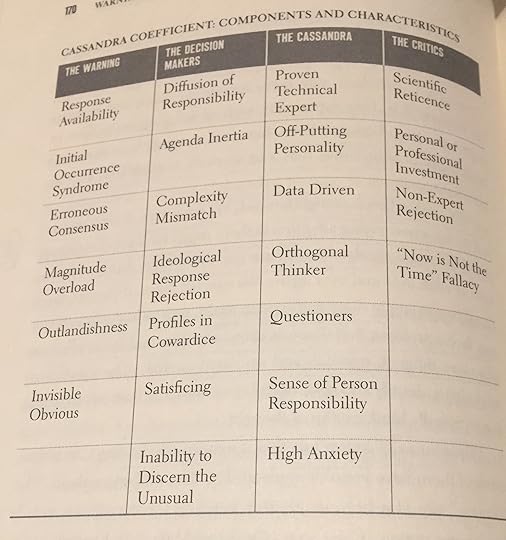
Before moving on to Current Warnings, Clarke and Eddy present their proposed mechanism for identifying contemporary Cassandras: the “Cassandra Coefficient”:

"It is a simple series of questions derived from our observation of past Cassandra Events. It involves four components: (1) the warning, the threat, or risk in question, (2) the decision makers or audience who must react, (3) the predictor or possible Cassandra, and (4) the critics who disparage or reject the warning. For each of the four components, we have several characteristics, which we have seen appear frequently in connection with past Cassandra events." (168, emphasis theirs)

The Cassandra Coefficient is by all accounts a great concept––one that I hope becomes common parlance in our discussions of how to frame the future of humanity. Clarke and Eddy put forth a rigorous set of terms that fills out the profile for each component, as shown here:

Cassandra Coefficient Grid

Grids like this might send some readers scurrying for lighter reading, but I was delighted to receive precise definitions for each component and characteristic. Unfortunately, the application of these terms in subsequent chapters proved far less robust than Clarke and Eddy led me to expect.

The best part of the Cassandra Coefficient is that it fully accepts the modern reality that humans have created and are now embedded in communal, national, and global systems that are far too complex for any one person or organization to comprehend:

"Systems can be so complex that even experts can’t see the disaster looming within. Complexity mismatch is a looming threat for government. For the first time, technologists are now building machines that make decisions with rationale that even the creators don’t fully understand. The accelerating growth of technology makes it increasingly difficult for scientists, let alone bureaucrats, to decipher the risks…Increasingly, we are operating or planning systems, software, or networks that no one person understands. It takes a team, one of many diverse talents. That team, however, is sometimes so large that it cannot be assembled in a conference room auditorium, or even in a stadium." (178-9)

Clarke and Eddy hit hard when it comes to the challenge of complexity, and yet I do not think they go far enough. I personally do not believe that any team of humans––no matter how numerous, experienced, or well-educated––can fully evaluate or analyze hypercomplex systems such as the global climate or the Internet. We will need artificial intelligence, or perhaps even artificial superintelligence, to grok these systems on our behalf (provided we can coax them into caring about us). Clarke and Eddy address AI in the Current Warnings section, but sadly do not seem to take seriously the possibility that AI may be human civilization’s only remaining route to sustained prosperity, even if that also means risking extinction.

On the whole, the Current Warnings section is less successful than Missed Warnings. The topics are: artificial intelligence, pandemic disease, seal-level rise, nuclear winter, the Internet of Everything, meteor strikes, and gene editing. These chapters are all interesting and informative, but Clarke and Eddy fail to cash in on the promise of the Cassandra Coefficient, mostly by watering it down to the point where one wonders why they bothered to flesh it out so thoroughly in the first place. The chapters end with cursory and inconsistent explanations of how the Coefficient applies to each situation. Clarke and Eddy also provide a grid showing a Low, Moderate, or High score of each of the Coefficient’s four components, but give little explanation for how those scores were reached. These casual applications belie the meticulous methodology that made the chapter introducing the Cassandra Coefficient so engaging. I was left musing about whether Clarke and Eddy ever decided what kind of book they wanted to write. Or perhaps their careful analyses were diluted by editors seeking to appeal to a wider audience. Whatever the case, the overall impact of Warnings suffers significantly.

Despite this critical failing, there are some terrific and terrifying insights here. By far the most distressing chapter is the one addressing sea-level rise, which a highly-credible Cassandra predicts will occur at a much swifter rate than most scientists are currently willing to admit. Given the world’s continued reluctance to take the climate bull by the horns in these crucial years, I find it highly probable that human civilization as we know it will not exist by 2100. Something much better than what we have now may emerge from the chaos, but we appear to be in for at least a century or two of wretched turmoil that only the very wealthiest humans will have any chance of weathering unscathed.

Clarke and Eddy are careful to eschew relinquishment as a viable method of avoiding or escaping disasters. Although some of their possible Cassandras naively posit relinquishment of modern technologies as a path forward (279), Clarke and Eddy generally come off as followers of the proactionary principle: “If we wait for only perfect and precise information, we court disaster” (234). Even if relinquishment would create a better world, this course of action is neither historically validated nor aligned with human nature. For better or worse, humanity must press on, relying on our powers of innovation, creativity, and ambition. Such striving need not be unethical, but ethics is not required for survival.

Clarke and Eddy wrap up with a plangent call for a National Warning Office, which they think ought to be run by the US government’s executive branch:

"This small, elite team should not be…part of the intelligence community, although it could task intelligence agencies to collect and analyze information. Rather, the office would have a broad, even intentionally vague, mandate to look across all departmental boundaries for new and emerging threats. The office should not address ongoing, chronic problems, such as obesity. Rather, the focus should be on possible impending disasters that are not being addressed by any part of government." (356)

Present leadership notwithstanding, this is a laudable idea. Couple this with advanced learning algorithms designed to pinpoint global weaknesses and engineer broad-ranging solutions, and we might have a much better shot at avoiding future catastrophes.

But let’s be real. Without exception, the process of obviating disasters before they occur is difficult and expensive. Today’s global leadership appears profoundly uninterested in tackling difficult and expensive problems. Even worse, the biggest beneficiaries of such action tend to be poor, vulnerable populations––those routinely ignored by elites with the power to create positive change. Warnings doesn’t leave me with much hope; rather, I now have a much clearer idea of why and how humanity’s future might reflect––or even surpass––the worst nightmares of Clarke and Eddy’s possible Cassandras.

This review was originally published on my blog, words&dirt.
Profile Image for Ruth.
530 reviews31 followers
March 20, 2020
A slightly weird time to finish reading this book, which is full of dire warnings, both past and present, about events including a flu pandemic (and a bunch of other stuff too). Not a very comforting read, especially given the emphasis the authors place on how important good leadership is. But nonetheless a very interesting book.
Profile Image for Mal Warwick.
Author 29 books489 followers
August 29, 2017
There is no lack of dire predictions about the future. Hundreds of dystopian novels, especially the flood of books in that genre for young adults, have portrayed innumerable variations on future catastrophes. I became so intrigued about all this attention to a possible dystopian future that I wrote a book about it. It's called Hell on Earth: What we can learn from dystopian fiction. Now I've found someone far better positioned to assess the likelihood that some of those dystopian scenarios might come to pass: Richard A. Clarke. In collaboration with his colleague R. P. Eddy, the former U.S. counterterrorism czar under three presidents has written Warnings: Finding Cassandras to Stop Catastrophes. This is a deadly serious inquiry into the reality underlying predictions of a killer pandemic, sudden massive sea rise, a devastating meteor strike, runaway artificial intelligence, and other chilling possibilities.

Accurate predictions of a dystopian future

In Warnings, Clarke and Eddy dive deeply into the expert predictions of scientists, engineers, and journalists who have stuck their necks out, often against enormous resistance, to warn the U.S. cassandra about seemingly unthinkable possibilities. They call these stubborn and courageous individuals Cassandras (after the princess of Troy in Greek mythology whose accurate predictions of disaster were forever doomed to be ignored). However, in every case, Clarke and Eddy's Cassandras have been anything but ignored—although some have labored for decades to be heard.

Warnings is not simply a study of the brave people who have risked their careers to make exceedingly unpopular predictions based on their expertise. The authors have undertaken to analyze the factors common to most Cassandras, deriving a "Cassandra Coefficient" based on four critical components: the character of the threat or risk itself and how it is received; the expertise and personality of the would-be Cassandras; the extent and character of resistance from the Cassandra's critics; and the receptiveness of the decision makers they hope to influence.

Eight "Cassandras" who were ignored

In the book's first part, "Missed Warnings," Clarke and Eddy relate the stories of eight Cassandras whose predictions were ignored. Included are the military analyst who predicted Saddam Hussein's invasion of Kuwait in time for it to have been prevented; the meteorologist who warned about the certainty of massive hurricane damage to New Orleans before Katrina; the seismologist who is even today pleading with authorities to mitigate the damage of the catastrophic earthquake that is certain to strike the U.S. Northwest; and others. It's a sobering account.

Will these later Cassandras be ignored, too?

The second part of the book, "Current Warnings," portrays the efforts of seven people who today are clamoring to be heard about the danger of such potential catastrophes as a massive meteor strike, a devastating pandemic, and runaway genetic engineering, among others. Each is a grim cautionary tale. In each chapter, the authors report on their interviews with the experts they portray as Cassandras. If you're prone to worry, these accounts may keep you up at night. Every one of the threats related in these chapters has the potential to yield a dystopian future.

Richard A. Clarke served as counterterrorism czar under Presidents George H. W. Bush, Bill Clinton, and George W. Bush. Following his departure from the White House in 2003, he gained widespread attention nationally with his harsh criticism of the Bush Administration's response to 9/11. He is the author of five nonfiction books and four novels.
Profile Image for Dan Graser.
Author 4 books121 followers
July 5, 2017
This new work from Richard A. Clarke and R.P. Eddy is so far the biggest surprise of 2017. Written with great passion, clarity, and erudition, the book succeeds on several levels and avoids the many pitfalls that could accompany a book dealing with the issues presented.

Richard Clarke, whose experience includes work in the State Department under Reagan through his days on the National Security Council of Presidents Clinton and Bush, and R.P. Eddy, who served as Director of the National Security Council but is perhaps more known for his work as CEO of Ergo, have use the myth of the Trojan Kassandra. Blessed by Apollo with the gift of seeing the future but cursed to the fate that no one would believe her, the authors take half of the book to explain several of the more important "Cassandras" of recent memory, most of whom were viewed more as "Chicken Littles" or mere alarmists constantly warning that the sky is falling.

In a central chapter, the authors lay out several guidelines, based in their historical analysis, to identify likely current and future Cassandras dealing with what they claim are some of the more important scenarios/emergencies of our time. This analysis is practical and well-supported, even if it paints with a pretty broad brush.

The last half of the work deals with these current Cassandras and the issues here are fascinating and likely well-familiar to you already. What makes them interesting beyond the daily pundit/news discussions you may have already heard is the highlighting of the most important figures in these fields (based on qualification, not on frequency of airtime) and being quite honest with what is, that they see at least, the most dire consequences of inattention and inaction.

Clarke and Eddy are fantastic guides through this huge range of topics and their subsequent recommendations moving forward are level-headed précis to future engagement with these topics. These topics included AI, manufactured Pandemic Disease, Sea-Level Rise, and Gene Editing. Highly Recommended!
Profile Image for Paul.
207 reviews4 followers
May 15, 2019
Excellent book. It looks at past disasters (Kuwait, Katrina, Isis, Fukushima, Bernie Madoff's Ponzi, Mine fires, and the 2008 recession), and the people who predicted them. Then it looks at possible future disasters (AI, epidemics, sea level rise, nuclear winter, the Internet of everything, meteors, and gene editing). The author's idea is: how do we find the future predictors? The science here is not to hard to follow, and the chapter on how the Internet of Things relates to industrial & utility control systems is truth.

We don't know what the future will bring, and this is not a zombie apocalypse type of book. But it gives good food for thought on how we might survive through the next 100 years or so.
Profile Image for Kate.
70 reviews21 followers
Read
January 1, 2022
wow!!! Do NOT read this book if you are prone to existential crises or are the type of person who will not watch the news because "they talk about too many bad things." This is just a book full of all the bad things, folks! Clarke and Eddy spend the first half of the book exploring catastrophes that were warned about, ignored, and then happened. The second half of the book explores problems that people are now warning about but have not yet happened: AI, gene editing, meteors, nuclear war, etc. So, not exactly a warm and cheery book, but a super important one nonetheless.
1 review
June 23, 2017
I spent most of the last 2 days reading this book and I can't stop thinking about it. I never heard of the author until I saw his book hit Amazon's top book list and decided to give it a try. The book is well-written and has insight from a plethora of credible sources. I felt that this book shed light on the many cassandras that exist in our modern world which I previously was not aware of, and most importantly the way in which a credible Cassandra can be determined.
1 review
June 23, 2017
A quick read that allowed me to reflect on recent disasters and ask the question, "could this have been avoided, or at least alleviated in some way". This book provides excellent advice from some world-class people that have done their research and lived through these catastrophes. We need more problem solvers like this in our world. Great read, can't wait to see what surprises these two authors have to offer their readers next!
Profile Image for Tom Hill.
465 reviews13 followers
June 7, 2017
I had high hopes for this book but unfortunately, the Cassandra in me forces me to warn you to stay away. Normally I would give a book like this 2 stars because I would learn at least a few things I did not know before. But Clarke and Eddy seem to have the same solution to every one of the so called catastrophes they review, which downgrades them to a one star. That is, the Federal Government needs to spend billions more of our tax dollars getting us prepared. Except Climate Change, just initiate a very high carbon tax then fossil fuels will disappear and nirvana will be achieved. They ignore a very real problem that is very likely to cause a major disruption in our lives long before the oceans start lapping at our toes. That would be our massive Federal Debt. You don't have to look very hard to find many Cassandras that have real data that shows what we are doing is unsustainable. Maybe this catastrophe was not included because their favorite solution would not work.
Profile Image for Candace.
36 reviews
October 29, 2019
I like ANOVA and linear regression, but there are just too many variables here to accurately predict large catastrophes as mentioned in this book.
Profile Image for Richard Guha.
52 reviews1 follower
December 25, 2020
This is a stunning book. It shows why well thought through, data-supported warnings, from credible experts, are often ignored. I also outlines a number if issues that governments and others in a position to act, have been waned about. It then discusses why little or nothing is being done on these existential issues.
Profile Image for Stephen.
528 reviews23 followers
November 17, 2020
I came to this book thinking about not how good it might be, but how useful it might be. I have to say that I did find it useful to a degree. The book starts with missed warnings. They are quite easy to find. There is an absolute cacophony of noise warning us all of all sorts of dire futures. Finding these is not the difficult part. The difficult part is sifting the signal from the noise, and that's what I wanted this book to help me with.

What I am far more interested in is a model by which we can appraise the noise and filter it to find the signals. The model is provided in Chapter 9, which is a distillation of the lessons learned from the warnings missed in the preceding eight chapters. I found the model to be useful. It's a useful starting point rather than the finished product. However, we ought not to understate it's importance.

The authors are a little too data heavy for my liking, and a little too judgement light. What this means is that we are often dealing with possible events that have either not happened before or which have happened s far in the past that they are outside all living memory. Using that definition, there can be no data about those events. There may be historical examples, there may be weak signals of an emergent future, but data about the events is sparse. This means that we have to rely more on judgement, and what interests me is how we get to that judgement.

To a degree, the study of trends can help us on this. We can cobble together bits and pieces of circumstantial evidence, but progress is more in the nature of detective work than data collection. In order to appraise that evidence, we will need some form of model to inform us about how we expect things to turn out. The process of modelling is more intuitive than computational. This is why I am uneasy about the over-reliance upon data feeds in this process.

The second half of the book puts the author's model to the test. I have to say that the authors have compiled an unimpressive list of cases. The pandemic case is well made, but that's just one out of seven. One could argue that a pandemic is nothing of a surprise at all and that governments around the world were surprisingly well prepared when COVID19 broke out. In many respects, this warning had been heeded and ought not to have been included in this book. The book is about warnings given and not heeded.

I can see why many readers are unsatisfied by this book. However, I think that they are expecting too much. From my perspective, I was hoping for a model and I got one. I was hoping for the application of the model. Although I received this, I found it to be a bit thin. Most importantly, I was looking for some ideas to feed into some work we are undertaking on wild card scenarios, and I think that I have enough to keep me happy.

The book isn't particularly well written, but does benefit from being written in a journalistic - as opposed to academic - style. It's easy to read, the cases are well made, even if they are not entirely convincing. In all, I found it to be a useful book.


Profile Image for Evan.
784 reviews14 followers
November 5, 2018
Unfortunately, I bought this book before I heard an interview with one of the authors - R.P. Eddy. Fortunately, I got the book from an Amazon special for $1.99! Anyway, in the interview, I learned that Eddy is quite arrogant and condescending (as in, why are so many people so stupid that they can't see what is obvious to someone as smart and as knowledgeable as myself).

The stories are interesting and engaging. However, as I read, I kept thinking, it seems like survivorship bias. Yeah, it is clear there were cassandras once an event occurred, but how many other people made predictions that were wrong? I was listening to an interview with Rodney Brooks (artificial intelligence expert at MIT), and he says people ask him all the time how he missed the impact of deep neural networks when the networks emerged in the 80's. His reply is that there were a 100 technologies that emerged, and 99 of them failed, so how was he supposed to know deep neural networks would work.

Which gets into the problem about knowing which cassandras to believe. Clarke and Eddy say it is easy because the cassandra will have strong credentials and be an expert in their field... Lucky for us, experts in their field are never wrong...

Don't waste your time with this book. I'll admit the initial stories were very interesting, but their framework is suspect and if you are interested in any of their dooms day scenarios, you can get better information elsewhere.
Profile Image for Gilda Felt.
737 reviews11 followers
August 16, 2018
I’m very much of two minds about this book. While I agree with the authors regarding how often warnings are ignored–they’re not called Cassandras for nothing–I’m not sure that our government, probably not any government, will follow their advise regarding what to do about future warnings.

Even though many examples are given of when warnings were ignored, humans tend to disregard anything that’s not immediate, especially if a loss of money is involved. I don’t see that changing anytime soon, so I think we will continue to ignore warnings, focusing too much on when the warnings proved false, as if one negated the other.

Will this book change any minds? Will something be done about future catastrophes before they happen? Going by how climate change is being handled, I heartily doubt it.


77 reviews
July 3, 2017
Worth reading. The first part, a series of what-if-we-had-listened pieces, gave me a good case of nostalgia for what might have been. The next part, a series of seven warnings by high-credibility scientists and engineers, gave me a good case of the jitters. The third part, a how-to-listen-for-warnings prescription utterly failed to give me any hope, but that may just be my own pessimism and the anti-science political party currently in power. So - is this book in itself the Cassandra warning for continuing to risk giving amateurs and ideologues decision-making power? I would say it's mostly an amplification of the other warnings, and valuable just for that.
Profile Image for Fred Leland.
284 reviews20 followers
January 16, 2018
Outstanding case studies on evolving threats

A great book if case studies in evolving threats manmade and natural. The books about those people who recognize the signs and signals form an orientation report what they believe only to fall on deaf ears. It also discusses the right ethos to develop in an effort for those charges with watching for and evaluations threats to observe orient decide and act in an effort to prevent disaster.
11 reviews
January 30, 2021
An interesting read and strong content. Different perspective on events than we typically see in news or writing. My only issue with the book is it gets repetitive by the end. Each story Of. Cassandra has the same structure. Could have benefitted from fewer examples and more summary at the end of what we can do about the challenges ahead.
Profile Image for Shana Yates.
845 reviews16 followers
February 28, 2018
Cassandra, of Greek myth, had the gift of prophecy but the curse of never being believed. In this book, authors Clarke and Eddy turn to modern day Cassandras--those who warn of dire events but whose warnings are unheeded. The book starts with multiple chapters, each dedicated to a different catastrophe. Each catastrophe is explained, with the authors outlining the factors that made each disaster particularly harrowing, and then we are introduced to the individual or individuals who predicted the event, tried to get the powers that be to mitigate it, but were ignored. This ranges from the Madoff scandal to the Fukushima Daiichi nuclear calamity, from the rise of ISIS to the formation of Hurricane Katrina and its fallout. In each instance, the authors have interviewed the Cassandra in question, parsed the technical expertise that underpinned the predictions, and examined the impact (short and long term) of failing to take the warnings seriously.

The second half of the book looks to the future. Bridging the past predictions and future warnings is a chapter where the authors introduce their "Cassandra Coefficient." They use this coefficient to examine how likely a person making a prediction is actually a Cassandra (meaning they have the expertise and grounding to understand the potential for cataclysm and make predictions that will likely come to pass). They also build into the coefficient a number of factors, including how complex the underlying issues are, if decision makers that could avert disaster are diffuse, and whether the predictions is do novel and dire that others have trouble comprehending it or taking it seriously.

Having articulated their coefficient and the way it can be used to differentiate between a Chicken Little and a true Cassandra, they turn to six issues that may pose existential threats to humanity if they are both true and underestimated or ignored. The authors use these potentially looming threats as case studies, aping the chapter structure in the first half of the book but inserting a discussion of the Cassandra candidates' coefficients rather than a discussion of why they were right. In doing so, the authors look at the threats of AI, pandemics, rising sea levels, nuclear winter, the internet of things, meteor strike, and gene editing. These chapters not only crystallize nascent threats, but in many instances also act as overviews of cutting edge technologies and science (with the exception of pandemics, which instead reintroduces the reader to the world that used to be the norm -- where illness lurked around every corner).

Overall the book is well done. It covers a wide range of issues and has the perfect amount of detail to leave the reader well versed in past and future threats. The content is interesting though unsettling. Though some of the potetial disasters have lower probabilities in any given lifetime (meteor strike), others are either always possible and have happened before (pandemic) or are already in progress (sea level rise). This gives the reader the not unwarranted feeling that we are not doing enough and may even be too late. My biggest complaint in their book is their failure to mention or synthesize some of the work of Dan Gardner and Philip E. Tetlock (Superforecasting, 2015), which looked at predictions and made the point that experts in a field are often terrible at prediction. In their book, the examined why hedgehogs (those with deep knowledge in one area) are often unable to have the perspective needed to truly examine and weigh and measure facts and sources. Such experts often become over-invested in certain theories or practices, and that results in less accurate predictions and a failure to adapt their predictions as necessary or properly evaluate new information. In that book the authors examined how foxes (those with less in depth knowledge but a willingness to constantly question their conclusions) often were better at prediction. This cuts against one major part of the Cassandra Coefficient, which talks about ability to be a first order thinking, bringing new ideas to bear and being data driven. I wonder if some of the most effective Cassandras will not be strictly experts in a field, but those with some expertise but no pure investment in one line of thinking. Nevertheless, well worth a reader's time.

Profile Image for J.K. George.
Author 3 books17 followers
April 28, 2018
"Warnings" includes a lot to think about, and all in around 370 pages, so not too thick. The authors, both with plenty of inside experience at high levels of the US Government, present several actual disaster/error occurrences and analyze why these were not spotted and/or acted on before hand. These include Hussein's invasion of Kuwait, Hurricane Katrina and the disaster to New Orleans (they will return to that basic theme with Climate Change as a near certain ongoing threat in the making), the Fukushima Nuclear Plant destruction, Madoff's Ponzi scheme, and the market melt-down in 2008. Each had predictors. None were acted on in advance to prevent the serious effects.

As you might expect, additional (ongoing) threats are covered, although none has exploded into disaster status ... yet. These include the runaway of Artificial Intelligence, pandemic diseases, sea-level rises ... slow and fast, a meteor strike, the impact of a nuclear war (nuclear winter), and gene (DNA) editing.

Others such as affects and widespread chaos from hacking into everything from power grids to our refrigerators and automobiles are covered, and this could be the single most likely thing to challenge society in our lifetime, to some degree or other.

He does not cover the eruption of the Super-Caldera at Yellowstone, which will, according to historical data, occur sometime in the next zero to one-hundred thousand years, but the book includes plenty of things to keep one up at night ... for sure!

It's easy to gloss over with the data, but the most chilling subject to me, and one that will impact humanity within a person's lifespan, is the impact of gene splitting with the CRISPR technology. It's possible now to "edit" a human's DNA in order to select eye and hair color, skin color, and height. Future directions could result in an "IQ enhancement" decision to move people on the smartest tier, and/or to select a "warrior class." it doesn't get too far-fetched to imagine a future society of super-humans of striking physical appearance directing military groups who are genetic Avengers of sorts. Is this a science-fiction? Yes, at present, but come back in one hundred years and check on what you see. It's genetically possible. Will it be prevented on ethical or moral grounds?

The authors deal with some headline and reality TV show subjects, but everything is possible, if not probable under some circumstances. There are some "slog" or slow parts of the book, but plenty or red meat as well. Read and decide for yourself.
Profile Image for Max Nova.
421 reviews243 followers
August 27, 2017
"Warnings" asks the most important question of our time: "when it comes to predicting disasters, who should we trust?" Unfortunately, Clarke and Eddy's answer is vague and untenable. One of their four key recommendations is to build a system to "sift the credible from the dubious, separating the signal from the noise." Sounds great, but how should we do that? They recommend:
Knowing when the data is rich and extensive enough to trust it and when it is too scant is difficult. If data is in short supply, don’t worry about probability... Instead, focus on possibility. Is it possible? Could it happen?

But this is rather shabby advice - an infinite number of disasters are possible. So we're left with no way to narrow down our focus and we're right back to where we started. So while the premise of the book is excellent, I'm forced to give this book a 3/5 because it offers an obviously non-viable solution.

There are many redeeming elements of the book though - particularly some of the case studies: "artificial intelligence, genetic engineering, sea level rise, pandemic disease, a new risk of nuclear winter, the Internet of Things, and asteroid impacts." The background on the CitiGroup and Madoff financial shennanigans were particularly interesting. And Paul Ehrlich gets called out once again for being a false Cassandra with his "Population Bomb."

Yet I found nothing novel in the authors' philosophy of complexity/prediction. They trot out the obligatory Tetlock paper and briefly discuss Isaiah Berlin's hedgehogs and foxes. Their most interesting Cassandra factor is "Scientific Reticence, a reluctance to make a judgment in the absence of perfect and complete data" - but they don't offer any reasonable alternative for making decisions in those scenarios. They pull in a quote from Michael Crichton (from his "Climate of Fear" phase) about the danger of "consensus" in science, but again, their framework offers nothing to guide our path in these situations. They did reference Harvard's Neustadt on the 1976 swine flu overreaction - his claim that the erroneous prediction was a result of "the expert community [having] a vested interest in strengthening the public health and vaccine system" is particularly noteworthy in our current state of climate hysteria.

I'll end this review with my favorite chapter epigraph:
One man with the truth constitutes a majority. —SAINT MAXIMUS THE CONFESSOR


Full review and highlights at http://books.max-nova.com/warnings/
Profile Image for Bryan Ney.
Author 3 books9 followers
July 23, 2017
I read this book to obtain insight into the politics of climate change. I found it to be a fascinating presentation of past crises, as well as future threats. The author presents a framework for thinking of the societal inertia that is common to both past and future threats, and in this I am reminded of the freakonomics books. The writing is more wonkish, but I found the author convincing in showing that common concepts ran through each chapter: Initial Occurrence Syndrome, availability bias, institutional satisficing, scientific reticence, diffusion of responsibility, and others.
I was reminded of Malcolm Gladwell's books as I read the historical part of the book (roughly the first half). I find Gladwell's style more engaging, but still the personalities of the Cassandra's come across the page well in "Warnings." I learned much of interest about the individuals who warned of the invasion of Kuwait, Katrina, Fukushima, the Madoff scam, and the 2008 stock market crash.

The author presents something he calls the "Cassandra Coefficient" as a unifying analysis of the future dangers we face. I find this lacking, but it is a minor part of the book. My problem with the coefficient is that it elevates several POTENTIAL problems to almost the same level as climate change. I learned much about these potential problems: artificial intelligence run amok, Pandemic disease, nuclear winter, the internet of everything, a meteor strike, and gene editing. In contrast to climate change, I see nuclear winter and a meteor strike as things that could wipe out humanity, but for which there is no obvious action humanity should take. I see the other issues presented as similar to the warnings of Malthus, who long ago presented that the earth's logarithmic population growth would outstrip arithmetic food supply growth. I see similarly, for several of the potential problems presented in "Warnings," that solutions might grow as fast as the problem. At present, regarding climate change, our solutions do not seem to be keeping up with the problem.
So overall, this will be one of the books that I bring up in conversation with friends as an important read, but I am a little dismayed at what I see as a false equivalency presented of climate change to a number of potential problems.
Profile Image for Vito.
Author 3 books9 followers
August 27, 2017
This book is an examination on two fronts: who were the Cassandras of some of our great catastrophes that could have been prevented and then moves into an examination of today's potential Cassandras.

Between these two sections is a chapter on what they've coined, "The Cassandra Coefficient." It's a formula they came up with based on previous Cassandras to apply to people today on whether they're an actual Cassandra or just a raving lunatic. They never flat out tell you, "Yes, this person is a Cassandra."

Instead, they leave it up to you to decide.

I rather enjoyed part one because it was fascinating to hear about the people who were absolutely correct and largely ignored. It kind of pisses you off in a way. The catastrophes ranged from the Challenger spaceship blowing up to the Fukushima meltdown, the cause of the Gulf War and the 2008 economic crisis.

What I appreciated most is how quickly those chapters moved. There was no need to belabour the point — they happened and we didn't prevent them. Here's who called it. Next.

Part two is where my interest peaked and waned.

I was very much interested in the upcoming crises experts are predicting and definitely wanted to hear what they had to say . My only issue is where the first half moved quickly, this part dragged on a little too much for me.

I get each one of those chapters could be an entire book in themselves (and in some cases, they are), but it ruined the flow as a narrative.

That aside, it's definitely worth picking up and reading to help you get a handle on what's happening today... and for our future.
Profile Image for Peter House.
46 reviews5 followers
August 20, 2017
Simultaneously an enjoyable and hard book to read, Warnings: Finding Cassandras to Stop Catastrophes, starts out with real stories ranging from the run up to the first Iraq War on to the West Virginia mine incident.

The books has three sections - the first recounts missed warnings like ones listed above. There's a brief interlude where the authors present a rubric for sifting through warnings.

The final section, the hardest, surveys a number of modern threats. The Internet of Things (already here, suckers), DNA editing using CRISPR/Cas9, and rising sea levels are just a few entries in the survey.

The final section of the book is the hardest to read because while I'm dropping my kids off to school and attending to my affairs, the expanding scope of impact at the very edge of our knowledge and ethical restraints (something we obviously have issues with - see current issues with neo-Nazis in America) has the potential to alter or end our lives.

The book aligns with many values I have, a desire to adhere strictly to data and interpret it as honestly as possible and a desire to achieve a form of "gritty optimism". In that regard, the book was an enjoyable read.
Profile Image for CHAD FOSTER.
178 reviews6 followers
January 9, 2018
This book has one of the most interesting and original premises that I’ve ever seen. The authors explore why “Cassandras” - those unique individuals who recognize emerging threats when those around them do not - are so often ignored.

The authors use multiple case studies to illustrate their argument in building the book’s most original contribution: the so-called “Cassandra Coefficient.” This concept lists four situational components and specific associated characteristics for each that can assist leaders and organizations in identifying if they are dealing with a possible “Cassandra Moment.” Of course, as others have pointed out, I wonder how much effort was put into identifying cases that might contradict the authors’ conclusions. The research smells a little like cherry-picking.

Overall, it’s quite an interesting book that proposes a relatively simple and easy to understand framework for understanding the problem. Enjoyable and a quick read.
189 reviews
July 16, 2017
This is a fascinating, scary, informational, educational book! I'm glad I read it. It did not frighten me as much as I had feared but it certainly informed me more than I had expected.
First half of book is about missed Cassandra warnings from Katrina to Madoff and Fukashima. The Cassandras are unexpected persons. It reminded me that there were enough warnings about 9/11 too; but they were from the "wrong" people ie Not Important People and thus ignored by those who believed themselves More Important or Very Important etc.
The second half of the book is about current Cassandras spreading warnings of oncoming catastrophes and also being ignored. It explores why they are being ignored. Again, they aren't just quite the right kind of people.... We ignore them at our peril. But we seem to be in so much peril these days; I guess it doesn't much matter WHAT kills us. Or who.
Profile Image for Mlg.
1,259 reviews20 followers
August 10, 2017
The authors first explore a number of well-known disasters and discuss the Cassandra's that predicted them. A Cassandra is usually someone with highly technical knowledge or specialty in a specific area. Most of them are not well-know, but they have predicted the Challenger disaster, the problems in the Syrian conflict, the invasion of Kuwait, Hurricane Katrina, Fukushima, Bernie Madoff, the Big Branch Coal Mine Disaster and the 2008 Recession.

The authors show what commonalities each event includes and how to spot a Cassandra. Far more interesting were the warnings about the future of events that haven't happened yet. Without giving them away, let's just say they will keep you up at night and scare the heck out of you.
Displaying 1 - 30 of 77 reviews

Can't find what you're looking for?

Get help and learn more about the design.