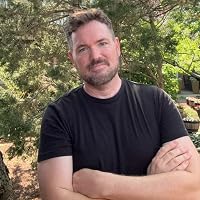
Optic Subwoof is a collection of talks that poet and National Book Award finalist Douglas Kearney presented for the Bagley Wright Lecture Series in 2020 and 2021.
As kinetic on the page as they are in person, these lectures offer an urgent critique of the intersections between violence and entertainment, interrogating the ways in which poetry, humor, visual art, music, pop culture, and performance alternately uphold and subvert this violence. With genius precision and an avant-garde sensibility, Kearney examines the nuances around Black visibility and its aestheticization. In myriad ways, Optic Subwoof is a book that establishes Kearney as one of the most dynamic writers and thinkers of the twenty-first century.
Douglas Kearney is an American poet and librettist. Kearney grew up in Altadena, California.
Kearney attended Howard University as an undergraduate. He also graduated from California Institute of the Arts, with an MFA. His work has appeared in Callaloo, Nocturnes, Jubilat, Gulf Coast.
Part presentation, part poetry, be thrown in the pool and follow me, showing by doing not telling--this series of lectures is not an easy read, best enjoyed by going with its flow and taking time. The lectures are akin to transcripts, giving the sense of being in the room with the audience. Presentation takes a conspicuous role as tool and subject at once. A Q&A from one of the lectures--included as an epilogue to the book--serves as a brilliant summary of all that has gone before. The lectures raise questions of performance on the page and off, especially if the author/reader is Black. Implicitly and explicitly, they address subtexts of expectations and conventions; what's in the room but not on the page; comfort and discomfort, and whose; the myth of catharsis; form vs structure, and much more. And of course, there are parallels drawn to music/sound technique as the title suggests (some ingenious synesthesia that!). I was especially intrigued by #WereWolfGoals and its fantastic analysis of positionality. I love how the different lectures build on each other and expand. As I said, go with the flow and enjoy the ride, and get ready to come back for more.
In these lectures, Kearney continues to employ his remarkable intellectual acrobatics to flip between topics: potential violences of collage, werewolves, the use of the body in readings, audience complicity. He brings in the words and thoughts of Tisa Bryant, Layli Long Soldier, Dawn Lundy Martin, Roland Barthes, Robin Coste Lewis, Solmaz Sharif, and many other luminaries in order to consider the complications of writing, form, identity, performance, and their multitudinous costs. This book is an incredible resource for any writer who attempts to understand the images and ideas that plague them, consider the importance of how their projects fit in the larger world around them—and impacts *them* in the process.
1. I will for now until the day I die write folks the way he does > folx.
2. This book is not for everyone.
3. I had no clue what a librettist was until I read this book.
4. I wouldn’t call it prose poetry or stream of consciousness. It’s very structured and intentional in every way. It’s truly a special form he’s writing.
Douglas jumps from Nina Simone to Michael Jackson to werewolves to the Asian Spa Massacre to Emmett Till to reading poetry in public. Needless to say, one can get lost.
But for the wondering mind, it brought me peace 🧘♀️
Music as it relates to poetry as it relates to collage as an art form as it relates to spoken word poetry and what happens when a poem is essentially not read-aloud-able? As it all relates to Blackness and being silenced versus wanting to be silent versus the expectation of performance and prostituting one's body and one's own experience for the enjoyment of others. There is just so, so, so much in these essays, you just have to read them yourself. I know I will read this multiple times and get something different from it each time.
Lectures on personal poetics and presenting poetry by possibly the most unique visual stylist and performer on the planet. For years I've "read" his poems and wondered How or WTF? Finally, here's the answer.
It was okay but not for me. Some interesting discussions about poetry especially how to utilize the visual form but I think that’s about all I will remember from this book.