Prolific even by eighteenth-century standards, Eliza Haywood was the author of more than eighty titles, including short fiction, novels, periodicals, plays, poetry, and a political pamphlet for which she was briefly jailed. From her early successes (most notably Love in Excess ) to later novels such as Betsy Thoughtless (her best known work) she remained widely read, yet sneered at as a ‘stupid, infamous, scribbling woman’ by the likes of Swift and Pope. Betsy Thoughtless is the story of the slow metamorphosis of the heroine from thoughtless coquette to thoughtful wife. Ironically, the most decisive moment in this development may be when Betsy decides to leave her emotionally abusive and financially punishing husband; it is only after experiencing independence that she returns to her marriage and to what becomes her husbands deathbed. Betsy Thoughtless may be the first real novel of female development in English. In this edition the text is accompanied by appendices, including writings from the period that shed light on Haywood’s life and work, and on her relationship with contemporaries such as Henry Fielding.
Eliza Haywood (1693 – 1756), born Elizabeth Fowler, was an English writer, actress and publisher. Since the 1980s, Eliza Haywood’s literary works have been gaining in recognition and interest. Described as “prolific even by the standards of a prolific age” (Blouch, intro 7), Haywood wrote and published over seventy works during her lifetime including fiction, drama, translations, poetry, conduct literature and periodicals. Haywood is a significant figure of the 18th century as one of the important founders of the novel in English. Today she is studied primarily as a novelist.
I love when people assume that any novel that was a bestseller in Jane Austen's time must have been quaint and adorable. That's when I get to tell them about all the prostitution and seduction and attempted abortions and attempted date-rape and out-of-wedlock babies.
True, Miss Betsy Thoughtless was a little before Austen's time – it was published in 1751, and Austen was born in 1775. But Eliza Haywood was widely known and eagerly read by Austen's contemporaries. I even found traces of her influence in the humorous writing Austen did as a teenager. (Stop me now, or I'll nerd out all over the place.)
I think one reason Betsy Thoughtless was so popular is that the female characters are completely human. Sure, they talk funny. But they like it when guys buy them gifts and talk about how hot they are. (Note to the curious: A pet squirrel was the kind of present that would move you up to the top of the list when it came to Guys The Girls Want At Their Next Party. Fer realz.) These women don't want to get married right away, because partying and flirting all night is fine if you're a single woman but What A Ho territory once you have a husband.
Don't get me wrong – Eliza Haywood wanted to teach her female readers some strong moral lessons. Eighteenth-century women really did have to be careful how far they went with a guy, because ruining your reputation meant ruining your shot at a respectable marriage and you couldn't just decide, what the heck, you'll go back to college and take charge of your own life. Career options were horribly limited. Being a single woman meant, at best, being looked down upon socially. And (as Austen herself said and knew from experience) single women in those times had a dreadful propensity to be poor.
And if you think single mothers have it rough now, try being one in eighteenth-century England.
But reading Eliza Haywood is very different from reading Samuel Richardson's Pamela, another popular novel of the time. Pamela has no discernible carnal desires, and only has to defend her virginity from those who would try to steal it from her – there's no way she'd give it away before her wedding night. She'd never feel the slightest temptation to do so. Sex? Fun? Only if you're a guy.
Eliza Haywood knew that women were just as tempted as men were to live, um, unchastely. Especially when a sophisticated French guy who knows how to please a lady comes along. In Pamela, he would have gotten his way only by forcing it. In Miss Betsy Thoughtless, Betsy listens with horror as her friend describes being seduced because being seduced is fun:
"In a word, my dear Miss Betsy, from one liberty he proceeded to another; till, at last, there was nothing left for him to ask, or me to grant!"
In Pamela's universe, this would have been a one-time Fall From Grace, and probably a fatal one. In Betsy's, her friend (the aptly named Miss Forward) has an affair with the guy all summer, and only stops, regretfully, when he leaves town.
I'm not recommending that anyone who doesn't love or live in the eighteenth century run out and grab this book. I read it as part of my research for a Regency novel. I'm the kind of person who reads Austen for fun, and even I found this a bit of a slog at times. The plot moves along briskly enough, but the language is a bit dense.
Just know that this time period wasn't all tea parties and ladylike behavior.
Other reviewers have commented that those who like Austen will like BETSY THOUGHTLESS. For me, what was so interesting was to think about how DIFFERENT this book is from Austen, particularly regarding gender roles and discussions of sex. Written in 1751, a time before domestic ideology became the dominant cultural code, BETSY THOUGHTLESS is far more open about discussing sex, pregnancy, adultery, and desire than Austen was -- Betsy's brother has a mistress; Betsy's friend gets pregnant and has a baby, and Betsy forgives her; Betsy's true love has casual sex with a woman after he is disappointed by Betsy's rudeness to him, and we're not supposed to think him contemptuous for such an action. Betsy herself worries at one point that if she lets her love escort her home, she won't be able to contain her desire for him. Fascinating!
This rates between a 3 and a 5, so I'll settle comfortably on a 4. (Judging it based on its 18th C value, it's definitely 5. Has it held its value overall: definitely 3).
Having been a fan of Fielding and Richardson, I came to this with extra delight -- I confess that both Fielding and Richardson fell somewhat in my estimation with Haywood's novel in my hands. I found the novel to be a refreshing and honest view of the 18th century social dance, with a forthrightness that is not found in male writers of the era. (Go figure!)
Notwithstanding its candour, humour and charm, I found my mind wandering at times as Betsy engages in the circular soap-operaesque (is that a word? If not, should be.) behaviour that can drive a person insane. Too much meandering, and too much repetition for my taste.
In terms of having kept its intrinsic value over time, as a novel of social mores, I can only judge for myself and say "no". Whereas I delight in re-reading any, and all, of Austen, for instance, and find a new delight in each one of her novels every time, I would not say the same of Haywood.
Assessment: I enjoyed the experience but see no need to repeat it.
honestly i wasn't expecting this to be this spicy omg, i really liked it i liked the writing and the fact that it didn't bore me to death, it kept me pumped. the characters were really cool and really well made and the plot was well developed. i loved getting to know Betsy and seeing a female figure different from the rest that i read about. i loved how she stood up for herself and her rights, she is really insipiring.
One of the writers who was instrumental in developing the novel as an artform, Eliza Fowler Haywood was widely-read in her day, even though she is barely known now. She influenced many writers who came after her, like Jane Austen and Fanny Burney, who built upon the work that Haywood had begun in her novels about young unmarried women and the dangers of courtship. It is certain that without Haywood, Jane Austen, and all of the novels that followed her, would not exist.
Modern readers, however, will probably find that Haywood's work more closely resembles a writer of a much later vintage than Jane Austen - the founder of the Regency romance genre, Georgette Heyer. It's clear from reading The History of Miss Betsy Thoughtless, that Heyer read and admired Haywood's work. And even though Heyer's novels are set some 60 years after this one, and written for a 20th century audience, they borrow many of the plot points, the character archetypes, the scenery, and the language of Haywood's work (and dial them up to 11).
It's not hard to see why Haywood's work was so popular and influential. Miss Betsy Thoughtless is positively addictive, despite (or perhaps because of) its high-flown language, its broadly-drawn caricatures, and its all too convenient deus ex machina plotlines. The plot is simultaneously expected and unpredictable; the main character is as captivating as she is infuriating; and the scenes of 18th century London spring off the page with a vibrancy that few authors of the era can match.
Miss Betsy is a young aristocratic woman of 15 when the novel opens, who moves from the sheltered world of a girl's boarding school to the dangerous and exciting world of London. She shares the curse/blessing that many heroines of modern young-adult novels have - she is very beautiful and witty, and just about every man who sees her falls in love (or lust) with her.
Being 15, she's bewitched by all the attention, and it quickly turns her into a rather vain and rather mean person. She strings along multiple suitors, all of whom have ridiculous names straight out of 18th century plays - Mr Staple, Lord Fineer, Mr Munden (Mundane) and Mr Trueworth. Her desirability also repeatedly puts her in danger of having her virginity violated (in 18th century London, it seems, there is a rapist around every corner).
Haywood has a great way with words (although her sentences can be a bit labyrinthine to modern readers), and has fun skewering the pretensions of the age, especially the fake and over-the-top language of courtship. Her book is a kind of educational manual for wealthy young women, teaching them, through Betsy's adventures, all the dangers that will face them when they go to choose a husband. It lightens moral instruction with comedy though, so it never feels too heavy, even to a modern reader with very different ideas about honour, virtue, and reputation. She uses the men in the story, both suitors and secondaries, to look at different styles of courtship, and how different men are likely to behave once married. She warns her readers to watch out for lies (especially lies about fortune and rank), and examines, through her secondary female characters, the fate that awaits young women who don't guard their virginity or their reputation. It's not enough in the 1750s to be virtuous, you must also give the appearance of virtue to the gossiping tongues of the world - your fortune and your family's fortune depends on it.
There's something slyly feminist about Haywood's story. Throughout the first three volumes, Betsy has zero desire to marry. She's fifteen! She loves parties, and balls, and going to plays and operas, and listening to boys tell her how pretty she is. Even when she meets a man worth marrying, she still doesn't want to marry. Why would she? Life is pretty great. She even gets to move out and live on her own for a while.
But after one particularly harrowing adventure in the third volume, her family convinces her the only way to be safe is to marry. And, taking a leaf from Anne Eliott's book, she is a bit too persuadable. The fourth and final volume of the book is taken up with her marriage. This is where the story drops some of its exaggerated theatricality and becomes a bit more realistic. Betsy's marriage is unhappy, and I wouldn't be surprised if some of her struggles mirror things Haywood experienced in her own life.
During this final phase of the book, we see something that hadn't happened in English literature before - a woman growing as a person. In previous stories, women pretty much remained as they were, virtuous or villainous, for the entirety of the novel. They were cardboard cut-outs for men to act against, not people in their own right. In Miss Betsy Thoughtless, Betsy is allowed to be imperfect, and then she is allowed to grow. She loses her thoughtlessness and vanity, and grows into a mature, compassionate, and wise woman. This is so obvious an idea now, but at the time it was revolutionary. Before this, in literature, only men grew. Women's characters were fixed. Thank god for Eliza Fowler Haywood - imagine how boring books would be if this were still the case.
Haywood also takes this opportunity to instruct young women on exactly how much crap to tolerate from their husbands (quite a bit) and how to act when their husbands treat them badly (be clever, prudent, and make sure you're always in the right). There are some all-too-convenient plot contrivances, and the story gets a bit mawkish towards the end, but Haywood manages to keep on just the right side of cloying, with some beautifully written letters and speeches that are more romantic than anything that comes before them, and prove that Haywood is a brilliant writer when she wants to be.
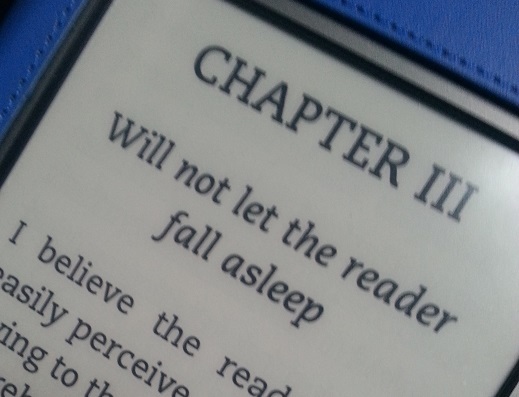
There's really so much to this novel that I think I'll be picking it apart for months to come, and I can imagine I'll learn something new every time I re-read it. If nothing else, it's a fascinating insight into the world of the 1750s, more illuminating than anything else I've read from that era. And I love, love, love the descriptions at the beginning of each chapter, which are less summaries of the plot than entreaties to the reader to keep reading. This is maybe my favourite:
Wow. There are very few novels above the length of 600 pages that I would take the time to read carefully, especially considering the fact that I'm an extremely slow reader and picky with prose style, but Eliza Haywood's "Betsy Thoughtless" is one of them. This was such an utterly fantastic story - with such fully fleshed out characters and plots - that I don't quite have the words to describe it. It was definitely an entertaining and emotional experience - it had almost everything that I love about Romanticism in it, and it's one of those few books that I feel has made me a better writer simply from reading it.
Haywood is clearly a master not only at omniscient viewpoints, but also at sub-plots stuffed under sub-plots. She has a unique way of telling an extremely long tale but still making each page engaging to the reader. But like I said, what I connected with the most here were the characters - to the point where I'm sad that I won't be reading about them anymore; as I really enjoyed their journeys and developments throughout. Lastly, I'll simply say that I don't think the comparison to Jane Austen is necessarily the greatest - I think Haywood exceeds Austen's writing in every way, but that's just my personal bias showing through. "The History of Miss Betsy Thoughtless" was pretty much everything that I love about 18th & 19th century literature - it's unfortunate that the title (and the broadview cover) might deter people from reading it; as it really is an amazing story. I really enjoyed this book & am looking forward to reading more of Haywood in the future.
This book was so wild. It was like Pride and Prejudice meets Persuasion on steroids. I would love to see this adapted as a mini-series starring Mindy Kaling.
Since I don't really imagine people coming to this book not knowing a bit about Haywood or this particular plot, I'm just focusing on the Broadview edition.
As with most editions from this publisher, the pieces in the appendix are well-chosen, especially the dialogue excerpted from Clara Reeve's The Progress of Romance praising Haywood. The introduction covers a lot of ground without really making any major claims, as say Christopher Heywood's more controversial Broadview edition of Wuthering Heights: http://www.broadviewpress.com/product...
It's a well-edited, affordable edition of a work I think should be more widely read by an author who should be at least as popular as Gaskell is now (can I please have a Haywood or Burney-based BBC mini-series?).
Minor points not worth a deduction (especially since almost any story with a squirrel-focused subplot gets an extra star from me any way, e.g. Kraken by China Miéville): The appendix doesn't include other works by Haywood, which I think would get a sense of how this fits into the themes in her other works as well as how stylistically flexible she was as a writer. I'm not sure when this edition came on in relation to the other Broadview editions of Haywood, but if there was a revised one, it seems like excerpt from those texts would fit well here.
I realize that students don't usually care as much about footnotes as I, but what I admire about Broadview is its policy of going beyond definitions of less familiar words to include commentary on the cultural context. The footnotes here are fine, but sparse.
Still, I really love this novel, not just as a scholar but as a reader, and this modern edition is one I'd recommend.
Betsy is so much more fun when she is being naughty. This is a spirited, although ultimately moralistic, take on women and marriage. Betsy is a fun, lively and intelligent heroine who insists on her own autonomy in an era that did not allow autonomy to women.
This book had really funny parts, but it's so long and we sometimes had to read upwards of 200 pages in two days, meaning I only had time to listen to it on audio at 2x speed and I didn't get the full experience. Also, everything kept repeating. The mayhem Betsy was getting into became redundant. I did really enjoy reading a whole novel from this time period with characters who are more fully fledged and sometimes even show mental/emotional development, rather than the archaic British poetry that I can't understand, or the plays that only focus on action and plot.
The Author disapproves of the fact that Ms. Betsy is a goodtime woman, yet cannot condemn her since she is neither malicious nor immoral; moreover none of the options presented are truly suitable. Initially the Reader thought Ms. Betsy would do well to get some training and a career, then continue on with her tack of enjoying life, but then the Gentle Reader realized she was thinking centuries ahead.
I finished reading for an 18th century Women's writers course. First of all, I was just excited that I could understand the story line and dialogue with old English dialect. I thoroughly enjoyed seeing into the world of a 14 year old girl of that time and I noticed that in terms of maturity not much has changed from then until now :)
I love Haywood's writing style. Simple English, straight forward, and she does not drag one mystery to another. In short, I can read with ease. A bit predictable - but, that's why this book is comfortable. Yet, She expresses character's mind fully, without sounding too much, rather it sounds logical and agreeable to my thoughts.
Well...wow. This was a long book (it took me an unusual five non-stop days to read), but very captivating. I found myself reflecting much on the similarities of my youth.
If, at 14, I had known this author existed, I would have and should have read this book when I was young and inexperienced with the wicked world and without a guide to help me. Oh well, next lifetime.
As it stands, I would recommend this book to anyone of any age.
When you get into the rhythm of 18th-century spelling (e.g. politick, romantick, In fine, etc.), this becomes an engrossing saga.
Tho far from a perfect book, this odyssey of misalliances has many delectable sentences and a twists worth reading. The flawed heroine is unforgettable
Slogging through for some reason (curious about books written in that approximate period, next up, "The Monk," & "Pamela"). Betsy is not, so far, super tempting, but perhaps that's in foil to the Dickens I'm also currently reading--who can compare? Set aside for Barnaby Rudge. Will come back to after.
---
Okay, so as is usually the case, this book picked up just after I got back into it. Interesting commentary on the times. The people of this era (as one can possibly surmise if having read Sterne or Fielding) were much racier than their descendants, the Victorians. Attempted rape, infidelity, out-of-wedlock pregnancy, philandering of all sorts, pregnancy in general, were much more "in the open" in these writings than they came to be 50-100 years later.
This book was a "moral" novel, intending to help young women be less, well, thoughtless? It had a lot of "preaching" but Haywood did it in such a way that it wasn't super annoying or preachy. But it did get long and the plot was a bit contrived and worked out a little too well for the hero/heroine--even if the reader was thoroughly rooting for what occurred to happen.
What interests me is that Jane Austen (and then most likely some Victorian authors as well)probably read this book. It has been said (here on goodreads and elsewhere) to be "Austenesque" but I disagree, I think the whole tone differs and the writing style is not as pleasing or readable.
It was fun that the publishers of this edition left all the original spelling.
I don't know if I have the heart now to go on to "Pamela" & "The Monk," I may have to take a little break before digging into those two.
A novel from the eighteenth century, this is a rambling novel that many readers would not enjoy.
I, however, did enjoy it. Immensely. It is unintentionally hilarious, and a novel I highly recommend if you're okay with a bit of meandering.
Taking into account the time period in which it was written, it seems well penned. It has some sensational aspects (rape attempts, etc.), is pretty easy to follow, and might well make you giggle.
If you're not into 18th century, 600+ page novels, but want to kind of get an idea of what I'm talking about, feel free to hop on over to my spoiler-ridden blog posts about this novel:
3 stars based on what I think would be general opinion; I actually quite liked it, and would probably have rated it 4 stars, if I was only thinking of my own enjoyment.
I'm still reading this monster. It's actually really good if you're a fan of Jane Austen...treats a lot of the same themes...limited choices of women in 18th c. England and the consequences of women's behavior. I'm learning more about Eliza Haywood now, but apparently she was one of the earliest female authors to make a living as a novelist, publisher, playwright, columnist. Alexander Pope ripped on her in a poem and I guess she was undaunted. I'm a fan so far.
Eliza Haywood can rightly be credited for establishing the novel genre. Though this story is ultimately one of virtue rewarded, there are many subplots that are gender subversive and interesting in feminist terms. Definitely too long but i enjoyed it. Fans of Jane Austen will enjoy this. Austen clearly borrowed Elizabeth Bennett from Miss Betsy.
Delightful. So much more enjoyable than Pamela (Richardson) or Fielding's Amelia. What is with the male writers in the 18th century? Haywood is hilarious. Some scenes/terms are surprising...they were a little more open about things in (some) 18th century novels versus what you'll read in Austen, which is humorous and fun.