First published three years before the print edition of Women Who Run With the Wolves made publishing history, this original audio edition quickly became an underground bestseller. For its insights into the inner life of women, it established Dr. Clarissa Pinkola Estés as one of the most important voices of our time in the fields of Jungian psychology, myth, and women's mysteries.
Drawing from her work as a psychoanalyst and cantadora ("keeper of the old stories"), Dr. Estés uses myths and folktales to illustrate how societies systematically strip away the feminine spirit. Through an exploration into the nature of the wild woman archetype, Dr. Estés helps listeners rediscover and free their own wild nature.
The magical storytelling, myths, and commentary on Women Who Run With the Wolves continue to inspire a new level of self-knowledge among listeners young and old.
Note: These CD-ROM-format enhanced CDs contain audio, music, and video clips and are meant to be played on your computer, using an Internet connection, speakers, and Real Player programs, which are free for download. Enhanced content is exclusive to CD version
An American poet, psychoanalyst and post-trauma specialist who was raised in now nearly vanished oral and ethnic traditions. She is a first-generation American who grew up in a rural village, population 600, near the Great Lakes. Of Mexican mestiza and majority Magyar and minority Swabian tribal heritages, she comes from immigrant and refugee families who could not read or write, or who did so haltingly. Much of her writing is influenced by her family people who were farmers, shepherds, hopsmeisters, wheelwrights, weavers, orchardists, tailors, cabinet makers, lacemakers, knitters, and horsemen and horsewomen from the Old Countries.
I think every woman should read this book. “Misplaced zygote” wow that was a deeply insightful and interesting concept. I don’t even know where to start here so I’ll leave you with that while you go run with the wolves. AWOO!!
This is an abridged version of a full book so I don’t wanna critique it too hard but honestly, it’s kind of boring and I feel like I know what she was trying to say, but I don’t like the way she said it😬
I wanted to like this book sooooo bad but I just couldn’t stomach it. It felt very dated, which of course it did, but still. She often had points that I felt were very contradictory. In one chapter she mentions that if you get offered a chance to go to the pyramids in Egypt, you should really think long and hard about if you really want to go, or if perhaps you want a motorcycle, or a trip to your grandmothers more. Ok? Then, the next chapter, she says we need to be more spontaneous and take great risks! Explore the world!! She also all but writes out for us that these “wild women” come from abusive homes where our parents didn’t raise us well enough. Also mentions things such as “women who were not abused as children will never stay with an abusive partner” and we should all just “not chose abusive partners”. She really just seemed to lack a lot of nuance? I was hoping to read a book about all of the ways women could connect with the wild woman archetype, and instead felt like I got a book that told me I should act one type of way to fulfill my prophecy.
EVERY WOMAN NEEDS TO READ THIS! This book would be PERFECT to read whilst in nature or somewhere quiet and peaceful to you. Whether you identify as a feminist or not, this is an eye opening guidebook for how to walk through this life. With/without sexism, life is simply different being a woman. Even written in 1989, everything in this book still LANDS and speaks to me as a woman in 2026. I find myself surrounded by women who Estes would describe as 'Misplaced zygotes' or women that seem to not 'fit the mold'.
Read this book out of curiosity bc so many stated it was life changing. It was very short so I did enjoy it being a quick read. A book on many different stories or examples of women that basically need to be their own person & strive for being able to stand on their own bc if you always people please or shrink yourself it will cost you one way or another. Nothing super mind blowing but definitely can be a boost for those who need reminders for empowerment.
I can see how this book is good for some people. It was not for me, because I couldn’t get past the feeling like I was listening to something culty or cheesy? And I know some reviews say you have to be in the right mindset and so maybe that was the problem, I wasn’t open enough! I can SEE the appeal and I agree with the author’s perspective on some things, but the way to get there, just felt theatrical at times and odd, TO ME!
I listened to this as an audiobook and they way it was paced and everything, it really felt like I was listening to a Ted Talk. This definitely was not what I was expecting it to be. I thought that there was going to be a lot more literary analysis than what was actually presented. But it was short and quick and made some interesting points that helped put to words feelings or concepts that I have had or heard before.
I have been wanting to get into audiobooks and read more nonfiction books. I found this 2-hour audio on the Libby app and figured it would be perfect. After reading other reviews, it seems like this is part of the full book. I think this was originally published around 1995, and it's almost sad to think that in 2025, society still wants to tame women. We have religious leaders, politicians, and government officials saying that women should not be able to vote. Incels openly discuss wanting a woman who does not think for herself, doesn't have hobbies, submits to her husband, and cares for the home and children. There is a rise in trad wife content online, and women have already lost their bodily autonomy in the US.
While there is some problematic language within this book and it is outdated, I think its message is still important to remember. This book encourages women to create community and follow their intuition. To not let themselves be tamed by their family or lose themselves in their romantic partners. Make time to be creative and nurture old ideas until they are new again. To not be distracted by fantasies and discover what they want in their life by asking, "What are you hungry for?"
A very quick listen. I agree wholeheartedly. I don’t know that much applies to modern women. Though I may just be privileged to have always been allowed my wild woman.
[This is a review of an abriged version, and even that was too long; there is no way I could ever handle almost 600 pages of this crap.]
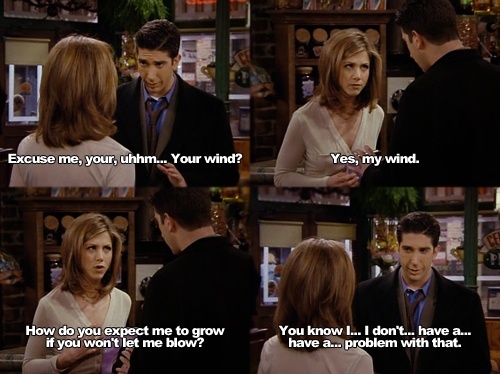
Reading Pinkola's book, I thought how strangely it reminded me of that book, Be Your Own Windkeeper, that the girls read in one of the Friends episodes. It's all mystical mumbo-jumbo about how the wind makes us women goddesses but men steal our wind, because they are the lightning bearers and they're always drinking from our pool of inner power. It's kinda like The Hobbit, except that it is nothing like The Hobbit.
So I googled it, and lo and behold, I found out that "The 'Wind Goddesses' book Rachel finds inspiring is a parody of mystical self-help books such as Clarissa Pinkola Estés' Women Who Run With the Wolves."
From the first pages, you can see it is a 90s book written for frustrated, middle-class, artistic Gen X women who are mad that they have to go to work instead of painting the whole day, who don't get along well with their family because they don't think they are the most special little genius in the world, and whose partner won't build them that dream treehouse because it costs $7k and they just don't have that kind of money. And these women the author refers to are so specific that I cannot help but think the book would have been way better if she just said "I" instead of "women." Or "Rachel." :)
Not to mention the nonsensical arguments and repeating the same word translated into Spanish. Wolf, la Loba. Okay, we got it, you speak Spanish; now pick a language to write a book in, please.
Then saying that the Brothers Grimm wrote Bluebeard, when in fact it is well known that that tale comes from the French folk tradition; and while it is true that the Brothers Grimm did write down a version in German, by far the most famous one is still Charles Perrault's. Also, lots of shitting on the Brothers Grimm, without really knowing their work and what they stood for, is tasteless and just shows her ignorance.
Another thing that irked me was how this book was presented as a scientific read, since the author holds a PhD in psychology (I guess PhDs are not what they used to be when they are given so easily to self-obsessed ignoramuses). There is absolutely nothing scientific about this, since the author never cites any data or research; all her sources are vibes, "trust me bro," and "it came to me in my dreams." Therefore, it should have been classified as a private journal of a woman going through a middle-age crisis, blaming men and society for everything instead of taking a bit of accountability for her own life and working on herself. Maybe see a colleague for starters.
I just imagine a person in crisis going to therapy, looking for some help, and there, sitting in a chair with an all-knowing gaze, Clarissa Pinkola Estés shows up as their therapist. I can only imagine the kind of advice the person could receive. Yikes.
In the end, I wonder if the women in this book are not running with the wolves, but maybe after the wolves who are trying to get away from the crazies?
So yeah, I've hated this book with a passion I usually reserve for lovers. It is that bad. From the first sentence to the end. I think Clarissa Pinkola Estés should publicly apologize to the descendants of the trees that have been cut to make the paper on which this insult to intellect was printed.
Let me just say, this book is not for the faint of heart—or for anyone looking for a light bedtime read. Clarissa Pinkola Estés is a powerhouse of myth, story, and psychology, and she weaves it all together like an ancient grandmother who also happens to be a trained psychoanalyst (which, well, she is). I picked up this book hoping for a soul-stirring feminist revelation… and I almost got it.
What kept me turning the pages were the parables. Estés has a gift for storytelling—folktales and myths from all over the world are used as tools to explore the psyche of the “wild woman” archetype. These stories were fascinating and evocative. I wanted more of that—and less of what felt like long-winded philosophical meandering through the forest of her thoughts.
In fact, the book reads less like a polished roadmap to empowerment and more like a fascinating first draft of someone’s late-night ramblings after three espressos and a tarot reading. Yes, the insights are good. Yes, the themes are important. But sometimes I felt like I was on the edge of a breakthrough, only for the thread to vanish into a metaphor.
It’s like Estés was almost about to hand me the keys to the kingdom of wild womanhood—but then got distracted and wandered into another forest. In other words, I was looking for that big, satisfying “aha!” moment—the mental fireworks, the epiphany, the cosmic wink—and I never quite found it. If she’d tied the ideas together more clearly, this book could have been an instant 5-star.
Still, I respect the work, the message, and the mystery of it all. It’s the kind of book that might change your life… if you can hang on for the ride (and maybe bring a notebook, some tea, and a Google tab for all the Jungian terminology).
Verdict: Worth reading—especially if you love myths, metaphors, and the idea that your inner wild woman is just one archetype away from waking up. Just don’t expect it to hold your hand or draw you a map.
This entire review has been hidden because of spoilers.
Repetitive. Very repetitive. Did I mention it was repetitive? Moist and bones were two words I'll remember from this book, and yet, they didn't appear to me to have any relationship to the message in the book. It was sexual when it didn't need to be. And the myths had NOTHING to do with getting the message across. I must also say that I strongly disliked the narrator. I'm not sure if that was the author, but it was not good to listen to. I believe the message is an important one, not just the way it was presented in this book. I listened to the end because a friend recommended the book, but it didn't get any better.
wilddddd horses loved loved loved listened to it as an audio book but j wish it bought it cause i would so re read this. exceptional advice i think every women needs to read this once . this will really stick with me. these two aspects especially:
-do not let anyone compress your ideas passionately opinions and thoughts.
-always ask yourself what are you hungry for and not what beckons at you. let the answer me instinctive and from within.
thank you! i yearn to be a woman of the wolves and needed this book so bad.
I recommend this to all women. Especially those who have been told they’re too much. Too loud. Too ambitious. Women who have gone through any sort of trauma (who of us hasn’t?). Women who are making major life changes. Women who just hit 40 and are wondering what’s next. Those who are going through a breakup, a divorce and are searching for that new beginning or fresh start.
The audiobook (which is I guess just an excerpt of her full publication) is the way to go, too. But I’ll be reading the full version now as well.
It’s hard to rate this book. This is an abridged audiobook based on the full text—I didn’t realize that when I started it. This had some enjoyable myths and stories but wasn’t the transformational experience I was hoping for. I wish there was a full audiobook version of the actual text being read. Will just have to read this in print!
This is a two hour version of what later became the book that is over 500 pages. This was excellent and makes me want to read the longer, more in-depth book. If you’re not interested in the longer version (which does not come in an audio format), please take two hours out of your life to read this version. It’s powerful!
bad it was bad almost a dnf and it’s only 2 hours weird self help paragraphs interspersed with abridged and cherry-picked folklore stories and both were not really interesting (the self help being the much worse aspect of this) yikes
A well organized book surrounding the archetype of the entrapped women and a guide on who to heal and become free. The usage of folklore and the author’s own thoughts are well balanced and kept me intrigued.
Women Who Run With the Wolves is not a book I think you simply read. I think you have to be willing to wander around inside it for a while and I did.
Clarissa Pinkola Estés takes old stories, fairy tales and myths and pulls them apart, looking underneath them for the parts of ourselves we lose, silence, abandon and sometimes have to fight very hard to find again. Some stories interested me more than others. Some I had to sit with but then I reached The Little Match Girl. That one went deep.
I knew the story, of course, but I had never looked at it in quite this way. Reading Estés’ interpretation pulled me backwards into my own childhood and then, strangely, forwards again into my adult life. I felt the sadness of it, the longing, the little lights that keep appearing in the darkness. What stayed with me wasn’t simply what had been difficult, it was what survived. I realised that through challenges beginning in childhood and continuing into adulthood, I had kept finding a creative voice. Sometimes perhaps without even knowing that was what I was doing. Writing, words, imagination and now lyrics and music. That was quite something to recognise because perhaps survival isn’t only about getting through something. Perhaps it is also about what you somehow manage to keep alive while you are getting through it; and I kept that.
There is a wildness running through this book, but I don’t think Estés means wild in the way we ordinarily use the word. I read it as something much closer to instinct. The part of us that knows; that gets buried beneath expectation, fear, pleasing, belonging and all the noise outside ourselves, but doesn’t necessarily disappear. That resonated enormously with me.
This is not a light read. Estés goes deep and sometimes she kept on going deep when I was ready to come back up for air. There were interpretations I connected with immediately and others I wasn’t entirely convinced by. At times I thought the symbolism was being stretched further than I would personally have taken it, but I rather liked questioning that to.
I don’t need to believe every interpretation an author gives me in order for their book to take me somewhere; this one certainly did. It made me think about instinct, creativity, the voices we silence, the parts of ourselves we leave behind and what happens when we begin retrieving them.
Most of all, though, I came away thinking about that little girl with her matches; because when I looked back at my own life, I realised something I hadn’t quite seen in that way before. I wasn’t only surviving. I was creating. Maybe I always had been.
"It may be that a woman's creative process is misunderstood or disrespected by those around her. It is up to her to inform them that when she has 'that look' in her eyes, it does not mean she is a vacant lot waiting to be filled. It means she is balancing a big cardhouse of ideas on a single fingertip, and she is carefully connecting all the cards using tiny crystalline bones and..."
In the book she also shares an idea about a woman enthusiastically telling her partner that they should build a treehouse, an imaginative creative project. Instead of her partner being curious or being enthusiastic, he instantly shuts it down with practicality, this can crush a woman's imagination and "card house of ideas." She then speaks about how the right match is somebody who meets her enthusiasm, not somebody that treats her creative bursts as an expensive nuisance or a flaw to manage.
I found this chapter to be the most impactful for me because I never understood why I felt insecure about my ideas being met with "logical correction." I myself always felt upset whenever somebody would shut an idea down due to our financial situation, or financial prediction. And what I don't think a lot of men (or people like this) understand is that sometimes I, and other women understand that the idea is not practical but possessing the ability to dream is something to be enthusiastic about. Dreaming should be something that all people wish to possess or be curious about.
I felt that her description and comparison of women being like a domesticated animal is beautiful, and her stories that she shares are incredibly deep.
This entire review has been hidden because of spoilers.
I picked this book 2 years ago. It was a Rakhi gift; I was asked to pick any one book in the store. I don't know why I felt a pull towards this book at that time. I found it really boring when I tried to read it; I simply couldn't connect with it. However, about a month ago, this book kind of called out to me; everything made more sense, and it ended up protecting me from my own reckless decision. It saved me energy and gave me permission to stop being sweet and protect my well-being. I was the little girl manifesting warmth instead of fighting the cold; this book was the grandmother who didn't take me to heaven but kicked my ass so that I would be more responsible with my circumstances.
This book also pushed me to listen to Carl Jung's thoughts. I am 30 years old; I had discovered Freud's ideas but never noticed Jung's ideas until now.
The crazy thing is, when I found the lessons in the book that were meant for me, I did the required actions I needed for my growth. Once I took those actions, I was spiritually aligned once again, and I lost all interest in the book again, and I dragged through the rest of the chapters. Something in my heart says I would return to it if I were lost similarly.
The way this book has protected me in helping me look at dark forces in my life is, in essence makes it a perfect Rakshabandhan Gift. Today on Rakhi, I am happy to have read through it; I am happy to have picked it up 2 years ago.