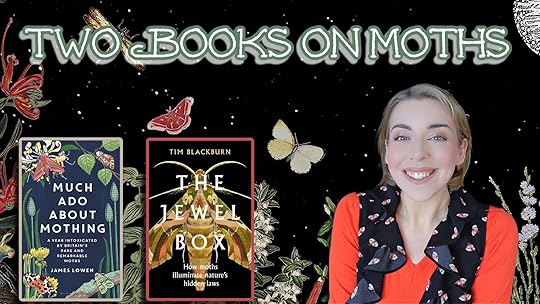
James Lowen narrates a year-long quest to see Britain's rarest and more remarkable moths.
Although mostly unseen by us, moths are everywhere. And their capacity to delight astounds.
Inspired by a revelatory encounter with a Poplar Hawk-moth – a huge, velvety-winged wonder wrapped in silver – James Lowen embarks on a year-long quest to celebrate the joy of Britain's rarest and most remarkable moths. By hiking up mountains, wading through marshes and roaming by night amid ancient woodlands, James follows the trails of both Victorian collectors and present-day conservationists. Seeking to understand why they and many ordinary folk love what the general public purports to hate, his investigations reveal a heady world of criminality and controversy, derring-do and determination.
From Cornwall to the Cairngorms, James explores British landscapes to coax these much-maligned creatures out from the cover of darkness and into the light. Moths are revealed to be attractive, astonishing and approachable; capable of migratory feats and camouflage mastery, moths have much to tell us on the state of the nation's wild and not-so-wild habitats.
As a counterweight to his travels, James and his young daughter track the seasons through a kaleidoscope of moth species living innocently yet covertly in their suburban garden. Without even leaving home, they bond over a shared joy in the uncommon beauty of common creatures, for perhaps the greatest virtue of moths, we learn, is their accessibility. Moths may be everywhere, but above all, they are here. Quite unexpectedly, no animals may be better placed to inspire the environmentalists of the future.
I love the title of this memoir about a man's travels around Britain to see as many moths as he possibly could in a year's time. Along the way, he also shares plenty of moth facts with us and does a great job in showing them to be gorgeous creatures, nearly indistinguishable from butterflies biologically-speaking, and entirely undeserving of their bad reputations (no, they're not all out to munch on your sweaters). It's a wholesome, charming book, but it lacks some oomph.
Click here to hear more of my thoughts on this book over on my Booktube channel, abookolive!
Compared to the dazzling colours of butterflies, I have always thought of moths as drab, slightly uninteresting insects that you only came across around the bathroom light just as I was getting ready for bed. I had been fortunate to see the odd hawk moth too. One was resting high on a wall at the shops near me a couple of years ago and I was amazed by how big it was. Apart from that, I knew next to nothing about moths.
James Lowen was the same until a particular date, 7th July 2012. He describes it as the day that changed his life forever. Until then he had considered moths as small brown and dull, uninteresting and even slightly eerie. Occasionally he even hated them. But what he had just seen had thrown him completely, it was a Poplar Hawk-moth, and she was utterly beautiful, he had been hit by what they call in Sicily, the thunderbolt. He was now smitten.
This interest grew and grew until he reached a point where he wanted to undertake some sort of a quest over the course of a year. Similar to those that have been all around the country looking for butterflies, orchids and dragonflies. Whilst those can be a challenge, there are relatively few species of those, whereas with moths there are around 2500 different species, and from what he could see from the guide books a sizable proportion of them looked remarkably similar. Especially the micro-moths! Instead, he decided that he would try and find the scarce and rare moths from various places around the country and tell their stories.
Searching for these moths would involve many very late nights, these are night insects after all, and he would drive around 14,000 miles in total travelling from the wilds of northern Scotland to the balmy Iles of Scilly and lots of places in between. Some of the moths he is hoping to find have been seen by almost nobody and a number of them are really local, moving no more than a handful of meters from where they hatched. He will find them in Second World War bunkers, near Neolithic mines, on heathlands and in the middle of forests.
Some of the names of these moths are fantastic. For example the Hummingbird hawk moth or the Bedstraw Hawk-moth but there are the Silver Barred, the Marsh Carpet, Rosy Footman, Jersey Tiger and the Pearly Underwing. Not all of them have these fantastic names though a number of them just have their Latin names and you need to be an expert to determine which is which.
I thought that this was a really enjoyable read. I like his writing style too, he includes enough detail in the prose to demonstrate that he knows what he is talking about, but doesn’t make it so complicated that it reads like a series of academic papers. He knows that the reader may know almost nothing about the subject so he writes with gleeful enthusiasm and a passion bordering on obsession about his mothy subjects. He says that he isn’t obsessed with these amazing insects, but I think he is besotted. I really enjoyed reading it and it makes me want to go out and get a moth trap now. 4.5 stars
I’m a new moth-er and otherwise wouldn’t have been reading this book. The variety of moths is remarkable, but after a while I got a bit bored of endless jaunts in search of different rare moths. And not really convinced of the ethics of moth twitching like this. Although obviously would like to catch a few rarities in my garden! Moths are great and unlike much wildlife they come to you (the light) and hang around to be ID’d but if you are not already into moths or perhaps a likely convert not sure this book will do much for you. Also recommend reading it with a moth ID guide to hand!
Although this took me a while to get through I really enjoyed it and part of me was a little jealous of all the moths Lowen got to witness! I do wish that there were illustrations of the moths that are mentioned throughout the book so that you could reference them. I do have both field guides to moths books but it was difficult switching between both books.
I'll start by saying, I was really excited to read this book. I love Moths, and I've heard the Author speak about moths and book before and was inspired by him. Unfortunately though the book did not manage to capture me in the same way. I reserve two stars for books that I managed to finish but didnt particularly enjoy. It's a long read but it's extremely repetitive (trips around the country with a moth trap) and there is only so many times you can read species names you've never heard of before getting bored. I hate to use the word bored but from 20% onwards I was unfortunately wishing the book away. Towards the end I was very much skim reading. Don't get me wrong, if I was out with the author on these trips Id be extatic, but the awe of moths is lost in the book. Perhaps it would be better if it was half as long and each moth had a photo next to the short story. Im not sure Mothing works as a book of this type. I also would have expected slightly more in info on what you can do with your garden to help moths similar to how a Dave Goulson does.
The journal of a man who became fascinated with moths and travelled 14,000 miles in one year to see Britain’s moths. He observes of this engrossing hobby, that “perhaps the greatest virtue of moths is their accessibility. Moths are everywhere, but above all they are here.”
This was so lovely. It took me a while to get through -- only because other books got in the way, and because I always need to take breaks to digest what I read in non-fiction -- but it was worth every second. I love moths, I always have, but it was really only this year, when I got into butterflies, that I realized just how much I adore them. It was incredibly interesting to learn about British moths, and exciting before I go there! James Lowen has such a gorgeous way of describing the moths too, his writing is just exquisite and it really made this a fun read. I highly recommend this, to people who love moths and to those who don't yet.
By now, the format of ‘how many British butterflies/orchids/moths can I see in a year?’ is fairly well worn. The author cannot possibly attempt all British Moth species in one year (over 2500) so he concentrates on the stunning, the weird and the rare. As well as light-trapping in his own garden, aided by his charming and enthusiastic young daughter Maya, he travels all over the country in search of these - and is amazingly successful in nearly all his quests. I did enjoy reading this, although I would class myself as only moderately successful in identifying British moths. It took me a long time to read this, as the descriptions of his travels, friends, acquaintances and the moths themselves are very detailed. I tended to read it in bursts, usually last thing at night (appropriately) and was often found by my husband with the book in my sleeping hands....however I was reading other books at the same time. The author’s style is very, very descriptive, and he often uses a little used adjective or phrase where a simpler one might do....and the descriptions of the moths! Here’s an example - the male Emperor Moth:- ‘The size of a Painted Lady Butterfly, a leonine mane divides wings worthy of adulation. Atop a grey background suffused with scarlet, and between two sets of bold lines ...sit two startling owl eyes, RAF roundels formed from wing scales. As I stroke the moth’s thorax, he strains his upperwings apart, revealing a second set of enraged eyes upon his blazing hind wings.’ There’s a lot more of this, possibly needed in a book with only 4 pages of colour illustrations. The novice moth-er would be advised to read this with a comprehensive illustrated guide to British moths to hand. Oh, and don’t read it if you’re dieting - most of the moths described are coloured chocolate or caramel or or almond nougat or Toblerone....slightly disconcerting.
Its taken me a while to read this book, but for all the right reasons! I've been interested in moths for a long time and learnt so much from reading this book. Thank you!
Damn this book, it’s going to cost me a fortune, not including the places I’ll be taking my new moth trap to. Damn your eyes and antennae Lowen, I expect this is exactly how you pictured it, activating your minions to do your bidding with little square boxes in the darkness.
A sweet little romp with a man who likes moths. I found it frustrating reading about so many different species without images, and I admit I don't really care about the people involved or their narratives. Just give me a textbook filled with creatures