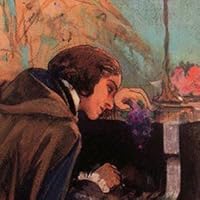
Selections from the Canzoniere and Other Works by Petrarch (Oxford World Classics)
Plutarch's description of his spiritual experience climbing Mount Ventoux with his younger brother was moving. "The Ascent of Mount Ventoux: To Dionisio Da Borgo San Sepolcro" is an interesting piece of autobiographical material which seems to elucidate much of Plutarch's mindset behind his arete, behind the excellence of his writings. He describes how, while mountain climbing, he kept seeking to take an easier side path and each time it ended up being a waste of his time and strength, instead of taking the direct, difficult way of ascent that his brother consistently took. It drove him to reflection on his spiritual failing. "I rejoiced in my progress, mourned for my weaknesses, and took pity on the universal inconstancy of human conduct." When a top the mountain, he opened a small volume of Augustine's Confessions at random, (in a way similar to Augustine's opening the Scriptures at random as recounted in the Confessions in a testimony of his conversion), and the first words his eyes saw were: "And men go about admiring the high mountains and the mighty waves of the sea and the wide sweep of rivers and the sound of the ocean and the movement of the stars, but they themselves they abandon." This piqued my interest more in Plutarch.
It might be said that Plutarch is struggling in this letter and in his poems to see with the symbolic imagination, rather than to sink into a mere immanence, characteristic of modern atheism. He sees the marvelous beauty and splendor of created things, and he is wrapt in adoring devotion to Laura, but also birthing a transcendent vision through the medium of her beauty and virtue.
In the introduction to this volume by Mark Musa, he makes the observation, "One might say Petrarch loved Petrarch more than anything or anyone else, and because of this he kept detailed records of his life and works." That strikes me as damning, but the aforementioned letter makes me wonder, and admittedly hope, that I will find in Petrarch's poetry more than just excessive self-love. The quote from Augustine points to a self-focus of self-examen as something evaded in the quest for adventure and experience, something of core significance. Many of Jesus' words seem to enjoin such a self-examination, and spur on to it.
The atheist might be said to suborn, or suppress the idea of sin, diving into a mere immanence. They avoid knowing themselves.
I am reminded of the words of Dante in Paradiso:
"this is no crossing for a little bark - the sea that my audacious prow now cleaves-
Nor for a helmsman who would spare himself…" I take his "audacious prow" to mean the Divine Comedy itself which he has written. In another Canto he described the poem in these terms:
" If this sacred poem--
This work so shared by heaven and by earth
That it has made me lean through these long years…"
Dante recognized the worth of his poem and also alludes to the rigor it cost him in writing it, an undertaking that was not for "a helmsman who would spare himself." Like Dante, Petrarch's elder contemporary, Petrarch recognizes in the metaphor of his experience with ascent of the mountain, that he must not be a helmsman who would spare himself- he must come to know himself.
I continue to be suspicious of Petrarch even though my admiration for his charm grows with direct exposure to his work.
In the second of the Canzoniere, Petrarch describes his state of being overcome with love for Laura when his strength was in his heart, and being defenseless from the passion. He describes love as unable "to lead me cleverly back up the high, hard mountain, saving me from slaughter." The footnote says "the high, hard mountain" is the symbol for Reason. It seems to me there is also an allusion to Petrarch's spiritual experience in the ascent.
Canzoniere 22 is a very beautiful and fascinating description of his passionate love for Laura.
Petrarch and Dante's examples as devoted craftsmen who accepted the deliberate rigor they were called to is challenging and bracing to me. I recognize in Petrarch's self-description a similarity with myself- a preferring of the easier path, of comfort at the expense of the cross I am called to.
**
I finished the selection of Plutarch's Canzoniere today. I am impressed by the level of his self-expression, the nuance and the refinement of it, and at once the immediacy and intimacy of the poems. I can now say I've had direct exposure to his greatness.
"The sluggard is a coward. He has no love for work, and therefore he is always ready to cheat his soul, 'inventing some vain excuse, so he will not have to do his duty,' reads Reformer's Notes. He shrinks from every work likely to involve trouble. Fancied dangers frighten him from real and present duties. There is a lion without- I shall be slain in the streets- an absurd excuse! As if public streets except in special cases, were the haunts of wild beasts. He is afraid of being slain outside when he willingly gives himself up to be slain within." -Charles Bridges, A Modern Study of the Book of Proverbs, pg. 486-87 commentary on Proverbs 22:13