Jump to ratings and reviews
Rate this book

A Voyager Out: The Life of Mary Kingsley

Rate this book
Mary Kingsley began her life as a typically conventional Victorian woman. She would end up travelling to some of the most inhospitable regions of Africa and became one of the most celebrated travellers of the day. At the age of 31, she sailed on a cargo ship along the coast from Sierra Leone to Angola and then traveled inland from Guinea to Nigeria, studying African customs and beliefs. On her second journey, she ventured into remote parts of Gabon and the French Congo--the first European to do so. She encountered cannibals and crocodiles, studied the religious customs of the reclusive Fang tribe, climbed Mount Cameroon and explored the Ogowe River, trading cloth for ivory and rubber to fund her trip. She returned only once to Africa, during the Boer War, when she worked as a nurse and journalist. Tragically, she died of typhoid in 1900, only 38 years old. This edition features a new Preface by [Frank].

352 pages, Paperback

First published January 1, 1986

5 people are currently reading
314 people want to read

About the author

Katherine Frank

16 books36 followers

Ratings & Reviews

What do you think?
Rate this book

Friends & Following

Create a free account to discover what your friends think of this book!

Community Reviews

5 stars
29 (29%)
4 stars
33 (34%)
3 stars
31 (31%)
2 stars
3 (3%)
1 star
1 (1%)
Displaying 1 - 17 of 17 reviews
Profile Image for Bettie.
9,976 reviews5 followers
November 22, 2015
NB: Further reading on Mary Kingsley was suggested; not specifically this book.

Description: Mary Kingsley began her life as a typically conventional Victorian woman. She would end up travelling to some of the most inhospitable regions of Africa and became one of the most celebrated travellers of the day. At the age of 31, she sailed on a cargo ship along the coast from Sierra Leone to Angola and then traveled inland from Guinea to Nigeria, studying African customs and beliefs. On her second journey, she ventured into remote parts of Gabon and the French Congo--the first European to do so. She encountered cannibals and crocodiles, studied the religious customs of the reclusive Fang tribe, climbed Mount Cameroon and explored the Ogowe River, trading cloth for ivory and rubber to fund her trip. She returned only once to Africa, during the Boer War, when she worked as a nurse and journalist. Tragically, she died of typhoid in 1900, only 38 years old.

The Royal Geographical Society briefly admitted some women as ‘Fellows’ in 1893, acknowledging their work to be contributing to scientific knowledge. The celebrated traveller Mary Kingsley was admitted as a fellow in this first cohort, but this was a short-lived achievement for women, and the society closed the membership category for women until 1913. This was noted in a satirical poem published in the newspaper ‘Punch’:

A Lady an explorer? a traveller in skirts?
The notion’s just a trifle too seraphic:
Let them stay and mind the babies, or hem our ragged shirts;
But they mustn’t, can’t, and shan’t be geographic.
For
My Parents
and
Lee and Justin

Opening quote:I thought for some reason even then of Africa, not a particular place, but a shape, a strangeness, a wanting to know... I have written "a shape", and the shape, of course, is roughly that of a human heart - Graham Greene

Opening: It was well past midnight, and as usual Mary Kingsley was still up, writing in the small library of her house at 32 Saint Mary Abbot's Terrace, Kensington.

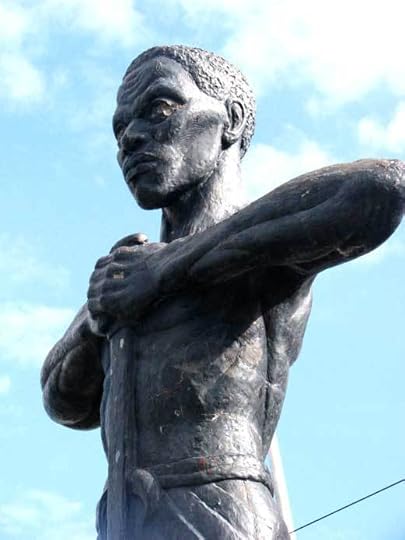
The Morant Bay rebellion began on 11th October 1865, when Paul Bogle led 200 to 300 black men and women into the town of Morant Bay, parish of St. Thomas in the East, Jamaica. The rebellion and its aftermath were a major turning point in Jamaica's history, and also generated a significant political debate in Britain. Today, the rebellion remains controversial, and is frequently mentioned by specialists in black and colonial studies.(wiki sourced)
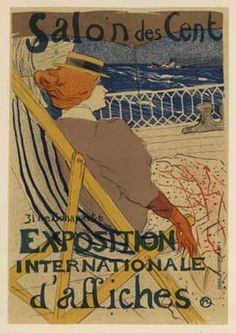
Page 109.

Profile Image for Ann.
145 reviews20 followers
May 12, 2007
This is a biography of Mary Kingsley, one of the most well-known woman explorers of the Victorian era. It was a very interesting read. Mary Kingsley was such a study in contrasts. She was a dutiful Victorian woman; putting her life and dreams on hold while she nursed her ill, demanding parents for years, untuil their deaths, and while she later kept house for her demanding brother.

There was a completely different side to Mary Kingsley, however. The minute that she was free from the demands of family duty, she packed up her bags and set off to explore little known areas of West Africa. Her focus was twofold: to gather information on the customs, practices, ethnology and culture of the Fang tribe, (who were considered a firect, cannabalistic people), and to collect specimens of previoiusly unkown fish from West Africa's rivers and lakes.

Her actual purpose was most likely to create a life for herself; to spread her wings as soon as she was free of the tethers that bound her to her family's hearth and home.

I enjoyed this book very much! It was right up my alley! The only nit-picky criticism I have is that the author seems terribly fond of the phrase "haut politique". I suspect she found it among Mary Kingsley's writings, and perhaps, seeing that Ms. Kinglsey was fond of the phrase, herself, became much attached to the phrase.

As I said, however, I quite enjoyed this book, and found Mary Kingsley to be quite an interesting subject.
Profile Image for Lobstergirl.
1,927 reviews1,439 followers
November 16, 2021

Mary Kingsley was a middle class Victorian, the just barely legitimate daughter of George (brother to Charles Kingsley, author of the well known The Water Babies) and his cook, Mary Bailey. George was a doctor, but seemingly more an adventurer and philanderer, and his Cockney wife Mary Senior took often to her bed with neurasthenia and was ministered to by Mary Junior. Young Mary was constantly called to nurse various relatives and when both parents died in the same year, she was in her late twenties and, unmarried, immediately began a life of travel and study of West Africa, though always coordinating her trips with those of her brother: when he was home in London, she was his housekeeper.

On her first trip to Africa, Mary took a phrase book containing “such useful sentences for the West African tourist as “Help! I am drowning!” and “The boat is upset,” as well as queries on the order of “Why has this man not been buried?” and the “cheerful answer”: “It is fetish that has killed him, and he must lie here exposed … until only the bones remain.”

After each of two trips to West Africa, Mary published bestselling books which combined nature writing, ethnography, and anthropology with more casual travel narrative. "...[O]ne of the many worst things you can do in West Africa is to take any notice of an insect. If you see a thing that looks like a cross between a flying lobster and the figure of Abraxis on a Gnostic gem do not pay it the least attention…just keep quiet and hope it will go away," she wrote in her second book. She became a popular lecturer.

An autodidact, Mary described her purpose in going to Africa as "fish and fetish" and would have three species of fish named after her. She rarely boasted but was proudest of learning to maneuver a dugout canoe. When she returned to England from her trips, she had no interest in the suffragette movement and didn't see any reason why women should get the vote. Rudyard Kipling, who knew and admired Mary, said of her, "Being human, she must have feared some things, but one never arrived at what they were."

Just as strange to the natives as Mary's white skin was her solo travel. She was so often harassed by questions of “Where is your husband?” that in a lecture she warned the female traveler “not to say she has not got one; I have tried it and it only leads to more appalling questions still. I think that it is more advisable to say you are searching for him, and then you locate him away in the direction in which you wish to travel; this elicits help and sympathy.”

Mary did fall in love once, with an army officer, Matthew Nathan, but it was an unreciprocated crush. They had met at a dinner party and exchanged letters on political views, leading Nathan to write to her, "I do want to understand you and I shall....It was your personality rather than your work which engaged my attention." Mary responded with a 24-page letter which included: “The fact is I am no more a human being than a gale of wind is. I have never had a human individual life. I have always been the doer of odd jobs and lived in the joys, sorrows, and worries of other people. It never occurs to me that I have any right to do anything more than now and then sit and warm myself at the fires of real human beings. I am grateful to them for letting me do this. I am fond of them, but I don’t expect them to be fond of me and it’s just as well I don’t for there is not one of them who has ever cared for me apart from my services.” Perhaps Mary's confessional alarmed Nathan, who made himself scarce.

Although she longed to go to Nigeria, Mary was kept in England housekeeping for her brother, or tending to her own bouts of influenza. When she finally got a chance to travel again it wasn't something she was thrilled about: nursing Boer prisoners of war in a hospital in South Africa. It was exhausting, horrifying, dangerous work. She wrote to a friend, "When a man is dying definitely, you don’t like the next two to turn to see the performance, so you trot off and find two little screens. Well, the other two know what those screens mean perfectly well, only they think they are there for them, so they start off on dying too.” Her sense of humor never abandoned her: “To keep things cheerful, last night when we were at dinner we heard guns, which means prisoners were escaping from the camp.” She caught typhoid in the hospital and died at age 37.
Profile Image for Em.
284 reviews7 followers
June 22, 2014
Most of this book is very engrossing & certainly the woman Mary Kingsley was an enigma, but to be perfectly honest there were times when this book was dry and tasteless as seven day stale bread. Perhaps it seemed so because I had to read it in starts and stops. But really some portions of it were truly spellbinding. Mary Kingsley was a Victorian spinster who traveled to the wilds of Africa alone. She was celebrated in her time precisely because of her unusual travels and she wrote and lectured about her adventures. She had very progressive views on the imperialism of Britain in Africa, yet though she traveled in the circles of men she was totally opposed to the suffragette movement and equality for women. Enigmatic! She was an isolated, lonely woman in spite of being the toast of the town for a time. She went to Africa first to seek oblivion, but she found a heightened sense of life & from then on when away from the dark continent never felt alive at all.
Profile Image for Karry.
931 reviews
June 19, 2017
I've wanted to read something about Mary Kingsley for years and I FINALLY got to it. Katherine Frank writes an extremely detailed story of Mary, one of the few English women who did ethnological studies in African during the 19th century. She was an amazing woman but, not a suffragette nor a defender of women's rights. She conformed strictly to the male dominated cultural rules and yet forged a path for other women and became quite famous in her own day. There were so many interesting things about her life and yet, she was a very strange woman and not one that I would choose to get to know. Read the book, it's worth the time and yet be aware that the author could have edited at least 100 pages and still informed the reader.
Profile Image for Jansen Estrup.
Author 9 books1 follower
October 5, 2016
A remarkable Victorian woman, Mary Kingsley became her mother's nurse and caretaker from age four to 30. Virtually abandoned by her world traveler father, she taught herself to read his medical books and had an insatiable interest in travel, tribal structure and religions, as well as flora and fauna. But as a proper daughter of the age, she was bound to the wish and whim of her father, and brother when the father died about the same time as her mother. Only when the brother journeyed half-heartedly in his father's footsteps was Mary finally free to make her own imprint upon the Death Coasts (where 9 of 10 Europeans died)... she made three trips to the rivers, swamps and colonial 'factories', studied diseases, collected fish and insects, but it was among the secretive tribes that she made so many discoveries about religion, more and government structure.
Between voyages (1893, 1895)she wrote best selling books, lectured in famous scientific settings and, somehow, edited her father's copious notes into yet another book. Finally she sailed to South Africa where she treated Boar soldiers, women and children in British concentration camps. There she contracted the very diseases she had survived in West Africa and in 1900, like thousands of others, died. Even in her 'full honors' burial at sea, she refused to follow accepted procedure and caused a legendary stir among her admirers. And yet she was no supporter of women's issues, spoke out against woman's sufferage, and worker conditions. Odd contradictions. The book is tedious at times, but richly researched and full of 'feel' for the Victorian Age. Well worth a reader's time.
Profile Image for Sam Maxfield.
Author 21 books13 followers
November 4, 2013
Beautifully written biography of Mary Kingsley, an extraordinary Victorian 'spinster' who travelled extensively in West Africa in the 1890s. Kingsley was not a missionary but an explorer, who against the conventions of the times took it upon herself to get to know the tribes and peoples of West Africa without trying to force her views upon them. Frank's writing is poetic, capturing the exotic beauty of the sights and sounds Mary encounters while also being highly informative and extensively researched.

I began reading the book for research for my next novel but soon found myself utterly captivated by the story and the quality of writing.
Profile Image for Kathy Duffy.
871 reviews6 followers
November 19, 2016
This was the second time I read this biography with a decade in between, a fascinating woman who did some pretty unimaginable things on her own. I would highly recommend anyone who finds this biography interesting read My Travels in West Africa which Mary Kingsley wrote and was published in the late 1890's because the biography gives highlights but her own words reveal a sly sense of humor and her outspoken thoughts on the various colonial governments and the missionaries which she felt were ruining African culture. A courageous and unusual woman.
Profile Image for Jan.
91 reviews
September 15, 2016
This biography of a really remarkable woman took me over one year to read. That should give you an impression of how well-to-read the thing is written.... Most of the time it is a very long-winded monologue on religion and politics that misses to conect these statements with the life of Mary Kingsley. Unfortunate to say it but that's a book I definitely would NOT recomend.
Profile Image for Kay.
1,020 reviews219 followers
January 26, 2018
Read for the Reading Genres book club meeting in June 2017 devoted to the theme "A Love Story: with a Twist" (i.e. a standard love story between humans). My take on this theme was that Kingsley was in love in Africa -- and the freedom it represented
Profile Image for Janet.
307 reviews23 followers
January 29, 2011
I loved this! To think of a woman in that time, going exploring alone, is fantastic-such courage, and she's inspirational.
Profile Image for Rachel.
61 reviews5 followers
May 31, 2013
Felt a real kinship with Ms. Kingsley. Excited to read her actual books with a pretty good perspective on her personal life.
38 reviews1 follower
January 21, 2015
Wonderful book! Mary Kingsley was an astonishing woman and her travels and writings are amazing. Highly highly recommended
Displaying 1 - 17 of 17 reviews

Can't find what you're looking for?

Get help and learn more about the design.