‘Excellent’The Times ‘One of the best novels I have read this year’Iris Costello ‘A luminous, pin-sharp portrait of a true trailblazer’Zoe Howe
Societies are oiled with the unpaid, unaccounted for, work of women. It is the very glue that binds us together, and yet we are blind to it; a woman’s work remains invisible.
Rosalind Franklin knows that to be a woman in a man’s world is to be invisible. In the 1950s science is a gentleman’s profession, and it appears after WWII that there are plenty of colleagues who want to keep it that way.
After being segregated at Cambridge, then ignored and put down in the workplace, she has no intention of being seen as a second-class citizen and throws everything into proving her worth. But despite her success in unlocking the very secret of life, the ultimate glory is claimed by the men she left in her wake.
Inspired by the true story of a woman so many tried to silence, Rosalind is a tale of hope and perseverance, love and betrayal … of real-life lessons in chemistry.
‘A poignant, compelling novel that takes us into the heart and mind of Rosalind Franklin as she struggles for recognition in a man’s world’ Louisa Treger
‘Loved this immersive journey into the life of a woman who changed the world’s understanding of what makes us who we are’ Emily Chung
‘An engaging novel that intertwines the personal and the universal like braided strands of DNA’ Luna McNamara
‘Rosalind paints a shocking and necessary portrait of institutional misogyny in mid-century science’ Nikki Marmery
AD/PR - Rosalind’s story is one of a fierce, determined and incredibly clever woman who refused to let sexism and misogyny dissuade her from achieving scientific greatness. Jessica Mills does a fantastic job bringing Rosalind to life through historical fiction and giving her the voice that history silenced.
If you didn’t know, Dr Franklin was instrumental to the discovery of the structure of DNA in 1953 through her work on x-ray diffraction. Swipe right to see her famous Photo 51 which showed the double-helix structure of DNA for the first time! But of course, because the patriarchy was living its best life at the time, one woman did the work and three men stole her idea. A man actually won a Nobel Prize based in large part on her work. None of the three men gave her any credit. I was FUMING!!!!! Not just for this but for the constant sexism and misogyny she’s subject to. Her own father telling her science isn’t a career for a woman. Her male colleagues relentlessly patronising her, putting her down, blocking her path and using her work without giving her credit. Throughout her career she’s called stubborn, difficult, moody, and told she needs put in her place. She’s criticised for not conforming to feminine ideals in her appearance. However, despite all of this she did NOT break. She believed in herself, she believed in her ideas and she trusted in the power of her brain and in her passion for science.
Rosalind is a book that will make you physically burn with feminist rage. It’s also a book that will make you feel so proud and so inspired by this courageous women who, despite only living 37 years, changed the world and refused to give up. Full of heart, spirit and all the YAY FOR SCIENCE!
Women in science, technology, education (women in general) will always be invisible whilst the patriarchy exists.
It’s abhorrent but the story of Dr Rosalind Franklin is not unusual. Women who uncover astonishing advancements and their achievements are shadowed by the men that they work with.
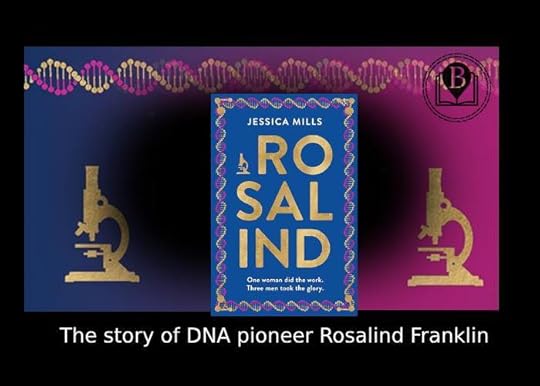
Rosalind: DNA's Invisible Woman is a piece of historical fiction which is based upon the real life of English chemist Dr. Rosalind Franklin.
Rosalind contributed greatly to the understanding of DNA, but her work was only recognised posthumously and she did not get awarded the Nobel prize which many thought she was due. This book paints a picture of Rosalind’s life and her scientific works. It begins in 1939, but the main focus is the years between 1951 and 1958 when Rosalind was at Kings college London, and her DNA discoveries. Prior to this she worked in Paris where she was taught how to use x-rays which she used in her later DNA trials.
The book is written in numerous short chapters and mixes the science with details of Rosalind’s life. Some of these passages were often quite lyrical as the author created images of Rosalind and her surroundings. I will admit that some of the science went over my head, especially the many discussions about the process and the DNA findings at various stages.
This is a story about a talented women, whose scientific discoveries were suppressed for many years. I am glad that she is now being recognised for her important role, but it saddens me that she never lived to see her work acknowledged.
If you enjoyed Lessons in Chemistry, I recommend this book - Rosalind was so much better! It is based on the true story of Rosalind Franklin, the scientist who back in the 50’s discovered how DNA is structured. Some male scientists she worked with stole her work and got the credit for the discovery which made my blood boil reading about it!
The writer has done amazing research into Rosalind’s life and it was so interesting to read all about this amazing woman who never received any recognition for her major discovery at the time.
It tells you snippets of her childhood, about some of the people who were important to her in her life, her passion and hard work for her career and fighting to be heard. Thanks to Mills who gives us insight to this incredible woman Rosalind gets the recognition she deserves. It is extremely sad she never got to see how much of an impression she has made within the scientific world.
This nearly was a five star read for me but I wanted a bit more depth to Rosalind’s life in terms of friendships and relationships with others and maybe a bit more of her early life as I felt it only touched on it lightly as it is quite a short book. I just loved reading it so much I didn’t want it to end! I could not put it down, I read it in two sittings!
Rosalind is a powerful and moving story about female rage and institutional misogyny. It’s a great experience to read about this remarkable woman and what she achieved in such an oppressive situation.
Here’s a woman who history, who men have tried to erase but one who kept fighting and fighting. She was on the path of a great discovery in DNA and she kept on it.
Jessica Mills has done a wonderful job bringing Rosalind to life – she gives her a voice and emotions and I was there right beside her. I do feel the book should come with a stress ball however – by a few chapters in I am fuming at what these scientific men were putting our Rosalind through.
I had heard of Rosalind Franklin but didn’t know that much about her role in DNA to be honest. I immediately rectified that. She was instrumental to discovering that DNA was a helix structure in 1953 and her work led to so many other discoveries and studies. She paved the way for so much that followed, yet she is hidden in history’s pages. Well, not any more!
The tag line for this book is One Woman did the work and three men took the glory. I was angry before I opened the book! When you read how and what they did, my blood was boiling. It’s Rosalind’s reactions that are the the most telling however, as you just know she is going to get her ‘ revenge’. Oh her male colleagues might put her down, block her path and take her work but she is not having it! She knew her work was crucial and that she could be on the cusp of a major breakthrough so she carried on. I admire her so much and oh, this story needs to be told.
Jessica Mills thank you for bringing Rosalind to so many readers – for showing us what she did and how she did it. The writing is scientific enough to learn but easy enough to read if, like me, you barely scrapped through GCSE. That is quite a feat in itself Jessica Mills should get an award for that!
Rosalind – died far too early – ( I cried at that bit) – but what a life. Now we can share it and live it again for her. Wow.
This book was completely fascinating and totally shed a light on a woman history could have forgotten.
This is not usually my sort of thing; I’m not going to lie - some of the scientific explanation/conversations in this book went over my head but that didn’t take away from my reading experience.
I think this book did a great job at capturing and bringing to life some real life events that I suspect many people, like me, are completely unaware of.
The feminist in me got angry many, many times while reading this book. I am so indignant at how this woman was treated both in terms of every day life and that her contribution to one of the biggest scientific discoveries was completely glossed over.
The writing style in this book really helped the flow; the chapters are short, the writing is beautifully descriptive and I really felt like I got to know Rosalind - not just as a scientist but as a woman.
This is a great book - be prepared to learn, get angry and sad and just really enjoy it.
It feels really harsh to give this book a one star, however, I did not enjoy it. I really wish I did- the premise of this book sounded intriguing, sounded like a feminist tale of hard work, struggling to make progress in a system not designed for us. However, the book was so heavily science laden, it feels as though they forgot to write a storyline alongside that!! Given the nature of the story it needs to talk about science, however, that should be small commentary to give context within a wider story on a woman living in a man’s world. Where is it felt like I was reading a science textbook.
I am a scientist (F) and have always been appalled by the way the scientific comunity (and humankind) treated Rosalind Franklin. She deserved better, and I will spend my whole life saying it to anybody who is willing to listen. I am very glad this book was written because with it we can, in a way, listen to her side of the story. I was iteratatively angry, upset and sad while reading it (do not recommend to read before bed, I would get so angry at times at "the men" I would have to read something else to be able to fall asleep). The book is well written but the temporal jumps make it a bit confusing at times.
I think this book deserves to be read. Although it is a novel, it is about such an important part of scientific history and really shows how women were treated during that time. I knew a little bit about the basis for this story so it was really interesting to me. I felt quite emotional at the end. Very well written.
Cannot think about Rosalind Franklin without my heart hurting anymore. Mills did an amazing job on this, beautifully highlighted the power imbalance between genders within a STEM environment, which unfortunately still exists till this day
July book club read Words that came up were sciencey, lacklustre and confusing. A list of characters would have been very helpful; there were a lot of similar white man names and I wasted time trying to figure out who was who.
This was such a fascinating and addictive read that I couldn't put down even when I did want to scream at the way Rosalind was treated throughout.
I loved that we got to follow Rosalind's career and that we got to see how much of an impact she made in the research and the understanding of DNA. I also really liked that we got to see parts of her life outside of it as I felt like we got to know Rosalind more.
While I know that women were treated incredibly poorly in these times it still blows my mind and absolutely angers me when I read about it. I wanted to cry and simultaneously fight for her honor and the way she was treated. The amount of times she was undermined, talked over, ignored and just treated so differently is honestly a joke. Its astounding how much she put in to researching and applying theories just to be silenced and not given the credit she deserved, honestly its boils my blood.
Before reading this book I didn't know a whole lot about Rosalind and her career but having since read it I've done more research into her life and her achievements. Rosalind was an incredible woman who deserves more recognition for her research!
An important (albeit partly fictitious) account of how Rosalind Franklin deciphered the structure of DNA (“the secret of life itself”) and how her discovery was stolen by the 3 men who went on to win the Nobel prize for it — James Watson, Francis Crick, and Maurice Wilkins. The book examines how female scientists (and females in general) were treated by academia and wider society in the 1900s, when sexism was rampant, tolerated, and even encouraged.
Although she is known by some now for determining the structure of DNA, this came long after her death from ovarian cancer, and she was ultimately robbed of the Nobel prize.