A fresh look at the December 7, 1941, events surrounding the bombing of Pearl Harbor. Jett focusses on the fates of four Pan Am Flying Clippers, each filled with influential passengers. The aircrafts' refueling stops included Midway Atoll, Wake Island, Guam, and Manila--all of which were targeted and attacked within hours of Japan's infamous early-morning attack of Pearl Harbor. Stranded in the sky, these civilian airlines--like any US plane in the region at the time--were unexpectedly at risk of being shot down by Japanese military. The Pearl Harbor bombing removed any possibility these four airlines had for US military assistance, and the attack of the refueling stations made it impossible for these airlines to fill up their depleting gas tanks. Consequently, the Pan Am crews and passengers must figure out how to survive during these volatile times in the Pacific Ocean, where neither land, air, nor sea can promise safety from the same Imperial Japanese military forces that devastated Pearl Harbor and brought our nation into the Second World War. The writing is good, and the narrative backbone is strong and gives this historical account a novel-like feel.
I thoroughly enjoyed this book. I grew up with the idea the Japanese attacked Pearl Harbor on December 7, 1941, and things got hot after. Later I found that this was one of many attacks that occurred that day which was December 8th in Asia. They were not a day later, but a few hours later. Recently I have read about submarine attacks on shipping off the coast of California on the same day. This is another fascinating piece of the history of December 7th.
The book starts with a discussion of the Pan Am Clipper Fleet of luxury flying boats and how the business operated, which was key to understanding why they were there. It explains the loss of the Hong Kong Clipper and epic flights of the remaking flying boats to return to the US with their crews, passengers and other refugees. The book tends to focus on the Pacific Clipper but includes many details about the trials all of the craft operating on the Pacific routes that fateful day.
If you are looking for something different about December 7, 1941. This is a great book and is well illustrated. I highly recommend it.
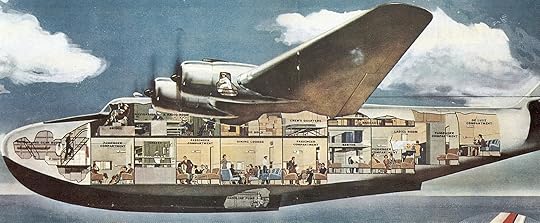
Cutaway of Boeing 314A, most famous type of the long-range, luxury, Pan Am Clipper
My dead pixels copy was a 420 pages. It had a US 2023 copyright. This book includes: a Glossary, Notes, Maps, Photographs, Bibliography, and an Index.
Philip Jett is a retired businessman, and writer of business-related historical non-fiction. He is the author of three books. This is the first book I have read by the author.
This was a popular history. A basic knowledge of the: Pacific War, Western Pacific and South Eastern Asian geography, and a working knowledge of early 20th Century aviation would be helpful.
TL;DR
It was business as usual, just before December 7, 1941, the bombing of Pearl Harbour, Hawaii. Americans and Europeans traveled freely between the States to: Hawaii, Australia, New Zealand, The Philippines (PI), and European South East Asian possessions such as Hong Kong and Singapore. The most expeditious mode of travel across the Pacific was by air.
Air travel cut a trip that could take weeks by sea to mere days. For example, San Francisco to Honolulu was five days by sea and only 18 hours by air. Pan American Airways exclusively operated a trans-Pacific air service carrying: airmail, priority cargo, and a small number of passengers.
The limited number of passenger seats available were all 1st Class. (Modern private, jet-level with private staterooms.) The typical fare was more than the average working man made in a year. Passengers were: government (diplomats, high-ranking politicians, and military), celebrities, top-executive businessmen and their dependents. Pan Am employees on priority assignment could also be “squeezed in”.
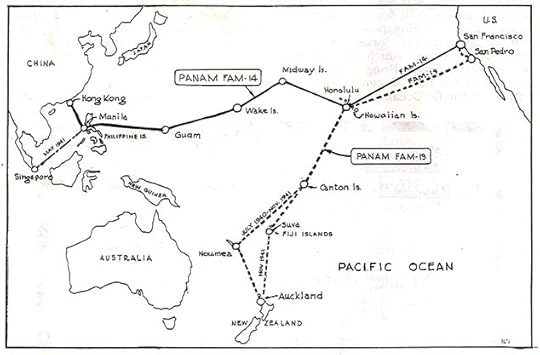
Due to limited aircraft range and no runways, Pan Am flew very large, advanced for the times, flying boats (AKA Seaplanes). These where the Pan Am Clippers. They island-hopped across the Pacific, landing and taking off from the water, refueling along the way. At the refueling points, as well as maintenance, Pan Am maintained luxury accommodations for passengers when none was otherwise commercially available, such as on remote islands. An example of a regularly scheduled flight was the ANZAC Clipper. It travelled between: San Francisco, Honolulu, Canton Island, Suva, Nouméa, and Auckland NZ. The route was about 11500km/7000mi over four days. From Auckland, ground-based aircraft took travelers on to Australian destinations over the Tasman Sea.
In the days straddling the Pearl Harbour and simultaneous attacks across the Western Pacific and Eastern Asia, Pan Am had four Clippers enroute. This is the story of the: aircraft, air crews, passengers of those four flights and the Pan Am off-shore employees and their dependents surprisingly caught amidst a war.
This book concentrates on the organization and operation of Pan Am at a dramatic point in both world and corporate history. Aviation was the High Tech of the early 20th Century. Pan Am was a pre-modern, technology company with strong-ties to the US Government. It had a significant: heavy lift capability, Pacific base infrastructure, and a construction organization in a strategically significant region, where the government was restricted by treaty. They also had a paternalistic concern for their employees, not found 85-years later in modern times.
Jett’s historiography was chronological, and very much of the The Great Man theory. It was anchored on individuals in the: Pan Am hierarchy's New York City headquarters, the Clipper air crews, and ground crews at Pan Am terminals at the time. Historically, he unsuccessfully attempted to extend the paradigm to Japanese diplomats and Imperial Japanese Navy (IJN) officers involved in the operations that led to the US entering the Pacific War. He also did the same of US politicians and United States Navy (USN) officers. As a business historian, he was good. As a military and diplomatic historian, he was less successful. He did show some aptitude for the history of technology, but that was incidental.
The Review
I put this book on my TBR immediately after reading a GR review of it. From my interest in the history-of-technology, and military-history, I was aware of the Pacific Clipper’s return to the eastern United States from the edge of a warzone in NZ. That there were three other likely as adventurous “Clipper” stories piqued my interest.
Jett’s prose was OK. It felt a bit gossipy? However, my eBook was not well groomed. I found a larger number than expected missing words and several instances of repetition. There appeared to be an error in the transcription, where italics were involved? For example, USS West Virginia appeared as USS with Virginia omitted.
Jett is not a pilot in a book with a lot of “air time”. There were some aviation vocabulary issues. He also had no military experience to aid in describing a “war zone”.
I noted that the participant interviews used in this book guaranteed their subject to be in the narrative. Many were recollections of the family of deceased participants. These anecdotes were somewhat successful in describing “how I lived and felt” through it all. They added some context, but not all were needed. In addition, what place did marital infidelities have in the narrative? The largest number of these anecdotes were American, a few were Australian. I note that there were a few Japanese anecdotes excerpted from noted literature and adapted. However, the result was a hackneyed, very American perspective.
Notes were brief. There was no notation embedded in the prose to indicate a Note appeared in the section. This may have been another eBook transcription error?
Maps were good. They were replications of period maps embedded in the text to support the narrative. Unfortunately, there was not a separate “Maps” section in the Table-of-Contents to make referencing them easy. I was able to use satellite maps for some locations, particularly the remote islands. Not all were “re-made” beyond the narrative’s recognition as a result of WWII renovations.
Photographs were good. They were embedded within the narrative. However, there were ten’s of them, which was too much. Almost every chapter had at least one, many times three. In addition to the “headshots” of folks appearing in the narrative, there were numerous, repetitious shots of the same aircraft types. (One Boeing 314 Clipper looks just like another.) I felt like I was reading a “picture book”. Stern editing of the pictures would have greatly reduced the page count.
There were several diagrams. They were excerpted from period documentation. They were good. However, there was no “Figures” section in the table of contents. Missing from the Figures were “Aircraft Line Diagrams”. These are a staple of aircraft technology descriptions. They’re a lot more valuable than pictures because they provide views of all sides.
The Index appeared accurate.
The Bibliography contained a lot of period newspapers and periodicals. Note that News sources are speculative, and can be sensational, unlike academic sources. The latest reference was 2018 the earliest 1935. There were very few notable military and diplomatic histories referenced.
Pacific Clipper Routes Prior to World War II
Jett, provided a particularly good physical description of the Pan Am facilities, landing areas, and aircraft interiors. However, for a narrative with such a large aviation dependency, he was remarkably scant on the meteorology of the Pacific. (There’s not much geography over those distances of open water to mention.) Weather is an important aspect of air transportation scheduling and safety. For example, the unpressurized seaplanes flew at 3000m/10,000ft. How did that ceiling effect their operations? You cannot easily climb above the weather with that low a ceiling.
Long distance navigation over open water at that time was problematic. At a high-level Jett was OK. There were some technical details, but they were scant. For example, I would have appreciated a larger discussion of the use of radio Direction Finding (DF).
In general, for a narrative so closely bound to aviation, there was a remarkable lack of aircraft technical discussion, or discussion of dependencies. He spent more verbiage on the interior, designer, décor of the Clippers than the operation of aircraft systems, like powerplant (engines). Jett was obviously not a pilot or had had an aircraft savvy editor.
Pan Am grew rich delivering intercontinental mail and light cargo. Jett points out, that per pound, mail was more profitable than passengers.
Jett also ties in how Pan Am’s growth was a contribution to the US’s technology and manufacturing industrial base. Aviation was the high technology of the time. Boeing designed the premier B-314A Clipper to Pan Am’s specification. That was a unique point in aircraft design history. The aircraft was affected by the need for 45000 kg/10,000 pounds of payload with a minimum range of 3800 km/2,400 miles and cruise speed of 240kph/150 mph at an altitude of 3000m/10,000 ft and no runways to land on. That was an outlandish specification at the time for the state-of-the-technology. The domestic development of this technology also had military applications. For example, with heavy bombers. Oddly, it was not until WWII had begun that air transport and air supply of: armies, fleets, and air forces in-the-field was recognized as a crucial strategic asset.
It should be noted that, at the time, Pan Am was operating three generations of sea planes. The Boeings were the newest and the most capable. Legacy Sikorsky and Martin flying boats with smaller cargo and passenger capacity and range were also in-service. These planes were being used on the shorter legs of their routes. For example, Manila in the PI to Hong Kong.
In addition, Pan Am’s island terminals allowed the US to circumvent the The South Seas Mandate Treaty which prohibited the fortification Pacific Islands. (Japan secretly violated this treaty.) Pan Am’s island terminals, with fuel, and aircraft maintenance facilities could be dual-use in the event of war. In addition, the specialized construction techniques Pan Am developed to build these island terminals was a valuable military technology. In particular, in the American "island hopping" strategy later in the war.
Pan Am was also an American “Team Player”. For example, at the government’s behest they sold, at a profit, half of their allocated, limited production run of B-314A’s to Great Britain, then fighting the Nazis. The Brits being in desperate need of long-range, heavy lift aircraft to fight a war. This came at the corporate loss of opportunity to expand Pacific routes. Operating on the periphery of the Second Sino-Japanese War they were also supplying and supporting the Chinese against the Japanese, with US approval.
By Jett’s account, Pan Am was also a very close-knit company. They demanded excellence in performance (the alternative could have dire consequences) and they had some of the best paying jobs in the recent post-depression American economy. This was indicated in the narrative, with the prioritization of evacuating, the: plane, air and ground crews, and then the passengers (in that order) from harm’s way.
However, the organizational behavior of Pan Am and the developing technology of long-distance air cargo and passenger transportation was not the history Jett wanted to write. He wanted to write about William Langhorne Bond (Pan Am VP in China), air crews, ground crews, and Frank "Mac" McKenzie, the civil engineer who supervised the construction and maintenance of Pan American's facilities in the Pacific. This is the Great Man historiography. It suggests that some men are born with the tools to make them effective. This is particularly important in historical events that involve great change-- like wars. It emphasizes the role of extraordinary individuals in shaping history. Several of the folks Jett writes about come out to be extraordinary, but most of them where just burdensome passengers on the story line.
That there were no female, Japanese veteran or Chinese anecdotes included was unfortunate. That left the book feeling unbalanced.
Of the four Pan Am flights in-transit, the passengers and crews were all extraordinarily lucky. One plane was lost, but the air crew and passengers were unharmed. Three planes made it back to The States, one of them badly shot-up. One of those three broke several world records in flying from Auckland to New York, skirting the war in Europe, Africa, and the Pacific. That was an impressive feat considering the conditions and circumstances. All planes and air crews eventually joined the US war effort.
Summary
This book with the right background adds detail to the US/Anglo/European response to the early phase of The Pacific War in the western Pacific.
Jett is an amateur business historian. He wanted to write a very Anecdotal American history of the Pan Am Greatest Generation. He named a lot of names. The Pan Am veteran’s anecdotes were his most important part of his book.
That only a small amount of historical analysis appeared to be given incidentally was a missed opportunity in telling a larger story.
For anyone with an interest in Pan Am history, this book is fascinating❣️ The focus is fully on the flying boats and the Pacific during the period of W2. The telling of the bombing of Pearl Harbor and the aftermath for Pan Am crew, passengers, and its flying boats is captivating.
As a Pan Am flight attendant for 28 years, it made me wish that we had been given at least a half day of Pan Am history in our training. I knew I had been privileged to have my Pan Am life, but reading this book made me even more aware of that privilege.
I highly recommend this book to anyone with an interest in history, especially aviation history!
Extremely well written ,gives a very good feel for the times and the tribulations and trials the crews and the people of that time lived through.Well worth the read.
Oh my goodness! I can't believe so few people have enjoyed this marvelous book. I was just riveted to it all the way through. The luxurious decor and exotic places first drew me in, then Dec. 7, 1941, happened. I was on the edge of my seat the rest of the book wondering if everyone was going to make it out alive and get back home! Also, it was full of fabulous photos! It is a must read and should be on the list for High School or College reading. Attention book clubs! Why haven't you requested this book? Just Fabulous! If I could, I'd give it 10 Stars!!!
I bought this book because my father was third officer on a Pan Am Clipper due to land in Honolulu at that approximate time of the attack on Pearl Harbor. Fortunately for them, they diverted to Hilo just in time and were spared the tribulations other clippers had to endure just to get back home to the U.S. A well thought out and riveting book for lovers of history and aviation. I was not disappointed.
During the bombing of Pearl Harbor, four Pan Am Flying Clippers were full of influential passengers and unable to receive military aid. Their refueling stops included Midway Atoll, wake Island, Guam, and Manila – all of which were soon under attack by the Japanese military. These four planes had to figure out how to survive in extraordinary circumstances on this infamous day in U.S. history.
What a fascinating story. You don't realize how everyday activities and everyday people get caught up in global affairs just living their everyday lives. Great read! I couldn't put it down!