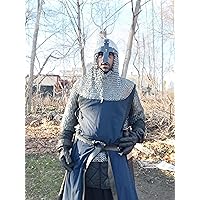
Reeling from their losses at Callinicum, the Roman army has repulsed the Persians from Mesopotamia, but at horrendous cost. Belisarius’ improbable triumph at Dara is cast aside by a vengeful legate, condemning Constantinople’s vaunted general to ignominious imprisonment. With his last order, Belisarius pleads with Varus to lead the army to safety and to bring peace to a shattered land.
Yet, conflict flares at other corners of the Empire with the merciless Vandal hordes looming over the wealthy cities of Egypt, pillaging and burning along the African coastline. Emperor Justinian greedily snatches at the opportunity, instructing his battered armies to seize the fabled city of Carthage against a tribe fabled for their appetite for destruction, undefeated in a century of combat against the Romans. And, against a warrior class that understands only one law: strength conquers all.
During preparation for war against the Vandals, the Emperor funds a glorious spectacle of chariot racing, drawing tens of thousands from across the Empire to the Hippodrome. Yet, just as an unbowed enemy occupies the fabled city of Carthage, so too have foes of the Emperor multiplied within the walls of Constantinople. Overtaxed, starving, and brutalized by the Emperor’s lawgivers, the Hippodrome’s sea of Green and Blue racing supporters are like kindling, awaiting the faintest spark to ignite in revolt against the heir to Caesar.
From civil strife to distant war, the Eastern Empire shall never be the same. And, in his moment of greatest need, the Emperor seeks the aid of Belisarius not only to achieve dreams of Roman glory along the distant African coast, but to save the lives of the Imperial court amidst the most disastrous rebellion in living memory.
“The Gates of Carthage: A Novel of Belisarius (The Last of the Romans Book 3),” continues the downward trend of Book 2. Losses of Continuity, Proofreading Fails, and use of modern / contemporary verbiage, purloined quotes that are re-worked and nomenclature in an allegedly 6th century era novel (command center, landing craft, beach head, ‘f-bombs, etc) abound. A Vandal chieftain character simulates his heart broken like a social media diva before galloping off. The navel gazing by the main protagonist(?) is unrelenting, ‘woe is me’ his mantra, as he searches for for pseudoscience therapy. All-in-all the wikismart focus group narrative is supremely odious.
Read fully via KU with some Notes / Highlights on Goodreads.
Nicely paced & mostly well plotted. Although a work of fiction, it is based on the state of the ancient world. It is easy to forget what it cost to establish Western civilization. Stories like these remind us of what we stand to lose with our current Western civilization under threat. We must never allow the wholesale return to barbarism under the guise of social justice & political ideology.
Completing the Trilogy, Havelock now has Belisarius in prison after the battle with the Persians, which Belisarius won by strategy despite the Persian superiority in numbers. Belisarius is thrown into prison by his political colleague and rival, Hermogenes. This effectively takes Belisarius out of the story, and begs the question, why is this Trilogy named 'A Novel About Belisarius'?
The action is all about Varus (Pharas) the Herulian, one of Belisarius's trusted commanders. In this part, Pharas is thrown into prison with a Persian hostage, Prince Xerxes the son of the Sassanid King Khavath. After a kangaroo court trial, during which a friend appears as if by a miracle to plead on his behalf, he is released and reunited with his wife and daughter. But the most striking chapters are those devoted to the Nika riots of 532 CE in which many of Varus's comrades are slain, in protests at Justinian's lavish lifestyle and needless foreign wars, while the common citizenry starved and Constantinople lay open to invaders. Ultimately, Theodora and Justinian, with the help of Varus and Belisarius, retain the throne against the mob's nominee, Hypatius. The final chapters are dedicated to Vandal wars and the retaking of Carthage.
This trilogy would have benefited as a single standalone book. It is not fair either to the memory of Belisarius, not to that of Varus, though sympathetic to both. The empress Theodora is revealed in this volume to be calculating and manipulative to the point of plotting murder, although in the earlier books, she had a more positive colouring. Justinian is shown to be a cowardly bully, and the main antagonist, while he is able to inflict serious damage, is at best a threat in the background. And while it has few anachronisms, the word 'shrapnel' jumps out at you in the era of spears and swords. It is a curiously unsatisfactory book, despite the wealth of striking characters and the great military struggles.
This is the best book thus far in the series. I loved Belisarius' portrayal in this third installment covering the Vandal war - cunning beyond all measure, a true soldier's leader, yet also incredibly human. This story came to life as I read it and provided one of the best battle scenes I've ever read with the final push against a horde of Vandals. The plot continues to thicken and I can't wait until the next book.
I thoroughly enjoyed this story. I feel as if I am going through what the characters are going through. I hear the honor and oath taking of these historical characters. I can imagine Belisarius standing tall, holding Justin's oath in his head. Well done. More. More. More!
I LOVED all three of these, the author did a SUPERB job bringing these tales to Life! The best part is the blending of reality with fiction, I felt like I knew them when I was done. I have a giant crush on Varus (Pharus). Cant wait for more. You have a big fan here, Mr. Havelock. ❤️
Sometimes hard to follow, but a highly enlightening while entertaining story. Seems remarkably possible as written. The author has an uncanny insight into the minds and psyche of his characters. The one thing that could make it easier to understand would be if Amazon could find a way to include copies of the maps provided in the print version.
While the Author takes some liberties this being historical fiction I found this really quite a good account of Belisarius invasion of North Africa. The characters are very believable and a nicely not to life. The description of the Roman armies and their battles are also very well done.
This story of Eastern Roman Empire retaking of Carthage was exciting and intricate with many upd and downs and narrow escapes for Varus who maintains his honor by never taking the expedient path even when his very life is at stake. Excellent read and shockingly true to historical events.
Great history, solid pacing and plot. Definitely a worthy read for historical fiction fans and I look forward to the next installment. My only complaint is that I wanted more.
It is an interesting era that has not been covered as much as the early Roman empire. With real characters and incidents from the period that bring the story to life.
It's difficult nowadays to find truly well written & riveting historical novels. The last of the Romans series I'd an example of just such books. Brilliant, just brilliant!!
While apparently not the capstone to the Belisarius series, this book was most entertaining, with a story line that flowed quickly and purposely. My only complaint was that there seemed to be a handful of mis-spellings or other editing errors. Proof readers.....please do a better job.
Once again, Havelock’s sublime writing and corresponding imagery is a pleasure to read. Possibly intended, the continuing saga of Varus and Belisarius compels the reader to press further into historical research. A must read for those who enjoy Roman history.
Havelock researched the society and culture of the period and incorporated it seamlessly into the three Belisarius novels. His writing is super and the reader flows with the novels. Highly recommend.
Good continuation of previous books although shorter on detail than earlier novels. I looked forward to reading ever night. Look forward to the next installment.
Mix of interesting interpersonal relationships, conflicts, alliances and betrayals, all of which develop alongside the struggle for the Eastern Roman Empire to survive And recapture some of ‘the grandeur that was Rome.’
Love learning history but hate reading history books. Historical novels make history fun, when the writer adds a little humor, well developed characters & relationships & slips a fair amount of history in!
This is just a top-notch, well-written, well-researched, novel of the continuing adventures of Belisario and Varus. It is exactly on par with the past two installments of the series.