

What do you think?

I've Got Your Back: The Indispensable Guide to Stopping Harassment When You See It
Hollaback!'s accessible and engaging step-by-step instructional guide to safe and effective bystander intervention
Bystander intervention is simply overcoming that freeze instinct and getting back to the very human desire to take care of one another. It's not about being the hero, strapping on spandex, and saving the day. And it certainly isn't about sacrificing your own safety. From the nonprofit organization Hollaback!, I've Got Your Back teaches listeners the ins and outs of bystander intervention using Hollaback!'s methodology: the 5D's of bystander intervention--distract, delegate, document, delay, and direct. Each chapter of the book dives deeply into what these D's can look like in practice, whether you are in public, online, or at work.
The rise in interest of bystander intervention comes at a moment when trust in the institutions historically responsible for keeping us safe is crumbling. However, as trust in our systems falters, trust in our own agency and our own ability to create change is rising. Perhaps for the first time we see that our actions matter. Or, at a minimum, we know our actions are the only thing we can truly control. We all have a role to play when it comes to ending hate and harassment in our communities. If you're new to these efforts, I've Got Your Back will give you the skills to get started. And if you've been doing this work for years, this book will provide you with the language to mentor others just beginning their journey.
Bystander intervention is simply overcoming that freeze instinct and getting back to the very human desire to take care of one another. It's not about being the hero, strapping on spandex, and saving the day. And it certainly isn't about sacrificing your own safety. From the nonprofit organization Hollaback!, I've Got Your Back teaches listeners the ins and outs of bystander intervention using Hollaback!'s methodology: the 5D's of bystander intervention--distract, delegate, document, delay, and direct. Each chapter of the book dives deeply into what these D's can look like in practice, whether you are in public, online, or at work.
The rise in interest of bystander intervention comes at a moment when trust in the institutions historically responsible for keeping us safe is crumbling. However, as trust in our systems falters, trust in our own agency and our own ability to create change is rising. Perhaps for the first time we see that our actions matter. Or, at a minimum, we know our actions are the only thing we can truly control. We all have a role to play when it comes to ending hate and harassment in our communities. If you're new to these efforts, I've Got Your Back will give you the skills to get started. And if you've been doing this work for years, this book will provide you with the language to mentor others just beginning their journey.
207 pages, Kindle Edition
First published May 1, 2022
Ratings & Reviews
Friends & Following
Create a free account to discover what your friends think of this book!
Community Reviews
Displaying 1 - 15 of 15 reviews

couldnt-finish
October 11, 2022I love the intent behind this book and I have no doubt it's a valuable tool in conjunction with Right To Be's Bystander Intervention training.
As a standalone guide, however, it feels like a pamphlet writ large and not responsibly.
The language seems aimed at readers who are already on a path to intersectionality and public activism so it may not be accessible to those who want to help but haven't been in activist spaces before. The graphics, which can enhance a guide, were not as concise as they should have been.
For example:
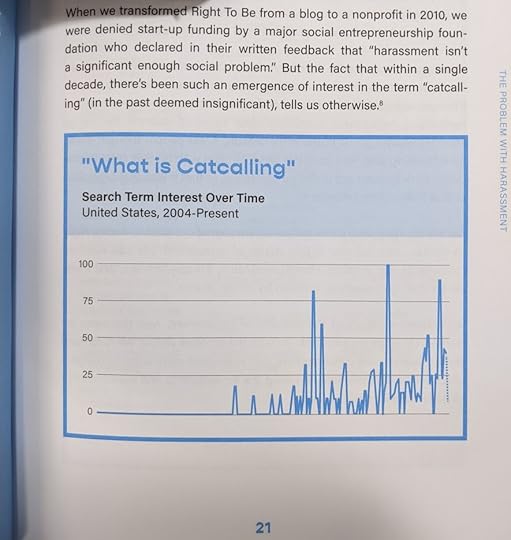
The years aren't shown along the X axis, the numbers on the Y axis aren't clarified. 100 what? Searches per year? 100 thousand? What's the context? Were these searches in a US high school library? Google searches?
and this is misleading:
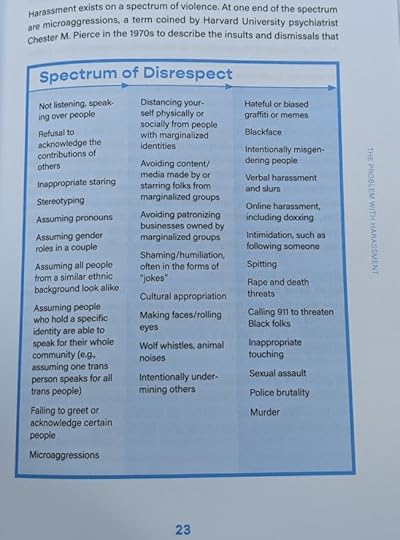
It looks like spitting is on the same level as SWATting. Getting spit on, especially in the face, is horrible. I'm not sure I would classify it as horrible as a rape threat. Maybe these aren't listed in three worsening categories of threat but that's what the chart looks like and I question why some of these actions are in the columns they're in.
I had this book for a month. It's very short at 205 pages and there are a lot of graphics so it's a quick read but I still wasn't able to get through it. I didn't feel like I could trust the information being given.
I think this will be helpful for a specific audience but I'm not sure it's going to work to empower mainstream do-gooders to feel confident in standing up for people being harassed in public spaces.
As a standalone guide, however, it feels like a pamphlet writ large and not responsibly.
The language seems aimed at readers who are already on a path to intersectionality and public activism so it may not be accessible to those who want to help but haven't been in activist spaces before. The graphics, which can enhance a guide, were not as concise as they should have been.
For example:
The years aren't shown along the X axis, the numbers on the Y axis aren't clarified. 100 what? Searches per year? 100 thousand? What's the context? Were these searches in a US high school library? Google searches?
and this is misleading:
It looks like spitting is on the same level as SWATting. Getting spit on, especially in the face, is horrible. I'm not sure I would classify it as horrible as a rape threat. Maybe these aren't listed in three worsening categories of threat but that's what the chart looks like and I question why some of these actions are in the columns they're in.
I had this book for a month. It's very short at 205 pages and there are a lot of graphics so it's a quick read but I still wasn't able to get through it. I didn't feel like I could trust the information being given.
I think this will be helpful for a specific audience but I'm not sure it's going to work to empower mainstream do-gooders to feel confident in standing up for people being harassed in public spaces.

March 2, 2025
This was okay. It's a great primer for bystander intervention. It's victim-focused and about getting the harassed to safety. They're the one being attacked. Attention and care should be directed to them, not the harasser. Give the harasser as little attention as possible. Show them they don't matter.
It introduces 5 tactics: distract, delegate, document, delay, and direct.
Distract involves getting in-between the harasser and the harassed, either physically or socially. Drop your coffee, your books, your phone. Fall over. Start singing. Interrupt the exchange with a "Hey bestie!" Make a scene. Break the script that's playing out. Then give the victim a sign. A look. A smile. A hand gesture. Mouth 'go'. Let them know you've done this for them.
Delegate involves recruiting others with you to intervene. It's about safety in numbers. It's shaking people out of their freeze response. Their fear of the harasser. Their confusion that no one else is helping. Something as simple as "Hey, this isn't right, we should do something" to more direct "Can you film this while I step in, so we have evidence of what happened here?" It's creating a spontaneous community of care.
Document is getting footage. Writing down events. Then handing it over to the victim for them to decide what to do with it. You can be sneaky about this. Pretend to be taking a selfie. Have your phone in your lap/by your waist. Ofc, prioritise the safety of the harassed before documenting. Don't traumatise them further by only filming the harassment.
Delay involves approaching the harassed after the event and telling them the harassment they received was messed. It's about validating their experience, rejecting the normalisation of violence, and giving them space to process. It's knowing you can still intervene, even if you froze or arrived too late. Don't victim blame, don't give unsolicited advice, don't minimise the harassment: this is about them and their shaken worldview, not you and yours. Practice active listening, empathic attunement, emotional intelligence.
Direct is creating a boundary between the harasser and the harassed. It's the most dangerous method, because it involves directing the harasser's attention to you. Some of it is simple shit like "What did you mean by that joke?" and when they try to weasel their way out of it you double down and make them feel uncomfortable. Show them that their racism or transphobia isn't commonsensical, but absurd. So they apologise or leave. The point isn't to grill them, however, but to reconstitute a safe space for the harassed. An assertive "Back off." A less direct method, especially online, is providing a counternarrative. Steal a hashtag and flood it with supportive messages for whoever is being targeted. Fact check and expose harassers. Make them cringe and retreat.
So why 3 stars? Because there's a lot of bad advice here too. Emily and Jorge repeatedly say it's a myth that you can avoid harassment by changing your behaviour. They argue that it's the harasser who must change, not the harassed. They do this to push against victim-blaming narratives that pin the blame of rape on woman raped, abuse on the partner being abused, and so forth. This is righteous, but there's a big difference between victim-blaming yourself and learning how to survive a violent world filled with evil. You can accept that it's not your fault you're being harassed, without losing the pragmatics of how to dress to avoid attention, which neighbourhoods to avoid because they're full of rapists who prop each other up, and what times of day are safer because of the crowds around you. It is fucking obscene to say, "babe, don't change your behaviour," when it's your life at risk, when it's your body being scrutinised, when it's your agency being stolen from you. There will not always be an intervener; someone will not always have your back.
It's also quite a milquetoast book. It opens with mention of the Black Panthers and the Stonewall Riots, but quickly reorients to an institutional setting. What to do when a colleague makes an inappropriate pass. And like, that's important. It's what we're surrounded by day to day. These are the microaggressions that wear us down until we're nothing but self-negation. But the opening led me to believe this book would engage with a more systemic analysis of harassment. Of harassment architectures. Of how harassers spread insidious ideas, like how rape isn't real. Or of how harassment is built into governmental and medical institutes that gatekeep resources we literally pay taxes for. But no, this book is about individualist interventions. There's no information on how to create a community of interveners. What kinds of workshops we should run and how often. Practical exercises to overcome freezing. To sound confident. What ongoing support we should provide to the harassed. Whether it's worth trying to turn harassers into interveners. There's just a general lack of coherence. So while I appreciate the skills being taught, it feels far too atomised, idealised, and neoliberal in its approach.
Highly recommend complementing this with nonviolent communication/resistance. Plenty of people in various restorative and transformative justice spaces will tell you about how many violent perpetrators have become some of the most ardent advocates of social justice, community building, and healing. There's a line in this book where the intervener just says to the harasser "Hey, that's transphobic" and it's like, okay, cool, does this help? Sure, it tells the harasser that they're not welcome in this space, but does it change their views? Do we want to get people on our side, or just push them out? Have we engaged with their grievances, or just told them their grievances don't matter? Because no matter who they're scapegoating to justify their aggression, there's a deeper hurt there. Hurt people hurt people. And maybe this isn't the book for these thoughts, but, at the same time, it feels incomplete without such thoughts.
It introduces 5 tactics: distract, delegate, document, delay, and direct.
Distract involves getting in-between the harasser and the harassed, either physically or socially. Drop your coffee, your books, your phone. Fall over. Start singing. Interrupt the exchange with a "Hey bestie!" Make a scene. Break the script that's playing out. Then give the victim a sign. A look. A smile. A hand gesture. Mouth 'go'. Let them know you've done this for them.
Delegate involves recruiting others with you to intervene. It's about safety in numbers. It's shaking people out of their freeze response. Their fear of the harasser. Their confusion that no one else is helping. Something as simple as "Hey, this isn't right, we should do something" to more direct "Can you film this while I step in, so we have evidence of what happened here?" It's creating a spontaneous community of care.
Document is getting footage. Writing down events. Then handing it over to the victim for them to decide what to do with it. You can be sneaky about this. Pretend to be taking a selfie. Have your phone in your lap/by your waist. Ofc, prioritise the safety of the harassed before documenting. Don't traumatise them further by only filming the harassment.
Delay involves approaching the harassed after the event and telling them the harassment they received was messed. It's about validating their experience, rejecting the normalisation of violence, and giving them space to process. It's knowing you can still intervene, even if you froze or arrived too late. Don't victim blame, don't give unsolicited advice, don't minimise the harassment: this is about them and their shaken worldview, not you and yours. Practice active listening, empathic attunement, emotional intelligence.
Direct is creating a boundary between the harasser and the harassed. It's the most dangerous method, because it involves directing the harasser's attention to you. Some of it is simple shit like "What did you mean by that joke?" and when they try to weasel their way out of it you double down and make them feel uncomfortable. Show them that their racism or transphobia isn't commonsensical, but absurd. So they apologise or leave. The point isn't to grill them, however, but to reconstitute a safe space for the harassed. An assertive "Back off." A less direct method, especially online, is providing a counternarrative. Steal a hashtag and flood it with supportive messages for whoever is being targeted. Fact check and expose harassers. Make them cringe and retreat.
So why 3 stars? Because there's a lot of bad advice here too. Emily and Jorge repeatedly say it's a myth that you can avoid harassment by changing your behaviour. They argue that it's the harasser who must change, not the harassed. They do this to push against victim-blaming narratives that pin the blame of rape on woman raped, abuse on the partner being abused, and so forth. This is righteous, but there's a big difference between victim-blaming yourself and learning how to survive a violent world filled with evil. You can accept that it's not your fault you're being harassed, without losing the pragmatics of how to dress to avoid attention, which neighbourhoods to avoid because they're full of rapists who prop each other up, and what times of day are safer because of the crowds around you. It is fucking obscene to say, "babe, don't change your behaviour," when it's your life at risk, when it's your body being scrutinised, when it's your agency being stolen from you. There will not always be an intervener; someone will not always have your back.
It's also quite a milquetoast book. It opens with mention of the Black Panthers and the Stonewall Riots, but quickly reorients to an institutional setting. What to do when a colleague makes an inappropriate pass. And like, that's important. It's what we're surrounded by day to day. These are the microaggressions that wear us down until we're nothing but self-negation. But the opening led me to believe this book would engage with a more systemic analysis of harassment. Of harassment architectures. Of how harassers spread insidious ideas, like how rape isn't real. Or of how harassment is built into governmental and medical institutes that gatekeep resources we literally pay taxes for. But no, this book is about individualist interventions. There's no information on how to create a community of interveners. What kinds of workshops we should run and how often. Practical exercises to overcome freezing. To sound confident. What ongoing support we should provide to the harassed. Whether it's worth trying to turn harassers into interveners. There's just a general lack of coherence. So while I appreciate the skills being taught, it feels far too atomised, idealised, and neoliberal in its approach.
Highly recommend complementing this with nonviolent communication/resistance. Plenty of people in various restorative and transformative justice spaces will tell you about how many violent perpetrators have become some of the most ardent advocates of social justice, community building, and healing. There's a line in this book where the intervener just says to the harasser "Hey, that's transphobic" and it's like, okay, cool, does this help? Sure, it tells the harasser that they're not welcome in this space, but does it change their views? Do we want to get people on our side, or just push them out? Have we engaged with their grievances, or just told them their grievances don't matter? Because no matter who they're scapegoating to justify their aggression, there's a deeper hurt there. Hurt people hurt people. And maybe this isn't the book for these thoughts, but, at the same time, it feels incomplete without such thoughts.
October 12, 2022
Favorite quotes:
From chapter 2, "The Problem with Harrassment"
"Addressing bias is a lifelong process, not something that happens overnight. It takes consistent work and deep self-awareness. The most important thing you can do...is to 'stay in the game. Don't get frustrated and bench yourself or walk off the field. That's how you get into trouble. You've just got to lean into the discomfort and keep playing.' p 30
"The way we treat people becomes so normalized over time that it becomes entrenched in policy and law. We have seen countless examples of this: consider the resolution to blame China for COVID-19, the many transphobic bathroom bills, Jim Crow voting laws, redlining, 'Stop-and-Frisk,' the legalized separation of children from their families at the US/Mexico border, and many more. When we embody hate, it doesn't just leak out of our mouths - it leaks out into our halls of power and becomes the basis for decisions that create even more harm. p 38
From chapter 3, "Reasons Not to Intervene"
"Online, the police also use virtual forums to self-organize and perpetuate hate. For example, Facebook contains numerous groups and pages where police post racist, misognynistic, homophobic, transphobic, and xenophobic memes and language." p 52
From chapter 2, "The Problem with Harrassment"
"Addressing bias is a lifelong process, not something that happens overnight. It takes consistent work and deep self-awareness. The most important thing you can do...is to 'stay in the game. Don't get frustrated and bench yourself or walk off the field. That's how you get into trouble. You've just got to lean into the discomfort and keep playing.' p 30
"The way we treat people becomes so normalized over time that it becomes entrenched in policy and law. We have seen countless examples of this: consider the resolution to blame China for COVID-19, the many transphobic bathroom bills, Jim Crow voting laws, redlining, 'Stop-and-Frisk,' the legalized separation of children from their families at the US/Mexico border, and many more. When we embody hate, it doesn't just leak out of our mouths - it leaks out into our halls of power and becomes the basis for decisions that create even more harm. p 38
From chapter 3, "Reasons Not to Intervene"
"Online, the police also use virtual forums to self-organize and perpetuate hate. For example, Facebook contains numerous groups and pages where police post racist, misognynistic, homophobic, transphobic, and xenophobic memes and language." p 52

December 14, 2024
This book gave me hope in humanity. I learned a lot about harassment (things that I didn’t know are considered harassment) the types and the spectrum, it’s very educational.

July 1, 2023
I read this book as part of my work research on Bystander Intervention. Many universities now mandate a training on how to safely intervene when we see abuse, harassment and discrimination. At first glance, I thought this book wasn't going to have a lot of information as it mostly targeted the 5D's of bystander intervention, but I was wrong. This book carries a lot of example and stories that gave me a clear perspective of just how much we can do to help others.
March 18, 2022
Brilliant! I tried to get Hollaback! (now called Right to Be) to come present to my organization but they were all booked up last year. I'm so glad they are getting the word out about bystander intervention and how to be an ally. I wish that everyone would read this book. You never know at what moment you might need to use this training, and this book will give you all the tools you need to be able to handle moments of uncertainty where otherwise you just wouldn't know what to say or do. Read this and next time you can say "I've got your back".
Thank you to NetGalley and ABRAMS for the opportunity to review this free e-arc in exchange for an honest review.
Thank you to NetGalley and ABRAMS for the opportunity to review this free e-arc in exchange for an honest review.
June 4, 2022
This book is indeed indispensable. It speaks to the moment, offering actionable actions and behaviors to disrupt patterns of abuse and harassment that occur in daily life. As someone who has been both harassed and has witnessed harassment happen to others, this is a the best blueprint I have seen for how to advocate for yourself and others in safe, intelligent and mindful ways. Right to Be is an incredible organization and I recommend this book for everyone, especially those interested in good citizenship, something desperately needed in these times.
June 13, 2022
"Indispensable" is the perfect word to describe this book-- it is a must-read for any and everyone, especially those involved in movement work. It is clear and concise in its description of how to understand what harassment looks like, how to intervene in instances of harassment, and how to better build movements and communities that are free of harassment and full of respect, dignity, and joy. I am eager to continue following the work of Emily May and Jorge Arteaga and supporting and donating to the brilliant organization they run, Right To Be!
May 24, 2022
I happened to stumble upon this book the day it was released and purchased it. I read it that weekend and all I can say is WOW. Such an important read at such a critical time. The information was delivered in an easy to digest way that left me feeling empowered and informed. I will be sharing things I learned in this book with my team and my kids. Definitely a must read!

August 27, 2023
A wonderful tool for beginners looking to understand the complexities of consent and race, as well as those more familiar with consent culture looking to gain resources - good to use as either/or a workbook (to journal alongside), or a quick read to remind ourselves how very prevalent this issue is. Definitely recommended for consent culture 101!

July 22, 2022
I learned a ton from this book and I highly recommend it. I am embarrassed that I didn't know there were that many types of bystander intervention and the ideas for using them together were really helpful.

December 2, 2025
Do you wish you were brave and had the perfect words to intervene when someone is harassing someone else? This book won’t give you the perfect words for every situation, but it will give you excellent tools to use in the real world. Now I just have to put it into practice.
June 6, 2022
Amzing book! As an Asian American who is being targetted with racism. This book helped me to stand up for myself and protect my children as well.

July 17, 2022
A good resource to accompany Right to Be/Hollaback trainings
May 22, 2024
While some stuff was good, it was mostly surface level performative stuff that just wasn’t realistic
Displaying 1 - 15 of 15 reviews