Jump to ratings and reviews
Rate this book

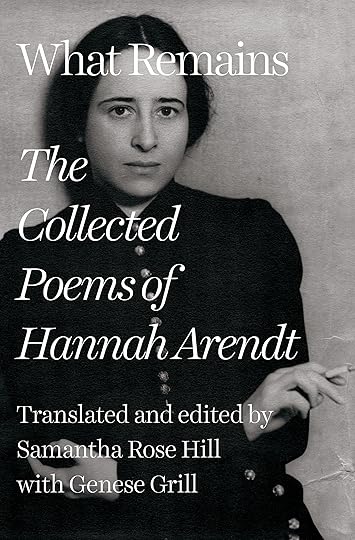
What Remains: The Collected Poems of Hannah Arendt

Rate this book
A landmark literary event, What Remains collects Arendt’s complete poetic oeuvre—never before published in English.

Internationally renowned as one of the twentieth century’s foremost public intellectuals, Hannah Arendt was also intensely private. Though she often acknowledged that the language of poetry—especially that of Dickinson, Goethe, and Lowell—informed her work, only a few people knew that Arendt herself wrote poems.

In fact, between 1923 and 1961, Arendt wrote seventy-four poems, many of them signposts in an otherwise unwritten autobiography. For nearly forty years after her death, these poems remained hidden among the archives of the Library of Congress, until 2011, when they were rediscovered by scholar and translator Samantha Rose Hill. Now, for the first time in English, Hill and Genese Grill present Arendt’s poems in chronological order, taking us from the zenith of the Weimar Republic to the Cold War, and from Marburg, Germany, to New York’s Upper West Side.

Throughout, Arendt uses poetry to mark moments of joy, love, loss, and reflection. In “W. B.,” written in 1942, she remembers Walter Benjamin, who died near the French-Spanish border while attempting to flee the Nazis: “Gentle whispering melodies / Sound from the darkness. / We listen so we can let go.” So, too, she reflects on mutability and transience in 1946: “I know that the houses have fallen. / We entered the world in them, wonderfully sure, that they / were more durable than ourselves.” She tries to understand her place in the world: “Ironically foolish, / I’ve forgotten nothing, / I know the emptiness, / I know the burden, / I dance, I dance / In ironic splendor.”

A gift to all readers of Arendt, this stunning, dual-language edition provides an unparalleled view into the inner sanctum of one of our most original thinkers.

208 pages, Hardcover

First published December 10, 2024

38 people are currently reading
3032 people want to read

About the author

Hannah Arendt

404 books4,864 followers
Hannah Arendt (1906 – 1975) was one of the most influential political philosophers of the twentieth century. Born into a German-Jewish family, she was forced to leave Germany in 1933 and lived in Paris for the next eight years, working for a number of Jewish refugee organisations. In 1941 she immigrated to the United States and soon became part of a lively intellectual circle in New York. She held a number of academic positions at various American universities until her death in 1975. She is best known for two works that had a major impact both within and outside the academic community. The first, The Origins of Totalitarianism, published in 1951, was a study of the Nazi and Stalinist regimes that generated a wide-ranging debate on the nature and historical antecedents of the totalitarian phenomenon. The second, The Human Condition, published in 1958, was an original philosophical study that investigated the fundamental categories of the vita activa (labor, work, action). In addition to these two important works, Arendt published a number of influential essays on topics such as the nature of revolution, freedom, authority, tradition and the modern age. At the time of her death in 1975, she had completed the first two volumes of her last major philosophical work, The Life of the Mind, which examined the three fundamental faculties of the vita contemplativa (thinking, willing, judging).

Ratings & Reviews

What do you think?
Rate this book

Friends & Following

Create a free account to discover what your friends think of this book!

Community Reviews

5 stars
80 (25%)
4 stars
142 (44%)
3 stars
82 (25%)
2 stars
13 (4%)
1 star
0 (0%)
Displaying 1 - 30 of 46 reviews
Profile Image for Paula Mota.
1,668 reviews567 followers
September 29, 2020
À NOITE
Tu que consolas, inclina-te sobre
o meu coração sem fazer ruído.
Tu que calas, dispensa alívio às minhas dores.
Interpõe a tua sombra diante de tudo
o que é demasiado claro
e traz o adormecer que me conceda uma
fuga do estridente.

Deixa-me o teu silêncio,
essa moderada libertação.
Deixa que oculte o mal na escuridão.
E quando a claridade me mortificar
com novas visões
dá-me força para cumprir
em todo o momento com o meu dever.


A versão que li é a da editora Sr Teste, um livro muito maneirinho, de apenas 53 páginas, ao qual só fica a faltar um pequeno preâmbulo a contextualizar a poesia de Hannah Arendt ou, pelo menos, a data de escrita de cada um destes poemas, que foram publicados postumamente. Os poemas de Arendt não são muito sofisticados nem complexos, assemelhando-se mais a pequenos desabafos sobre a passagem do tempo, com uma enorme insistência no tema da noite e do crepúsculo, e sobre os momentos trágicos da sua vida, como a morte de alguns amigos e facto de ser apátrida por o regime nazi lhe ter tirado a nacionalidade.


W.B. [Walter Benjamin]
Novamente escurece a tarde
e das estrelas cai a noite
enquanto nos deitamos
e estendemos os membros
ao perto e para longe.

Saem das trevas
pequenas e plácidas melodias.
Agucemos os ouvidos para o descontrolo.
Já é hora de expulsar as correntes.

Se remotas são as vozes, próxima está a
angústia:
aquelas vozes daqueles mortos
que enviámos como emissários
que nos precedem
para nos escoltarem até ao entorpecimento.
384 reviews13 followers
Read
April 16, 2021
Todo el mundo conoce la faceta filosófica (o teórica política, para no hacerla enfadar) de Arendt, por lo que saber que escribía poesía es toda una sorpresa. Para mí lo ha sido. Aun así, hay que ser precavidos y no esperar una poeta profundamente filosófica. Hay filosofía en sus poemas, sí, pero en pequeñas dosis. Lo que prima es una búsqueda hacia el pasado de la autora con vistas a esclarecer su presente y poner en regla sus sentimientos, un tanto arrolladores si se tiene en cuenta que la mayoría de los poemas fueron escritos en el exilio y los que escribió en Alemania se dan en el contexto de su affaire con Heidegger. Así, su poesía se vuelve más un ejercicio de memoria, una forma de volver a aquella lengua materna (tanto en un sentido figurado como literal) que siempre queda. Sin embargo, que sean poemas emotivos no quiere decir que sean irracionales, pues Arendt es muy capaz de canalizar sus sentimientos y llenarlos de razones.

Hasta ahora he sido muy descriptivo. Si tuviese que mojarme debería decir que como tales los poemas son correctos o al menos correcta es la traducción. ¿Solo correctos? Lo cierto es que al no ser un poemario propiamente dicho falta una unidad temática o estilística y eso se nota, por lo que la experiencia de lectura no resulta "única", por decirlo de alguna manera. Eso no quita que haya algunos poemas absolutamente brillantes y que su lectura por lo general sea agradable. Hay que entender estos poemas como lo que son: retazos muy personales de una amante de la poesía cuyos esfuerzos intelectuales, no obstante, estaban en otra parte.
Profile Image for la poesie a fleur de peau.
508 reviews63 followers
January 21, 2021
"Ainda sem notícias
daqueles dias em que,
dando lugar um ao outro,
consumiram-se fogosamente,
dilacerados:
a ferida que deixa
torna-se estigma, não cicatriz.

Dele não chegaram notícias

Se o teu dizer
não lhe ofereceu permanência:
a palavra poetizada
é sede que ampara e não garantia."

***

Este livro comporta um nível de dor extremo. Uma espécie de nervo em permanente tensão, que só raramente encontra uma verdadeira libertação; vive de cinzas, de escuridão, de solidão. E é perfeito.
Profile Image for Sophie.
289 reviews334 followers
April 21, 2016
Eine Frau, die dichtend denkt, ist Hannah Arendt definitiv.
Sie vereint Erzähltraditionen, Geschichtsschreibung und Poesie in ihrem Werk, angeleitet von Vorbildern wie Martin Heidegger und Hermann Broch [denen sie beiden durch Gedichte und Biografien Denkmäler gesetzt hat].
Hannah Arendt reagiert auf Verluste, Liebesschmerz, die Ermordung der Juden, dahingehend ist dieser Gedichtband natürlich von Negativvokabular dominiert. Sowohl romantische als auch klassische Elemente [die von einer Bewunderung von Goethe/Schiller herrühren] als auch volksliedhafte Anteile vermischen sich mit strengen Reimkonventionen oder treten in freien, Versen aber durchaus in komponierten Strophen auf.
Mir gefiel dieser Gedichtband sehr gut.
Natürlich gefiel mir nicht jedes einzelne Gedicht.
Leider "doppelten" sich 2 Gedichte, um auf eine frühere und spätere Phase der Bearbeitung hinzuweisen [das hätte für mich lediglich in den Editorischen Bereich gehört].
Für 20,00€ bekommt man also:
- Ein gebundenes schmales Bändchen mit Schutzumschlag
- 71 Gedichte [durchnummeriert, oftmals Ohne Titel]
- ein hübsches Lesebändchen
- ein Essay über Arendts Dichtung [25 Seiten]
- Editorische Notizen mit Hinweisen auf Ersten/Zweiten Druck, Erstveröffentlichung, Hinweise auf Widmungen und Veränderungen der Gedichte
Als Gesamtwerk macht es dieses Werk also möglich, es durchaus für Studienzwecke zu nutzen, aber auch mir im Privaten machte es große Freude, mehr über Hannah Arendt zu erfahren und wie sie über [ihre] Dichtung dachte und in welchen Traditionen sie schreibt.
(: Eine Empfehlung!
Profile Image for Gabriela.
164 reviews10 followers
June 26, 2025
Le compré este libro a mi papi porque quería tener los poemas de Hannah Arendt a la mano, le gustaban mucho.
Por fin lo leo y me place ver a la poesía de mi papá en la poesía de quien admiraba.
Me gustó el ensayo final, muy conmovedor y esclarecedor :)
Profile Image for Zoë.
53 reviews
January 15, 2025
4* for the poems and the translation; however the digital edition of this book has been directly carried across from a print version, so there's a very distracting issue with the parallel translations that makes some of these poems unreadable. if you're considering buying this book, buy it physically.
Profile Image for Alan Navarro.
99 reviews13 followers
August 3, 2022
Una interesante recopilación de poemas de una mente brillante. No hay mucho qué decir, ya que la colección está curada, pero no deja de ser eso, un álbum de poemas que van desde lo romántico/trágico (suponemos que dedicados a Heidegger) hasta la introspección profunda, cómo lo etéreo y lo imaginativo.
Profile Image for Juliet.
31 reviews
May 14, 2025
One of my all time favorite philosophers comes out with a poetry collection??? This I gotta read. Most of the poems were brilliantly written, the footnotes included by the translators were really insightful as well. I really enjoyed having the original German versions as well, it was fun to compare and contrast diction and phrasing. Overall a good read.
Profile Image for Maribel.
7 reviews2 followers
August 1, 2018
"No hay palabras que irrumpan en la oscuridad
ni dioses que alcen la mano.
Adonde quiera que mire...
tierra amontonándose.
No hay formas que se desprendan.
Y sigo oyendo todavía:
Demasiado tarde, demasiado tarde"
Profile Image for Zuy.
23 reviews
May 9, 2025
Es la primera vez que leo a Hanna Arendt y justamente estaba buscando un acercamiento más íntimo y real a la manera en la que pensaba o sentía, por lo que iniciar con este libro me parece muy indicado ❤️
Me encantaron los conceptos de: pensamiento poetizado y meditativo
Profile Image for Nadin.
Author 1 book28 followers
Read
June 17, 2025
"Komm und wohne
in der schrägen, dunklen Kammer meines Herzens,
dass der Wände Weite noch zum Raum sich schliesst.

Komm und falle
in die bunten Gründe meines Schlafes,
der sich ängstigt vor des Abgrunds Steile unserer Welt."

Arendts Gedichte lesen sich größtenteils ziemlich emo, auch mal politisch und oft wie kleine Lieder.
Profile Image for Sarah.
96 reviews
Read
April 10, 2025
It turns out I didn't need to read love poems to Heidegger as much as I thought I did. There are a few gems in here outnumbered by blander, more middling poems. I still find it impressive that a political and ethical thinker as brilliant as Arendt maintained a poetic practice throughout her life.


"Then I will run as I ran before
Through grass and trees and fields;
Then you will stand as you once stood
The most heartfelt greeting in the world.

Then the steps will be counted
By what is near and what is far;
Then this life will be recounted
as a dream from long ago."
Profile Image for Holly.
515 reviews31 followers
July 12, 2025
As someone who knows German (not perfectly fluent but well enough to notice this), I was highly disappointed with the translations from German to English. I genuinely feel bad for English readers because none of you are getting the correct translation and in several cases I felt like the entire point of the poem was lost in the shoddy translation. This was all especially disappointing since the introduction focused on Hannah Arendt's own personal issues with her work being translated out of German and how the German language kept her tied to her German identity. My 2 star review has nothing to do with the quality of Arendt's poetry. Her poems are beautiful. Very poor translation, in my humble opinion, that negatively affects the work.

ex: I would never use the word Heimat for home/house, however this is what the translator chooses to translate Heimat to. Heimat is a feeling. A feeling of your homeland, ancestral lands, where you came from, etc. Furthermore, the concept of Heimat was used heavily by the NSDAP for nationalist reasons and I think that is likely what was being referred to by Arendt if you try harder than just a Google Translate search of the word Heimat without any historical or cultural context at all. Like, FFS even the generic Wikipedia page has more context that this translation -- https://en.wikipedia.org/wiki/Heimat
Profile Image for Nora.
49 reviews9 followers
January 6, 2016
Ein Muss für alle, die sich mit Hannah Arendt und ihrem Denken beschäftigen. Rezension folgt...
Profile Image for Ted Kim.
36 reviews1 follower
February 7, 2025
The introduction makes this heartfelt collection worth it. The poems didn’t really move me, however.
Profile Image for Melissa.
72 reviews1 follower
February 10, 2025
The second half is stronger than the first. You can really hear her poetic voice gaining strength, rhythm, and confidence.
Profile Image for Tomás Figueroa.
39 reviews
February 12, 2025
Me atrevería a recomendar este libro primero, antes de incursionar en la obra de Hannah Arendt.
Profile Image for Stephen Okita.
84 reviews1 follower
July 18, 2025
Arendt is one of the most important philosophers in how I shape my methods of understanding philosophy and systems. Poetry for Arendt was that "whose material is language, is perhaps the most human and least worldly of the arts, the one in which the end product remains closet to the thought that inspired it".

Her poems here are presented chronologically as a diary of sorts, detailing the affective states of her storied life. It goes through her many lovers, death's of friends (a lot of deaths), perfunctory moments in strange city, nature and homages. It has so many moving pieces, like her poem to Walter Benjamin (who entrusted her with his works before he killed himself as to evade capture by the Nazis) really grips the tragedy of war.

In general, if you love Arendt or have interacted with her work a lot you will really love this read. I have very elementary German and could see the subtle differences in translation (this book is meant to be read in German at Arendt's request), however it in my understanding is not that big of a dampening force on the effective and affective force of this work.

**Question on how Arendt interacted with Nazi's post WW2?**
Arendt and Hedigger were lovers in pre-nazi Germany when she studied under him. The poems she writes of their love are passionate and move the soul.

Do you not know the day's joys
Walking with a beloved?
Do you not know the evening's farewells,
Partings full of melancholy?

Come with me and make love to me (Komm mit mir und hab mich lieb)
Do not think about your sadness,
Can't you trust yourself-
Come and take and give.


Martin bent the knee to Hitler in 33` while Arendt (a jew) fled. Arendt still writes him a poem in 1953 for Heidegger's 64th birthday.


"The past comes and walks by your side once more.
Don't Change your heart, don't be charmed.
Don't longer, take leave of the time
And hold on to your gratitude and enchantment.
With an Averted Glance."
In her letter's she writes, "your loving remembrance was a great joy in the hourly and daily path of memory.


My question is how tf was Arendt strong enough to still show this level of love and strength to someone who supported and worked for the regime that tortured and murdered her family and 6 million other Jews. While not everyone knew of Martin's Nazi association, it is undoubtable that she did.
Profile Image for Dillon Allen-Perez.
Author 2 books6 followers
April 25, 2025
Hannah Arendt believed that her poetry is untranslatable. Samantha Rose Hill & Genese Grill went ahead & did it anyway. Personally, I thank them for doing it.

Best known for her nonfiction works such as The Origins of Totalitarianism & Eichmann in Jerusalem, Arendt's philosophical writing continued to gain international attention after she fled her home country of Germany in 1933—Nazism on the rise. Though she mostly kept her poetry to herself during her lifetime, or shared with people close to her, Arendt kept her poems in a collected form from 1923 until at least 1961, years before her death in 1975. Finding these poems in their original German in the Library of Congress, Hill & Grill's What Remains offers the first ever English translations of the poetry that Arendt used to "record events, reflect on experiences, & engage in what she [Arendt] called 'the free play of thinking'."

Things will always be lost in translation—maybe in the most significant ways when it comes to poetry. On the other hand, so much is gained when the thoughts and expressions of writers are shared internationally & made more accessible to a greater variety of readers. Plus, this is a bilingual edition. If you can read German, Arendt's original words are conveniently printed on the left page, across from the English translations on the right.

To quote Hill & Grill's introduction to What Remains:
In one of her notebooks [Arendt] asks: “Is there a way of thinking that is not tyrannical?” She never offers a direct response to this question, but my wager is that if she had, it would have been poetic thinking.

“Poetry” she argued, “whose material is language, is perhaps the most human and least worldly of the arts, the one in which the end product remains closest to the thought that inspired it.”
If Arendt is one of the most important thinkers of the 20th century, What Remains is one of the most important poetry publications of the 21st century so far, as it presents the form of her writing that she herself considered closest to her original thoughts.
Profile Image for Ian Mond.
749 reviews120 followers
Read
June 5, 2025
I know. I fucked up. No one in their right mind would pick up Hannah Arendt’s poetry—poetry never formally published but rather sent to lovers and friends—before reading her famous works, books like The Human Condition and The Origins of Totalitarianism.* But Backlisted decided to cover it, and because I do everything they tell me, I skipped the important stuff for this very slim book of interesting but not particularly memorable poetry.

I’m not a connoisseur of poetry. I may have said it here (or in the pages of Locus; it starts to blur after a while), but I avoided poetry as a kid, a teen, and a young and old adult. It’s only recently, primarily because of the aforementioned Backlisted, that I’ve started reading poetry and enjoying it (even if I still find it a bit befuddling). As such, my opinions of Arendt’s poetry should be sneered at, or just dismissed altogether.**

I didn’t hate the poems. I just felt you had to be there, which makes sense because they weren’t written for a wider audience. As I say above, they were written for friends and lovers (all men, from memory). And they were written for Arendt. As Samantha Rose Hill points out in the book’s Introduction, Arendt cared enough about her poems that she carried them:

“over the Ore Mountains to Prague, then to Geneva… She took them to Paris… and they remained with her as she divorced her first husband, then met, fell in love with, and married her second husband… She held on to them for eight years in exile as she worked with Youth Aliyah to help Jewish youth escape to Palestine… [and so on, until Arendt and the poem reach their final resting place—New York City]”

One poem did grab my attention; it could have been written yesterday. Here it is in full:

~Oh, who cares~

What we are and how we appear.
It doesn’t make a difference to them,
What we do or think.

The sky is in flames,
Heaven is on fire
Above us all,
Who don’t know the way

*Which, you know, feels sort of important given the “current moment”. I will, eventually, get to them. I hope.
**This isn’t self-deprecation. I know my limits. Poetry is a weak spot.


Profile Image for Keith.
938 reviews12 followers
June 2, 2025
I picked up What Remains on a whim at my local library. I had no idea that the famous political theorist Hannah Arendt also wrote poetry. What Samantha Rose Hill has given to the English-speaking world is the closest we will ever get to Arendt’s autobiography. It is in her poems, written from 1923 to 1961, that we get a true sense of the great philosopher’s inner thoughts and feelings.

The poems here are generally good, although I can’t say I found anything especially moving. Perhaps much is lost in translating from the original German to English. Hill acknowledges a paradox in this book, because for Arendt her poems were “untranslateable. Because after everything, what remained for Arendt was the language of German poetry” (p. xxix). Still, short of learning German, What Remains provides the best way to read her poems. I particularly enjoyed "Late Summer" (pp. 32-33), the untitled poem on pages 84-87, "H.B." (pp. 90-91), and "Goethe's Theory of Colors" (pp. 132-133).


***************************************************************************


[Image: Book Cover]

Citation:
Arendt, H. (2023). What remains: The collected poems of Hannah Arendt (S.R. Hill & G. Grill, Trans.). Liveright Publishing

Title: What Remains: The Collected Poems of Hannah Arendt
Author(s): Hannah Arendt (1906-1975), Samantha Rose Hill (Editor and Translator), Genese Grill (Translator)
Year: 2024
Genre: Poetry
Page count: 208 pages
Date(s) read: 5/26/25 - 5/28/25
Book 110 in 2025
***************************************************************************
Profile Image for Vítor Leal Leal.
Author 1 book3 followers
August 29, 2025
«À noite

Tu que consolas, inclina-te sobre
o meu coração sem fazer ruído.
Tu que calas, dispensa alívio às minhas dores.
Interpõe a tua sombra diante de tudo
O que é demasiado claro
E traz o adormecer que me conceda uma
Fuga do estridente.

Deixa-me o teu silêncio,
Essa moderada libertação.
Deixa que oculte o mal na escuridão.
E quando a claridade me mortificar
Com novas visões
Dá-me forças para cumprir
Em todo o momento com o meu dever.»
Profile Image for James.
1,230 reviews43 followers
October 12, 2025
Arendt's poems were never officially published or even submitted in her lifetime but they were available in her papers. Samantha Rose Hill translates them for the first time in English, but the edition includes the original German, as well. While Arendt's poems are interesting, they do not have the import of her more philosophical work. However, they do provide further insight into her philosophy and thinking.
Profile Image for Gonza M Fontán.
220 reviews10 followers
June 24, 2025
3,5 quizais. Gustoume bastante e aprendín moito de lelo en valenciano sen traducción ó castelán. chegoume moito a pesares de non entender literalmente todas as palabras ás veces. estivo guai coñecer esta faceta e historia de Hannah Arendt aínda que os temas me interesen moitísimo algúns e nada outros.
Profile Image for 9.
128 reviews1 follower
Read
August 7, 2025
this collection is hard to rate because for me arendt remains a poetic thinker but not a poet. i like her voice better in prose than in verse. i think her poetry resides between the lines of her political and philosophical works. anyway this collection feels intimate…a nice lil travel read but not an essential arendt book
Profile Image for Tserond.
41 reviews3 followers
December 26, 2024
Hannah Arendt no sólo fue (es) una de las pensadoras contemporáneas más importantes, en especial en lo que a filosofía política respecta, sino que también escribió poesía. Pérdida, dolor, esperanza. Una escritora que hizo frente a su época.
Profile Image for chris.
905 reviews16 followers
January 27, 2025
Collapse, horizons,
Let the strange light in;
Oh, the earth, the sunlit earth
Wants to prepare for the universe
that captures unfathomable
Distances with apparatuses
And thunderously explodes
Earthly tides.
-- "Collapse, horizons"
Profile Image for Phil Crawford.
30 reviews
Want to read
March 26, 2025
I listened to the author interviewed in Barcelona recently. Excited to read the poems, especially the ones about the protection of nightfall and her relationship with Heidigger.
Displaying 1 - 30 of 46 reviews

Can't find what you're looking for?

Get help and learn more about the design.