

What do you think?

The Dark Lady
A natural storyteller with a vision of his own, The Dark Lady , Akala's debut novel for teens will enthuse and entertain teenagers and young adults, showing that reading is a true super-power.A pickpocket with an exceptional gift. A prisoner of extraordinary value. An orphan haunted by dreams of the mysterious dark lady.Henry is an orphan, an outsider, a thief. He is also a fifteen-year-old invested with magical powers...This brilliant, at times brutal, first novel from the amazing imagination that is Akala, will glue you to your seat as you are hurled into a time when London stank and boys like Henry were forced to find their own route through the tangled streets and out the other side.
305 pages, Paperback
First published January 1, 2019
About the author
Akala
41 books882 followersKingslee James McLean Daley, better known by the stage name Akala, is an English rapper, author, poet, and political activist.
Originally from Kentish Town, London he is the younger brother of rapper/vocalist Ms. Dynamite. In 2006, he was voted the Best Hip Hop Act at the MOBO Awards. He was awarded an honourary doctorate by the University of Brighton in 2018.
In May 2018, Akala published Natives: Race and Class in the Ruins of Empire. The book is part memoir, part polemic, on the subject of race in modern Britain.
Akala has given guest lectures at East 15 Acting School, University of Essex, Manchester Metropolitan University, Sydney University, Sheffield Hallam University, Cardiff University, and the International Slavery Museum, as well as a workshop on songwriting at the School of Oriental and African Studies. He has also spoken at the Oxford Union.[ He has also been involved in campaigns to 'decolonise' the curriculum including giving a talk at the University of Leicester.
From Wikipedia: https://en.wikipedia.org/wiki/Akala_(...
Originally from Kentish Town, London he is the younger brother of rapper/vocalist Ms. Dynamite. In 2006, he was voted the Best Hip Hop Act at the MOBO Awards. He was awarded an honourary doctorate by the University of Brighton in 2018.
In May 2018, Akala published Natives: Race and Class in the Ruins of Empire. The book is part memoir, part polemic, on the subject of race in modern Britain.
Akala has given guest lectures at East 15 Acting School, University of Essex, Manchester Metropolitan University, Sydney University, Sheffield Hallam University, Cardiff University, and the International Slavery Museum, as well as a workshop on songwriting at the School of Oriental and African Studies. He has also spoken at the Oxford Union.[ He has also been involved in campaigns to 'decolonise' the curriculum including giving a talk at the University of Leicester.
From Wikipedia: https://en.wikipedia.org/wiki/Akala_(...
Ratings & Reviews
Friends & Following
Create a free account to discover what your friends think of this book!
Community Reviews
Displaying 1 - 30 of 132 reviews
May 12, 2021
3.5★s
Fifteen-year-old Henry lived with Mary and her brother Matthew, Aunt Joan and Agnes. They were destitute on the streets of London at a time when beggars and thieves ruled the rough streets of the city. Henry was a master pickpocket and thief and while Mary’s beautiful singing voice provided the distraction, Henry and Matthew robbed the nearby watchers so they could eat for a few days. But when a robbery went wrong, Henry’s life immediately changed…
Henry had a magical gift; one he’d used to help Joan – but could it get him out of the dire situation he was now in? The stinking streets of London no longer seemed safe to him.
The Dark Lady by Akala is a strange, fantastical novel set in long ago London where the young did what they could to survive. The language is old time English (with an index at the back to help the reader) and the differences between the poor on the streets of London and the rich with their sprawling homes, servants and carriages are vast. Sonnets and poems, the theatre with the Bard’s plays, tonics, poisons, and women who were called witches – an intriguing and slightly odd book which I didn't love or hate. Recommended.
With thanks to Hachette AU for my ARC to read in exchange for an honest review.
Fifteen-year-old Henry lived with Mary and her brother Matthew, Aunt Joan and Agnes. They were destitute on the streets of London at a time when beggars and thieves ruled the rough streets of the city. Henry was a master pickpocket and thief and while Mary’s beautiful singing voice provided the distraction, Henry and Matthew robbed the nearby watchers so they could eat for a few days. But when a robbery went wrong, Henry’s life immediately changed…
Henry had a magical gift; one he’d used to help Joan – but could it get him out of the dire situation he was now in? The stinking streets of London no longer seemed safe to him.
The Dark Lady by Akala is a strange, fantastical novel set in long ago London where the young did what they could to survive. The language is old time English (with an index at the back to help the reader) and the differences between the poor on the streets of London and the rich with their sprawling homes, servants and carriages are vast. Sonnets and poems, the theatre with the Bard’s plays, tonics, poisons, and women who were called witches – an intriguing and slightly odd book which I didn't love or hate. Recommended.
With thanks to Hachette AU for my ARC to read in exchange for an honest review.

June 3, 2021
Goodness, that was terrible.

A brutally slow, meandering tale with little discernible plot, awkward prose, and thoroughly unlikable characters, "The Dark Lady" was an absolute chore to read.
The book follows a fifteen year old orphan named Henry living in Tudor England. His father an unknown and his mother having left him as a small child, he has grown up with a woman named Joan, her sister, and her sister's two children, Matthew and Mary. He spends his days in petty thievery, trying to scrounge together enough money for food and necessities. He also has a magical gift that allows him to translate texts in any language.
The set-up for the novel is not so bad. Tudor England is a particular interest of mine, so the historical setting immediately had me intrigued. The focus on reading and literature also sounded awesome. Additionally, like our protagonist, I'm a huge fan of Shakespeare, so I had high hopes that pulling the Bard into the story might make for some fascinating, nerdy reading.
It didn't.
Like another reviewer pointed out, the whole Shakespeare thing, and Henry's poetry, feel incredibly contrived and work poorly within the bounds of the story.
But let's really get into this.
Plot
We really have to start here, because as far as plot goes ... there honestly isn't one.
The book reads like an incredibly long intro and spends inordinate amounts of time on pointless exposition, long-winded and repetitive descriptions of London and life in Tudor times (which I ought to have found interesting, given how much the subject generally fascinates me), and scenarios that contribute little or nothing to story or character development.
It baffles me that an editor would let this go to print without pointing out the fact that the story is quite literally buried under anecdotes depicting the everyday.
The story of Henry's mother, which we are told in very brief snippets in between the regular chapters, is possibly the most interesting part of the book, and should have had more focus.
The story was also painfully clichéd in so many ways, and when Akala dragged the actual Shakespeare into the plot, it was like reading really bad, gratuitous fanfiction.
Prose
The book is, I am sorry to say, incredibly poorly written. Occasionally, Akala has some truly beautiful descriptive passages (these seem to be his forte), but apart from these limited paragraphs, the writing is awkward, repetitive, and contrived.
He has chosen to use slang from Tudor times, but as the rest of his prose bears little or no resemblance to how people spoke at that time, the inserted slang just feels jarring and confusing. Seeing as the prose is also interspersed with obviously modern phrases and idioms, the result is a linguistic mess that puts you in doubt whether English is in fact Akala's native language. In fact, the prose bears a similarity to that frequently written by confused Americans attempting to sound English. Given that Akala actually is British, I find this rather impressive.
The poetry, too, is absolutely atrocious.
As a rapper, Akala is obviously well versed in composing lyrical texts, but his style and the Shakespearean style do not mesh well. The result is poetry that doesn't sound like it belongs anywhere, and certainly not in sixteenth century England.
(I'll resist ranting about the historical innaccuracy inherent in a fifteen year old's attempting to compose Shakespearean sonnets at that time.)
As mentioned earlier, the writing is also filled with a lot of awkward exposition (particularly in the first hundred or so pages) and is unnecessarily repetitive. Details we already know are constantly shoved down our throats. I've seen other writers of YA literature do the same thing, and it feels like they think they're writing for much, much younger children. Needless to say, this style of writing makes for slow, boring reading.
The conversations are often particularly frustrating to read, as they're interspersed with the main character's constant internal monologue and analysis of the other characters. These internal ramblings interrupt the dialogue and make it seem awkward and stunted.
Additionally, the linguistic quality of the writing is frequently rather poor. There are errors in syntax, incorrect word useage, awkward sentence structures, dangling modifiers, and the list goes on.
Characters
Poorly developed characters also seem to be a trend in modern YA books.
Here, we have an incredibly bland main character whose personality seems to be whatever Akala needs it to be in any given moment, and a host of extremely charicatured supporting characters about whom you really can't be bothered to give a crap.
And the thing is, because he has such a poorly defined personality, you really don't care much about Henry either. In fact, I found him rather irritating.
He's presented as clever, and yet he's constantly gullible enough to believe things he's told by complete strangers. Additionally, he changes his mind at the drop of a hat, and often several times during a single conversation or internal monologue.
He has little drive and no focus, and is, as such, very difficult to connect or sympathise with.
He has a lot in common with a slew of other badly written YA protagonists who are written not as actual people, but as tools the authors can use how and when it suits them. These protagonists can't have too much personality, because if they do, the authors have to organise the plot so that the protagonist actually works within it. As it is, Akala, like many other bad YA authors, simply makes his main character fit whatever situation he wants him to.
As an example, Akala has chosen the third person limited narrator for this tale, yet he clearly feels the reader needs to constantly know what the other characters are thinking. The solution is to make Henry ridiculously perceptive and constantly, instantly, and correctly analyse all the other characters' reactions, motivations, and feelings. Turn the page, and Henry is instantly and effortlessly tricked in a way that makes him seem like a complete idiot.
He has an intense pride in his low status one moment, and then he is suddenly magically adapted to noble life in the next.
As mentioned, this makes Henry an unengaging, dull protagonist.
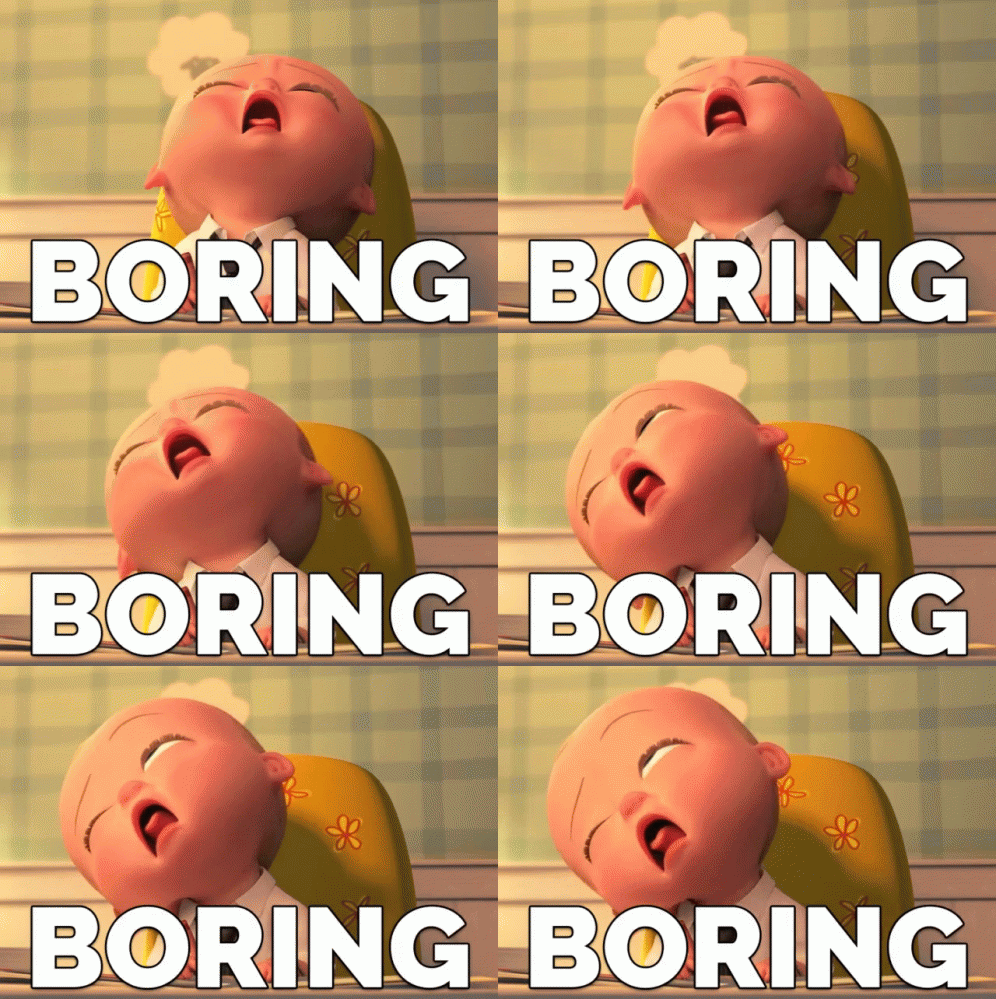
And, honestly, "boring" pretty much sums up this entire book.
It took me ages to finish it, simply because I just could not motivate myself to pick it up.
I'm so happy to be done, and will probably not be reading anything else by Akala in the future.
Perhaps this might appeal to teens who are particular fans of Akala's, I dunno.
One good thing did come from this book - it opened my eyes to how little I, in spite of my love of all things Tudor England, know about the people of colour living in England at that time. I will definitely be doing some more research on this topic and have added the book Black Tudors: The Untold Story to my to-read list.
A brutally slow, meandering tale with little discernible plot, awkward prose, and thoroughly unlikable characters, "The Dark Lady" was an absolute chore to read.
The book follows a fifteen year old orphan named Henry living in Tudor England. His father an unknown and his mother having left him as a small child, he has grown up with a woman named Joan, her sister, and her sister's two children, Matthew and Mary. He spends his days in petty thievery, trying to scrounge together enough money for food and necessities. He also has a magical gift that allows him to translate texts in any language.
The set-up for the novel is not so bad. Tudor England is a particular interest of mine, so the historical setting immediately had me intrigued. The focus on reading and literature also sounded awesome. Additionally, like our protagonist, I'm a huge fan of Shakespeare, so I had high hopes that pulling the Bard into the story might make for some fascinating, nerdy reading.
It didn't.
Like another reviewer pointed out, the whole Shakespeare thing, and Henry's poetry, feel incredibly contrived and work poorly within the bounds of the story.
But let's really get into this.
Plot
We really have to start here, because as far as plot goes ... there honestly isn't one.
The book reads like an incredibly long intro and spends inordinate amounts of time on pointless exposition, long-winded and repetitive descriptions of London and life in Tudor times (which I ought to have found interesting, given how much the subject generally fascinates me), and scenarios that contribute little or nothing to story or character development.
It baffles me that an editor would let this go to print without pointing out the fact that the story is quite literally buried under anecdotes depicting the everyday.
The story of Henry's mother, which we are told in very brief snippets in between the regular chapters, is possibly the most interesting part of the book, and should have had more focus.
The story was also painfully clichéd in so many ways, and when Akala dragged the actual Shakespeare into the plot, it was like reading really bad, gratuitous fanfiction.
Prose
The book is, I am sorry to say, incredibly poorly written. Occasionally, Akala has some truly beautiful descriptive passages (these seem to be his forte), but apart from these limited paragraphs, the writing is awkward, repetitive, and contrived.
He has chosen to use slang from Tudor times, but as the rest of his prose bears little or no resemblance to how people spoke at that time, the inserted slang just feels jarring and confusing. Seeing as the prose is also interspersed with obviously modern phrases and idioms, the result is a linguistic mess that puts you in doubt whether English is in fact Akala's native language. In fact, the prose bears a similarity to that frequently written by confused Americans attempting to sound English. Given that Akala actually is British, I find this rather impressive.
The poetry, too, is absolutely atrocious.
As a rapper, Akala is obviously well versed in composing lyrical texts, but his style and the Shakespearean style do not mesh well. The result is poetry that doesn't sound like it belongs anywhere, and certainly not in sixteenth century England.
(I'll resist ranting about the historical innaccuracy inherent in a fifteen year old's attempting to compose Shakespearean sonnets at that time.)
As mentioned earlier, the writing is also filled with a lot of awkward exposition (particularly in the first hundred or so pages) and is unnecessarily repetitive. Details we already know are constantly shoved down our throats. I've seen other writers of YA literature do the same thing, and it feels like they think they're writing for much, much younger children. Needless to say, this style of writing makes for slow, boring reading.
The conversations are often particularly frustrating to read, as they're interspersed with the main character's constant internal monologue and analysis of the other characters. These internal ramblings interrupt the dialogue and make it seem awkward and stunted.
Additionally, the linguistic quality of the writing is frequently rather poor. There are errors in syntax, incorrect word useage, awkward sentence structures, dangling modifiers, and the list goes on.
Characters
Poorly developed characters also seem to be a trend in modern YA books.
Here, we have an incredibly bland main character whose personality seems to be whatever Akala needs it to be in any given moment, and a host of extremely charicatured supporting characters about whom you really can't be bothered to give a crap.
And the thing is, because he has such a poorly defined personality, you really don't care much about Henry either. In fact, I found him rather irritating.
He's presented as clever, and yet he's constantly gullible enough to believe things he's told by complete strangers. Additionally, he changes his mind at the drop of a hat, and often several times during a single conversation or internal monologue.
He has little drive and no focus, and is, as such, very difficult to connect or sympathise with.
He has a lot in common with a slew of other badly written YA protagonists who are written not as actual people, but as tools the authors can use how and when it suits them. These protagonists can't have too much personality, because if they do, the authors have to organise the plot so that the protagonist actually works within it. As it is, Akala, like many other bad YA authors, simply makes his main character fit whatever situation he wants him to.
As an example, Akala has chosen the third person limited narrator for this tale, yet he clearly feels the reader needs to constantly know what the other characters are thinking. The solution is to make Henry ridiculously perceptive and constantly, instantly, and correctly analyse all the other characters' reactions, motivations, and feelings. Turn the page, and Henry is instantly and effortlessly tricked in a way that makes him seem like a complete idiot.
He has an intense pride in his low status one moment, and then he is suddenly magically adapted to noble life in the next.
As mentioned, this makes Henry an unengaging, dull protagonist.
And, honestly, "boring" pretty much sums up this entire book.
It took me ages to finish it, simply because I just could not motivate myself to pick it up.
I'm so happy to be done, and will probably not be reading anything else by Akala in the future.
Perhaps this might appeal to teens who are particular fans of Akala's, I dunno.
One good thing did come from this book - it opened my eyes to how little I, in spite of my love of all things Tudor England, know about the people of colour living in England at that time. I will definitely be doing some more research on this topic and have added the book Black Tudors: The Untold Story to my to-read list.
August 11, 2021
A wandering narrative with lacklustre prose. Akala, of Hip Hop Shakespeare fame, clearly has some knowledge of Shakespeare, but this young adult novel fails to understand the Elizabethan world picture and make the historical element believable. The Dark lady of the sonnets is the stepping off point. Dr John Dee, Elizabeth I's conjuror and code breaker, is thrown in for good measure. There is a walk on part by Shakespeare, about as convincing as Autolycus pursued by a bear, and a spattering of Tudor words attempts to establish a period atmosphere. As ever a lot of blurbing and hype have inflated this into something it isn't.

October 25, 2020
This is a good debut novel that is written very well, with a strong lead character and a well drawn setting that is let down by weaker secondary characters, an unexplored magic system and a rather muddled narrative that doesn’t really go anywhere. It’s one of those books that you enjoy whilst your reading it, but have to wonder what the point was. I also didn’t really get the point of the poetry verses interspersed between chapters, I suspect that they are intended to build on Henry’s abilities or his fascination with Shakespeare and to give a little background to his mother perhaps, but it isn’t made clear even by the end of the novel.
In terms of what the novel does well, it is very readable and Akala writes well. Henry as a character is well developed and I appreciated how Akala used the racial prejudice of the time to build his character and the setting. The descriptions of Elizabethan London are well done, and there is a clear juxtaposition between the haves and have-nots. And despite the plot not really going anywhere, I was interested in what was going on particularly at the moments where the pace moved a little more quickly.
The problem is that generally the pace of the novel is undeniably slow, and it doesn’t really seem to go anywhere. This isn’t helped by the fact that the novel ends on a cliff hanger without really managing to resolve any of the main narrative threads properly. The secondary characters are incidental rather than important, with very few of them bringing anything crucial to the story. Whether noble of thief, they are all just background characters. And then you have the magic system. Another reviewer has described it as window dressing and I can see why. It isn’t explored and aside from Henry’s gift of reading any language by closing his eyes being what makes him ‘valuable’, it doesn’t add anything to the narrative.
So there’s a lot of potential here, but it didn’t quite work for me. More work needed to go into building up the secondary characters and the magic system so that they didn’t feel like incidental add-ins. More importantly though, there needs to be a main narrative hook and I suspect that won’t materialise until the sequel, as this is certainly not a stand alone. It’s almost like it’s a prequel to the action really starting rather than a full novel in and of its own right.
Many thanks to NetGalley and the publishers for my free review copy of this title.
In terms of what the novel does well, it is very readable and Akala writes well. Henry as a character is well developed and I appreciated how Akala used the racial prejudice of the time to build his character and the setting. The descriptions of Elizabethan London are well done, and there is a clear juxtaposition between the haves and have-nots. And despite the plot not really going anywhere, I was interested in what was going on particularly at the moments where the pace moved a little more quickly.
The problem is that generally the pace of the novel is undeniably slow, and it doesn’t really seem to go anywhere. This isn’t helped by the fact that the novel ends on a cliff hanger without really managing to resolve any of the main narrative threads properly. The secondary characters are incidental rather than important, with very few of them bringing anything crucial to the story. Whether noble of thief, they are all just background characters. And then you have the magic system. Another reviewer has described it as window dressing and I can see why. It isn’t explored and aside from Henry’s gift of reading any language by closing his eyes being what makes him ‘valuable’, it doesn’t add anything to the narrative.
So there’s a lot of potential here, but it didn’t quite work for me. More work needed to go into building up the secondary characters and the magic system so that they didn’t feel like incidental add-ins. More importantly though, there needs to be a main narrative hook and I suspect that won’t materialise until the sequel, as this is certainly not a stand alone. It’s almost like it’s a prequel to the action really starting rather than a full novel in and of its own right.
Many thanks to NetGalley and the publishers for my free review copy of this title.
May 20, 2021
A story exploring the power of reading, magic, race, class and family in Elizabethan London.
Honestly I was disappointed in this after the raw rage of Akala's "Natives" autobiography. This novel was SLOW. Like pull out my eyes slow.
I've rounded up to 3 stars because I liked the premise and Elizabethan realness but omg literally nothing was happening and the few things that did were so over -explained it sucked my joy away. Not to my taste sadly but if you love historical fiction then it may be for you....
Honestly I was disappointed in this after the raw rage of Akala's "Natives" autobiography. This novel was SLOW. Like pull out my eyes slow.
I've rounded up to 3 stars because I liked the premise and Elizabethan realness but omg literally nothing was happening and the few things that did were so over -explained it sucked my joy away. Not to my taste sadly but if you love historical fiction then it may be for you....

February 16, 2020
(As a warning I want to make it clear I review this with my professional hat on not personal. Personally, I thought this was pretty good but I review this in a professional capacity and as such must keep that in mind):
Some would argue that using his mainstream appeal to young people as a tool to get them to read what is essentially educational historical fiction is very clever. Some would argue it will inspire today's youth to view Shakespearean language and culture with new eyes. However, I, someone who has lived and worked among London teens for many years say differently.
This is a book lovers book. By which I mean it will appeal to children who love to read and don't really care who the author is. In my work I need books that entice the book haters, the boys who resent the things that don't reflect their realities. The idea of having a book by Akala to call upon to tempt those boys was a god send! So imagine my sadness when instead of a novel that speaks to these children, I got yet another (very good but wholly unnecessary) historical/fantasy/adventure.
Please don't misunderstand me authors should be able to write whatever they want, and Akala shouldn't be pigeon holed because of this musical career... But I had such hope that he would take his passion for politics and activism and use it to write something powerful and relatable that would inspire the children who need a push. The ones who might only pick the book up because he wrote it, not one's who are already in the Library everyday looking. I hope he keeps writing YA, because he has real power, and I will keep my fingers crossed he uses his talent to write me the kind of book I need.
Some would argue that using his mainstream appeal to young people as a tool to get them to read what is essentially educational historical fiction is very clever. Some would argue it will inspire today's youth to view Shakespearean language and culture with new eyes. However, I, someone who has lived and worked among London teens for many years say differently.
This is a book lovers book. By which I mean it will appeal to children who love to read and don't really care who the author is. In my work I need books that entice the book haters, the boys who resent the things that don't reflect their realities. The idea of having a book by Akala to call upon to tempt those boys was a god send! So imagine my sadness when instead of a novel that speaks to these children, I got yet another (very good but wholly unnecessary) historical/fantasy/adventure.
Please don't misunderstand me authors should be able to write whatever they want, and Akala shouldn't be pigeon holed because of this musical career... But I had such hope that he would take his passion for politics and activism and use it to write something powerful and relatable that would inspire the children who need a push. The ones who might only pick the book up because he wrote it, not one's who are already in the Library everyday looking. I hope he keeps writing YA, because he has real power, and I will keep my fingers crossed he uses his talent to write me the kind of book I need.

January 30, 2023
This book hasn't seemed to have done well with reviews on here but I really enjoyed it.
A story about a young black boy thief with a magical gift for translating any written language, living in Shaksperean London.
I normally read on my commute to work or in bed before sleeping so there's something to be said about the fact I chose to read it through the day on my day off work - only dissapointment was the fact that it ended abruptly but its clearly setting up for a second one so I don't really mind at all.
All the harsh reviewers maybe need to keep in mind that it's a book written for teenagers.
Ps. Akala rules.
A story about a young black boy thief with a magical gift for translating any written language, living in Shaksperean London.
I normally read on my commute to work or in bed before sleeping so there's something to be said about the fact I chose to read it through the day on my day off work - only dissapointment was the fact that it ended abruptly but its clearly setting up for a second one so I don't really mind at all.
All the harsh reviewers maybe need to keep in mind that it's a book written for teenagers.
Ps. Akala rules.

May 30, 2022
One of those that I really wanted to like more than I did, which was a shame. An entertaining read, but unsatisfying in places.


May 22, 2020
I received a free arc of this book from the publisher via Netgalley in exchange for an honest review.
I wanted to read this book as I admire Akala as a musical artist and an activist, and was confident in his ability to be a good fiction author. I was not disappointed!
This book was nothing like I expected - we open with three young people, one black and two white, in Elizabethan London. The language they use is quasi-Elizabethan and it works to anchor the reader to the time period, while still being believable and understandable dialogue.
Henry is a disillusioned teenager living in the London slums with his extended family as his mother who is from Benin has seemingly abandoned him as a young child, and is possibly dead.
Henry and his cousins Mary and Matthew pass the time and earn some precious money by robbing more well to do houses in London. One night Matthew tells of a commission he's had for them to steal a particular item of jewellery from a Duke's house. They get disturbed, Matthew gets away but Mary and Henry get caught and their lives change forever. Henry has a 'gift' that the Duke exploits, but will he conform to the high life at the expense of his heritage and true family?
This book was well written and well paced - I very much enjoyed it and will look forward to more of Akala's fiction.
I wanted to read this book as I admire Akala as a musical artist and an activist, and was confident in his ability to be a good fiction author. I was not disappointed!
This book was nothing like I expected - we open with three young people, one black and two white, in Elizabethan London. The language they use is quasi-Elizabethan and it works to anchor the reader to the time period, while still being believable and understandable dialogue.
Henry is a disillusioned teenager living in the London slums with his extended family as his mother who is from Benin has seemingly abandoned him as a young child, and is possibly dead.
Henry and his cousins Mary and Matthew pass the time and earn some precious money by robbing more well to do houses in London. One night Matthew tells of a commission he's had for them to steal a particular item of jewellery from a Duke's house. They get disturbed, Matthew gets away but Mary and Henry get caught and their lives change forever. Henry has a 'gift' that the Duke exploits, but will he conform to the high life at the expense of his heritage and true family?
This book was well written and well paced - I very much enjoyed it and will look forward to more of Akala's fiction.
March 29, 2020
On the surface, this book seemed to offer everything I like: Shakespeare, pickpockets, references to Moll Cutpurse, and Elizabethan London. The title refers to the mysterious 'Dark Lady' referenced in Shakespeare sonnets and a few of his plays (I think Rosalind in Love's Labour's Lost, for example). However, the lady herself didn't play much of a role in this story, and I'm assuming a sequel will come.
The excess of Elizabeth jargon was a fun addition, though it petered out fairly quickly. Akala is clearly a Shakespeare nerd, but sometimes the detail given about Elizabeth London felt more like research being demonstrated than seamless musing by the protagonist.
Where Akala shines is in his painting of Henry's outsider status, and the links between Henry's experience of discrimination and contemporary prejudices doesn't feel overwrought.
If this book seems almost to be written for study in class, it's still a page-turner, and ages 12+ will enjoy this foray into a London at once materially different, and socially identical to the one we live in now.
The excess of Elizabeth jargon was a fun addition, though it petered out fairly quickly. Akala is clearly a Shakespeare nerd, but sometimes the detail given about Elizabeth London felt more like research being demonstrated than seamless musing by the protagonist.
Where Akala shines is in his painting of Henry's outsider status, and the links between Henry's experience of discrimination and contemporary prejudices doesn't feel overwrought.
If this book seems almost to be written for study in class, it's still a page-turner, and ages 12+ will enjoy this foray into a London at once materially different, and socially identical to the one we live in now.

February 2, 2020
Sophisticated engaging historical mystery, with many gaps I suspect will be filled in future books. It doesn't feel like a standalone.

May 29, 2022
Amazing! I can’t wait to recommend this to my students

June 8, 2020
The Dark Lady was a surprising read for me, but not for the reasons that you're probably thinking.
It's not because the story itself took a different turn that I wasn't expecting - though that's definitely one of the reasons why. It's because even though I was very excited to dive into this book, I was only three chapters in when I was already considering DNFing it. It was slow-moving almost instantly, and I just found that I was not connecting with this story whatsoever, and I could just feel it putting me into a reading slump already; I just knew that this book was not for me.
Plus, I'd reached that fifty page mark where, if I reach that point of the story and I still want to stop reading it, then I give myself permission to do so. But because of how slow-moving this book is, I wanted to read on to at least a hundred pages of this story, just to see if things would then pick up...
And I am SO GLAD that I did, because that is when this book started getting much, much better. So much so that by the last page, I had a huge smile on my face and a craving for more.
Henry is a poor, uneducated orphan who's just trying to find his place in a world that doesn't seem to want him. If they don't want him because of his social status (or lack thereof), then it's because of the colour of his skin. But when a ransack on a Duke's house goes wrong and Henry finds himself captured, he finds that what keeps him alive isn't his ability to lie, steal, and deceive his way out of trouble, but is thanks to the magic that runs through his veins - magic that makes it so that he can read and understand any language, and even translate an entire book in an hour.
Whilst at first that did not sound impressive to me whatsoever, it's as the story goes on that you realise the significance of such a talent in a world - but more so, in a time - such as this one.
Set in Elizabethan London, The Dark Lady was an enjoyable and original historical poetic fantasy that may have started off with an unpromising beginning, but it progressed into an engrossing story that then finished off with a surprising and climactic ending, and I could not get enough of it.
Yet despite all my praise, it definitely had its flaws that were unignorable - flaws outside of the constant slow-pacing that made getting into this story very difficult.
To me, I felt that the storyline itself wasn't greatly developed in the long run, and that there was no real motive to this plot whatsoever. The side characters had no real purpose to this story as a whole, and despite the fact that this is a fantasy, it's clear early on that the magic of this world - but more so, of Henry and his foster aunts, Agnes and Joan - are not a main focus nor a top priority for this story at all.
I just feel like, had Akala put more focus on the magic of this world - maybe even explained it and developed it a little better - then this book would've been an outstanding read for me. But he didn't, so that definitely made this story fall flat in that aspect.
But at the same time, that's simply my own preference to see in a novel like this one.
If I put that aside, I can't ignore the fact that The Dark Lady was a really enjoyable book to read.
I enjoyed the historical setting, I enjoyed the poetry that grows and evolves throughout, and I enjoyed the mystery to this story surrounding Henry's mother, the woman haunting his dreams, and those bold paragraphs in between each chapter - paragraphs that felt out of place with this book at first, but now that I've finished this story... I completely understand their significance, and they've made me very excited at the prospect of more to come.
If you're looking to read a story that isn't necessarily a life changing one to read, but is an impactful one nevertheless - one about growth, mistakes, race and poverty, and finding power in words - then you should definitely give The Dark Lady a go. It has its flaws (as I've mentioned in this review), but overall, it is an amazing story to read, and I'm now so excited to see what it is Akala delivers next when it comes to Henry's journey.
TW:
ARC provided via Amazon Vine for honest review
It's not because the story itself took a different turn that I wasn't expecting - though that's definitely one of the reasons why. It's because even though I was very excited to dive into this book, I was only three chapters in when I was already considering DNFing it. It was slow-moving almost instantly, and I just found that I was not connecting with this story whatsoever, and I could just feel it putting me into a reading slump already; I just knew that this book was not for me.
Plus, I'd reached that fifty page mark where, if I reach that point of the story and I still want to stop reading it, then I give myself permission to do so. But because of how slow-moving this book is, I wanted to read on to at least a hundred pages of this story, just to see if things would then pick up...
And I am SO GLAD that I did, because that is when this book started getting much, much better. So much so that by the last page, I had a huge smile on my face and a craving for more.
Henry is a poor, uneducated orphan who's just trying to find his place in a world that doesn't seem to want him. If they don't want him because of his social status (or lack thereof), then it's because of the colour of his skin. But when a ransack on a Duke's house goes wrong and Henry finds himself captured, he finds that what keeps him alive isn't his ability to lie, steal, and deceive his way out of trouble, but is thanks to the magic that runs through his veins - magic that makes it so that he can read and understand any language, and even translate an entire book in an hour.
Whilst at first that did not sound impressive to me whatsoever, it's as the story goes on that you realise the significance of such a talent in a world - but more so, in a time - such as this one.
Set in Elizabethan London, The Dark Lady was an enjoyable and original historical poetic fantasy that may have started off with an unpromising beginning, but it progressed into an engrossing story that then finished off with a surprising and climactic ending, and I could not get enough of it.
Yet despite all my praise, it definitely had its flaws that were unignorable - flaws outside of the constant slow-pacing that made getting into this story very difficult.
To me, I felt that the storyline itself wasn't greatly developed in the long run, and that there was no real motive to this plot whatsoever. The side characters had no real purpose to this story as a whole, and despite the fact that this is a fantasy, it's clear early on that the magic of this world - but more so, of Henry and his foster aunts, Agnes and Joan - are not a main focus nor a top priority for this story at all.
I just feel like, had Akala put more focus on the magic of this world - maybe even explained it and developed it a little better - then this book would've been an outstanding read for me. But he didn't, so that definitely made this story fall flat in that aspect.
But at the same time, that's simply my own preference to see in a novel like this one.
If I put that aside, I can't ignore the fact that The Dark Lady was a really enjoyable book to read.
I enjoyed the historical setting, I enjoyed the poetry that grows and evolves throughout, and I enjoyed the mystery to this story surrounding Henry's mother, the woman haunting his dreams, and those bold paragraphs in between each chapter - paragraphs that felt out of place with this book at first, but now that I've finished this story... I completely understand their significance, and they've made me very excited at the prospect of more to come.
If you're looking to read a story that isn't necessarily a life changing one to read, but is an impactful one nevertheless - one about growth, mistakes, race and poverty, and finding power in words - then you should definitely give The Dark Lady a go. It has its flaws (as I've mentioned in this review), but overall, it is an amazing story to read, and I'm now so excited to see what it is Akala delivers next when it comes to Henry's journey.
TW:
ARC provided via Amazon Vine for honest review
April 1, 2023
Henry tried to fend for himself and his family by stealing, but when he tried to buy bread with the money he stole he got shut out.
Henry looses his temper with mathew and punches him, after the fight he travels to Graham’s needle making shop.
When an opportunity arises Henry is asked to take over the shop from graham which is making needles, but to Graham’s surprise will he take the opportunity?
Agnes finds out that Henry has punched mathew and tries to punish him but when Joan steps him, she’s told him to write 10.000 words for punishment, without his powers.
Mary invites Henry to see a horse being killed by dogs and she invites mathew without telling him. mathew and Henry are friends again and when mathew tells him there’s a house to steal from, a wealthy house Henry is up for it, mathew comes with him but then mary turns up to help.
Henry got the gold bird from the safe and everything else he could find in the house and then he heard the front door and they all ran, but the caught mathew and mary so Henry had to go back or they would drop mary on her face from the window.
The duke realised that Henry has a gift. So now Henry is a prisoner with extraordinary gifts. He’s been tested on how his gift works, then he is brought to a room with men and they get him to show everyone his gift, Henry’s gift is that he can write out any book that is handed to him.
Shakespeare was in that room and he was not impressed.
when Henry went to go see one of the plays he knew then that he is weathly and and not poor like he used to be.
He met Lucia and he saw mary he said horrible words to mary and stayed in Lucia’s bed, then when he got to the dukes palace mary had gone and Henry tried to ask the duke if he could find her, but when the duke told him that his mother was still alive, he felt anger mixed with betrayal and grief through him all at once.
Then in the middle of the night he ran away from the duke’s palace. He knocked on the door of Joan’s house and asked her is it true that his mum has been writing to her asking for her and she did not say anything. Well it is… and then he left.
Now he’s ended up outside Graham’s store and told him everything but all Henry wants to do is sell the gold bird and find his mum in Venice.
But before that he met Lucia and she offered to sell the golden bird and meet him before 12 so she could come to Venice with him.
When morning came Henry waited and waited for Lucia to come but she didn’t, so Henry now had to save up more money so he didn’t the only thing he knew he stole, but people weren’t on guard when he was wearing the cast off’s from the duke they treated him with respect.
He saw mathew in the pub and gave him wine and told the server it was from the duke and mathew collapsed and couldn’t breathe, so Joan came over to bring him back to life. When the crowd saw that she brought him back to life they knew then she was a witch and kicked her until she was lifeless.
So Henry told mary that the have to leave she went to go get tickets for the ship that was leaving to Venice. But he was waiting… a while, until someone created a blow to the back of his head and tied him up.
It wasn’t wilmslow it was William Shakespeare, he left Henry a note saying that wilmslow’s people were waiting for him at the dock, and he told him that there was money in the draw to help him on his way to find his mum.
William Shakespeare successfully got henry on the ship without wilmslow’s guards finding him.
Henry looses his temper with mathew and punches him, after the fight he travels to Graham’s needle making shop.
When an opportunity arises Henry is asked to take over the shop from graham which is making needles, but to Graham’s surprise will he take the opportunity?
Agnes finds out that Henry has punched mathew and tries to punish him but when Joan steps him, she’s told him to write 10.000 words for punishment, without his powers.
Mary invites Henry to see a horse being killed by dogs and she invites mathew without telling him. mathew and Henry are friends again and when mathew tells him there’s a house to steal from, a wealthy house Henry is up for it, mathew comes with him but then mary turns up to help.
Henry got the gold bird from the safe and everything else he could find in the house and then he heard the front door and they all ran, but the caught mathew and mary so Henry had to go back or they would drop mary on her face from the window.
The duke realised that Henry has a gift. So now Henry is a prisoner with extraordinary gifts. He’s been tested on how his gift works, then he is brought to a room with men and they get him to show everyone his gift, Henry’s gift is that he can write out any book that is handed to him.
Shakespeare was in that room and he was not impressed.
when Henry went to go see one of the plays he knew then that he is weathly and and not poor like he used to be.
He met Lucia and he saw mary he said horrible words to mary and stayed in Lucia’s bed, then when he got to the dukes palace mary had gone and Henry tried to ask the duke if he could find her, but when the duke told him that his mother was still alive, he felt anger mixed with betrayal and grief through him all at once.
Then in the middle of the night he ran away from the duke’s palace. He knocked on the door of Joan’s house and asked her is it true that his mum has been writing to her asking for her and she did not say anything. Well it is… and then he left.
Now he’s ended up outside Graham’s store and told him everything but all Henry wants to do is sell the gold bird and find his mum in Venice.
But before that he met Lucia and she offered to sell the golden bird and meet him before 12 so she could come to Venice with him.
When morning came Henry waited and waited for Lucia to come but she didn’t, so Henry now had to save up more money so he didn’t the only thing he knew he stole, but people weren’t on guard when he was wearing the cast off’s from the duke they treated him with respect.
He saw mathew in the pub and gave him wine and told the server it was from the duke and mathew collapsed and couldn’t breathe, so Joan came over to bring him back to life. When the crowd saw that she brought him back to life they knew then she was a witch and kicked her until she was lifeless.
So Henry told mary that the have to leave she went to go get tickets for the ship that was leaving to Venice. But he was waiting… a while, until someone created a blow to the back of his head and tied him up.
It wasn’t wilmslow it was William Shakespeare, he left Henry a note saying that wilmslow’s people were waiting for him at the dock, and he told him that there was money in the draw to help him on his way to find his mum.
William Shakespeare successfully got henry on the ship without wilmslow’s guards finding him.

May 23, 2020
Want to see more...
Bookstagram
Website
Thank you Hachette for this book in exchange for an honest review
So I wanted to like this book. I really did. Pickpocket, prisoner, orphan that has haunted dreams, this has every concept to make an interesting story but I overall felt like the author was beating me with a Shakespeare novel and I wasn’t impressed. If I’m to have books shoved in my face, its book I choose. Don’t get me wrong, I like Shakespeare but I felt as though this was the main thing that carried through the book and the characters, plot and story got left behind, behind Shakespeare.
The pace of this book was off and at times you are stuck with intense dialogue that makes you sigh, put the book down to make a coffee and prepare yourself for what’s to come. I found that the last few chapters of the book had an interesting pace that should have been carried across the whole book.
The slang was over use. Again. A way to slap you with Shakespeare. I understand that it was crucial to the time and somewhat for the story but I can’t help but feel that if all the Shakespeare elements were withdrawn from the story it would have been better.
The plot was…. Two plots? There were story lines that didn’t mesh well and seemed to be throwing Shakespeare shade at each other throughout the whole book. They didn’t work well together and kinda ruined it.
I think this book isn’t a young YA book but more of an adult kinda books. I seriously will buy ice-cream to the younger generation that read this book.
Can I finish with, hey the characters were good though, and the setting was detailed? Unfortunately this was one of those books where the negative outweighed the good.
Bookstagram
Website
Thank you Hachette for this book in exchange for an honest review
So I wanted to like this book. I really did. Pickpocket, prisoner, orphan that has haunted dreams, this has every concept to make an interesting story but I overall felt like the author was beating me with a Shakespeare novel and I wasn’t impressed. If I’m to have books shoved in my face, its book I choose. Don’t get me wrong, I like Shakespeare but I felt as though this was the main thing that carried through the book and the characters, plot and story got left behind, behind Shakespeare.
The pace of this book was off and at times you are stuck with intense dialogue that makes you sigh, put the book down to make a coffee and prepare yourself for what’s to come. I found that the last few chapters of the book had an interesting pace that should have been carried across the whole book.
The slang was over use. Again. A way to slap you with Shakespeare. I understand that it was crucial to the time and somewhat for the story but I can’t help but feel that if all the Shakespeare elements were withdrawn from the story it would have been better.
The plot was…. Two plots? There were story lines that didn’t mesh well and seemed to be throwing Shakespeare shade at each other throughout the whole book. They didn’t work well together and kinda ruined it.
I think this book isn’t a young YA book but more of an adult kinda books. I seriously will buy ice-cream to the younger generation that read this book.
Can I finish with, hey the characters were good though, and the setting was detailed? Unfortunately this was one of those books where the negative outweighed the good.

April 12, 2020
Thanks to NetGalley and The Publisher for this eARC in exchange for an honest review.
3.5 stars rounded up.
I enjoyed reading this. A lovely little adventure with a historical fiction background. There's lots in here for young people to think about; identity, loyalty and consequences of ones actions. Back to the historical fiction element, I really like what Akala has done here. He's choose a time in history that Black people being in London are not often associated with. And he's also chosen to include the often not talked about aspects of Elizabethan society and European history, like the prejudice and persecution of foreigners and different religious groups.
I love that the main character Henry is a nerdy pick-pocket, but the ending. That can't be the ending. Surely this is just the beginning of Henry's story and assume there is a sequel coming, that I am eager to read.
A good read for young adults and fans of young ault fiction.
3.5 stars rounded up.
I enjoyed reading this. A lovely little adventure with a historical fiction background. There's lots in here for young people to think about; identity, loyalty and consequences of ones actions. Back to the historical fiction element, I really like what Akala has done here. He's choose a time in history that Black people being in London are not often associated with. And he's also chosen to include the often not talked about aspects of Elizabethan society and European history, like the prejudice and persecution of foreigners and different religious groups.
I love that the main character Henry is a nerdy pick-pocket, but the ending. That can't be the ending. Surely this is just the beginning of Henry's story and assume there is a sequel coming, that I am eager to read.
A good read for young adults and fans of young ault fiction.

October 27, 2022
1,5 stars. not one round character in this book tbh. they were all forgettable at best or annoying at worst. especially the main character, henry, who is a spoiled, self-centered, ignorant brat. he doesn’t grow as a character throughout the book. his mothers curse is never really explained and neither is the connection between joan and the society.
if Matthew was hired by the duke to lure henry into his trap, then why did he tell henry that his prigger wanted the golden bird? the duke never noticed it was missing and we never found out what lucia did with it.
the elizabethan setting is kinda half arsed, just a bunch of random slang thrown in whenever it’s convenient.
if Matthew was hired by the duke to lure henry into his trap, then why did he tell henry that his prigger wanted the golden bird? the duke never noticed it was missing and we never found out what lucia did with it.
the elizabethan setting is kinda half arsed, just a bunch of random slang thrown in whenever it’s convenient.
This entire review has been hidden because of spoilers.

February 3, 2024
Could not put it down!
Great first YA novel from Akala. Exciting introduction to early Elizabethan London, with creative license of course.
I love that the synopsis didn’t give away the journey of this interesting story.
Great first YA novel from Akala. Exciting introduction to early Elizabethan London, with creative license of course.
I love that the synopsis didn’t give away the journey of this interesting story.

March 28, 2023
rubbish

July 23, 2024
Blud who tf is the dark lady??? Everytime i read this (i had to read it for english) i wanted to gouge my eyes out violently.
April 4, 2025
This just wasn’t very good or interesting… Easy read though mainly bc it lacked a proper plot

December 4, 2023
Honestly, this wasn't too bad.
Quite enjoyable actually, it was a but slow at first though but picked up and became wildly interesting. I'd recommend it honestly if you're looking for a bit of magic with your reading

July 29, 2026
I picked this up when I went to see Akala in conversation cos I can’t say no to merch and I’d already read Natives so didn’t need a signed copy of that.
I know I’m not the target audience and it’s aimed at late teens but I couldn’t help but think if I was a teenager I’d be sooooo bored reading this. Was just a bit nothing. Lacklustre!
I know I’m not the target audience and it’s aimed at late teens but I couldn’t help but think if I was a teenager I’d be sooooo bored reading this. Was just a bit nothing. Lacklustre!
August 4, 2021
Oooops, I did just finish this in one evening after picking it up from Waterstones earlier today. Trying to read some more Young Adult fiction with a view to my new school librarian post.
What this book did well:
Highlighting racism in a historical context. Great that the black experience in Tudor England is given some light. It feels spooky and uncomfortable to realise how little as a society we have progressed on these fronts.
The main character's thought process and self-reflection was great, superb depth of complicated emotions displayed and felt.
What I particularly liked was how Henry, the main character is given a chance to experience privilege and it shows how easily he is able to settle into his new position in the hierarchy now that it benefits him. I think this is something we can all relate to, since we all to some degree experience privilege at the expense of others and I like that the uncomfortableness of this is explored.
Love the references to Shakespeare. The use of Tudor street speak is a great way of gently exposing YAs to the language of the period in an accessible way.
What I felt was lacking:
The development of the secondary characters. Sometimes there are hints of complexity e.g. the Duke's caring family back story and why exactly Joan doesn't tell Henry about his Mum and why is Agnes so horrid but these are never really explored properly. It felt like characters were there to move the plot on or get Henry to tackle moral questions rather than being autonomous entities.
The magical element - seemed very under done. I loved Henry's magical superpower and those of his Aunts - I would have liked more to have been made of this especially as the Tudor relationship between religion and magic is fascinating. A lot left wanting with regards to his mother's mythic backstory too...
I also thought the poems were very iffy, but then again they are just meant to be the musings of a 15 year old?
I want to know more about the secret society!!!
What this book did well:
Highlighting racism in a historical context. Great that the black experience in Tudor England is given some light. It feels spooky and uncomfortable to realise how little as a society we have progressed on these fronts.
The main character's thought process and self-reflection was great, superb depth of complicated emotions displayed and felt.
What I particularly liked was how Henry, the main character is given a chance to experience privilege and it shows how easily he is able to settle into his new position in the hierarchy now that it benefits him. I think this is something we can all relate to, since we all to some degree experience privilege at the expense of others and I like that the uncomfortableness of this is explored.
Love the references to Shakespeare. The use of Tudor street speak is a great way of gently exposing YAs to the language of the period in an accessible way.
What I felt was lacking:
The development of the secondary characters. Sometimes there are hints of complexity e.g. the Duke's caring family back story and why exactly Joan doesn't tell Henry about his Mum and why is Agnes so horrid but these are never really explored properly. It felt like characters were there to move the plot on or get Henry to tackle moral questions rather than being autonomous entities.
The magical element - seemed very under done. I loved Henry's magical superpower and those of his Aunts - I would have liked more to have been made of this especially as the Tudor relationship between religion and magic is fascinating. A lot left wanting with regards to his mother's mythic backstory too...
I also thought the poems were very iffy, but then again they are just meant to be the musings of a 15 year old?
I want to know more about the secret society!!!
September 5, 2022
Akala's 'The Dark Lady' is a young adult historical fiction novel and his debut novel at that. It is an easy and interesting read that represents the Tudor period in a very real and very realistic way that busts previous myths and misconceptions about this era. If you want to know what life was like in the Tudor dynasty, then this novel is for you. It gives the reader detailed insight into what it was like for a variety of different people such as the rich, the poor, for foreigners, for black people, for women, for the educated, for the uneducated and for those deemed witches. I can guarantee you that this novel has a little bit of something for everyone.
The main protagonist, Henry, is a Moor and a poor one at that. The story is told through the eyes of Henry, so we get to view the world from an immature teenager who is good at heart but makes some poor decisions throughout the book. The novel has other authentic characters in it that help keep the story interesting and that counterbalance Henry's character well. But what I like most of all is the attention to Tudor specific detail, which was spot on. Also another thing I really liked about the book was the way that Akala confronts rather important themes that are still issues in society today, racism, misogyny, the wealth divide, classism, xenophobia, religious domination and the fear of the mystic and spiritual. This book deals with so much, and on so many different levels, it is a great story for teenagers, and I highly recommend this book.
What I didn't like about this book though was how rushed in felt in the last quarter of the book and also how it was clearly set up for a sequel so it felt like it wasn't properly concluded. What I do hope, though, is that a second book will come out!
The main protagonist, Henry, is a Moor and a poor one at that. The story is told through the eyes of Henry, so we get to view the world from an immature teenager who is good at heart but makes some poor decisions throughout the book. The novel has other authentic characters in it that help keep the story interesting and that counterbalance Henry's character well. But what I like most of all is the attention to Tudor specific detail, which was spot on. Also another thing I really liked about the book was the way that Akala confronts rather important themes that are still issues in society today, racism, misogyny, the wealth divide, classism, xenophobia, religious domination and the fear of the mystic and spiritual. This book deals with so much, and on so many different levels, it is a great story for teenagers, and I highly recommend this book.
What I didn't like about this book though was how rushed in felt in the last quarter of the book and also how it was clearly set up for a sequel so it felt like it wasn't properly concluded. What I do hope, though, is that a second book will come out!

February 5, 2023
The plot of this book was all over the place, nothing made sense or was explained, why did Shakespeare suddenly interfere what was his mother even doing? How did she give him visions? How is the general cursed? The ending was really abrupt and Joan's death was unneeded and how come Mary just abandoned her brother? There was no confrontation with Agnes or Mathew about selling Henry out so it just felt really badly written. The setting of the Elizabethan times also felt rather unneeded, it could have just as easily been set in modern times. Lucia was also not even needed, her only purpose it would seem is to show Henry as naive but he couldn't do anything with the bird anyways. The poem at the back of the bird isn't explained? The society isn't explained, especially Shakespeare's inclusion? Completely incomprehensible.
This entire review has been hidden because of spoilers.

August 15, 2021
Didn’t understand the ending.

August 25, 2024
In atmospheric Elizabethan England, Henry, alongside his cousins Matthew and Mary live hand to mouth, spending their days thieving from the rich and obtuse, and just trying to survive. The London they reside in is rife with magic, and Henry himself has his own unique gifts to bestow upon the world. However, with the city grasping any opportunity to demoralise and intimidate 'foreigners' Henry has to navigate and survive a world that is determined to bring him down. So, when the opportunity to live the rich and successful life he's always dreamed of lands in his lap, for the small penance of his gift, Henry has to decide whether it's worth giving up the people he holds closest for a taste of the lavish life he's long since been denied.
I don't know what it was about Henry but he was a truly astounding and powerful character, and he endeared me to him so quickly.
This was so vividly written, with a fantastical and atmospheric twist on Elizabethan London, rich with it's slang and customs. I adored Henry, he's chaotic but incredibly tenacious, a Shakespeare lover and sonnet composer, he's a jack of all trades. However, he holds a deep resentment in his heart towards his mother for leaving him in such a cruel and oppressive place, as well as towards the aristocracy itself. He has an intense thirst to prove himself whilst trying not to be moved by the blatant abuse and racism he's targeted with everyday. Henry dreams of travelling the world, and taking his own life and destiny into his own hands, proving his status within a society determined to tear him and anyone who looks like him down.
He's spirited, and strong, but when one of him and his cousin's thieving jobs goes awry, he's imprisoned and experimented on for his extraordinary gifts, and he must use his cunning and vast intellect to steel his resolve, and find a way to escape whilst simultaneously cementing how crucial and important his life is to those who look down their noses at him. Henry desperately clings onto the smallest sliver of hope that he'll get out of this situation alive and making his name in society, turning to his poetry and sonnets as a safe haven and place of solace within this desolate and isolated palace. He often does find it hard to hold his tongue, letting his pride and thirst for vengeance dictate his actions which can often lead him into some treacherous and dire situations, but he's nothing if not determined. Seeing him take on the situations given to him, and making the best out of it, despite the pain and abhorrent racism he faces, was so powerful and yet poignant.
'The Dark Lady' is gritty, raw, and authentic to the time period, with a little dash of magic added into the mix. This story is compelling, mysterious and a beautiful love letter to Shakespeare, bursting with twists, and betrayals that utterly broke me and had my jaw on the floor, it's an action packed and atmospheric read. It's a story that truly will grab hold of you and refuse to let you go, it was profoundly moving at times, exploring some poignant and important themes including racism and classism. This was incredible, powerful and impactful in such a profound way. I really hope they'll be a sequel because I have a LOT of questions!
I don't know what it was about Henry but he was a truly astounding and powerful character, and he endeared me to him so quickly.
This was so vividly written, with a fantastical and atmospheric twist on Elizabethan London, rich with it's slang and customs. I adored Henry, he's chaotic but incredibly tenacious, a Shakespeare lover and sonnet composer, he's a jack of all trades. However, he holds a deep resentment in his heart towards his mother for leaving him in such a cruel and oppressive place, as well as towards the aristocracy itself. He has an intense thirst to prove himself whilst trying not to be moved by the blatant abuse and racism he's targeted with everyday. Henry dreams of travelling the world, and taking his own life and destiny into his own hands, proving his status within a society determined to tear him and anyone who looks like him down.
He's spirited, and strong, but when one of him and his cousin's thieving jobs goes awry, he's imprisoned and experimented on for his extraordinary gifts, and he must use his cunning and vast intellect to steel his resolve, and find a way to escape whilst simultaneously cementing how crucial and important his life is to those who look down their noses at him. Henry desperately clings onto the smallest sliver of hope that he'll get out of this situation alive and making his name in society, turning to his poetry and sonnets as a safe haven and place of solace within this desolate and isolated palace. He often does find it hard to hold his tongue, letting his pride and thirst for vengeance dictate his actions which can often lead him into some treacherous and dire situations, but he's nothing if not determined. Seeing him take on the situations given to him, and making the best out of it, despite the pain and abhorrent racism he faces, was so powerful and yet poignant.
'The Dark Lady' is gritty, raw, and authentic to the time period, with a little dash of magic added into the mix. This story is compelling, mysterious and a beautiful love letter to Shakespeare, bursting with twists, and betrayals that utterly broke me and had my jaw on the floor, it's an action packed and atmospheric read. It's a story that truly will grab hold of you and refuse to let you go, it was profoundly moving at times, exploring some poignant and important themes including racism and classism. This was incredible, powerful and impactful in such a profound way. I really hope they'll be a sequel because I have a LOT of questions!

June 9, 2020
It took me a little while to get to grips with the Elizabethan slang, which I felt was a rather fun and authentic touch once you settled into it. The only real issue I had was, unfortunately, with the magic - Henry has the ability to translate any language written on paper, a feat that - as far as the many European characters are concerned - is something wholly unique and unheard of before. His adoptive mother figure, Joan, also seems to have the ability to perform actual magic, including 'chi blasts' where she can telekentically hurl people and objects. His other step-mother, Agnes, is also able to actively curse people.
It's real magic, which is at complete odds with the rest of the setting. No one seems to be too alarmed by Henry's ability, and he isn't particularly shy about hiding it either - Joan and Agnes' abilities are also treated as witchcraft, yes, but...standard witchcraft.
It feels like you're missing something, and it makes it very hard to judge the stakes. No one seems to be either horrified or too impressed, and the world's axis doesn't seem to be tilting (as it would if these magical abilities were discovered even now, never mind in a time where people didn't know what a germ was). Should I be alarmed when Henry tells someone about his power? Apparently not. And if everyone else is acting so blase, should I be impressed either? Also, apparently not.
It really feels like the magic was added in as window dressing, because fantasy is a subject that sells in YA. The larger implications, or impact, don't seem to be getting addressed, and it doesn't seem like the author cares overly much for them either. I get it, this story is about other things, but if you're not going to develop your magic or the world it's living in, don't bother using it at all.
The parts without the magic were great! Genuinely! For a YA book aimed at the younger end of the spectrum it was a fun historical adventure, but whenever the magic reared it's head I just felt disappointed. Other books have done this sort of thing - Sorcerer to the Crown, for example, or Jonathan Strange and Mr Norrell - and done it far better, but if it's a teen's first journey into historical fantasy it's definitely a good leaping off point.
It's real magic, which is at complete odds with the rest of the setting. No one seems to be too alarmed by Henry's ability, and he isn't particularly shy about hiding it either - Joan and Agnes' abilities are also treated as witchcraft, yes, but...standard witchcraft.
It feels like you're missing something, and it makes it very hard to judge the stakes. No one seems to be either horrified or too impressed, and the world's axis doesn't seem to be tilting (as it would if these magical abilities were discovered even now, never mind in a time where people didn't know what a germ was). Should I be alarmed when Henry tells someone about his power? Apparently not. And if everyone else is acting so blase, should I be impressed either? Also, apparently not.
It really feels like the magic was added in as window dressing, because fantasy is a subject that sells in YA. The larger implications, or impact, don't seem to be getting addressed, and it doesn't seem like the author cares overly much for them either. I get it, this story is about other things, but if you're not going to develop your magic or the world it's living in, don't bother using it at all.
The parts without the magic were great! Genuinely! For a YA book aimed at the younger end of the spectrum it was a fun historical adventure, but whenever the magic reared it's head I just felt disappointed. Other books have done this sort of thing - Sorcerer to the Crown, for example, or Jonathan Strange and Mr Norrell - and done it far better, but if it's a teen's first journey into historical fantasy it's definitely a good leaping off point.
Displaying 1 - 30 of 132 reviews