

What do you think?

Phasers on Stun!: How the Making (and Remaking) of Star Trek Changed the World
Written with inside access, comprehensive research, and a down-to-earth perspective, Phasers on Stun! chronicles the entire history of Star Trek, revealing that its enduring place in pop culture is all thanks to innovative pivots and radical change.
For over five decades, the heart of Star Trek’s pro-science, anti-racist, and inclusive messaging has been its willingness to take big risks. Across thirteen feature films, and twelve TV series—including five shows currently airing or in production—the brilliance of Star Trek is in its endless ability to be rethought, rebooted, and remade.
Author and Star Trek expert Ryan Britt charts an approachable and entertaining course through Star Trek history; from its groundbreaking origins amid the tumultuous 1960s, to its influence on diversifying the space program, to its contemporary history-making turns with LGBTQ+ representation, this book illuminates not just the behind-the-scenes stories that shaped the franchise but the larger meaning of the Final Frontier.
Featuring over 100 exclusive interviews with actors and writers across all the generations, including Walter Koenig, LeVar Burton, Dorothy Fontana, Brent Spiner, Ronald D. Moore, Jeri Ryan, and many more, Britt gets the inside story on all things Trek, like Spock’s evolution from red devil to the personification of logical empathy, the near failure to launch of The Next Generation in 1987, and how Trekkie outrage has threatened to destroy the franchise more than once. The book also dives deep with creators like Michael Chabon (co-creator of Star Picard) and Nicholas Meyer (director, The Wrath of Khan). These interviews extend to the bleeding edge of contemporary Star Trek, from Discovery to Picard to Lower Decks, and even the upcoming highly anticipated 2022 series, Strange New Worlds.
For fans who know every detail of each Enterprise bridge, to a reader who has never seen a single minute of any Star Trek, this book aims to entertain, inform, and energize. Through humor, insight, archival research, and unique access, this journey through the Star Trek universe isn’t just about its past but a definitive look at its future.
For over five decades, the heart of Star Trek’s pro-science, anti-racist, and inclusive messaging has been its willingness to take big risks. Across thirteen feature films, and twelve TV series—including five shows currently airing or in production—the brilliance of Star Trek is in its endless ability to be rethought, rebooted, and remade.
Author and Star Trek expert Ryan Britt charts an approachable and entertaining course through Star Trek history; from its groundbreaking origins amid the tumultuous 1960s, to its influence on diversifying the space program, to its contemporary history-making turns with LGBTQ+ representation, this book illuminates not just the behind-the-scenes stories that shaped the franchise but the larger meaning of the Final Frontier.
Featuring over 100 exclusive interviews with actors and writers across all the generations, including Walter Koenig, LeVar Burton, Dorothy Fontana, Brent Spiner, Ronald D. Moore, Jeri Ryan, and many more, Britt gets the inside story on all things Trek, like Spock’s evolution from red devil to the personification of logical empathy, the near failure to launch of The Next Generation in 1987, and how Trekkie outrage has threatened to destroy the franchise more than once. The book also dives deep with creators like Michael Chabon (co-creator of Star Picard) and Nicholas Meyer (director, The Wrath of Khan). These interviews extend to the bleeding edge of contemporary Star Trek, from Discovery to Picard to Lower Decks, and even the upcoming highly anticipated 2022 series, Strange New Worlds.
For fans who know every detail of each Enterprise bridge, to a reader who has never seen a single minute of any Star Trek, this book aims to entertain, inform, and energize. Through humor, insight, archival research, and unique access, this journey through the Star Trek universe isn’t just about its past but a definitive look at its future.
388 pages, Kindle Edition
First published May 31, 2022
Ratings & Reviews
Friends & Following
Create a free account to discover what your friends think of this book!
Community Reviews
Displaying 1 - 30 of 205 reviews

August 31, 2022
"The power of Star Trek is that it teaches you, over and over, how to live better. How to be a more thoughtful and kinder person. There are other pieces of art that do this too, of course. There is philosophy. There is religion. There is yoga and meditation and therapy. But in all of that, and perhaps more, Star Trek, I believe, is one of the only phenomena in the world that contains all the benefits of those things, but also mixes in the pain and the fun in equal measure." -- the author, page 335
What was great about Britt's Phasers on Stun! is that it will likely be enjoyed by the legions of faithful Trekkers as well as the fair-weather fans. He delves into the pop-cultural behemoth that quietly began as a weekly network series in 1966 - oft-forgotten that it was the first significant and serious sci-fi show to hit the airwaves AND attract a prolific, non-niche audience - to the lean years of the 70's (thank goodness for fanfic, fanzines, and fan-generated conventions to help keep things alive in that pre-Internet era) and then the stunning rebirth of sorts during the 80's into the 90's with the cycle of movies featuring the original cast as well as several new spin-off shows such as The Next Generation, Deep Space Nine, and Voyager. (I was occasionally somewhat lost in the unfamiliarity sea during the handful of final chapters, centering on the 21st century output of new shows, but they were still well-written like the rest of the book. I just wish there had been a bit more focus on the J.J. Abrams-produced film trilogy from 2009 to 2016, if only because I both really enjoyed them and thought they were a solid entry point for the newer fans.) Overflowing with interview excerpts - ranging from the various involved performers, writers, producers, to longtime devotees and pundits - it was playfully humorous without being disrespectful, engaging in a non-warp speed sense, and an informative look at the ups and downs involved in making 55 years worth of screen entertainment.
What was great about Britt's Phasers on Stun! is that it will likely be enjoyed by the legions of faithful Trekkers as well as the fair-weather fans. He delves into the pop-cultural behemoth that quietly began as a weekly network series in 1966 - oft-forgotten that it was the first significant and serious sci-fi show to hit the airwaves AND attract a prolific, non-niche audience - to the lean years of the 70's (thank goodness for fanfic, fanzines, and fan-generated conventions to help keep things alive in that pre-Internet era) and then the stunning rebirth of sorts during the 80's into the 90's with the cycle of movies featuring the original cast as well as several new spin-off shows such as The Next Generation, Deep Space Nine, and Voyager. (I was occasionally somewhat lost in the unfamiliarity sea during the handful of final chapters, centering on the 21st century output of new shows, but they were still well-written like the rest of the book. I just wish there had been a bit more focus on the J.J. Abrams-produced film trilogy from 2009 to 2016, if only because I both really enjoyed them and thought they were a solid entry point for the newer fans.) Overflowing with interview excerpts - ranging from the various involved performers, writers, producers, to longtime devotees and pundits - it was playfully humorous without being disrespectful, engaging in a non-warp speed sense, and an informative look at the ups and downs involved in making 55 years worth of screen entertainment.

June 1, 2022
Insightfully, the subtitle of Phasers on Stun! by Ryan Britt captures the essence of this latest Star Trek book. How the Making (and Remaking) of Star Trek Changed the World is the basis of this franchise analysis. A well referenced tome that is based on hundreds of interviews including writers, actors and creators. It has numerous chapters including Star Trek shows from Discovery to Picard to Lower Decks, and even the new 2022 series, Strange New Worlds. A must have for Trekkies and a most valuable resource for those interested in the phenomena of Star Trek. With its rich tapestry of information and in depth analysis makes this is a five star must read rating. With thanks to Penguin Group Dutton and the author, for an uncorrected advanced reader copy for review purposes. As always, the opinions herein are totally my own and freely given.

October 18, 2022
This was fun. Needed more, and I mean WAY MORE on DS9, but overall a good overview of Trek history... from one perspective. Sentimental and a bit simplified, but you know, not wrong.

July 10, 2022
That was a fun read! I could tell the author was a fan of the Star Trek oeuvre but I was incredibly relieved he wasn't overly pedantic about it all (a rarer combination than one might expect, considering the so-called philosophy (IDIC) of the source material). He made many interesting and engaging points bolstered very well with quotes from voluminious interviews with actors, producers, writers, etc. from across all the Star Treks. Again, fun!
I had extra, extra fun reading this concurrently with watching the final episodes of the first season of Strange New Worlds (SNW). I personally find SNW to be the most reminiscent of the original Star Trek (TOS) so the author's discussion of those qualities that made TOS delightful (my words) actually enhanced my enjoyment of SNW. Heh, yeah, sometimes it's just the fun that makes it.
I had extra, extra fun reading this concurrently with watching the final episodes of the first season of Strange New Worlds (SNW). I personally find SNW to be the most reminiscent of the original Star Trek (TOS) so the author's discussion of those qualities that made TOS delightful (my words) actually enhanced my enjoyment of SNW. Heh, yeah, sometimes it's just the fun that makes it.

October 10, 2024
I love reading nonfiction about media that I enjoy. While I haven’t watched every episode of every iteration of Star Trek, I do love the bits that I have seen. This book traces the history, evolution, and impact of Star Trek over the years. I love how you can tell that the author of the book is a massive fan. But that also doesn’t stop him from pointing out shortcomings of the franchise and ways things could’ve been improved. Like, there is praise for having a racially diverse cast on the show back in the 60s, but also criticisms for why it took so long for there to be meaningful queer/trans representation within any of the main casts.
It was fascinating to read little tidbits about the franchise entries that I haven’t seen. It now has me interested in catching up with all the various starship crews. If you love Star Trek in the slightest then I definitely recommend checking out this book. Don’t worry if you haven’t seen all of it, it’s still a wonderful and understandable reading experience.
It was fascinating to read little tidbits about the franchise entries that I haven’t seen. It now has me interested in catching up with all the various starship crews. If you love Star Trek in the slightest then I definitely recommend checking out this book. Don’t worry if you haven’t seen all of it, it’s still a wonderful and understandable reading experience.

June 24, 2023
Some brilliant insights into the Original Series and the early movies, but towards the end it becomes obvious the author is a paid PR flack who has nothing bad to say about any of the latest shows or even the execrable JJ Abrams "reboot" movies, known and hated by fans of all ages. It doesn't help matters that Ryan Britt can't go two paragraphs without a sudden outburst of infantile profanity. Nobody expects a Star Trek "scholar" (cough, cough!) to write like Christopher Hitchens or George Orwell, but this guy comes across as someone who never made it out of seventh grade. Reading Ryan Britt is like listening to Kevin Smith talk on and on during a DVD commentary for one of his awful movies . . . and that's not a good thing.
Hit me again with the neural neutralizer, Dr. Adams!
Hit me again with the neural neutralizer, Dr. Adams!
January 26, 2024
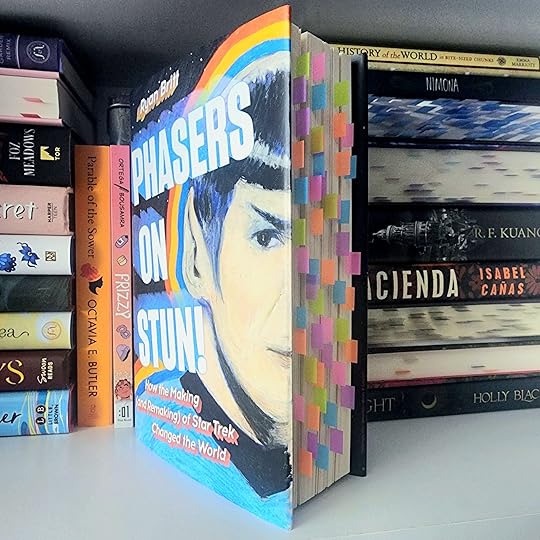
really fun & approachable overview of some trek history :)

May 23, 2022
Star Trek’s original series lasted 79 episodes. Amazingly, there are now more non-fiction books about said franchise than there are individual episodes of the classic show. Many of the well over one hundred Trek non-fiction books focus either on individual shows and movies or specific themes and subjects, but a handful use their viewscreens panoramically and attempt to give a full sense of Trek’s half-century. One such is Ryan Britt’s Phasers on Stun!, probably closest in scope, and even title, to Marcus Berkmann’s Set Phasers to Stun: 50 Years of Star Trek (2016). Britt doesn’t break a lot of new ground with this book, but offers enough distinctive characteristics to avoid becoming a mere transporter duplicate, and will likely prove engaging to modern readers or newbies.
Throughout the book’s seventeen chronologically arranged chapters Britt mines over one hundred original interviews to back up his observations. This original primary source material – ranging from comments by William Shatner to recent YouTube reviewers – is the book’s biggest contribution to Trek non-fiction. The end-notes to each chapter reveal that Britt has dug deep into the dilithium mines of franchise lore and history. Britt’s synthesis of countless episodes and movies, not to mention ancillary reference tomes, media tie-in novels, and comics, is impressive, and speaks to his zeal and commitment.
A prolific writer of punchy online articles, Britt approaches his overview in a similarly chatty, profanity-laden way, with hyperbole the default setting. For example: “This hints at the key element to Star Trek fandom that everyone forgets: We know Trek is a little silly, but if you ask us about it, we’ll tell you it’s the most fucking intellectually important thing of all time.” Britt’s many judgments are unleashed like Ferengi energy whips. “Picard yelling at people,” he writes, “constitutes 99 percent of all of Patrick Stewart’s best performances.” Or: “[Sean] Connery playing Sybok would have saved The Final Frontier.” Yeah, well, you know, that’s just like, your opinion, man.
The book’s early chapters deal with Star Trek’s inception, production challenges, and initial reception, often via catchy introductory hooks, like the quality of Spock’s prosthetic ears. Writers like Isaac Asimov and Theodore Sturgeon are introduced thusly: “A divisive figure in literary science fiction history, with a troublesome reputation for arrogance and misogyny, Asimov” and “Theodore Sturgeon, an eccentric science fiction writer who was the real-life basis for Kurt Vonnegut’s infamous fictional sci-fi writer Kilgore Trout.” Britt gives us a good sense of the complexities of Gene Roddenberry’s character, and spends welcome time on the contributions of other key players like Gene L. Coon. When discussing the original feature films, Britt uses the journey of the character Saavik as a connective line that reveals the movies’ predilection for nostalgia, and in a later chapter he likewise zooms in on Picard’s Earl Gray contrasted with Janeway’s coffee as a “microcosm” to reveal the differences between The Next Generation and Voyager. Chapter nine makes commendable use of a deleted episode scene to comment on therapy. When discussing LGBTQ+ representation, Britt’s deep knowledge of his subject matter shines through in his references to the 1996 Marvel comics series Star Trek: Starfleet Academy. In Chapter 16, Britt makes the important observation that “in Star Trek, adolescent tales of heroic quests are mostly backstory. And that’s because working adults – complete with regrets and family angst – tend to dominate the narrative.” Yes, though I think this understates the importance of these adults’ highly developed competencies. Chapter 17, which wrestles with the question of what Star Trek really is, contains this thought-provoking idea: “in some ways this cycle of backlash and acceptance not only defines the history of Star Trek, but also presents the real reason why it endures as such a hopeful, and nearly secular, religion.” The volume concludes with a handy franchise summary.
One of Phasers on Stun!’s draws is that it covers post-2009 Trek within a broader continuity of analysis and appreciation. “If Deep Space Nine was ‘hope through darkness,”’ Britt comments, “then Discovery Season 1 was hope as an abstract concept while also inside a pitch-black room in which the lightbulbs have been broken.” Regarding two other series, he says, “Picard and Lower Decks might seem like totally different Trekkie beasts, designed for completely disparate audiences, but they’re both forms of contemporary, fully sanctioned fan fiction, primarily spun out of The Next Generation.” Britt opines that these shows “provide the same warm-blanket-on-a-cold-night feeling people think about when they remember the best of Star Trek.” But as he himself is quick to point out about Picard: “From Seven of Nine shooting up seedy bars with her phaser rifle, to Picard’s new Number One, Raffi (Michelle Hurd), battling drug addiction, to Starfleet admiral Clancy (Ann Magnuson) dropping the f-bomb, Picard Season 1 drew plenty of criticism from longtime TNG fans who felt betrayed by the darkness of the new show.” Dude, where’s my blanket?
Britt’s poppy writing style makes for breezy reading, but his penchant for simplification is sometimes misleading. Consider: “Even in 2016, George Takei was filmed watching a trailer for Star Trek Beyond, reacting with disgust to spaceship explosions, and saying, ‘This is not the peaceful vision of the future Gene Roddenberry created.’ Now, Takei is a wonderful and smart person, but even he still leans into the false narrative that all good Star Trek comes from Gene Rodenberry’s vision.” I invite curious readers to seek out that reaction video online. Takei remains impassive while watching the trailer and then offers a quick but thoughtful reaction. He does reference Rodenberry’s name, but he doesn’t actually use the word “peaceful.” Britt is paraphrasing and slightly distorting what Takei actually says (“I didn’t in the preview note anything of the substance of what made Gene Roddenberry’s Star Trek so engaging, and it was the commentary on social justice, political reality at the time,” among other things), yet citing Takei in quotation marks. This is a small example of Britt’s buttressing a belief by sacrificing nuance and accuracy. Ironically, Britt’s own assessment of the earlier 2009 feature film largely mirrors Takei’s critique of Beyond: “Trek 2009 succeeds at being ‘for everyone’ because it’s not actually about anything Star Trek is really known for. It’s only a character piece, and mostly just about Kirk and Spock.” Later, Britt offers this generalization: “True fans of Star Trek know that to love Star Trek is to love something that is deeply flawed.” It seems circularly self-defeating to use the phrase “true fans” in the context of discussing series reception. At one point, Britt suggests that fans may be “inherently conservative,” but a few pages later he celebrates that fans are “primed to embrace change.” In Chapter Nine, Britt notes: “At the height of Trek’s ’90s renaissance, Pocket Books was publishing six different original novels a year.” In fact, from 1995 through the early 2000s, Pocket Books published over 20 original novels a year. I noticed a few other minor gaffes, like the title of the DS9 episode “Rejoined” being accidentally substituted for “Attached” (a TNG episode) in Chapter 15, but hopefully these exist only in the uncorrected pre-publication proof.
Towards the start and the end of the book, Britt twice quotes Picard’s reflection on humanity (though both times Britt attributes it to the pilot, “Encounter at Farpoint”, the line actually derives from the time-traveling series finale, “All Good Things”): “We are what we are, and we’re doing the best we can.” I like Britt’s notion that “after 800 hours of episodes and movies,” fans believe that “maybe this time they’ll get it right. Maybe this time it will be perfect.” That’s emblematically hopeful. Anyone picking up the latest history of Star Trek may understandably feel the same way.
https://locusmag.com/2022/08/alvaro-z...
Throughout the book’s seventeen chronologically arranged chapters Britt mines over one hundred original interviews to back up his observations. This original primary source material – ranging from comments by William Shatner to recent YouTube reviewers – is the book’s biggest contribution to Trek non-fiction. The end-notes to each chapter reveal that Britt has dug deep into the dilithium mines of franchise lore and history. Britt’s synthesis of countless episodes and movies, not to mention ancillary reference tomes, media tie-in novels, and comics, is impressive, and speaks to his zeal and commitment.
A prolific writer of punchy online articles, Britt approaches his overview in a similarly chatty, profanity-laden way, with hyperbole the default setting. For example: “This hints at the key element to Star Trek fandom that everyone forgets: We know Trek is a little silly, but if you ask us about it, we’ll tell you it’s the most fucking intellectually important thing of all time.” Britt’s many judgments are unleashed like Ferengi energy whips. “Picard yelling at people,” he writes, “constitutes 99 percent of all of Patrick Stewart’s best performances.” Or: “[Sean] Connery playing Sybok would have saved The Final Frontier.” Yeah, well, you know, that’s just like, your opinion, man.
The book’s early chapters deal with Star Trek’s inception, production challenges, and initial reception, often via catchy introductory hooks, like the quality of Spock’s prosthetic ears. Writers like Isaac Asimov and Theodore Sturgeon are introduced thusly: “A divisive figure in literary science fiction history, with a troublesome reputation for arrogance and misogyny, Asimov” and “Theodore Sturgeon, an eccentric science fiction writer who was the real-life basis for Kurt Vonnegut’s infamous fictional sci-fi writer Kilgore Trout.” Britt gives us a good sense of the complexities of Gene Roddenberry’s character, and spends welcome time on the contributions of other key players like Gene L. Coon. When discussing the original feature films, Britt uses the journey of the character Saavik as a connective line that reveals the movies’ predilection for nostalgia, and in a later chapter he likewise zooms in on Picard’s Earl Gray contrasted with Janeway’s coffee as a “microcosm” to reveal the differences between The Next Generation and Voyager. Chapter nine makes commendable use of a deleted episode scene to comment on therapy. When discussing LGBTQ+ representation, Britt’s deep knowledge of his subject matter shines through in his references to the 1996 Marvel comics series Star Trek: Starfleet Academy. In Chapter 16, Britt makes the important observation that “in Star Trek, adolescent tales of heroic quests are mostly backstory. And that’s because working adults – complete with regrets and family angst – tend to dominate the narrative.” Yes, though I think this understates the importance of these adults’ highly developed competencies. Chapter 17, which wrestles with the question of what Star Trek really is, contains this thought-provoking idea: “in some ways this cycle of backlash and acceptance not only defines the history of Star Trek, but also presents the real reason why it endures as such a hopeful, and nearly secular, religion.” The volume concludes with a handy franchise summary.
One of Phasers on Stun!’s draws is that it covers post-2009 Trek within a broader continuity of analysis and appreciation. “If Deep Space Nine was ‘hope through darkness,”’ Britt comments, “then Discovery Season 1 was hope as an abstract concept while also inside a pitch-black room in which the lightbulbs have been broken.” Regarding two other series, he says, “Picard and Lower Decks might seem like totally different Trekkie beasts, designed for completely disparate audiences, but they’re both forms of contemporary, fully sanctioned fan fiction, primarily spun out of The Next Generation.” Britt opines that these shows “provide the same warm-blanket-on-a-cold-night feeling people think about when they remember the best of Star Trek.” But as he himself is quick to point out about Picard: “From Seven of Nine shooting up seedy bars with her phaser rifle, to Picard’s new Number One, Raffi (Michelle Hurd), battling drug addiction, to Starfleet admiral Clancy (Ann Magnuson) dropping the f-bomb, Picard Season 1 drew plenty of criticism from longtime TNG fans who felt betrayed by the darkness of the new show.” Dude, where’s my blanket?
Britt’s poppy writing style makes for breezy reading, but his penchant for simplification is sometimes misleading. Consider: “Even in 2016, George Takei was filmed watching a trailer for Star Trek Beyond, reacting with disgust to spaceship explosions, and saying, ‘This is not the peaceful vision of the future Gene Roddenberry created.’ Now, Takei is a wonderful and smart person, but even he still leans into the false narrative that all good Star Trek comes from Gene Rodenberry’s vision.” I invite curious readers to seek out that reaction video online. Takei remains impassive while watching the trailer and then offers a quick but thoughtful reaction. He does reference Rodenberry’s name, but he doesn’t actually use the word “peaceful.” Britt is paraphrasing and slightly distorting what Takei actually says (“I didn’t in the preview note anything of the substance of what made Gene Roddenberry’s Star Trek so engaging, and it was the commentary on social justice, political reality at the time,” among other things), yet citing Takei in quotation marks. This is a small example of Britt’s buttressing a belief by sacrificing nuance and accuracy. Ironically, Britt’s own assessment of the earlier 2009 feature film largely mirrors Takei’s critique of Beyond: “Trek 2009 succeeds at being ‘for everyone’ because it’s not actually about anything Star Trek is really known for. It’s only a character piece, and mostly just about Kirk and Spock.” Later, Britt offers this generalization: “True fans of Star Trek know that to love Star Trek is to love something that is deeply flawed.” It seems circularly self-defeating to use the phrase “true fans” in the context of discussing series reception. At one point, Britt suggests that fans may be “inherently conservative,” but a few pages later he celebrates that fans are “primed to embrace change.” In Chapter Nine, Britt notes: “At the height of Trek’s ’90s renaissance, Pocket Books was publishing six different original novels a year.” In fact, from 1995 through the early 2000s, Pocket Books published over 20 original novels a year. I noticed a few other minor gaffes, like the title of the DS9 episode “Rejoined” being accidentally substituted for “Attached” (a TNG episode) in Chapter 15, but hopefully these exist only in the uncorrected pre-publication proof.
Towards the start and the end of the book, Britt twice quotes Picard’s reflection on humanity (though both times Britt attributes it to the pilot, “Encounter at Farpoint”, the line actually derives from the time-traveling series finale, “All Good Things”): “We are what we are, and we’re doing the best we can.” I like Britt’s notion that “after 800 hours of episodes and movies,” fans believe that “maybe this time they’ll get it right. Maybe this time it will be perfect.” That’s emblematically hopeful. Anyone picking up the latest history of Star Trek may understandably feel the same way.
https://locusmag.com/2022/08/alvaro-z...

February 5, 2023
"The power of Star Trek is that it teaches you, over and over again, how to live better. how to be a more thoughtful and kinder person."
"For almost six decades, Star Trek's little starships have taken us boldly though the looking glass, to find ourselves. The making and remaking of Star Trek isn't just about complicated business decisions made in Hollywood. That's part of it. But the profound aspect of Star Trek is in its willingness to radically change so often. It's the story of human survival, and human triumph."
Ryan Britt
Science fiction stories generally fall into three camps. The first camp is the classic hero's journey of good versus evil, but this time in space with aliens involved. Star Wars easily falls into this category with its plucky, virtuous heroes and evil dastardly villains. There's no grey areas about who to root for, except once in a while when Darth Vader turns on the Emperor and changes his tune at the very end of his story. The second camp is pure dystopian sci-fi that portrays mankind as flawed and evil, with technology as its main villain. These stories include popular movies like Planet of the Apes, Hunger Games, Blade Runner, I Robot, Divergent, and Waterworld. Buried into these dystopias are a few good people, but they rarely find a way to change the system and their small victories are of little comfort.
The third category of sci-fi is where Star Trek comes in- full of grey areas and optimism. Like the first two, there are spaceships, robots, and great special effects. Technology is seen as mostly a net positive, because humanity has tamed it and improved themselves to the point where they can explore the universe with noble intentions. There are bad guys of course, but they are complicated and not as easily dispatched as those in the first two camps. Star Trek pretty much invented this category, and over 60 years and multiple adventures the franchise has owned it. The heroes of Star Trek, such as they are, are complex and flawed, and most of the stories involve journeys of understanding rather than simple battles of conquest.
I did a deep dive into Star Trek with this book, Phasers on Stun, that covers the entire franchise from its humble beginnings to its fascinating position today with multiple shows that show how far we've come as a society in the past 50+ years. Ryan Britt is a journalist who has focused his career on science fiction, and he does an excellent job of looking at the many different versions of the Star Trek story that have emerged since the beginning. Considering the fact that there are 13 full length movies, 12 Star Trek series with over 900 episodes, and large numbers of books, podcasts, and fan fiction devoted to Trek, this was no easy task. In 330 pages there is room for only a few of the most important stories, but he does a good job of covering what has made Star Trek special throughout the years.
The first part of the book covers the original Star Trek series with Captain Kirk and Mr. Spock, and the many groundbreaking things that came from it. The original series came along at an interesting time in 1966. The space program was in full swing, with the moon landing on the horizon and everybody excited about what awaited us in outer space. In addition, the US was in a controversial and unpopular war in Vietnam, feminism was on the rise, and civil rights demonstrations were transforming race relations. Television had just transitioned to full color programming, and the show made good use of it with its sets and costumes. Science fiction was still very much a literary entity back then, with television rarely attempting it due to the huge expenses involved in its production. With apologies to Lost in Space, Trek was the first real attempt to bring science fiction to mass culture.
When Gene Roddenberry first proposed the show, there were many obstacles to overcome. The first pilot episode was rejected by NBC, but thanks to Lucille Ball the show got another chance to recast and re-imagine itself. They hired William Shatner to play Captain Kirk, altered Leonard Nimoy's character as science officer Spock, and dumped Gene Roddenberry's girlfriend at the time who was to play a strong woman officer. Britt tells the fascinating story of just how pivotal the Spock character became to the ultimate success of the original show, detailing how they went from portraying him as demonic to cool and logical, and obsessing over the shape and size of his famous pointy ears. The 79 episodes of the original Star Trek were revolutionary in many ways for television at that time. The crew was diverse- with a black woman, Uhura, and an Asian, Sulu given important roles. In age when racism was very much a thing, Star Trek portrayed a post-racial society that only got more and more diverse as the show evolved.
The show hired many of the best writers in the science fiction world to come up with scripts, and these thoughtful stories challenged viewers like never before. While some of the scripts were downright silly, most of them were thought-provoking and appropriate for the period. Some of my favorite aspects of the original series, as pointed out in this book include:
- Weapons were not glorified. Phasers could be set on stun to only immobilize an enemy, and not destroy them.
- The prime directive guided the Enterprise crew to never interfere with developing, primitive civilizations. This flies in the face of centuries of colonization and imperialism that guided much of Earth's history.
- People of different races and planets lived and worked together in a relatively just society. Certainly some episodes did touch on racism, but the assumption was that diversity was widely accepted. (except for homosexuality, which only recently entered the Star Trek world along with the rest of pop culture.)
- Money is generally not an issue (nor, apparently are bathrooms), and there is apparently no problem in the 23rd century with income inequality.
- Stories involving exploration and new ideas take precedence, and petty personal dramas are rarely the focus.
- Transporters could scramble your DNA and perfectly reassemble you across the galaxy. How cool is that??
Britt covers the surprising fandom that emerged in the 1970's after the original series was cancelled, resulting in Star Trek conventions, fan fiction, and groups of Trekkies who obsessed over the show and its optimistic universe. This all resulted in a motion picture in 1979, followed by 12 more, some of which were more successful than others. In 1987, the franchise returned to television with The Next Generation, a new series set in the future with a new Enterprise and new diverse cast including women, minorities, and an android. In this second golden age of Star Trek there would be three series in all that greatly expanded the Star Trek universe- Next Generation, Deep Space Nine, and Voyager. The book gives a nice recap of each series, how they came about, and how they added to the Star Trek canon.
Klingons, who had been mortal enemies to the Federation during the first episode, became allies during the second period, and a Klingon character, Worf, was added to the crew of several series. Technology was seen as both a good thing, through the android character Data, and as an evil, through the Borg, a new cybernetic villain that rose up in the first episode of Next Generation.
After the turn of the century, Star Trek went through a quiet period with fewer new stories save the little known Enterprise series with Scott Bakula. In 2009 the franchise was jump-started again by JJ Abrams and a new cast with a series of new full-length movies. And now, in the 2020's Star Trek has evolved once again with five vastly different series, all in production at once- Discovery, Picard, Strange New Worlds, Lower Decks (animated) and Prodigy (aimed at kids). With each new version, Star Trek becomes a more diverse, more "woke", and more ambitious. The stories are as interesting and entertaining as ever, but the theme of seeking out strange new worlds, and civilizations, boldly going where no man has gone before continues.
The subtitle of this book is "how the making and remaking of Star Trek changed the world." Did Star Trek change the world? Perhaps. NASA named one of its space shuttles after the Enterprise. It certainly enriched many lives. But it also gave us a role model for the future- one where technology is our friend, sentient beings are protected no matter what their shape, size, or color, and where everybody is open to learning new things. Britt says that one of the problems with the Star Wars saga is that everything seemed so perfect in the first 1977 movie, and all that followed was compared to that unrealistic standard. Star Trek, on the other hand, never got it all right, and kept on trying to improve and explore its world (both the fictional one and the real world of its viewers), making its stories resonate. I can identify with the flawed crew of the Enterprise, and learn from their well-intentioned mistakes, and so Star Trek has definitely changed my world.
This is the best book on Star Trek that I've ever read, but it's not for the uninitiated. I would recommend catching up on episodes before tackling the book (Most of them are available on Paramount +). Live long, and prosper.

April 22, 2022
I liked this book. I’m an old-time Star Trek fan and I enjoyed the parts of the book that discussed the shows of 2001 and earlier. I also liked the discussion about movies 1 through 6. Possibly not a surprise, but I did not like the parts of the book that discussed the newer series and movies. This corresponds exactly to how much I enjoyed or did not enjoy the various series and movies. Ryan Britt actually discusses this schism which is quite common. This told me that Britt really knows his stuff and discusses it in an erudite manner and with some humor. To say the least, the book is thought-provoking. So looking back, I now appreciate the value of Britt’s discussion of the newer Star Treks. The footnotes are worth reading as well, as is the convenient timeline. Thank you to Netgalley and Penguin Group Dutton.

July 17, 2022
When I was born in 1985, my father almost missed my birth because he was so engrossed in an episode of Star Trek: The Original Series (yeah, this doesn't look good for my dad, but he made up for it later.) I grew up watching Star Trek: Deep Space Nine and Voyager. My parents often quoted Star Trek to each other. So, when Phasers on Stun! by Ryan Britt was published I knew I wanted to read it.
Phasers on Stun! is a fun look at the history and making of Star Trek. Star Trek has been a revolutionary series from the very beginning, breaking boundaries of race, gender, and culture to nurture a more ethical worldview. My two favorite Star Trek series Deep Space Nine and Voyager both boundary-breaking in their own way. Deep Space Nine had the first black captain who was a father, mentor, and friend to those on the ship while Voyager had the first female captain represented in Star Trek.
This book was published in 2022 so while you may have heard some of the history of the older shows this book is up to date on the current shows as well. I would recommend this book to any Star Trek fan who is interested in learning more about the history and behind the scenes of Star Trek shows.
Rating: 4/5
Genre: Non-Fiction
Phasers on Stun! is a fun look at the history and making of Star Trek. Star Trek has been a revolutionary series from the very beginning, breaking boundaries of race, gender, and culture to nurture a more ethical worldview. My two favorite Star Trek series Deep Space Nine and Voyager both boundary-breaking in their own way. Deep Space Nine had the first black captain who was a father, mentor, and friend to those on the ship while Voyager had the first female captain represented in Star Trek.
This book was published in 2022 so while you may have heard some of the history of the older shows this book is up to date on the current shows as well. I would recommend this book to any Star Trek fan who is interested in learning more about the history and behind the scenes of Star Trek shows.
Rating: 4/5
Genre: Non-Fiction

August 17, 2022
I was disappointed by the overall presentation. While the early chapters I found fascinating and insightful, giving credit to early creators while giving historical context, etc., was great. I'm a new Trek fan, I missed on TOS, TNG, DS9, everything until DISCO and now I'm watching from the start. However, neglecting to remember the entire character of Keiko (which could have been avoided by slightly different phrasing), writing about Pride in a weird kind of "cis ally thinks they know how to be helpful" kind of way I found disengenous, and a deep self-regard for himself "hey guys a fan figured out the twist on DISCO before it aired and CBS reached out to him to stop..that was totally me, y'all" just felt like a pat on the back instead of continuing to discss the relationship between Trek and fan base.
I don't know. For how strong the start was, I feel very let down by the second half. I recognize the second half covers a lot of the new and ongoing Trek, but even the Ds9, Voyager, and Enterprise sections were remarkably sparse.
The first half would have been better as the start to a "making of TOS" biography type thing, and the second half as a series of disconnected essays.
I don't know. For how strong the start was, I feel very let down by the second half. I recognize the second half covers a lot of the new and ongoing Trek, but even the Ds9, Voyager, and Enterprise sections were remarkably sparse.
The first half would have been better as the start to a "making of TOS" biography type thing, and the second half as a series of disconnected essays.
March 13, 2022
This was an interesting look into the making of Star Trek. I appreciated all the insights and inside stories about cast members, how they were chosen, how their characters were developed, how the cast related to each other, etc. They really were “fascinating” to borrow a phrase from Spock.
The presentation of the information seemed a little bit scattershot at times. It made it a little hard to follow the narrative. To some extent, reading it it felt the way it feels when you’re talking to a grandmother or grandfather about things that happened in their life a long time ago. And as they’re talking, they do follow a general timeline but still throw in things here and there that they just thought of or are just tangentially related to the main story they’re telling, or suddenly they’re on to a new, related topic, and it takes you a second to realize the leap of logic they made to get there.
But it was still manageable enough to be an enjoyable read. Even if you like Star Trek but aren’t a super big fan of the shows, you will probably like this one.
Disclosure: I read an ARC copy provided by NetGalley
The presentation of the information seemed a little bit scattershot at times. It made it a little hard to follow the narrative. To some extent, reading it it felt the way it feels when you’re talking to a grandmother or grandfather about things that happened in their life a long time ago. And as they’re talking, they do follow a general timeline but still throw in things here and there that they just thought of or are just tangentially related to the main story they’re telling, or suddenly they’re on to a new, related topic, and it takes you a second to realize the leap of logic they made to get there.
But it was still manageable enough to be an enjoyable read. Even if you like Star Trek but aren’t a super big fan of the shows, you will probably like this one.
Disclosure: I read an ARC copy provided by NetGalley

July 7, 2022
At times, I found Britt very patronizing . He calls Star Trek "kitsch" and "goofy". I resented his attitude. He seemed to be completely unaware that he was offending fans. Fans aren't just people who watch a series. They love it, they identify with it and it becomes a significant part of their lives. I imagine that Britt immersed himself in Star Trek for the purpose of writing the book, but he probably couldn't imagine the mindset of a Star Trek fan.
It was enjoyable to re-live the earlier Star Treks that I've seen through Phasers on Stun and to learn about the newer series that I haven't seen. I'm considering viewing Discovery and Strange New Worlds. There's just so much for me to catch up on in digital format.
For my complete review see https://shomeretmasked.blogspot.com/2...
It was enjoyable to re-live the earlier Star Treks that I've seen through Phasers on Stun and to learn about the newer series that I haven't seen. I'm considering viewing Discovery and Strange New Worlds. There's just so much for me to catch up on in digital format.
For my complete review see https://shomeretmasked.blogspot.com/2...

June 8, 2022
This is one hell of a good look at the history of 'Star Trek'. Engaging on every level, Britt explains the highs and lows of the series as an experience that is worth having. There is no bad 'Star Trek', he posits, because 'Star Trek' is aspiring to be something more and, even when producers make a wrong turn, the experience informs future development.

July 1, 2022
As a casual Star Trek fan, this was at most going to be only a four-star read for me. I grew up watching the original series and was mildly interested in the Next Generation series and the movies, but loss interest in the great proliferation of television series that have come since. I liken it to college sports in that I’m too lazy to put in the work to get that invested in anything so time-consuming that’s supposed to be enjoyable. I did think all three of the reboot movies excellent, but more as action movies and less as Star Trek stories. With all that said, this was an interesting book. The author obviously did extensive research and worked very hard to produce a coherent narrative linking many story threads. It’s mostly well-written (insofar as breezy pop culture histories can be) and was well-structured and organized. I was a little disappointed that despite obvious extreme left-leaning politics, the author did nothing to address the sexism of the original series. As a kid, I didn’t notice it, but my wife has pointed it out and in addition to the costumes I now remember how they always seemed to use a different lens on closeups of female characters so that they appeared as through some sort of misty fog. In hindsight, this seems weird at best and horribly objectifying at worst. The things that knocked this book down a bit for me, though, were the gratuitous swearing (it comes across as immature and unprofessional) and the way the author bangs on and on and on about the exclusion and later inclusion of LGBTQ storylines and characters in the later series. I can empathize that it must be frustrating for LGBTQ people to constantly feel excluded from mainstream society and I think it’s good that this has changed/is changing to some degree, but Ryan Britt hammers on and on for what seemed like at least forty chapters about this issue, but was probably only one. It would have been nice if his editor could have dialed him back a bit. All in all, not a waste of time if you’re interested in Star Trek, but nothing to make me run out and catch up on the thousands of episodes I’ve never seen.

June 22, 2024
Phasors on Stun is a comprehensive look at Star Trek and all of its iterations. Ryan Britt does a fantastic job of chronicling the entire 55+ year history of the franchise, and more importantly, how Trek has changed with each series to reflect the issues prevalent in society when that series was airing. I found this to be an important aspect of the series because there is a lot of vitriol online in the Trek community for recent Trek series.
As a fan of the recent Trek shows, it has been hard to show support online because the vocal minority will come out of the wood work to attack you for your opinions and make you feel like you have no place to being in the Trek community. As a LGBTQIA+ person, this can be incredibly disheartening to see a fandom actively go out of their way to make their negativity known in such a way that it feels like they are attacking the new series because they feature openly LGBTQIA+ characters and people of color.
However, Ryan Britt chronicles how Star Trek was always trying to incorporate present issues (at the time each series was produced) as part of its more leftist ideology. He even discusses how each new iteration of Trek goes through a period of “this isn’t real Trek” until the “fans” decide it is after a length of time.
I’m not trying to get in a soap box and tell everyone why they should embrace Discovery and Picard as Trek. But instead say that maybe everyone should read this book and understand that what makes Trek great is that it’s always been about showing us that we can one day go beyond our prejudices so long as we embrace what makes us different.
As a fan of the recent Trek shows, it has been hard to show support online because the vocal minority will come out of the wood work to attack you for your opinions and make you feel like you have no place to being in the Trek community. As a LGBTQIA+ person, this can be incredibly disheartening to see a fandom actively go out of their way to make their negativity known in such a way that it feels like they are attacking the new series because they feature openly LGBTQIA+ characters and people of color.
However, Ryan Britt chronicles how Star Trek was always trying to incorporate present issues (at the time each series was produced) as part of its more leftist ideology. He even discusses how each new iteration of Trek goes through a period of “this isn’t real Trek” until the “fans” decide it is after a length of time.
I’m not trying to get in a soap box and tell everyone why they should embrace Discovery and Picard as Trek. But instead say that maybe everyone should read this book and understand that what makes Trek great is that it’s always been about showing us that we can one day go beyond our prejudices so long as we embrace what makes us different.

November 12, 2022
If you enjoy Star Trek, there's a good chance you have a favorite series and/or movie. I'm a TNG fan, myself, partially because it's what I grew up on (a nod to Picard and Strange New Worlds for being top notch). And I will admit I haven't seen all the series. But regardless, I think most of us can say there's plenty of room in the Star Trek universe for all past, present, and future series/movies (seriously, don't gatekeep someone's love of something, it's a jerk move).
This is a book written by a fellow nerd, it's part history and part love letter to all things Star Trek. I learned a lot and it was quite entertaining from beginning to end. I'll take marks off for some pretty big spoilers on Star Trek: Discovery. Which is more my fault that I haven't watched it yet but, dangit, that was a big spoiler (or maybe not, I dunno, I haven't seen it still but it sounded big 😂). If you enjoy Star Trek, I say pick up this one up!
This is a book written by a fellow nerd, it's part history and part love letter to all things Star Trek. I learned a lot and it was quite entertaining from beginning to end. I'll take marks off for some pretty big spoilers on Star Trek: Discovery. Which is more my fault that I haven't watched it yet but, dangit, that was a big spoiler (or maybe not, I dunno, I haven't seen it still but it sounded big 😂). If you enjoy Star Trek, I say pick up this one up!

June 19, 2022
I'm not a Trekker by any stretch of the imagination, but I have enjoyed elements of Star Trek for as long as I can remember. So it is that getting so much BTS info and a wider view of the importance of Star Trek in the wider sci-fi and IRL world was fascinating.
Britt goes deep into very specific elements of Star Trek, yet I love how it never feels like a casual watcher/reader is being pushed out of the narrative by a lack of knowledge. Now, I admit that this might mean that a hardcore fan might find that there is information that didn't need to be shared or obvious, but I loved how it made the deeper elements of Trek more accessible.
Overall, I'm walking away from this with a much deeper appreciation of everything Star Trek and curious to look up more writings by Ryan Britt.
Happy thanks to NetGalley, PENGUIN GROUP Dutton, and Plume Books for the interestingly educational read!
Britt goes deep into very specific elements of Star Trek, yet I love how it never feels like a casual watcher/reader is being pushed out of the narrative by a lack of knowledge. Now, I admit that this might mean that a hardcore fan might find that there is information that didn't need to be shared or obvious, but I loved how it made the deeper elements of Trek more accessible.
Overall, I'm walking away from this with a much deeper appreciation of everything Star Trek and curious to look up more writings by Ryan Britt.
Happy thanks to NetGalley, PENGUIN GROUP Dutton, and Plume Books for the interestingly educational read!

September 25, 2022
There are many histories written about the original series, probably my favorite is The World of Star Trek by David Gerrold, there are even books on Phase II the unmade 1970s ST series. Taking on the entire history of Star Trek with 800 plus hours of entertainment that is still almost weekly adding to this number is daunting but Ryan Britt appears to be the guy to do it. Featuring a wide range of interviews done over several years it appears that Ryan Britt was fully committed to the process of this history.
If you are a super nerd for the series there is not much new information, although there are lots of great new interview quotes from folks in front of and behind the camera throughout the book. Most importantly I think this book can add context and history to a show for people who don’t love it.
I mean the outside critic might be wondering. Why is Star Trek so important? What does it all mean? This is a terrific book for just that.
Even though I think I know everything there is to know about Star Trek somehow I never heard that Nichelle Nichols named Uhura after a 1962 novel by Robert Ruark. I didn’t know that Gene Coon had a super radical secretary Ann Richardson (who I working on getting to interview), and a few other details but I don’t think this book is for us super fans.
I think the ideal reader is the critic or those interested in pop-culture history that want to understand Star Trek but have only a little knowledge. In that sense, I think Britt did an amazing job writing the history. Big thumbs up.
If you are a super nerd for the series there is not much new information, although there are lots of great new interview quotes from folks in front of and behind the camera throughout the book. Most importantly I think this book can add context and history to a show for people who don’t love it.
I mean the outside critic might be wondering. Why is Star Trek so important? What does it all mean? This is a terrific book for just that.
Even though I think I know everything there is to know about Star Trek somehow I never heard that Nichelle Nichols named Uhura after a 1962 novel by Robert Ruark. I didn’t know that Gene Coon had a super radical secretary Ann Richardson (who I working on getting to interview), and a few other details but I don’t think this book is for us super fans.
I think the ideal reader is the critic or those interested in pop-culture history that want to understand Star Trek but have only a little knowledge. In that sense, I think Britt did an amazing job writing the history. Big thumbs up.
April 7, 2023
As a lifelong Star Trek fan (The Next Generation was my first but I love them all), this book was simply wonderful. I was initially a bit worried about the book - would it be critical and ruin my ongoing love for Trek? After all, much literary criticism seems to have the effect of ruining great books. Fortunately, this book achieved the exact opposite: enhancing and enriching Star Trek from the 1960s to the 2020s.
I appreciate that the author weaves together both a love of Trek and a critical eye. Some of my favorite chapters: one on the writing of the Original Series, Trek's preoccupation with time travel (one of my favorite aspects of SF) and the chapters on the newest Trek.
The book also has delightful footnotes that added fun details, humor and more! Well worth reading for any Star Trek fan or, indeed any science fiction fan.
I appreciate that the author weaves together both a love of Trek and a critical eye. Some of my favorite chapters: one on the writing of the Original Series, Trek's preoccupation with time travel (one of my favorite aspects of SF) and the chapters on the newest Trek.
The book also has delightful footnotes that added fun details, humor and more! Well worth reading for any Star Trek fan or, indeed any science fiction fan.

October 9, 2022
What a wonderful book! As a viewer of Trek from its the origins, an attendee of the 1974 NYC Trek Con and a one time visitor to the set of Next Gen I do love books about the history and meaning of all things Trek. This covers it all from OS to the current iterations including the animated versions and includes the fandom and conventions. Full of insights and tidbits from a huge variety of sources and interviews written in a light and breezy style that never left the reader feeling overwhelmed by data ( not THAT Data). Fascinating.

October 1, 2026
What a fun read! I have seen some Star Trek through my parents but have never considered myself a serious fan. This was super informative and entertaining, and felt like returning to my parents old couch watching an original series episode with them. Hearing about all the characters felt like hearing out my parents friends. I especially appreciated the critical lens on diversity and representation in the Trek series and the risks it took in the time of filming versus how it comes off today. Now it's time to watch all the Trek series......

November 26, 2023
Fabulous book for fans! Written by a longtime sci-fi journalist, this book delves into the history of Star Trek like no other, pulling out the deep cuts and bringing in top-notch criticism. Many of the stars were interviewed personally for this book, but Britt's commentary could carry the book on its own. This is not just a history, but a comprehensive look at the franchise and how it's changed over the years, plus the impact it's made on society.

January 23, 2026
While a lot of the information in the book isn’t new, Britt does present a lot of it through a focused, modern lens. I’m not so sure the book does illustrate how the different series have “changed the world”, but I do think there’s a lot on how it’s changed science fiction, fandom, and media analysis.
August 1, 2022
A more in-depth book than I expected, although it retreads a lot of the same paths and thoughts of other books on Trek past and present.
The writer's style and excitement helped keep me engaged even in chapters I knew exactly what was ahead for me in reading.
Recommended unless you're such a Trek fan as to have read all the materials already and kept up to date on all fan and pro gossip…
The writer's style and excitement helped keep me engaged even in chapters I knew exactly what was ahead for me in reading.
Recommended unless you're such a Trek fan as to have read all the materials already and kept up to date on all fan and pro gossip…

June 3, 2024
I really enjoyed this, I listened to the audio book and loved every chapter!

June 14, 2024
Stunning!

February 12, 2025
Quite the detailed exploration of all things Star Trek. I'm a bit annoyed that the author uses a lot of 2020's terminology, such as "woke" and "OG". As a person who watched the first episode of the original series (known here in the book and elsewhere as TOS) when it first aired (but had nightmares that night so my parents wouldn't allow me to watch any other episodes for quite awhile) I don't like his use of idioms. The book was very thorough and was a fun way to remember favorite episodes and actors and learn more about the making of the various iterations of Star Trek.

August 5, 2025
This is a great read for any Trek fan. I knew some of the things that Britt tells, but I learned quite a few new things about the history of Star Trek. This isn't your usual "history of" book. Britt writes in a style that is easy to read and enjoy. Of course, there were certain parts that I wanted more details on (most of The Next Generation era), but there's still plenty available in this book.
4.4 out of 5 stars
4.4 out of 5 stars
Displaying 1 - 30 of 205 reviews