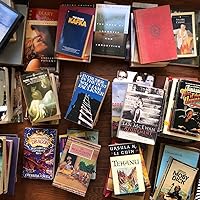
Once I got past not receiving the kinds of closure I was looking for, I really enjoyed this story collection - I had so many thoughts about Le Guin's brilliance and about what she's exploring in this story collection, but I thought for the time being, I would just post my response for my Le Guin class I'm taking. Professor Scott Black, in his lecture on Le Guin's Five Ways to Forgiveness, said, “For both Havzhiva and Rakam, problems may be identified from the outside, but they must be addressed from the inside, from the intimacy of the local pattern and from the intimacy of the body, where you live your history and find your freedom. … In the intimacies of our lives, we live history. How we live in our most intimate moments is a political act.” What I sense playing out politically, socially, and culturally today: how we talk about history has become politicized, but what lens through which we view history has always been political. Le Guin’s brilliance is pointing the narrative lens at these realities and not focusing on the adventure narrative within these fictional histories. Maybe because of the nature of teaching, the net of what can be perceived as political has always seemed larger to me than we traditionally define it?
The description of history from “A Man of the People” also stayed with me, “You say: there is a great river, and it flows through this land and we have named it History. .. To Havzhiva the knowledge that his life, any life was one flicker of light for one moment on the surface of that river was sometimes distressing, sometimes restful.” Throughout these stories, I was impressed by Le Guin’s poetic and masterful way of evoking the setting. The story seemed to be taking place in hot, dry, dusty conditions, but as a balance there is either water or imagery of water.
The quote from “Old Music and the Slave Women,” “We followed his weakness. His incompleteness. Failure’s open. Look at water, Esi. It finds the weak places in the rock, the openings, the hollows, the absences. Following water we come to where we belong," gave me some insight into the setting and the presence of water and water imagery, and really connected to this point from Professor Black's lecture, “At its core are the simple cycles of light and dark, or yang and yin, which revolve like the moon waxing and waning and then waxing and waning again. The Daodejing advocates equanimity and stability amid this flux, like being at the hub around which the spokes of a wheel rise and fall, and practicing wu-wei, or non-coercive action, spontaneous activity free of ingrained habits and so attuned to whatever circumstances you find yourself in." This reminded me of a passage from On Earth We’re Briefly Gorgeous by Ocean Vuong where he observes: “You killed that poem, we say. You’re a killer. You came in to that novel guns blazing. I am hammering this paragraph…. I owned that workshop…. We smashed the competition,” and this really – struck? – me at how much violence can be expressed through the English language and that can be potentially seen in our culture. The stories in Le Guin’s collection have as a backdrop a revolution, a system based on slavery and aggressive profiteering, and other aggressive actions, and yet the stories show characters within that narrative finding harmonious ways to interact with those events or to be part of those events. So many times I wanted the characters to react against the injustice or to meet violence with violence, but Le Guin’s narratives present such a nuanced perspective within historical events.