The next pulse-pounding chapter in Chip Zdarsky’s sprawling saga of New York City’s Guardian Devil, starring Elektra Natchios in her new role as Daredevil — and spinning directly out of the shocking revelations in the pages of DEVIL’S REIGN! Elektra is the world’s deadliest assassin — but she’s taken a vow never to kill again. And now someone has put themself directly in her path, with potentially deadly consequences! What else would you expect from the greatest hunter in the Marvel Universe?
COLLECTING: Daredevil: Woman Without Fear (2022) 1-3, TBA
Chip Zdarsky is a Canadian comic book artist and journalist. He was born Steve Murray but is known by his fan base as Chip Zdarsky, and occasionally Todd Diamond. He writes and illustrates an advice column called Extremely Bad Advice for the Canadian national newspaper National Post's The Ampersand, their pop culture section's online edition. He is also the creator of Prison Funnies and Monster Cops.
I don’t blame others for having lukewarm feelings about the Woman Without Fear section, but holy shit I adored it.
My main problem with this book is with everything else about the collected edition Marvel released for it. This isn’t just the 3 issues of Zdarsky’s Elektra miniseries, since Marvel can’t print a trade that small, so they filled this book in with a ton of not-so-great Elektra extras. We get a story by Ann Nocenti from Elektra #100, a couple of short stories (that I think are also from #100), and a giant cover gallery showing over 100 covers from Elektra’s history, along with a variant cover gallery for Woman With Fear and Elektra #100.
Full reviews for the individual stories are down below, but I’d only recommend this for people who like Zdarsky’s Daredevil run or are obsessed with Elektra.
”Daredevil: Woman Without Fear” by Chip Zdarsky, Rafael De Latorre, Federico Blee, and Clayton Cowles ☆ ☆ ☆ ☆ 1/2
Make sure to read issue #3 of this AFTER Devil’s Reign #5. There’s a massive spoiler in this final issue that might ruin a big surprise and development in the main Devil’s Reign story for some.
This is about what Elektra’s Daredevil is up to during most of the main Devil’s Reign event, taking place after Elektra learned something at the end of Devil’s Reign #1. It’s also a fast paced story that gives us dope fight scenes with Elektra as Daredevil, a lot of insight into her backstory and motivations, and all topped off by some killer action. It is AMAZING.
Elektra taking up the mantle of Daredevil is such a perfect fit for her at this point, and this was an enjoyable and much-needed exploration of her as the character. We get some nice flashback scenes that tie in with past runs, and there’s also an awesome villain that Elekta ends up fighting in the present day. I won’t spoil who here, but it leads to some intense action scenes during all 3 issues. I’m a sucker for whenever this rogue pops up in other Marvel books.
And the art, even if it’s not by Marco Checchetto, is stunning from beginning to end. Rafael De Latorre was the best possible choice as an artist for this 3 issue run. I wouldn’t mind this guy becoming the regular fill-in artist for the main Daredevil book whenever Checchetto needs a break. All his action scenes are crisp, clean, and dynamic. And his smaller character beats bring the emotion Zdarsky needs them to bring, while his layouts are simple and easy to follow.
This is an easy recommendation for any and everyone who likes Zdarsky’s Daredevil or Elektra. It is easily the strongest part of this otherwise mediocre collection. This is the mini I’ve been waiting for ever since Elektra took on the Daredevil mantle.
Elektra #100 by Ann Nocenti, Sid Kotian, Edgar Delgado, and Clayton Cowles ☆ 1/2
Just some nonsense with Elektra and Typhoid Mary dealing with Mary’s DID and some weird tornado storm in NYC. It’s pretty bad.
“Waltz” by Declan Shalvey, Stefano Raffaele, Rachelle Rosenberg, and Clayton Cowles ☆ ☆ ☆ ☆
Sweet little one-shot with some gorgeous art. Probably the only worthwhile bonus in this whole trade.
“Daily Bugle Funny Pages” by Ty Templeton ☆ 1/2
Gonna be honest, I found all 3 of these to not be very funny.
“Mini Marvels” by Chris Giarrusso ☆ 1/2
This was also not funny.
TLDR; The 3 issues of the Woman Without Fear story are fabulous and are a must-read for any fans of Zdarsky’s Daredevil run. Sadly the rest of this book is filled out with bad stories and some not very great extras at the end. I’d recommend reading only the WWF part, the "Waltz" short, and then just flip through the cover galleries to close things out.
I'm giving this a three because there were parts of it I really liked but it took very little time to read and I would be furious if I paid full price for it. It's basically a three issue conflict between Daredevil and Kraven the Hunter. I love Electra as Daredevil and the fight scenes were very well done. There wasn't much else to it. I don't remember Zdarsky's other Daredevil stuff being this decompressed. I think I'm going to stick with my original plan of rereading Zdarsky's run in omnibus form once its finished.
This is basically Chip Zdarsky getting to have his Daredevil cake and eat it too. While the main Daredevil book is on hiatus during Devil's Reign, Zdarsky unleashes Elektra on her own solo mini-series.
It's nice for Elektra to get some time to breathe in the spotlight without having to share it with Matt, even if it's only for three issues. This story introduces some characters from Elektra's past that will no doubt cause problems during the Daredevil relaunch, as well as Kraven The Hunter, who is a fun foil for Elektra to deal with. I'm not sure if 'Goldy' is a character from classic Daredevil, but I'm guessing he probably is given how Zdarsky likes playing with older continuity.
The artwork's from Rafael De La Torre, who I believe also drew some Black Widow recently, both of which were lovely. It's good for this book to have its own visual style while Marco Checchetto is busy tearing up a storm on Devil's Reign.
Also included here is Elektra #100, which I freely admit I haven't read, but I expect it's probably just here for padding more than anything else. Nice to have, but not necessary to the rest of the story.
If you're going for essential Devil's Reign tie-ins, this one's the one to grab - although that should really be obvious from the fact that it's Zdarsky penned, more than anything else.
This was a pretty fun read and ties into the Devil's reign event and shows Elektra going against this villain called Aka and the hand and showing her past with them and this villain and what happens when Kraven comes in too and will Elektra be able to defeat him and save her friend "Goldie" who might harbor some secrets of her own and also hints at Matt-elektra stuff to come.
This comic was perfect in so many ways showing a side of Elektra you dont usually see and I love the way Chip explores her and gives her a great new villain in Aka and building towards his next big story arc vs the hand while finishing this fisk storyline and that just shows his brilliance as a storyteller and how he can manage so many things so well.
Its amazing piece of writing and even better art though the last issue being written by someone else which pits Elektra against Typhoid Mary and sort of explains or explores her mental conditions and all.. its okayish but mostly boring and brings down the pace of the book but still its like a filler and you can skip it if you want as it doesn't really add anything.
But yeah the 3 part story by Chip was really good and was a nice tie in to the event!
One of those books that only makes sense as a small side chapter in a larger work. And even then it barely makes sense.
It's mostly a bunch of flashbacks as Elektra dresses up as Daredevil and worries about someone telling a secret about her to Matt Murdock, who also dresses up as Daredevil. She fights various people -- including one who trained her years ago -- to track down the holder of the secret until the secret becomes moot for a variety of reasons -- not the east being it was a stupid secret in the first place. Filler. Filler. Filler.
An entirely incoherent Ann Nocenti story from Elektra #100 -- where Elektra dresses like Elektra -- is included as a back-up to get this book up to the minimum four-comic-book requirement for Marvel collections. Elektra's top billing aside, it is really about Typhoid Mary, her dissociative identity disorder, and tornadoes striking New York City. It's dumb and bad.
FOR REFERENCE:
Contains material originally published in magazine form as Daredevil: Woman Without Fear (2022) #1-3 and Elektra (2022) #100.
Contents: Daredevil: Woman Without Fear, Chapters 1-3 / Chip Zdarsky, writer; Rafael De Latorre, artist; Chris Bachalo, cover artist -- Elektra #100: Twisters / Ann Nocenti, writer; Sid Kotian, artist; Dan Panosia, cover artist -- Waltz / Declan Shelvey, writer; Stefano Raffaele, artist -- Daily Bugle Funny Pages: The Elektra Company Presents Ninja Super Stories featuring "Fantastic Reader" Richards / Ty Templeton -- Daily Bugle Funny Pages: Matty and Stick / Ty Templeton -- Daily Bugle Funny Pages: Dagger the Hireable / Ty Templeton -- Mini Marvels [Daredoubles] / Chris Giarrusso -- Elektra 100 Cover Gallery -- Variant Cover Gallery / John Romita Jr. and John Dell, Jen Bartel, Nicoletta Baldari, Bryan Hitch, Todd Nauck, Jorge Fornés, Mark Bagley, Carmen Carnero, Dike Ruan, David Lopez, artists
Very wordy, I realize this is a Marvel tradition but the talking to self via dialog boxes so much it would make Tom King writer of Super Girl Woman of Tomorrow proud. I'm not sure why these issues got their own trade as they are part of a larger overall story arc mini-event. If you are not up on the current Daredevil story line, like myself, this leaves many questions than are left unanswered. I have not read Daredevil seriously in years as after a certain point it is all just more of the same, but worse. I mean Kingpin is Mayor of NYC and appears to have access to more armies than the President of the United States of America. Much like when Lex Luthor was President it is just dumb that Kingpin can get away without repercussions all the murder and destruction he inflicts (often brags about) on the world. This is no longer the "Street Level" supers of our youth.
Good on Zdarsky - found a way to rewrite Elektra’s backstory that felt cohesive with the 616 we currently live in, *and* compellingly complicated and dangerous enough that it sets us up for all sorts of possibilities.
Chasing her as she whisks through the wispy smoke that are her conflicted threads of life experience, I’m on the edge of not keeping up, and prepared for nearly any outcome as her sanity and desire to hold to Matt’s pleas hang in the balance. It’s a journey we’ll worth taking.
This volume includes the three-issue mini series "Daredevil: Woman Without Fear", written by Chip Zdarsky, as well as "Elektra #100", with stories from Ann Nocenti, Declan Shalvey, Chris Giarrusso and Ty Templeton. The main story ("Daredevil: Woman Without Fear") ties in to the "Devil's Reign" event and it shows what was Elektra up to, during that time. Kingpin gave her file to The Hand and Kraven the hunter, who wants to kill her. So, following The Hand's orders, she goes back to Columbia University, where she first met Matt. There she finds an old acquaintance of hers and they chat for a bit, until she sees Aka, who works for The Hand. While trying to follow her, she bumps on Kraven the Hunter and they get into a huge fight that gets interrupted by the police, but continues later in the city. This was a fine story, but it certainly wasn't as interesting as the main "Devil's Reign" event. I'd honestly say that this is the least interesting addition to Chip Zdarsky's Daredevil run so far. It's certainly not bad, but it's also not as good as the rest of the series. First of all, it bothers me that this mini series can't stand alone. It ties in to the main event so much, that it doesn't make sense by itself. That's something that I always dislike in comics like that. Other than that, I also don't think that the main story is so interesting. It doesn't really go anywhere. Elektra just fights with Kraven and remembers a lot of things about her past. I think that this entire series was primarily an excuse for Chip Zdarsky to put many flashbacks from Elektra's origin and her relationship with Daredevil. That would make a lot of sense, because these flashbacks are the most interesting and most carefully written part of the comic. I actually enjoyed them a lot and they do add to her character and her relationship with Daredevil. The narration is very good and we clearly see how much Elektra cares about Matt. That's honestly great to read. Furthermore, there's a lot of action in this comic and it's very well written, but it's certainly not very interesting, because the stakes aren't particularly high. So I guess it's supposed to be just entertaining, but I don't particularly enjoy action scenes, when they don't play a big part in the story. The artwork by Rafael De Latorre is a bit hit or miss for me. At some parts it's pretty good, but at other parts it's very average. I really love the way he draws fight scenes. They are filled with energy and amazing poses. Also, I really like how he draws Daredevil's costume. What I don't really like is how he draws faces. They always seem a bit weird. Overall, this was a decent volume, with someone pretty good moments, but certainly not something special. 6.5/10
In thirty-six issues, Chip Zdarsky wrote one of the best Daredevil runs as with every volume, it felt like the status quo was always changing. Whether it was Matt Murdock accidentally killing someone and decides to turn himself in, albeit still with his mask on, or his on-and-off girlfriend Elektra now donning the mask, Zdarsky was always surprising us. After Zdarsky’s initial run, the title went through a bit of a change, now retitled as Daredevil: Woman Without Fear, which ran for three issues.
The conflict romance between Matt and Elektra has had its ups and downs, with the latter being an antagonist, since she’s the world’s deadliest assassin. However, after years of typically complicated comics history, Elektra has now taken on the mantle of Daredevil and so she has taken a vow not to kill. Zdarsky has explored this internal conflict during his initial run and with this miniseries, he is not saying anything new with the character, but he still writes her incredibly well, from her inner monologues to the flashbacks showcasing her violent upbringing and initial romance with Matt.
As she is still wrestling with what it means to be Daredevil, Elektra is reunited with Aka, who trained her in the ways of the Hand. As Elektra tries to discover the motives of her former mentor, she becomes prey to the classic Spider-Man villain, Kraven the Hunter. The last time I saw Kraven was when he was the villain during one of Nick Spencer’s Amazing Spider-Man arcs, which was a convoluted can of worms. Whilst there isn't much characterisation for Kraven, who is basically a hunter-for-hire, he serves as a fun foil for Elektra.
Whilst Daredevil’s main artist Marco Checchetto was occupied on Devil’s Reign, Rafael De Latorre draws the three issues of Woman Without Fear and does a good job in maintaining a similar visual aesthetic. As well-done as the action is, the ending felt a bit anticlimactic, due to the story being a tie-in to Devil’s Reign and even the current run of The Punisher.
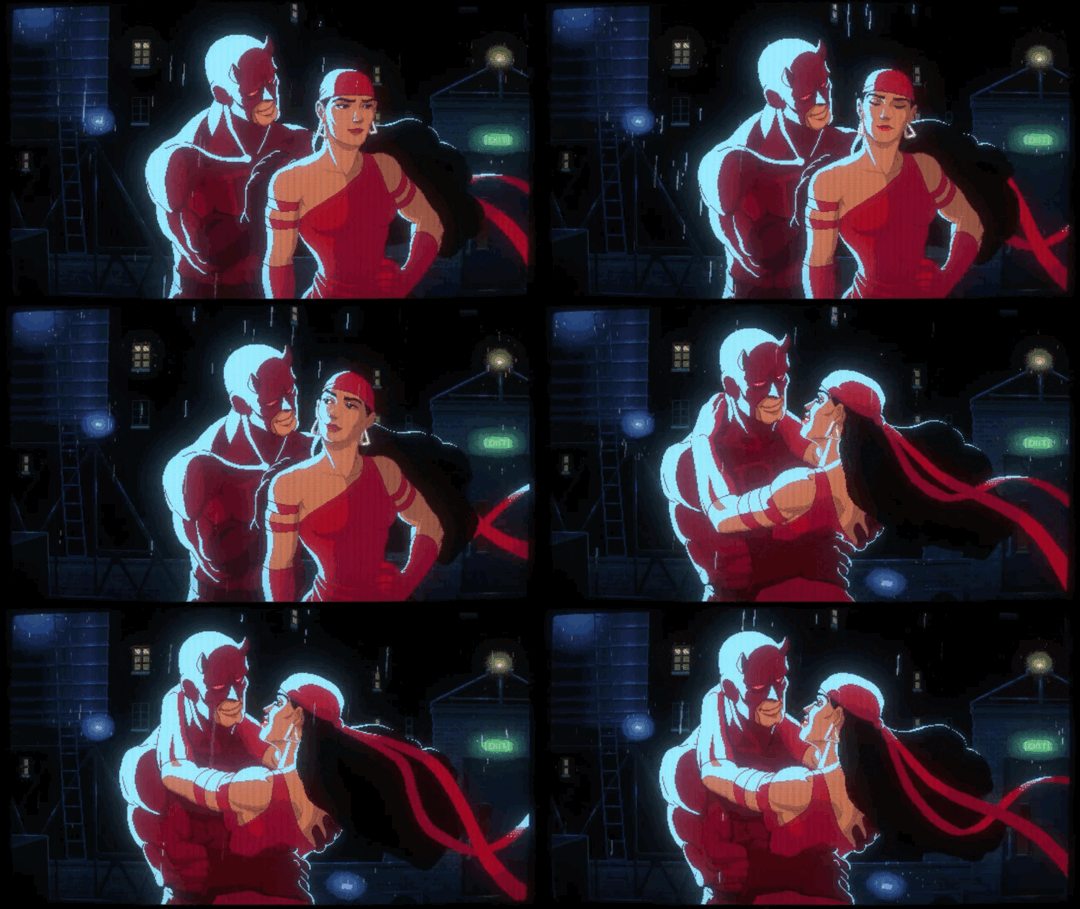
Concluding the trade is Elektra #100, which has the main feature and three backups, all of which celebrate the deadly assassin. The main feature, written by Ann Nocenti and Sid Kotian, is essentially a battle between Elektra and Typhoid Mary, whilst being a psychological examination towards the latter, none of which are appealing. Regarding the backups, mostly comic strip sketches, the best of which is Declain Shalvey and Stefano Raffaele’s “Waltz”, in which Daredevil and Elektra are just dancing, and it’s romantic, if a bit twisted that defines the romance.
Overall, a fun addition to the overall Zdarsky run on Daredevil, even if it feels more like a placeholder.
If Elektra has a million fans I am one of them. If Elektra has ten fans I am one of them. If Elektra has only one fan then that is me. If Elektra has no fans, that means I am no longer on earth. If the world's against Elektra, I am against the world. I love Elektra till my last breath.
I love she!!! So much!! Why was this only three issues I would like more. I didn't read the Elektra #100 comic because it didn't look related to anything and the art was hideous so I will ignore it though lol.
This takes place in the middle of the Devil's Reign event and shows what Elektra was up to: seeing someone from her past and fighting Kraven the hunter who was sent by Fisk, via the dangerous person from her past.
I absolutely love what Chip Zdarsky did with Elektra in the Daredevil run and having this mini series really felt like a gift. Elektra is a really complex character and seeing more of her past and her relationship with Matt is just *chef's kiss*. Plus seeing her fight Kraven was great. I love how she's a deadly assassin but she limits herself now by not killing. Even so she beats ass and it was beautiful. Her in action and with her badass costume?? Very nice.
I don't even know what their ship name is rip but this clapped with Matt x Elektra content. I've always been trash for them but lately I've become the whole dumpster. Elektra thinking he's dead and planning to go murder the asshole killer because of it??? The literal slay of it. And her calling Matt her beautiful eternal fool had me on my knees.
I really liked the art in this and that was probably because it was giving Marco Checcetto the entire time. It was a bit messier and I don't think I needed to see Elektra's bare ass but I appreciate that he was copying the gorgeous style I've been obsessed with.
Daredevil: Woman Without Fear collects issues 1-3 of the Marvel Comics series and stories from Elektra #100 written by Chip Zdarsky, Ann Noncentl, and Declan Shalvey with art by Rafael De Latrobe, Sid Kotian, and Stefano Raffaele.
The Woman Without Fear series tells the story of what Elektra is up to during the events of Devil’s Reign. Wilson Fisk sold his personal file on Elektra to a mysterious buyer who leads Elektra on a trip down memory lane. The Elektra 100 issue collects a story of Elektra and Typhoid Mary dealing with Mary’s multiple personalities while a series of tornados rampages across New York. Finally we get a short story of Daredevil and Elektra meeting atop of a New York skyscraper to take in the music and dance of the city below.
Do yourself a favor and make sure to read Woman Without Fear after Devil’s reign or in conjunction with it. It should be labeled as a crossover event as it contains spoilers to the main Devil’s Reign storyline. Overall, I didn’t think this story was that interests and just going through the motions to set-up Daredevil and Elektra’s next adventures. The Elektra/Typhoid issue was incredibly bad, wordy, boring , and filled with art that made all the women look like pornstars. I found the date issue of Daredevil/Elektra to be a cute interlude that showcased the character’s history - very similar to Batman/Talia Al Ghul.
Overall, I don’t think this collection is must read and has the least interesting arc for Zdarksy run on Daredevil and Elektra. I do wish we got a bit more of Elektra on her own in New York while Murdock was in prison. I think that was a missed opportunity of exploring her character and giving her more depth.
This is a pretty strange volume. Half of it is really excellent. Elektra’s POV as to what’s going on with her and Matt, the stuff with her backstory—all of that is more interesting than the actual DD run right now, for me. The other half is filled with random Elektra stories, which is a weird decision. The lead up to Devil’s Reign, something I thought was extremely derivative, was better than the story itself. Why this is contained in volume before the main DD & Elektra, maybe they just wanted a clear start? It’s a shame it wasn’t half as long, easily a five star read without the other crap.
I really enjoyed this book. It is set alongside Devil's Reign. Elektra takes a side mission, but is she the hunter or the prey?
Someone bought Elektra's file (containing all her secrets) and a message/challenge. How is the ghost of her past and who is their pawn.
I especially like that Elektra comes back to her own fighting style. I think she has been using the brawing style the favours Matt, whilst she has been filling in as Daredevil.
The book also contains Elektra #100. The main story is Elektra VS. Mary with links to one of the Black White and Blood short stories. The issue 100 contains thumbnails of every Elektra issue so far. The book finishes with a varient cover gallery.
Eu sei que Chip Zdarsky é um escritor competente, mas não consigo ver nele essa virtuosidade que muitos enxergam. Por exemplo, nesta minissérie da Elektra como Demolidora (que a Panini Comics Brasil incluiu na coleção do Demolidor), ele faz um roteiro correto, mas nada mais que isso. Não surpreende, não traz nada de novo para a baila. Os desenhos de Rafael de La Torre são bastante competentes e ajudam a melhorar a atmosfera da história. Acompanha também o encadernado a edição Elektra #100, com historinhas curtas e uma história maior de Ann Nocenti em que Elektra enfrenta a Mary Tifóide. Achei essa edição a pior parte do encadernado, parece que está ali apenas para encher linguiça. E não parece nem de longe a boa Ann Nocenti que estamos acompanhando novamente na Saga do Demolidor. Uma pena. Elektra vem amargando más fases desde os anos 1990 quando ganhou série solo. Pouquissimos escritores acertaram na personagem.
Just finished Daredevil: Woman Without Fear — now that my Halloween stack is complete, I’m diving back into Zdarsky’s Daredevil run. This Elektra-focused mini is sharp and introspective, giving real depth to her struggle to live up to the Daredevil mantle. De Latorre’s art is sleek and cinematic, and the story adds emotional weight to the larger saga. A strong bridge as I move into Devil’s Reign which is up next!
Lovely. Some really interesting callbacks to Frank Miller’s run. I only wish this was more of an Elektra run and less of a supplemental Elektra story to back up Devil’s Reign. It’s fine though, I still loved it.
Per una banda, "La mujer sin miedo" és Elektra, en el paper de Daredevil mentre aquest està a la presó i amb l'objectiu de guanyar-se la seua confiança i ajuda per a enfrentarse a La Mano. Història en tres números en què Elektra s'enfronta a Kraven el Caçador, entre flashbacks que ens porten al Daredevil Born Again de Frank Miller. Bona història i dibuix correcte.
Per una altra banda tenim Elektra #100 USA, que conté un grapat d'històries curtes, on podem veure com Elektra s'enfronta amb Typhoid Mary o Matt i Elektra tenen una "cita" un poc particular, entre altres. Algunes històries tenen un punt paròdic i d'homenatge, amb referències al propi univers d'Elektra o Daredevil, o a altres personatges del còmic; molt bona la referència a Calvin i Hobbes! Lo millor d'aquest número 100, que en conjunt m'ha semblat un poc irregular, tant en guió com en dibuix.
"El mundo nos ha lanzado de todo. Hemos pecado, nos hemos arrepentido, hemos vuelto a pecar. Hemos caminado entre incendios provocados por nosotros, pero estamos aquí, ahora. Todo lo que hemos hecho nos ha traído a esto. A este momento".
Woman Without Fear is a spin-off of the Devil's Reign event without clearly being marked as such, so lucky me for having stacked them together on my TBR. In this book, Elektra is sent on a merry chase through her past by Kingpin. It's some nice backstory for Elektra (if you're not familiar with her backstory) and some extremely dull wheel-spinning for anyone interested in Devil's Reign details.
I guess Elektra and Daredevil are going to reboot the Hand in future Daredevil issues? Great. This book is a meeting that could have been an email. The three Chip Zdarsky issues are padded out with some goofy Sunday-sillies-style comics and the terrible Elektra #100 which features Elektra and Typhoid Mary sparring and having way too much conversation. The 100 Elektra covers at the end just serve as a reminder of how female superheroes in the 90s were required to stand in sexy poses at all times.
Since Elektra took over the mantle (co-mantle actually) of Daredevil, I feel like she has been a better and emotionally deeper person. This Volume is short, and kind of is really only a connection between the end of the Daredevil run and the Devil's Reign storyline (which part of is covered here). We explore flashbacks of her and Matt's relationship, have her fight Kraven (a newly "legal" Thunderbolt... see Devil's Reign I guess), and deal with her pull away from the Hand, trying to do the right thing and live as a hero. I'll be reading Devil's Reign soon and can't wait to see what happens with both Matt and Elektra. Recommend. Would love more ElekDevil Volumes.
This felt like a distraction rather than an actual fleshed out story, but to be fair, I am missing a lot of context since I haven't read anything else involving Elektra other than Zdarksy's run + Miller's Born Again and Man Without Fear. Perhaps this could have been remedied a little bit if it was a little longer than just 3 issues.
Nocenti's issue was kind of confusing (probably because I know jack shit about these characters), but that's okay. Buff women in slutty outfits fighting each other save me
This showed up slightly damaged, banging around lots inside a too-large Amazon box addressed to me but with no note inside. I didn't order it. I read it, and liked it, and am glad for whoever thought to send it. It made me far more interested in the recent arc of Elektra/DD than I've ever been.