After her first book, The Nurse's Dilemma (1966), most of her magazine articles and 16 novels for children were written with her husband, Bill.
Together, they produced more than a dozen novels for young adults. Their subject matter reveals a particular interest in mountain children who have both physical and mental problems. The Cleavers were three times nominated for the National Book Award, and their novels made multiple appearances on the American Library Associations list of "Notable Books." Settings often mirror the Cleavers' place of residence.
After Bill's death, Vera Cleaver wrote Sugar Blues (1984) and Sweetly Sings the Donkey (1985).
This is a book that had me warring with myself. As a 12 year old I would have loved this book beyond measure, identified strongly with Mary Call, the 14 year old leader of this family, and would have read the novel multiple times, rating it with all the stars available. As an older adult, I spotted too many inconsistencies, thinking logically instead of emotionally, and as a result, the book lost the magic that it needed. The older me was the loser in that battle, and my 4 star rating is an attempt to merge those two "mes".
Whatever age, the language was beautiful, almost poetic in its portrayal of the natural world of the Appalachians, and the characters honestly portrayed.
I can't believe I have been on GoodReads for over a year and just remembered this book! I read it so many times when I was in middle school-it was one of my favorites!
I loved books like this one that were about kids who had to make it in the world alone because their parents are absent for some reason. (In this book, the parents were absent because they were DEAD!) I think I was drawn to that plot line because I just wanted my parents to leave me along. (Not that I wanted them dead. I didn't particularly want them dead. I just wanted them to leave me along.) But anyway...
There was a movie (maybe a made for TV movie) based on this book. I remember watching the movie, and I still remember rather vividly the scene where the older guy who wanted to marry the quiet, shy, maybe mentally slow older sister (played by the actress who went on to play Bailey on WKRP in Cincinnati) was really sick with some sort of lung ailment. The kids put him in a bathtub while he still wore his grimy looking long johns and poured steaming hot smothered onions over him. This scene led to a inside joke in my family that I am not even going to try to explain.
شگفت زده ام کرد! انتظار نداشتم انقدر عمیق باشد و آدم را درگیر کند. داستان از زبان دختر ۱۴ ساله ای به نام مری کال روایت می شود که به پدر بیمارش از او قول گرفته بعد از مرگش مراقب خواهر و برادرهایش باشد. پدر می میرد و مری کال برای آن که خانواده از هم نپاشد و سر از یتیم خانه درنیاوردند مرگ پدر را پنهان کند. به همراه برادر کوچکترش با کمک یک چرخ دستی، پنهانی، پدر را به سمت گوری که خود قبل از مرگش کنده بود می برند و دفنش می کنند.
مری کال ۱۴ ساله ناگهان خود را با انبوهی از مشکلات رودررو می بیند و با این حال تمام تلاشش را می کند که از خانواده نگهداری کند؛ حتی اگر به قیمت از دست رفتن مهر و علاقع برادر و خواهرانش نسبت به خودش باشد. بر خلاف برادرش که می خواهد مشکلاتشان را با تفنگ ساچمه ای حل کند، مری کال تلاش می کند که راه حل عقلانی برای تک تک مشکلاتش پیدا کند.
کتاب در سال ۱۹۶۹ چاپ شده و تقریبا میشه به روحیه آمریکاهای ان دوره که مری کال نمودی از آن است پیبرد. مری کال دائما تلاش می کند که روی پای خودش باایستد و از هیچ کس کمکی نگیرد. معتقد است صدقه گرفتن باعث تحقیر آدم می شود. مسئولیت پذیر است و میگوید انچه که از فقر بدتر است نادانی است. تمام این ها شاید به این خاطر باشد که به نتیجه تلاش های خودش امیدوار است. که می تواند روزی به مقام بلندی برسد.
“Friends were another thing Miss Breathitt believed in and thought wonderful. Friends, she said, improved talents and happiness and all of us should take care to make some.” ― Vera Cleaver, Where the Lilies Bloom
This is a book about Mary Call, a strong minded young woman trying to keep her family together after the loss of her parents. She feeds and clothes her siblings and tries to keep up the pretense that her parents are still there, for if outsiders knew what had happened they would surely separate the family.
I. LOVED. THIS.
The book is a wonderful read. There are themes of loss and poverty. The characters start to feel like old friends. One gets invested and roots for the sassy Mary Call and her small group of siblings as they fight to stay together in the North Carolina mountains.
This is an exceptional and very special book that nobody should miss out on.
3.5 stars, rounded up for the poetic descriptions of the native plants and landscapes of the North Carolina mountains and for the authentic vernacular of this area with words like “wildcrafting” (harvesting medicinal herbs and plants); “jularker” (beau); “beller” (yell); “tintinnabulation” (ringing sound); “ye” (your) and going by “shank’s mare” (using your own two legs to travel someplace). Thank goodness for Google and Wiki.
14-year-old Mary Call Luther makes promises to her dying, widowed, tenant farmer father that she struggles daily to fulfill, both physically and emotionally. One of those promises is to keep her three siblings - Devola, Romey and Ima Jean -together with her and out of the hands of county social services. But winter is coming, money is tight, and secrets are hard to keep. This short novel was an easy, immersive read for me, and even though it is listed in the YA/Children’s genre, the issues faced by the Luther family were true for many people in this region and point in time (the early 1970’s). The book was a finalist for the 1970 National Book Award for Children’s Books and later made into a 1974 movie that was filmed entirely on location in western North Carolina. It is also my second consecutive novel featuring strong-willed, capable, young Appalachian women, and I now add Vera Cleaver to my list of favorite Appalachian writers. Her memorable protagonist Mary Call Luther embodies the meaning of Appalachian grit.
“Beyond Romey’s slight figure I saw this tree, alone and different from the rest, its branches all streamed back in one direction from the winds that had battered it year on year. It was quiet now because there was no wind but I could imagine what it looked like in a storm, bending and twisting in the gusts and the rain, resisting with all of its grit, the forces that would uproot and destroy it. It looked old and tough and the sight of it made me feel old and tough. I felt like the tree and I were related.” ~ Miss Mary Call Luther
I saw this movie years ago (1970s?) and never realized it was based on a book until I taught middle school and found the book. Of course I had to read it with students, since I loved the movie so much! I think part of the attraction was the setting, the Appalachian Mountains, but in the movie I fell in love with Mary Call. Mary Call is a 14 yr-old girl who is left to care for her siblings after her parents die. Before her father passed on he made Mary Call promise to keep the family together and not to accept charity. Most importantly, not to let Devola, her older sister, marry Kiser Pease. In order to abide by her father's wishes the children have to keep his death a secret and bury him themselves. They have a poor existence on the mountain, but they are proud and determined. Mary Call finds her mother's old wildcrafting book and organizes the family into starting their own wildcrafting business. The money they earn from selling herbs and roots to the local pharmacist helps to make ends meet, but soon winter sets in and puts an end to this seasonal work. In the end, Mary Call learns to accept help from outsiders and that Kiser isn't so bad after all.
The book gave breathtaking descriptions of the mountains and I learned a lot about the plants of that region. I wish I could survive on the environment and relish in the beauty of "heaven on earth." I would try roughing it if I could, but I'm sure I'd miss technology.
Written in 1969, this incredible YA book received numerous awards including a National Book Award finalist, New York Times Outstanding Book of the Year, School Library Journal Best Book, Boston Globe-Horn Book Award, and the ALA Notable Children’s Book.
This is a touching, moving, realistic portrayal of poverty in the Trail Valley of the Appalachian Great Smokey Mountains of NE North Carolina.
Mary Call was 14 when her father died, leaving her with unrealistic promises to fulfill and three siblings to raise.
Unrealistically as stubborn as her father’s short-sighted, unyielding demands, Mary valiantly attempts adherence to his edicts of keeping the family together while never accepting assistance from anyone, never allowing her “dimwitted” sister to marry the local man who loved her, to hide his death, to bury him in the mountain and to at all times maintain self reliance .
Never stooping to over sentiment, this marvelous book is a shining treasure, chocked full of trials, travails and the reality of stubborn misguided loyalty vs the reality of what can and cannot be accomplished against the odds of nature, unrelenting poverty and the terrible burden placed on the shoulders of a mother and fatherless child.
As a means of survival, the Call family become wildcrafters harvesting and selling medicinal plants found in the mountains. While this brought a modicum of relief, when an exceedingly harsh winter arrives, Mary Call realizes that while her bravery and courage has enabled the family to survive for a short period of time, forces outside her control mandate that she become more malleable.
It is at this point in the story that the authors wonderfully weave the portrayal of Mary Call who, in order to survive, must shift her paradigm to incorporate the fact that while stubbornness is necessary, to survive one must accept the assistance of others and must pave the destiny of her family by opening to the possibility that her father’s well-intentioned, but misguided rules cannot be followed.
Found in 1,001 Children’s Books You Must Read Before You Grow Up, this is a gem to savor and re-read time and time again.
Mary Call is thrust into the position of provider for the three siblings after her father sickens and dies. She and her brother covertly bury him on their property, and they must keep up the pretense that he is still in the sickroom with outsiders. Mary Call is a strong fourteen-year-old, and she courageously schemes and plots to secure the land and home and food for her family while railing against her chief adversary, Kaiser Pease.
You won't run across a stronger girl character than Mary Call, I think, and you won't find a more compelling story than Where the Lilies Bloom.
I love Appalachian fiction, and this book ranks among one of my new favorites. The authors do an excellent job of depicting the proud, stubborn, and loyal people of the region through the main character Mary Call. Even though it's hard, she does what is required for the survival of her family, and she keeps her promises to her father at all costs. Her pride is almost her downfall, but Mary Call maintains her dignity. Even in the end, she and her siblings continued to forage for herbs and roots to provide for themselves.
Appalachian fiction is always sad on some level because of the hardship, poverty, and lack of education that the region has experience historically. While things are getting better, the people of Appalachia, my people, have been playing catch up for years.
I assume this novel is set in the 1950's based on the time it was written, use of cars, the description of the town, and the county's maintenance of the road after the blizzard. However, this story could have been anytime from the 1930's to the late 1960's. Time stood still for much of Appalachia during those years. Life was not much different for my mother's generation than it was for her mother or her grandmother.
I loved this book and would recommend it to any of my 6th grade students as well as my friends.
I read this for a book report assignment over the summer before sixth grade. I liked the setting for the book, very rustic; plus, I love mountains and all that. And looking back on it I really like how strong a character Mary Call is. She does whatever is necessary to keep her family together and healthy. Another book I might have to revisit one day.
Loved reading this story. Had lots of adventure and what is going to happen? It is an older book, but is still a great adition to stories out there. Fast reading!
I so enjoyed this middle grade story, recommended to me by a new friend, my bookish twin. Reminded me of the favorite kinds of books I read as a kid, especially ones with a tough young girl as the protagonist. My book twinsie has read it many times in her life. And I can see why.
It is funny, sad, and mighty eventful. Also worrisome to this old lady. Lordy, how are these children going to survive is the question I asked myself time and again as their growing dilemmas unfolded.
But they are made of tough Appalachian stuff. I was uplifted that it was also a story of kith and kin.
The short afterward by authors and married couple Vera and Bill Cleaver was a fulfilling end. I don't know how a couple writes a book together, but this book had such an authenticity to it that however they arranged it, they made a smooth, believable combination.
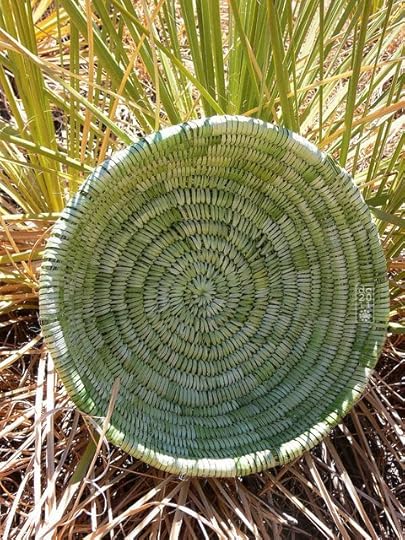
I've never been too "grown-up" to read books for kids or young adults; it can often be a great introduction to a larger picture. Like, "wildcrafting," I had never heard of that before. Yet, it's right up my alley. I spent a year teaching myself to make yucca baskets from the yuccas that grow wild on my place. (Easier to let them grow than to try to dig them up!) I even tried my hand at dyeing some of the prepared yucca fronds with cochineal, the red bugs that grow on prickly pear cactus, encased in white fuzz. Truth is, though, I hated killing the insects just for their red color so my baskets started off a light green hue and then quickly would fade to a simple golden pale hay color. They were lovely and I enjoyed giving them away, except saving one, the last one for myself that I still use.
Thank you for the recommendation, Book Twinsie. I laughed out loud about the onions. And the bear!
Where the Lilies bloom by Vera Cleaver is about the Luther family struggling to survive without their recently deceased father. His daughter Mary Call Luther promises to look after her family, and has to go through many obstacles to achieve her goal. Mary Call Luther has to be by-far one of the best heroines I have read about so far. She brushes off insults coolly, and has her family at heart, going so far so to keep her family together. She is a great role model, and she really leaves an impression on you. In fact, this whole book leaves an impression on the reader. Its humor was absolutely 'on point', as well as the writing style and details. Also, I very much enjoyed the pictures, help me get a better picture of what everything was like. It was a tad to short for my liking, I prefer longer books. I also wished the ending could've been more clear. maybe it's just me but, I could not wrap my head around it. In conclusion, this book was a fun quick read,(even though i would prefer it to be longer) and the character development was just fantastic. Even though at some points i would get confused. Nevertheless, the theme for this book is ask for help when you need it. I rate this book 5/5 stars.
The authors have created a wonderful first-person narrator - the writing style is distinctive. The story is engaging and holds the reader's attention all the way through to the end. There's quite a bit in the premise of this book that is also found in Cynthia Voigt's 1981 book Homecoming - both books feature a strong teenage girl forced to take charge of her siblings (including a sister who may or may not be retarded in some way) and to hide the truth of the family's lack of adults. In Homecoming, the kids are on the road down the east coast, but here they never leave the family home, such as it is, in the mountains of North Carolina.
I see there is a sequel (Trial Valley) - I can't imagine it being as good as this, but hopefully it's not a disaster.
The 1974 movie version takes some liberties, but it is still excellent.
I read this when I was a kid. Probably I loved it so much because it had such a strong female protagonist. I honestly can't remember the details of when and where, but you have a group of siblings who for whatever reason have no parents but are still living in their small house in an isolated area. The land lord wants to marry the oldest daughter, who's beautiful but a bit simple. The second oldest girl is the one in charge, and you get to see her struggle to keep her family together and continue paying the landlord rent. The end was great; people really changed, but in a realistic fashion that gave a sense of closure and hope.
When my son told me he had to read this book for his seventh grade language arts class, I remembered how much I had enjoyed it almost 40 years ago. Some stories just stick with you over time and this was one that had stuck with me but was way overdue for a reread. I am so glad it has not gone out of print. Rereading it reminded me of all the things I loved about the story when I read it the first time. It even brought back the memory of getting in trouble with my mom for reading with a flashlight way passed my bedtime because I couldn't stop until I found out if Mary Call Luther could keep her family together. Oh how I love that character of Mary Call Luther!
This one probably deserves 3.5 stars. It was a re-read for me; I remember reading it as a kid and seeing the movie. I like the strong central female character who IS NOT an ignorant hillbilly. The descriptions of rural poverty and the beauty of the NC mountains were very good. Interesting descriptions of wildcrafting as the kids try to support themselves by harvesting medicinal herbs, roots and bark. Kids who have been through tough times will find an accurate mirror to their own experience here and a worthwhile reading experience.
I originally read this in grade school - some time around the sixth grade - and I remembered liking it very much. I misremembered some of the details - I'd thought Roy Luther was a coal miner rather than a sharecropper. I enjoyed reading it again as an adult, although I now realize the quality of the writing isn't as good as it possibly could be. Still, this is a fascinating story of a 14-year-old Appalachian girl in North Carolina trying to keep her siblings together after their father becomes gravely ill. It's also a nice depiction of wildcrafting.
For me, Where the Lilies Bloom was like meeting someone new. At first, I didn't know them very well, and I didn't really think that the two of us would hit it off. However, as we spent more time together, I developed a deep love for them and couldn't wait to spend time with them. Where the Lilies Bloom is a compelling story about a young girl having the weight of the world being placed on her shoulders and her undying reliance to help her family. It's a story that will captivate you and that you'll remember for years to come and will inspire you to face your biggest obstacles head on.
This was required reading in grade school. The descriptions of poverty were evocative, but somewhat long-winded. What I remember most is that the TEACHER despised the book, and gave us as little work from it as possible. Validation for my feeling of dull.
What I found the most irritating was the resolution: the retarded older sister suddenly becomes well enough to see the need of her family and take charge.
I can't believe I just got around to reading this book now....I loved it!! One of my favorite YA books thus far. I love reading books about kids who are determined to make it in the world dispite their circumstances. I kept wanting to make it on their own after their father died...just didn't want them to be split up and sent to live with people who were mean to them. I would have liked the book to be a little longer in order to tell us what happened to the kids as they grew up.
I read this book many times and enjoyed the movie many years ago. It portrays the hardships endured by a family of children and the pride instilled in the oldest daughter, Mary Call, by her father. Mary Call was saddled with the responsibility of raising her siblings on her own at a very young age. She had remarkable character and tenacity and made sure they had shelter and food to eat. I would recommend it to anyone.
I have been looking for this story for years. Something about the mountains and the characters stuck out in my mind from when my elementary school librarian read this to us, but I couldn't remember the title. I remembered "lilies" but nothing more. But the imagery and characters were just as sharp this reading.
A well told story of what it was like to be mountain people in the deep south, sharecropping and how they deal with life after a family tragedy of major loss. Judging from the references, this could take place anytime from post WWII to the mid 1960s. It doesn't really reference any significant point in time or history. It's a judgement call but that takes nothing away from the story.
Mary Call was such a strong character in this book. She had to keep such a terrible secret, but somehow she did it. This book showed her range of emotions. Everything from happiness to sadness, to anger. I can see why people liked this book as much as they did, and why it was so popular in the 60's.
I read this book several times over as a child. Definitely a childhood favorite of mine. I am so glad that goodreads lists this book, as it is from the 1970s. I hope it is still a classic for young adults/pre-teen set. I would like to reccommend it to my daughter when she is older.
I got the book and it smelled like poo. I thought it was just the book,so I got a new one and that smelled like poo too. So I actually opened the book and read it, then I realized what it was. This book is a piece of poo.