What do you think?
Rate this book

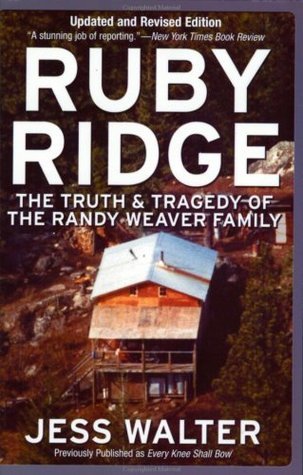
406 pages, Paperback
First published January 1, 1995
What ever one's views about religion, separatism, the government and the use of power, this book has it all. Like many, I watched the media coverage of the events at Ruby Ridge and wondered how this could be happening and how things could have gone so terribly wrong. I think the author does an excellent job in chronicling the events in a way that explains without judging, and helps the reader to realize the intransigence on both sides and where it can lead, if unchecked.
"Fear thrives in Boundary County. It takes form in tall mountain grass, peers down from granite crags, and waits in shaded creek beds. It jostles and pops along dirt roads and stares unflinchingly through strands of pine. Fear is the last cash crop left in North Idaho, the last big predator, the last roadside attraction.
From all over the country, fear dragged people away from cities and into the mountains of North Idaho. In the early 1980's, when the reasonable folk of North Idaho noticed all these strange newcomers, they quickly saw the hatred: of racial minorities, of the government, of the decadent society. But what many failed to notice was the fear, the choking paranoia that made young, reasonable families seek out a place where they felt in control of their lives again."
(Chapter 4)
"They were seduced by conspiracy and a religion called Christian Identity, by beliefs steeped in racism and fear of government oppression, beliefs that helped bring about the very thing they feared."
(Introduction)
"...the Weaver case is not proof of broad government oppression and tyranny, but of human fallibility and inhuman bureaucracy, of competitive law enforcement agencies and blind stubbornness. The Randy Weaver case is a stop sign, a warning--not of the dangers of right-wing conspiracies or of government conspiracies--but of the danger of conspiracy thinking itself, by people and by governments."
(Introduction)
"Few people who don't follow conspiracy theories comprehend their attraction: they create a framework for understanding everything by tying coincidence and accident together. If every event is part of the fabric of the conspiracy, then everything must have a reason, a meaning. And so, when the same unlikely details from one mimeographed pamphlet show up on a tape or in a mail-order book, it comes not only as confirmation but as revelation: "Here it is again! The Illuminati!" For true believers, the conspiracies seem no more unlikely or illogical than other things that are considered truth."
(Chapter 3)
"It was ironic that in a case that began because of conspiracy theories, that's what good lawyering resembled more than anything else. Both require careful selection of certain facts, rejection of anything that doesn't fit, and the formation of a cohesive explanation of everything that--by its nature--is only part of the truth."
(Chapter 18)