Poor queen of love, in thine own law forlorn
To love a cheek that smiles at thee in scorn!
Males are pursuers and females pursued. Nowhere does this more in evidence than in the animal kingdom. In the act of copulation males offer and females accept; males give and females take; males perform the act, and on females, the act is performed. Or so goes the conventional view. But if evolutionary biology is to be believed, all species are obliged to spread their genes around to ensure continued existence of their type. If reproduction is the singly unique purpose of life, any behavior that subverts that purpose, such as evasion on the part of the pursued, is a hindrance whose raison d'être is owed more to incidental, and probably misconstrued, threats to one’s wellbeing than a natural response to some evolutionary compulsion.
In other words, relegating male and female amatory behaviour to the role, respectively, of the pursuer and the pursued, is a social construct and, like the history of ideas, might well fall in the realm of the history of social behavior of the human species. Many writers from the time of Ovid down to the present day, perhaps in the spirit of contrariness, have explored the idea of male coyness to contrast it with female boldness, challenging the conventional wisdom, and thus disturbing the secure notion of the pursuer and the pursued with tantalizing results. Here in the lush playground of this poem Shakespeare extends the franchise with his own retelling of the luscious story of Venus and Adonis.
He burns with bashful shame; she with her tears
Doth quench the maiden burning of his cheeks.
Then with her windy sighs and golden hairs
To fan and blow them dry she seeks.
__He saith she is immodest, blames her miss;
__What follows more, she murders with a kiss
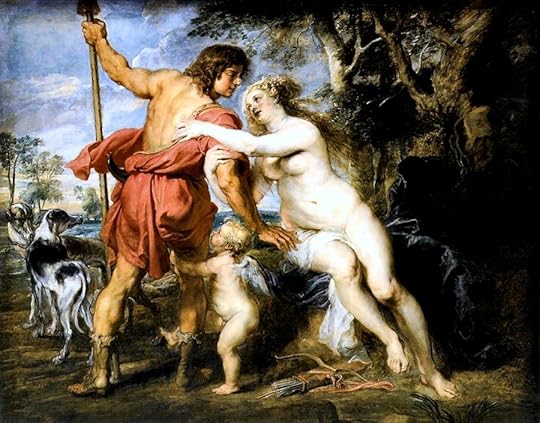
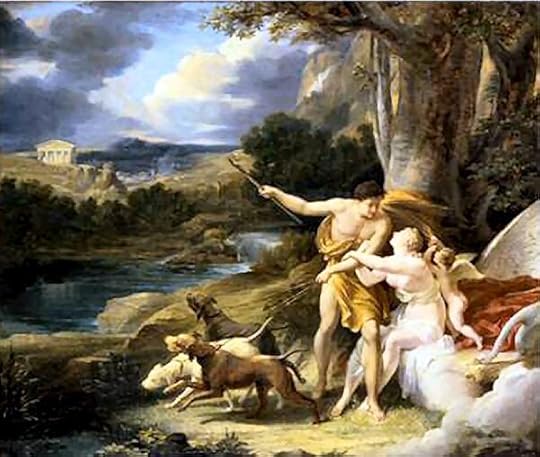
The poem is like a one-act play wherein Venus goes to great persuasive lengths, in a series of claspings and clingings, to win the amorous favours of Adonis who, in his baffling reticence, evades her like a doe with ears alert in alarm, listening to the timid murmurings of danger. Venus entices him with the promise of her beauty, but when At this Adonis smiles as in disdain / That in each cheek appears a pretty dimple, she, exasperated, compares him to Narcissus, rhetorically asking, Is thine own heart to thine own face affected?
She urges a carpe diem approach in seizing the moment of pleasure: Make use of time, let not advantage slip; / Beauty within itself should not be wasted / Fair flowers that are not gathered in their prime / Rot and consume themselves in little time.
She ups the ante with playful double entendres to arouse the young man’s desire comparing herself to a park and him to a deer who is invited to Feed where thou wilt, on mountain or in dale; / Graze upon my lips; and if those hills be dry, / Stray lower, where the pleasant fountains lie. Delights await him. If he wills, he may take a leisurely walk on the sweet bottom grass and take a climb atop the round rising hillocks of her park!
When all else fails she invokes the 'law of nature' according to which living beings must reproduce themselves if they want to conquer time and death. Adonis accuses her of rationalising her lust, O strange excuse, / When reason is the bawd to lust’s abuse!; and he pleads his youth and his inexperience, Measure my strangeness with my unripe years / Before I know myself, seek not to know me.
To assuage his injured manliness Adonis takes leave to go on a boar hunt with his friends. This makes the second half of the poem. Here Shakespeare inlays playful sensuousness with ironic humour, to create an elegant and entertaining picture of the two conflicted lovers and their pathos. Venus, taking him at his word for his untested youth, senses in it a danger to Adonis' life, and advises him against such rash adventure. When he persists, she pulls him off his horse, and tucks him under the arm, pouting and blushing; when he wrenches free from her tight and embarrassing grip (she manages to steal a damp kiss too!), he turns back to mount his horse, only to find it gone in chase of a stray mare. Adonis nonetheless spurns her entreaties and flees, dead set in his goal to hunt the boar, and meets the tragic end, in a darkly humourous ironic twist:
"'Tis true, 'tis true! Thus was Adonis slain:
He ran upon the boar with his sharp spear,
Who did not whet his teeth at him again,
But by a kiss thought to persuade him there;
__And, nuzzling in his flank, the loving swine
__Sheathed unaware the tusk in his soft groin.
As one can infer, not much happens in the poem, with each trying to convince the other of the superiority of their position in an extended, painful, and playful argument which neither wins. Shakespeare does not allow for the development of the characters; they are one-dimensional and flat, symbols representing contrasting attitudes to love. In that the poem may be seen as an allegory in which Adonis represents the rational principle of cautious control in the face of worldly snares as represented by the wanton goddess of erotic love. But this interpretation is frustrated by another reading where the wild boar and the unbridled horse symbolise uncontrolled passions that contradictory approaches to life try to rein in, one, by route of avoidance; the other, by way of taking it head on. This seems to be the case when you consider Venus’ warnings of hunt. This allegorical aspect gives the poem a certain seriousness which is matched by delightful metaphors of sensuous love that makes it a highly entertaining read. Yet, the allegoric content is not central to this poem; it stands on its own as a direct, emotionally charged poem spiced with eros. At any rate, the poem offers an ambiguous view of love as sublime and earthly, gentle and wanton, rational and fickle – that cannot be explained in singular terms.
I was surprised to learn that Venus and Adonis is Shakespeare's first published work, and a fine example of his stylised diction, rich imagery, engaging dialogue, turns of phrase, philosophical ambiguity, and character ambivalence, that set him on course to penning more amatory poems, culminating in the gems we know as Sonnets.
PS: Italics are direct quotes.
May 2015