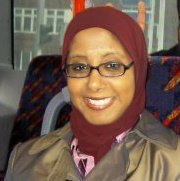
Twenty-five-year-old Asma Hasan describes herself as a Muslim feminist cowgirl (she was raised in Puebo, Colorado). Convinced that Muslim Americans are the victims of mistaken identity Hasan breaks through the stereotypes and generalizations to talk about the religion and the believers she knows from the inside.While the book provides a lot of basic information about Islam in America, the major emphasis is on the sheer normalcy of American Muslims. Like other Americans, they are very keen on family values, religious freedom, and the opportunities the U. S. has always afforded new immigrants.Moreover, says Hasan, American Islam, as it grows and evolves, will offer a model to Islam in the rest of the world: a purer Islam, one more conscious of the difference between the essence of Islam and its accomodations to various cultures over time.
Author Asma Hasan wrote in the Preface to this 2000 book [the first edition], “My parents are from Pakistan, but I am American---an American Muslim… I am a self-proclaimed Muslim feminist cowgirl, a category I created… My spirit is a mix of American individualism, the American West, the Islam I grew up with and practice, my family’s code of ethics, and the feminism I believe in. This book is about other Muslims like me, who are living as Americans and Muslims and figuring out their spirit and identity as we go along… The dream of six million of us is to be American and Muslim, and we’re doing it. That is what this book is about.” (Pg. 3-4)
She suggests, “In American today, I would day it is no longer religious sects that are a source of division for American Muslims, but their ethnic diversity. Their various ethnicities---whether Palestinian or Pakistani or African-American---prevent American Muslims from having a single opinion on practically any issue at a time when unity is necessary to wield political influence in America. American Muslims don’t emphasize our sects because we have so much else to emphasize: our status as a religious minority in America and our ethnic divisions.” (Pg. 26)
She explains, “Though African-Americans are the largest American Muslim group about 42 percent of the American Muslim population, they are not the entire community. South Asian Muslims are the next largest group at about 24 percent and then Arab Muslims at about 12 percent. Beyond these three major groups, people of other ethnicities also make up the American Muslim population, including white Americans, Africans, Southeast Asians, and so on. In Islam, no race or country is favored over other races and countries. You can see from the ethnic and national diversity of American Muslims that we come from all over the globe.” (Pg. 28)
She says of Louis Farrakhan’s Nation of Islam, “Muslims do not believe that Farrakhanism is a proper interpretation of the Qur’an. However, Muslims are instructed ty the Qur’an not to judge each other … The most exciting development in Farrakhanism is Farrakhan’s February 2000 pledge… with Warith Muhammad to unify their communities, ending twenty-five years of rifts… If Farrakhan is really serious about abandoning Farrakhanism, the results could be phenomenal… A unified group of African-American Muslims, in the view of NOI leaders, cold embark on large projects to reform America’s poorest neighborhood where they have ties and influence.” (Pg. 67)
She notes, In Britain, Pakistani women who refuse to marry boys their families pick for them are so severely punished, sometimes burnt with acid or beaten, and threatened that they run away from home… We certainly don’t want what’s happening in Britain to happen here. We need to strike a balance between the traditions of Islam and the freedoms of Western culture. They should not be so dissimilar as to result in life and death situations, and we, as American Muslims, should be strong enough to overcome the difficulties and challenges.” (Pg. 137)
She asserts, “Accurately, Muslims see a double standard in American foreign policy. The United States vigorously defeats Iraq in Desert Storm as mandated by U.N. resolutions and, at the same time, ignores equally important U.N. resolutions on Palestine, Bosnia, Chechnya, and Kashmir. The United States finally assists Muslims (the Kuwaitis), but only when a Muslim was the aggressor. In other cases where Muslims are victims, American Muslims have concluded that the United States does not act strongly. Muslims believe the inaction is based on a belief in what is called the Islamic Threat, perceived to be, after the fall of Communism, the largest threat to democracy. Muslims see themselves as victimized and misunderstood in the world. The world strains itself to empathize with the Israelis, the Indians, nearly everyone except Muslims.” (Pg. 155-156)
On separation from men in the mosque, she argues, “I don’t see why we can’t all pray in the same room, split by gender down the middle of the room… If men and women pray alongside each other in Mecca, why can’t we in our local mosque?... When I tell this to men who defend separating women, they think I’m only trying to cause trouble. But this is really about respect. I want to know that I’m respected in my mosque and received as a peer, an equal… I may make myself unwelcome at many mosques in the United States, but I really think men just want to protect their big prayer rooms where they can line up behind the mosque religious leader, the imam…. It’s just patriarchy. The reasons to preserve segregation are not good ones. I’m tired of Muslim women having to make concessions, like… wearing hijab because men can’t control themselves… There is nothing in the Qur’an that solidly justifies such segregation. There is much in our native cultures that does, and we must move beyond that. We’re Americans now, and must come together as such.” (Pg. 167-169)
This is an intelligent and insightful perspective, that will be “must reading” for those interested in learning more about Muslims in the U.S.
Even though I support Hasan's feministic views on what Muslim women need to do in order to achieve the rights the Quran promises them, I was also very skeptical of some of the things she says. The whole thing about her reasoning as to why Muslims don't eat pork is just crap. I looked it up myself & i was disapointed in Hasan's lack or research in her final chapters that she can get something so basic wrong. But the book does raise some interesting questions that will get non-Muslims to really question their actions toward Muslims.
decent enough... but really didn't provide much information that i hadn't gotten elsewhere. completely non-academic book and appeared to over simplify the concepts presented within. would be a good introductory text for folks looking to learn more about american muslims. also, clearly written pre 9-11
Ridiculous. Vacuous, barely there analysis, universalizing fairly singular experiences to those of the rest of the American Muslims. If this chick can make it through law school, so can I.