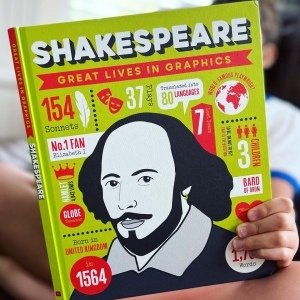
The Great Lives in Graphics series is a new way of looking at the lives of famous and influential people. It takes the essential dates and achievements of each person’s life, mixes them with lesser-known facts and trivia, and uses infographics to show them in a fresh visual way that is genuinely engaging for children and young adults. The result is a colorful, fascinating and often surprising representation of that person’s life, work and legacy. Using timelines, maps, repeated motifs and many more beautiful and informative illustrations, readers learn not just about the main subject of the book but also about the cultural background of the time in which they lived. You may already know that William Shakespeare was a playwright, but did you know he learned nothing but Latin at school? Or that he couldn’t even spell his own name? This graphic retelling of Will’s story gives children a visual snapshot of his life and the world he grew up in, while educating them on everything from Elizabethan theatre to the power of words.
Loved it! Simple, plenty of fun and curious facts, visual and entertaining. I will use it in class with my ESL students when working with Shakespeare - I'm sure this will increase their motivation!
This review was originally written for The Baby Bookworm. Visit us for new picture books reviews daily!
Hello, friends! We’re bringing you a special weekend review and taking a look at the latest titles in Button Books’ Great Lives In Graphics series, which introduces notable figures from history in a kid-friendly, infographic-style format.
Did you know that William Shakespeare invented 1,700 words? Or that Frida Kahlo painted over 200 paintings in her lifetime? Did you know Jane Austen invented a writing technique called “free indirect speech” that changed the fiction genre forever? Or that Nikola Tesla could speak eight languages and had a photographic memory? Young readers can learn these fascinating factoids and more, laid out in a colorful and engaging infographic style that is sure to leave the audience with a better understanding of these fascinating figures.
We’ve reviewed a couple of titles from this series before, and these six new additions – covering Tesla, Shakespeare, Austen, Kahlo, Mozart, and Einstein – are equally edifying and fun. Information on the luminaries’ lives, the time periods and societies in which they lived, and the lasting impact of their work are all organized into infographics that are packed with facts but never overwhelming, and are perfect for grabbing the attention of elementary to middle-grade readers. Occasionally, some of the details or subjects covered can feel a little extraneous (such as the biological mechanics of how we hear sound in Mozart’s biography), but most are enriching and often fun; a particular favorite for me was the Regency Name Generator in Austen’s book, and JJ loved the Shakespeare Insult Generator. Overall, these are incredible ways to gets kids engaged in historical figures and events, and we highly recommend them. Baby Bookworm approved!
(Note: Copies of these books were provided to The Baby Bookworm by the publisher in exchange for an honest review.)
The Bard is arguably one of the most overrated creative people in history. However, as someone who appreciates and supports theatre in all of its capacities, this book will make him arguably one of the most exciting of the arts world. The book focuses on Will's life and times more than other factoids. It does (mostly) skip over the 100+ sonnets he wrote though. The allure of the book is the showcase of his times showing his inspiration for his plays. For example: the two-page spread called BOOM! talks about the timeline of the political overthrows and dangers that were going on with religion and even sharing facts about Guy Fawkes' Day. There's other pages that discuss the Plague and Magical Elements (or was it undiscovered science?) The book features a great Elements spreadsheet (play on words there) for the unique aspects that Shakespeare included in many of his plays and why/how that worked out. It also features several games like What Shakespeare character are you? This book is PACKED with up-to-date found research and its shared in an incredibly vibrant way. Two other cool pages talk about how plays were rehearsed. Actors learned 800 WORDS A DAY? (WHAT?!) how effects were made, chemistry of stage makeup, and in a bit gruesome way, the Death Count of his tragedies. Did you know that only 6 characters die in Romeo and Juliet but a whopping 14 die in Titus Andronicus? Lastly, this book told me something and I can't say I'm surprised by it, but I know now the most commonly used word in all of Shakespeare's plays. See if you can find it!