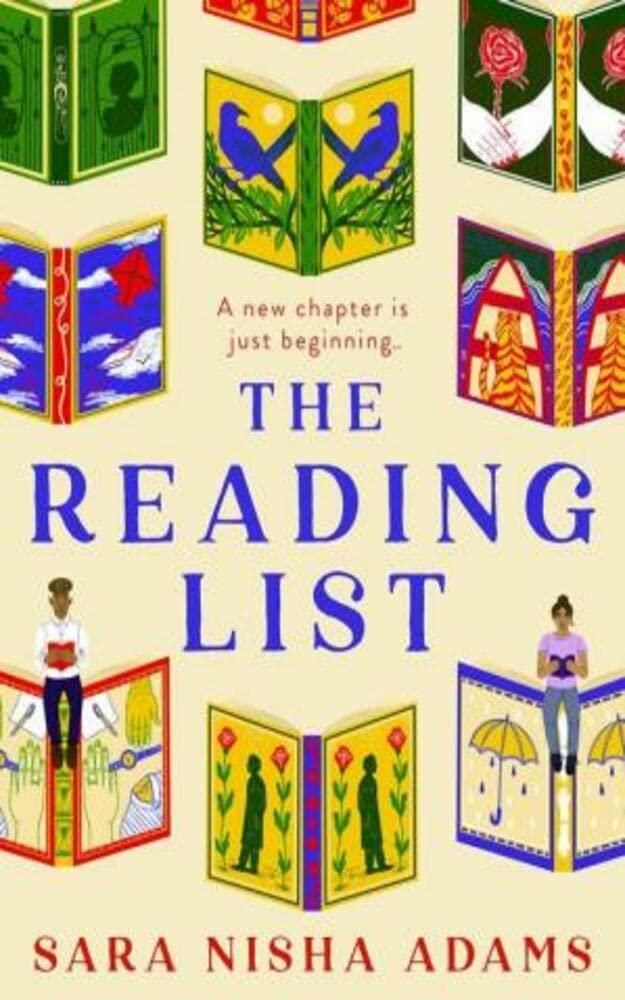
The Reading List revolves around 2 characters and a reading list. The protagonist is a young girl named Aleisha, and the other is an old man named Mukesh. A reading list and a library connect the 2, and they read through the books on the list together, discussing their reading experiences and sharing life's trivial matters. Along with them, the lives of their relatives and friends unfold.
The 2, who previously disliked reading, began to read under a strange circumstance. Their reading scenes are exceptionally vivid, a construction of the spiritual world. When reading Rebecca,, Mukesh immersed himself in it, often feeling that Mrs. Danvers, the housekeeper in the story, was beside him, watching him, reminding him not to forget his deceased wife. This terrified him, but he was also attracted to the world in the book. The lonely man hoped to find a place to belong, a temporary escape from the silent home after his wife's death.
Aleisha’s reading was the same. Turning the pages of a book would take her to another world, allowing her to temporarily escape her suffocating life. In reality, she had a mentally ill mother to take care of. In her own words, her mother and brother wanted her to be a child, but when her mother needed care, she couldn't even be a teenager; she could only be a mature and responsible adult, even though she was just a little girl.
While reading this book, I felt the same as the scenes described in the book. I also entered the world of the book. The characters in the book were 3 - dimensional and vivid, and the scenes were 360 - degree surround. In the quiet library, sunlight poured in from the window, illuminating the fine dust particles in the air. A girl squinted her eyes against the sunlight, her expression changing with the content of the book. Such scenes replayed in my mind like a movie.
Despite the initial warmth and comfort I felt while reading, Aiden’s death cast a pall of sadness over the entire book. Aiden was Aleisha’s brother. After their parents' divorce, he had always taken on the role of father to take care of his mother and sister. At a very young age, he took on the responsibility of the entire family. A tiring job, a mother whose condition showed no signs of improvement for years, and dreams that had no time or energy to realize - under heavy pressure, Aidan chose to leave.
When I read to this point, I even wondered if I had read too fast and missed some links. How could Aiden, such a warm and responsible person who loved his mother and sister so much, silently leave? I went back and looked only at the parts about Aiden. Sarah Nisha didn't write much about him. Occasionally, there were clues, like him saying he had a headache and went to the pharmacy to buy medicine. I think he probably suffered from depression, so even though he had a family he deeply loved in reality, under the torment of life pressure and mental illness, he still couldn't hold on.
In the end, the mystery was solved. It was Mukesh's wife, who wrote the reading list. She hoped that after her death, her husband could live well and hoped that reading these books would bring him light and joy.
Sarah Nisha, the author of this novel, said that this book was inspired by her connection with her grandfather through books. With extraordinary writing skills, she vividly presents the characters and their inner worlds, making me feel as if I know them personally.
The writing style is warm and inviting.
Through the characters in the book, I can also clearly see the underlying symptoms of the times - the rapid development of urbanization has led to alienation, mobility, and busyness. The popularity of video media has made reading a luxurious indulgence. The deserted community library symbolizes the subtle changes in people's lifestyles.
However, this constantly drifting list injects spiritual strength into Mukesh and Aleisha. They constantly draw courage, faith, perseverance, and love from the reading list. As the narrator describes Alesha's thoughts: She learned from Atticus Finch in To Kill a Mockingbird how to fight for her beliefs; from Pi in Life of Pi how to survive under a tiger's nose; from Amir in The Kite Runner that it's never too late to do the right thing...
When comforting and encouraging Alesha, Mukesh also said: Reading is not always an escape; sometimes books teach us something. Books show us the world, not hide it.
Books have the power to heal.
Reading List in the book: The Time Traveller’s Wife, To Kill a Mockingbird, Rebecca, The Kite Runner, Life of Pi, Pride and Prejudice, Little Women, Beloved, A Suitable Boy. (I’ve read them all except A Suitable Boy).
4.1 / 5 stars