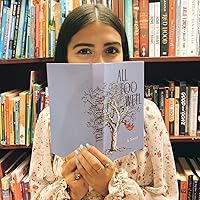
Won an ARC from GoodReads. Opinions are all my own
Taking place in the roaring jazz era of the 1920s in Kansas City, Missouri, Bindle Punk Bruja follows Luna Alvarado, the White-passing daughter of a Mexican mother and a White-American father. She's also a bruja--a witch--however her magic doesn't work quite as well as it shoukd. At least, not as good as her abuela Mamma Sunday. To the rest of the city, her name is Rose Lane, one of the first women to own a speakeasy. With her half-brother Javier being her bartender, Luna's club gets on modestly. But then things start to change.
The mafia keeps putting the screws on Luna's business, and her day job as a newspaper column editor she has to deal with more sexism and drama than ever. So, Luna decides to get big. Get a new club, get new friends that will finance her, and work on her bruja magic to protect herself and those she loves. However, 1920s Kansas City will continue to bite back at Luna and prevent her from getting her goals. From racists and sexists, to the mafia, and to even the Ku Klux Klan, Luna's dreams will be made more and more unattainable. But all she can do, and need to do, is fight back.
While there is good and evil in this book, this isn't a traditional fantasy scenario where the good constantly fights back against the evil. While there are occasional fights and conflicts, there's no street battles or magic battles that happen. This is mostly about Luna and her friends and family just trying to survive and be comfortable. However, for people like Luna and her friends and family, especially into 20s, such a simple feat is not done so easily.
Bindle Punk Bruha tackles a bunch of different issues: sexism, racism, homophobia, divided ethnic heritages. We see this solely through Luna's perspective, however I think Desideria Mesa handled this well for the most part. Luna feels like everything is against because she's primarily a woman. Her brother Javier, who is darker-skinned and full-blooded Mexican and (as we eventually learn) bisexual, points out to her though that she has it easier because she's White-passing and using an Euro-American name. It's a difficult truth for Luna to accept because she tells Javier that he doesn't know what it's like to be a woman. I think the story could've benefitted from hearing the experiences of a darker-skinned woman as that would shown a perspective that faces double oppression. There is a bisexual Black character named Penny in the story, but she never really takes center stage and her experiences are only alluded to; not erased or ignored, but just not considered. Luna eventually learns that her clinging to her White-passing identity, while giving her somewhat of a social boost, has made her unconsciously distance herself from both her bruja magic and her Mexican heritage. Mesa handled this issue without making the usual errors often made by actual White feminists who tackle these issues.
A lot of these issues often tie into the historical setting, which is brilliantly and authentically realized. Seriously! Mesa did a TON of research into 1920s society from the fashion, to the politics, to actual historical figures, and to even the way people spoke back then. The dialogue is probably the most authentic part about the setting. I will say that Mesa uses A LOT of the slang, some that I had never heard of before. Some might find this distracting, and it was at first for me, but I got around it. I will say that every character started to sound like a character in the movie Goodfellas. "I get to live the rest of my life like a schnook!" Yes, a completely different era, I know. You get my point.
While the dialogue was that swanky, 1920s "How you doin', toots! Ya gams look great!" kind of dialogue, the narration prose was a bit more sophisticated. The prose is beautiful, readable, and occasionally sensual. We see and feel everything Luna sees and feels from her most simple moments to her her most emotionally-charged ones. We are well and truly inside of Luna's head in this book, and the prose aids this. She never feels out of character; Mesa never dips from the viewpoint she's showing us. Mesa always captures a scene, its characters, and its feelings and never loses hold of it. However, I will say this: one of the errors I found with the book, at least in its beginning parts as I didn't see this at all later on, is that Mesa had some moments where she told right after she had already shown. These moments were are similar moments where Luna faces sexism or witnesses another form of prejudice thrown at another character. Luna would often inform us that the men who did these prejudices were being prejudiced and discriminatory. This wasn't needed. You don't need to tell when you've already shown; trust your audience to understand what just happened.
In terms of characters, I think everyone, save for some of the side characters were fully fleshed out. As I said above, I think the story could've benefitted from informing us about a few other perspectives in this fairly intsectionalist novel. Luna is a sassy, flirty, but also serious woman trying to make her way in the world. Javier is a brave but cautious man who wants to best for himself and his sister, but worries about any repercussions. Heck wants to find love with another man, but is worried about losing his inheritance, especially after his family already tried to "deprogram" him. Margaret wants to find love and escape the clutches of her terrible husband. Gio wants Luna to be his girl and to live a good life. Everyone for the most part is seen and felt.
Now, here's were I get into some more stronger criticisms. Overall, I think Bindle Punk Bruja is a good book. It's a debut novel, and it's weighed down by the common errors that come with a debut novel. For one, I think the first five or six chapters are a bit slow. There's a lot of different hit men and mafia guys and politicians who are kind of similar to each. Each a wise-talkin' Italian kind of guy or some big shot who has a lot of sway and/or power over the city. Except for Heck, Javier, and Gio, some of the side male characters are a little hard to distinguish. Additionally, I think this is the book's biggest burden, is that it tries to do too much sometimes. There's the complex network of financial payment Luna needs to give to certain mafia bosses, there's these same mafia bosses threatening her and coming for her, there's all the set-backs Luna faces--which are lot, by the way, and I'll get to that--, there's the Klu Klux Klan, there's Al Capone coming to town--it's all A LOT! Luna's struggle with her bruja magic and her Mexican heritage is still relevant throughout the book, you never forget about it, but it often takes a very far back seat to these other issues.
Luna faces a lot of setbacks in this book. In fact, it became quite depressing. This book isn't too brutal, it isn't grimdark, and it does have a mostly happy ending, but the constant fears, setbacks, and threats Luna faces in the middle of the book and towards the end just really started to feel depressing. Obviously, Mesa doesn't need to pull her punches, and life for minorities during this time period (as it still is in many parts of the USA) was rough, but still it's a lot. Also the addition of Al Capone felt a bit deus ex machina and a felt a bit off. He isn't the only actual historical person to show up in the book, and I understand why Mesa put him in there, and he's truly an intimidating figure on page. However, he felt like a MacGuffin in human form. I think Mesa could've made up her own crime boss and the story and its resolution would've been the same.
That being said, while this is not a perfect debut, it is a noticeable one and one that shows promise for the author. I think a sophomore novel would be a step up for Mesa. She is clearly an author who cares about details in her story and is able to deliver exciting characters and an interesting world. She's one to watch.
A modest, upper 3.5/5 stars!