

What do you think?
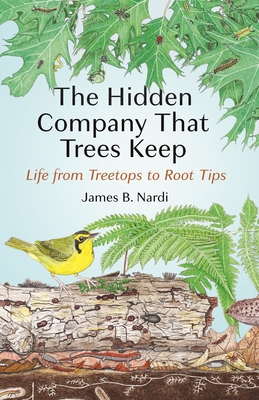
The Hidden Company That Trees Keep: Life from Treetops to Root Tips
A spectacularly illustrated journey into the intimate communities that native trees share with animals, insects, fungi, and microbes
You can tell a lot about a tree from the company it keeps. James Nardi guides you through the innermost unseen world that trees share with a wondrous array of creatures. With their elaborate immune responses, trees recruit a host of allies as predators and parasites to defend against uninvited advances from organisms that chew on leaves, drain sap, and bore into wood. Microbial life thrives in the hidden spaces of leaf scales, twigs, and bark, while birds, mammals, and insects benefit from the more visible resources trees provide. In return, animals help with pollination, seed dispersal, and recycling of nutrients. The Hidden Company That Trees Keep blends marvelous storytelling with beautiful illustrations and the latest science to reveal how the lives of trees are intertwined with those of their diverse companions.
Features a wealth of richly detailed drawings accompanied by breathtaking images of microscopic landscapes on leaf, bark, and root surfacesIncludes informative fact boxesDraws on new discoveries in biology and natural historyWritten by one of the world’s leading naturalists
You can tell a lot about a tree from the company it keeps. James Nardi guides you through the innermost unseen world that trees share with a wondrous array of creatures. With their elaborate immune responses, trees recruit a host of allies as predators and parasites to defend against uninvited advances from organisms that chew on leaves, drain sap, and bore into wood. Microbial life thrives in the hidden spaces of leaf scales, twigs, and bark, while birds, mammals, and insects benefit from the more visible resources trees provide. In return, animals help with pollination, seed dispersal, and recycling of nutrients. The Hidden Company That Trees Keep blends marvelous storytelling with beautiful illustrations and the latest science to reveal how the lives of trees are intertwined with those of their diverse companions.
Features a wealth of richly detailed drawings accompanied by breathtaking images of microscopic landscapes on leaf, bark, and root surfacesIncludes informative fact boxesDraws on new discoveries in biology and natural historyWritten by one of the world’s leading naturalists
320 pages, Hardcover
Published February 7, 2023
Ratings & Reviews
Friends & Following
Create a free account to discover what your friends think of this book!
Community Reviews
Displaying 1 - 18 of 18 reviews

June 1, 2023
This book is very beautiful and the illustrations are lavish, but I can't help but feel that the author doesn't know who they are writing for as the text is quite dense and not extremely well structured and certainly not poetic or pretty and is paired with quite lovely illustrations which are normally very separate audiences. I quite a bit had to go through the book a second time to go through the illustrations as shifting attention to them from the text was difficult, but that may be a me issue
The book itself is a collection of stuff, if you like reading Wikipedia and clicking through all the related links, this is a fun but less detailed book. Paper quality and illustration quality 5/5
The book itself is a collection of stuff, if you like reading Wikipedia and clicking through all the related links, this is a fun but less detailed book. Paper quality and illustration quality 5/5
February 20, 2025
This book was far nerdier then I expected. But it's a testimony to its quality that I feverishly read it cover to cover in little time. Nardi covers a wealth of information and minute observations; a second reading of this book wouldn't begin to exhaust its value for me. I don't think this is an intro- to-ecology book, more like a, so-you-think- you-know-trees? book. The book tells very little about trees. But in a comprehensive nod to ecological interrelatedness, it tells you all about their neighbors. Illustrations on every page helped me visualize the infinite entomology. Bonus: there's a gazillion alive things.

January 21, 2024
This is a beautiful book. Almost every page has incredibly detailed illustrations done by the author of whatever subject he’s discussing. I learned a lot, and for the most part I enjoyed reading it. I particularly liked the little etymology lesson that came with every new species name.
At times, the book felt repetitive, but I also feel like you aren’t supposed to read it all the way through. If I was putting it down for months at a time (like I did in the very beginning, oops) the repetition would be beneficial.
Personally, I don’t think this one is very useful to me and my curriculum, sure I learned a lot, but mostly about insects. Especially parasitic wasps. I now know a lot about parasitic wasps. I flagged a couple things that could be useful but I don’t actually think this can be classified as a botany book- it’s mostly about bugs!
At times, the book felt repetitive, but I also feel like you aren’t supposed to read it all the way through. If I was putting it down for months at a time (like I did in the very beginning, oops) the repetition would be beneficial.
Personally, I don’t think this one is very useful to me and my curriculum, sure I learned a lot, but mostly about insects. Especially parasitic wasps. I now know a lot about parasitic wasps. I flagged a couple things that could be useful but I don’t actually think this can be classified as a botany book- it’s mostly about bugs!


July 14, 2025
This book is full of interesting facts and sets out to show the interconnected relationships between between trees and many, many other organisms. I was expecting a more narrative approach but this was much more scientifically descriptive. It's beautifully illustrated throughout. Not quite a reference book, not quite a roadmap, not really a story or a giide either, I'm honestly not quite sure how to sum this one up but will refer to it many times in the future.

August 15, 2024
I’ll give this book five stars for the extraordinary research behind its pages as well as fabulous illustrations. But to be honest, it took me most of a year to read. I couldn’t read more than 1-2 pages at a time. Finally, 30 pages from the end, I had enough and couldn’t read it anymore. You really, really, really have to love bugs to like this book. I don’t.

February 23, 2026
The Hidden Company That Trees Keep completely changed the way I view trees. I never realized how complex their interactions with animals and microbes could be. The illustrations are stunning and bring these hidden worlds to life. I now notice the tiny ecosystems around me every day. This book is both beautiful and deeply educational.

February 23, 2026
I was amazed at the intricate networks that trees maintain with other organisms. Jim Nardi explains these relationships clearly, blending science and storytelling in a way that’s easy to follow. The fact boxes and illustrations made concepts concrete and fascinating. I feel I’ve gained a real understanding of forest ecology. It’s a book I will return to again and again.

February 23, 2026
This book opens your eyes to the hidden companions of trees. From microscopic microbes to birds and insects, every interaction is important and fascinating. The illustrations are incredibly detailed, making it easy to visualize the unseen world. I learned so much about ecological interdependence. It’s rare to find a book that is both educational and visually captivating.

February 23, 2026
The book beautifully explores the birth of anthropology as a discipline. It doesn’t shy away from the politics of museums and cultural ownership. Nuttall’s independence is both admirable and complicated. I found the Mexico–U.S. connections particularly compelling. It’s thoughtful and nuanced throughout.

February 23, 2026
I loved how the book highlights the defensive strategies of trees and their partnerships with other organisms. The illustrations give a sense of the microscopic world I never knew existed. The writing is clear, engaging, and thought-provoking. I found myself pausing to consider the trees in my neighborhood differently. This book truly broadens your perception of nature.

February 23, 2026
The book is a wonderful combination of science and art. The detailed illustrations alongside explanations of microbial and animal interactions made it fascinating. I enjoyed the way Nardi connects different species to show ecological interdependence. I feel more aware of the delicate balance in nature. It’s inspiring and educational at the same time.

February 23, 2026
This book is a fascinating guide to an unseen world. I had no idea trees had such elaborate defense mechanisms and partnerships. The combination of detailed illustrations and clear explanations makes it accessible yet rigorous. I enjoyed the fact boxes that added extra scientific insights. It’s both informative and captivating.
November 23, 2023
An amazing book that gives a pleasantly detailed look at all the amazing lives that are intertwined with those of trees. I highly recommend this book for anyone who is interested in the wildlife in their yard and/or in nurturing the ecosystems around them.
February 23, 2026
I’ve never read a natural history book quite like this. The depth of research and storytelling are impressive. The illustrations give life to otherwise invisible creatures. I learned about the symbiotic relationships that sustain forests. A truly remarkable and eye-opening read.

August 24, 2026
This is a fun, interesting, and well written book. Looking at the whole complex of life that a tree supports, you'll have much more appreciation for the wide variety of life that exists right in front of you. The drawings and diagrams bring so much to life.
March 24, 2023
This book is amazing, but it is slow reading as it really it more like a textbook. So much information about so many insects! It was a bit over my head. I plugged along slowly and did enjoy it.

January 29, 2024
Charming book covering in impressive detail the many other creatures of many different sizes that share space with trees. Beautiful pencil drawings.
Displaying 1 - 18 of 18 reviews