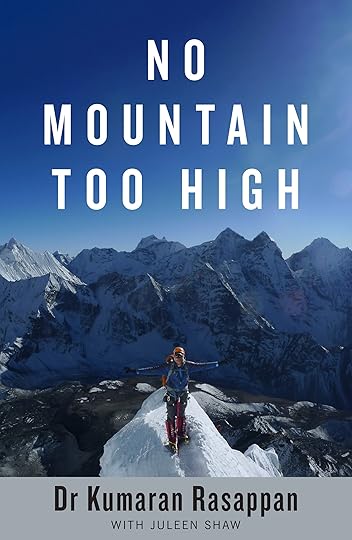
A school trip to rural Nepal when Kumaran Rasappan was 15 years old gave him his first glimpse of Mt Everest, and launched him on a lifelong journey of adventuring that would take him to over 20 mountains, from the wilderness of Kilimanjaro to the frozen glaciers of Sichuan and ultimately to the roof of the world, Mt Everest.
Dr Kumaran tells the story of his extraordinary journey from sheltered Singaporean to adventurer, doctor and humanitarian. Along the way, he witnessed death, experienced avalanches, survived earthquakes and made surprising discoveries about the tenacity of the human spirit, the nature of success and failure, and the beauty of different cultures. The biggest lesson that his journey has taught him is that one's success and failure cannot be defined by others. Each one of us has our own mountain to climb.
One can’t quite help drawing parallels between this book and Project Possible by Nirmal “Nims” Purja about how the latter summited the 14 eight thousand metre peaks of the world in record time. Both books started with an abundance of naysayers when the aspirations were first revealed, narrated how promising trajectories in career got interrupted (Kumaran on starting medical housemanship, Nims on getting his end-of-service pension), how each man worked against time to get sponsors, living apprehensively while realising their dreams, all driven by a consuming passion for the mystique of the mountains.
But that’s where the 2 books diverged in their themes. Where Project Possible is all about machismo, supreme athleticism and astounding the world, this book exhibits a more human side while at the same time providing more detailed, quirky accounts of the ascents. It’s story telling in its most visceral and vulnerable - how the writer juggles a budding medical career with tackling the giant peaks and serving the Nepalese community in the medical outposts in villages with his future wife. Despite self doubts, the writer climbed 4 eight thousand metre peaks (Cho Oyu, Everest, K2, Makalu) and garnered a wealth of unique experiences interacting with colourful individuals from across the world. That he only managed to summit Everest and had to turn back before the summits of the other three, does not in any way detract from the magnitude of his achievement. I’m inspired by a quote from the book: “Your comfort zone is a beautiful place, but nothing grows there.”
Dr Kumaran Rasappan is an excellent writer and the humility, compassion and iron grit shines through in his quest to exceed his own limits. This is Singapore’s version of Project Possible. I’m proud that we both came from the same alma mater in Singapore, a secondary school called Raffles Institution. Auspicium Melioris Aevi.
This entire review has been hidden because of spoilers.
Book recommendations often come from the most unexpected places. This one came from a taxi driver during one of my rides. She noticed me reading a book (yes, I know it’s a bad habit!) and told me how much she had enjoyed this memoir. Her recommendation was spot on.
What an inspiring and remarkable book this is!
This memoir chronicles the mountaineering adventures and humanitarian work of Dr. Kumaran Rasappan, an orthopaedic surgeon at National University Hospital (NUH), Singapore. Born into a middle-class Singaporean Indian family, Kumaran grew up as an ordinary boy with extraordinary dreams. His father had migrated from India to Singapore as a casual labourer and, through perseverance and self-education, worked his way up to become an official in the Ministry of Education. His mother was a Tamil teacher, and together they instilled in him the values of hard work and determination.
Kumaran’s fascination with mountaineering began during a school field trip to Nepal, where he met a Singaporean volunteer teacher. Captivated by the majestic Himalayas, he set his sights on scaling their peaks—both literally and figuratively.
While pursuing his medical degree, he joined the NUS intervarsity climbing team. However, his path to mountaineering proved to be as challenging as the mountains themselves. Financial constraints threatened to derail his ambitions, but he refused to give up. Through fundraising efforts and the support of numeorous sponsors, he successfully climbed his first 8,000-metre peak, Cho Oyu, on the China–Nepal border.
As his medical training progressed, so did his mountaineering ambitions. He went on to tackle some of the world’s most formidable peaks, including Ama Dablam, Mount Everest, and K2. While he successfully summited the first two, he made the difficult yet wise decision to turn back from K2 due to safety and personal considerations—a choice that exemplifies one of the book’s recurring themes: knowing when perseverance must give way to prudence.
Alongside his wife, Gayathri, Kumaran also devoted himself to serving impoverished Himalayan communities. Isolated by rugged terrain and limited resources, many villagers had to trek for days to access even basic medical care. Together with a small team of volunteers, the couple established medical camps, carrying supplies and equipment through some of the harshest terrains imaginable to provide much-needed healthcare.
Following the devastating Nepal earthquake of April 25, 2015, Kumaran and Gayathri returned to what had become their second home to assist in rescue and relief efforts. His passion for the mountains eventually led him to pursue a degree in Mountain Medicine, a specialised field focused on treating illnesses and injuries associated with high-altitude environments.
The memoir brims with authenticity, and the attention to detail is exceptional. Beyond vividly describing life in the mountains, the author highlights important values such as perseverance, integrity, humility, and the ability to take calculated risks. Equally important is his emphasis on knowing when to step back—a lesson that is often overlooked in stories of achievement.
What could easily have become a dry account of mountaineering expeditions is energized by Dr.Kumaran’s humour and engaging storytelling. His honesty about failures, fears, and setbacks makes his accomplishments all the more inspiring. The sincerity and resilience with which he approaches life’s challenges are truly admirable.
If you’re looking for a book that will inspire you to pursue your goals with grit, determination, and purpose, this memoir is well worth your time. Kumaran’s story serves as a powerful reminder that no mountain is too high, provided you keep your eyes fixed on the summit and continue moving forward with grit and patience.
Finished this book with goosebumps! Hugely inspired by Dr Kumaran Rasappan's adventures and work. I think I first heard him speak a decade ago. He was addressing a packed auditorium of bright-eyed girls and boys, me seated amongst them. I recall him recounting his experience of asking his dad to sign the indemnity form before he set off for Everest, the days he spent with Scouts, and his exploits in the Himalayas. I was wowed by his photos and stories, and the call of the mountains grew louder in me.
The second time I heard Dr Kumaran speak was at a reunion gathering of MIR members several years later, after having had my first taste of technical mountaineering. Again I remember some memorable anecdotes of his from then, like how he was moved by the heartfelt gratitude of a guide whose daughter he had helped to treat (for scalding), and how an elderly woman's vision "improved" significantly after just a cleaning of her dirty spectacles. I read about these amazing moments in his life and many new stories eagerly.
I loved how Dr Kumaran married climbing and community work in his life. It appeared to me that the book focussed on mountaineering in the first half and shifted gears into medicine in the second half. Dr Kumaran goes into specifics and details, walking us through his expeditions and projects from start to end. As such, one comes away having learnt a great deal about and having gained insights into both mountaineering and medicine without having stepped so much as a foot on the mountains or picked up a stethoscope. The book is thus a superb resource for anyone seeking to walk in his path, for aspiring mountaineers and medical workers alike.
However, it also speaks broadly to people from all walks of life. The diverse topics covered in the book include: Dr Kumaran's family background, the climbing community in Singapore, scouting and values, Sherpas and their way of life, the value of mentorship, the role of luck and higher powers, prominent peaks around the world, mountaineering history and record setters, technical mountaineering, high altitude problems and remedies, fund raising, project planning, disaster recovery, humanitarian aid, and more.
I especially enjoyed the mountaineering and life quotes peppered throughout the book and at the start of every chapter. The colour photos were great additions too. A few photos were absolutely breath-taking, for instance, the view of Makalu along the descent on Everest (pg 204), and the view of K2 from Concordia (pg 253).
A serendipitous encounter - I was reading the book on the MRT when a traveller strolled in with luggage. He sat beside me and after recognising Kathmandu (just rattled by the 2015 quake) in a picture on the book, he pointed to it and said he has been there. It turns out, he's a Nepali from Pokhara who just arrived in Singapore for a 3-day vacation. We then bonded over our half-hour commute exchanging stories. I was thrilled at the coincidence. I was also pleasantly surprised to see familiar names like Melvin Lim and Mr Krishnan Pillay in the book. It's a small world.
Motivated to embark on my next climb after this read. Everest might just be within reach one day. No Mountain Too High!
This entire review has been hidden because of spoilers.
Coming back to Singapore after climbing mountains in Europe, I had a great and increasing passion for mountaineering. I picked up the first book I saw on my shelf. It turned out to be published in Singapore! I was surprised and I felt that I could take great inspiration from his story to become a mountaineering Singaporean too.
Dr Kumaran details most of his life, from the first view of Everest at 15 years old, to becoming a doctor, funding his expeditions, and all his various climbs (no matter failed or succesful), in this auto-biography. He is an incredibly kind-hearted, open, high-achieving man who constantly pushes himself past his limit, all while helping others in whatever way he can. He acknowledges that it is a team effort, naming and detailing the lives and contributions of countless Singaporeans and Nepalese people, not all of them mountaineers. I've noticed that even though he talks about some climbers with nasty demeanours (like the guy who threatened to sue him on K2, and the Everest guide), he takes care not to name them to protect their privacy and dignity.
There is such an incredible wealth of information and history related to climbing, mountaineering, Nepal, and medicine conveyed by Dr Kumaran. He talks alot about the villages of Nepal in the Himalayan Range, his second home, through many years and many events. Since 15 years of age, he's been to Gorkha for humanitarian work, to contribute to their secondary school. Before embarking to the summit of Everest, he was at the village of Phortse to start a clinic for the villagers, only to be replaced by his doctor wife for two months while he climbs Everest. After the 2015 massive earthquake that hit Nepal, he and his wife went back in separate relief teams to help, and after that they started Project Aahale for long-term recovery efforts and medical assistance to more remote Nepalese villages. Throughout all these, he talks about his many mountaineering achievements and their near death experiences, notably K2 and Makalu, which are his last 8000ers before fatherhood. He failed to summit both, but those were his proudest climbs. The ability to be able to draw the line and turn back is extremely important in life; sometimes failure is seen as success.
Dr Kumaran has inspired me greatly, not only in the area of mountaineering, but how to live out my life, especially coming from a fellow Singaporean. As he closes his book, he asks, "What is your Everest? What beckons your heart and fills your dreams?" He has taught me to overcome my fear: fear of the unknown, fear of failing, fear of stepping outside of my boundaries; to push myself, and to achieve greatness.
An awesome read of Dr Kumaran's mountaineering journey and the valuable life lessons learned along the way.
I've never climbed, or had an interest in anything remotely South Asian, but was captivated by the stories of the mountains, villages and people, that not only did I feel like I was alongside him on this arduous journey, I have even learned a few mountaineering terms! And, turns out climbing is so much more than just about the sport itself but also a lifelong exercise in perseverance, trust, kindness, friendship and more...
Be sure to follow the links at the end of the book - you'll have a deeper appreciation, understanding and awe at the videos and blog content.