The Byzantine Empire was one of the longest-surviving empires in world history, spanning nine centuries and three continents.
It originated as the eastern half of the mighty Roman Empire, and established its center at Constantinople, a glittering capital straddling the frontier of Europe and Asia. From the outset, Byzantium was surrounded by potential enemies. Persians, Arabs and Ottoman Turks in the east, Slavs and Bulgars in the north, Saracens and Normans in the west; all vied to control the rich empire of the Bosphorus.
John Haldon’s comprehensive short history tracks the checkered past of an historical enigma, a ‘lost empire’ which stood for a thousand years against the might of Islam and which preserved and transmitted the literary and linguistic heritage of ancient Greece and Rome. He tells the story of the cycle of conquest and reconquest of its lands and finally its complete destruction by the Ottoman Turks in 1453.
John Haldon is Shelby Cullom Davis '30 Professor of European History, and Professor of Byzantine History and Hellenic Studies. He has been Director of Graduate Studies for the History Department since July 2009. His research centers on the socio-economic, institutional, political and cultural history of the early and middle Byzantine empire from the seventh to the eleventh centuries. He also works on political systems and structures across the European and Islamic worlds from late ancient to early modern times and has explored how resources were produced, distributed and consumed, especially in warfare, during the late ancient and medieval periods. Professor Haldon is the author and co-author of more than two dozen books. His most recent books are The social history of Byzantium (Blackwell, Oxford 2008) and Byzantium in the iconoclast era: a history, with L. Brubaker (Cambridge University Press, Cambridge 2011).
Professor Haldon is the director of the Euchaita/Avkat Project - an archaeological and historical survey in north central Turkey. As well as traditional methods of field survey and historical research, this long-term project employs cutting edge survey, mapping and digital modeling techniques to enrich our understanding of the society, economy, land use, demography, paleo-environmental history and resources of the late Roman, Byzantine and Seljuk/Ottoman periods. Further information on the Euchaita/Avkat Project is available through the following links.
He is also co-director of the international Medieval Logistics Project - an international project deploying Geographical Information Systems and sophisticated modelling software to analyze the logistics of East Roman, early medieval Western European and Early Islamic warfare and structures of resource allocation.
A native of Northumbria, England, Professor Haldon has worked at the Universities of Athens and Munich, at the Max-Planck-Institut for European Legal History in Frankfurt, and at the University of Birmingham, where from 1995 he was Director of the Centre for Byzantine, Ottoman and Modern Greek Studies and from 2000-2004 Head of the School of Historical Studies. He came to Princeton University in 2005. From 2007-2013 he is a Senior Fellow at the Dumbarton Oaks Center for Byzantine Studies in Washington D.C. He is a Corresponding Member of the Austrian Academy of Sciences in Vienna and a member of the editorial boards of several scholarly journals in Europe and the USA.
This is an excellent, highly informative, very interesting and scholarly impeccable introduction to the history of the social, political, economic and cultural features of the Eastern Roman Empire. This is a highly accessible work by a foremost practitioner, presenting a good level of detail throughout, and it is definitely of high interest even to readers with previous knowledge of this fascinating civilization spanning several centuries, a remarkably resilient and sophisticated polity located at the physical and cultural crossroad of East and West.
The book starts with a succinct history of the main political and military events, highlighting all the major developments and stages of the Eastern Empire, with its multiple ebbs and flows, starting from Constantine the Great up to the collapse of 1453. The next chapters provide a 360% overview of all major aspects of the Byzantine civilization, including the usage and distribution of available resources, the complex ethnic composition, the main cultural elements, the state and religious ideologies, the social classes and their inter-relationship, individual lifestyles and even some very interesting glimpses into village and city life, commerce and trade etc. There is no facet of this complex civilization that is not explored, to some extent, by this gifted and knowledgeable author, whose areas of expertise is Byzantine history.
This remarkable and very enjoyable book is also completed by good maps and illustrations, a very useful glossary, a very good and quite detailed timeline, and even a chronological list of emperors.
Perfect as an introduction, highly recommended also for future reference. I had read a few books about Byzantine history in the past before approaching this book, but I must say that I did learn quite a few interesting aspects of this unique civilization, and I quite enjoyed it.
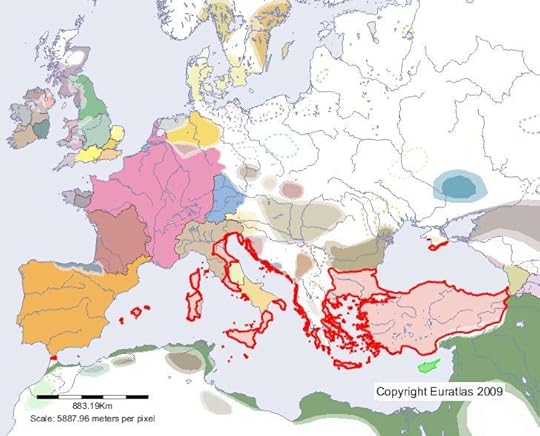
The Byzantine Empire is one of those entities which always seems to have appeared at the periphery, a bit part actor mentioned in world history courses in its role as a conduit for trade goods from the East. There is a perception that it is an archaic entity destroyed by more dynamic powers - Venice, the Ottomans. Some elements of those perceptions are true, however John Haldon’s excellent book serves to enlighten, and provide a more rounded perspective. Although there were cultural shifts over time, the fact that the empire lasted for over 1,000 years is certainly cause for respect, and many scholars in fact see it as a continuation of the Roman empire which puts its longevity on an even more impressive scale. I was reminded of Mark Twain’s oft-quoted comment when asked about reports in the press that he had died: “The reports of my death are greatly exaggerated”. One could argue that reports of the death of the Roman Empire began early - perhaps the 200s with instability and economic turmoil, more certainly in the 400s with invasion by barbarians, the disastrous defeats to Islam and the Bulgars in the 600s, as seen in this map: Yet by the reign of Basil II at the cusp of the 1000s “the Byzantine empire appeared to be impregnable: rich, with an efficient bureaucracy, a powerful, tried and experienced army which had been victorious on all fronts with few exceptions, and vastly expanded territories in the Balkans and eastern Anatolia.” Haldon heads up the section on the succeeding era “Political Eclipse, Cultural Inheritance” which describes well the decline of political, military and economic power, whilst at the same time the cultural legacy of the empire was maintained to various extents in the Balkans and of course Russia with the Orthodox church. Even this period of ‘decline’ lasted 500 years. Haldon really sets the standard for introductory histories with an excellent overview of the Empire, long enough to provide sufficient detail and coverage (192 pages) and clearly written. The first two chapters deal with the political and military history, providing a chronological framework. These chapters were really teasers - although they aren’t brief I was left wanting more. The remainder of the book deals with “The Byzantine World”, a balanced and broad overview of the topology, functioning and transition of the state, social history, the church and culture. Haldon positions the state clearly in its role as an extractor of surplus from the largely agricultural population. He highlights the changes as power was diffused to and clawed back from the nobility. At times power was successfully clawed back - “the seventh century witnessed a massive re-concentration of power and economic control in the hands of the state.” Ultimately the state dwindled away, however what Haldon calls “the Byzantine symbolic universe” (the cultural inheritance and particularly the religious framework of Orthodoxy) was left behind the ebbing tide of the Empire across Asia Minor and the Balkans. The decline of the Empire was due to a variety of factors: “The reduced income derived from the appropriation of surplus through tax on a much smaller, and constantly shrinking, territorial base, the fragmentation of territory and political authority and the lack of a serious naval power with which to defend its interests were fundamental.” The military failures which resulted in the loss of territory are only really dealt with in the first two chapters, and probably a bit too briefly considering their significance. Most of the failures are attributed to “treachery and tactical blunders” without much detail. Another significant factor though which Haldon is good on is the failure to appreciate the significance of commerce. Haldon describes how “The Byzantine state … played no role at all in promoting indigenous enterprise, as far as we can see from the sources, whether for political or economic reasons, and viewed commerce as simply another minor source of state income: commercial activity was regarded as – and was, in respect of how the state worked – peripheral to the social values and political system in which it was rooted”. Venice exploited this failure to its own advantage. On balance this book couldn’t have done much better in providing an overview of the Byzantine Empire and a starting point for further research with the likes of John Julius Norwich’s books. The military defeats leading to the loss of territory are described a little superficially but overall the political, cultural, economic and social history of this important entity are superbly dealt with in a very readable book.
This book should've been called "Byzantium: An Overview". Byzantine Empire lasted for a thousand years, but this book is only 200 pages long! So, no details here.
But if you have only a very tentative knowledge of East Roman Empire, this book is a good starting point. I feel like I'm ready for a more in-depth history, now that I got here the general outline of the Empire's history, economy and culture.
Bysantti on yleisessä ymmärryksessä vähän hämäräksi jäävä valtakunta. Nykypäivän näkökulmasta se on kaukainen, vähän eksoottinen antiikin jäänne. Tämä kirja on hyvä johdatus "todelliseen Bysanttiin". Todella kivasti kirjoitettu ja kattava pläjäys niin poliittista historiaa kuin kulttuurihistoriaakin. 1000 vuotta kuitenkin paahdetaan läpi aikamoisella vauhdilla, jolloin tämä todellakin on vain johdatus aiheeseen.
Hyvä ja tiivis yleiskatsaus Bysantin historiasta. Alussa käy nopeasti läpi koko Bysantin historian, minkä jälkeen käsitellään mm. vallanjaon, uskonnon ja talouden kehittymistä aikakaudella. Sisältää paljon karttoja ja soveltuu hyvin ensipuraisuksi Bysantin historiasta.
Lyhyt, yleisluontoinen esittely Bysantin historiasta.
Tämä on noin 200 sivua pitkä ja Bysantti oli olemassa taas reilut tuhat vuotta, joten lienee selvää, että ihan kauhean syvälle tässä ei päästä. Mikä on sinällään harmi, koska se maistiainen mitä tämä tarjoaa, on hahmotelma erittäin mielenkiintoisesta ja uniikista imperiumista.
Rakenteen osalta alussa käydään historian tapahtumat pääpiirteissään läpi - skaala on niin valtava, että monista hallitsijoista ei saada muutamaa lausetta enempää. Esim. itselle tänä talvena tutummaksi tullut ristiretkiaika vilahtaa ohi häkellyttävän nopeasti.
Myöhemmät osiot tarkastelevat yhteiskunnan eri osa-alueita erillään - lukuja on armeijan organisaation muutokisista, kauppasuhteiden kehittymisestä, kirkon ja kulttuurin kasvusta ja niin edelleen. Nämä toimivat alkuosaa paremmin, koska tahti ei tunnu ihan niin hengästyttävältä.
Kolme tähteä tulee tosiaan ensisijaisesti siitä, että sivuja on vain liian vähän. Kirja on tarkoitettu henkilölle, joka alkaa perehtymään Bysantin maailmaan mutta sellaiseenkin suurempi sivumäärä olisi antanut enemmän hengitysvaraa.
Teksti on hiukan väritöntä mutta ajaa asian. Omalla kohdalla tämä onnistui tavoitteessaan eli kiinnostuksen nälän kasvattamisessa. Haluan tietää lisää Bysantista!
A concise description of both the history of, and the function of society within the Byzantine Empire. The tone is rather academic and, considering the vast subject area, makes summarizing the Empire in such a few amount of pages sometimes list-like. However, having read the book a basic overall understanding of the empire results, and thus in my opinion the book achieves what it sets out to do.
This is the go-to book for anyone not professionally a Byzantine Historian who is looking to learn more about this truly enchanting world.
I think the layout is exceptionally good for an introduction level book covering Byzantium, rather than going chronologically like similar books traditionally do instead Haldon zooms in on different aspects of life in the Byzantine Empire chapter by chapter.
He starts with a brief history of political events. The next chapter starts with the lands and people of Byzantium, explaining the geography, agriculture, climates, lifestyles etc. He details lots of things from crop-growing, ore mining, animal husbandry giving nice glimpses into Byzantine village and city life. Then chapters continue; one is on trade, commerce and economy in general. Another one is on the Byzantine political society, which is a nice little analysis on Byzantine social history. Then he moves on to the religious aspect of the empire and details its transformations and the formation of Orthodoxy. And so on.
The only thing lacking from this book is perhaps a cultural overview of the empire, there isn't really anything on art, literature or music in the Byzantine world. But, again, Haldon's book is meant as an introduction, and a springboard to pursue further interests in this enchanting Medieval world.