Explore the incomparable reach of the most beloved of impressionist masters, Claude Monet. Working en plein air, Monet’s dappled renderings of the reality taking place “between the motif and the artist” emphasized the ephemeral moment and with it became eternal markers of burgeoning modernism.
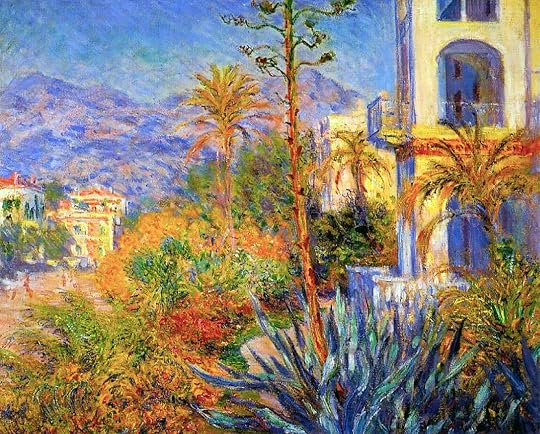
أنهيت الكتاب منذ يومين إلا أنه لم يغادرني. منحني مونيه تجربة انغماسية جمالية يصعُب علي وصفها، ولكني سأستلهم وصفَه الشخصي الذي كان يصف به شعوره بكل جمال يقابله: "هناك الكثير من الجمال لأرسمه"، هذا الشعور الغامر بالجمال الذي يلجم لسانك ويدفئ روحك، هذا الشعور الذي وصفه مونيه مراراً وحاول جاهداً تسجيله في لوحاته، إنه الشعور المدهش الذي ينتابنا في حضرة كل جمال نتعثر به. نراه في زيارته لمدينة بورديجيرا الإيطالية الساحلية المشهورة بالنخيل، حين وصف تجربته في مراسلاته: "هذا بلد ساحر كقصص الخيال، لا أعرف من أين أبدأ، كل شيء فيه جميل بشكلٍ استثنائي، أريد أن أرسم كل شيء، فالمناظر الطبيعية جديدة تماماً بالنسبة لي."
وفي إشارة إلى الجمال الذي يتحدى قدرته على تصويرِه، كَتَب: "أشجار النخيل ستجعلني أشعر باليأس، زُرقة البحر والسماء لا تُحتمَل!"
Villas at Bordighera, 1884 واحدة من لوحاته الساحرة في مدينة النخيل
كان هذا انطباعي الأول عن رائد الانطباعية كلود مونيه، هناك الكثير من الانطباعات التي احتشدت مع كل صفحة من كتابه، أتمنى أن أسجلها تباعاً لتوثيق هذه اللحظات المميزة، تماماً كما سعى مونيه لتسجيل كل جمال رآه.
A poor guy uses his talent and buy a whole island, good story :) anyway few observations, the respect that he had for his teacher, not a great artist but great teacher. Impressionism is not about the fine details but the picture as a whole. Monet love of Normandy is viable and also his love for Japanese influences. I think Japan loves him as well but that another story. Is obvious that he grows older and his vision changes, his painting style change as well. Is all about the light and how we perceive those frequencies, how we use our arms to create a snapshot of a moment. A great eye to hand artist, great light sensors he had!
Claude Monet is one of my very, very favourite artists and painters, so naturally I am fond of any picture book showcasing his artwork. This was an elegant and affordable Taschen series (for a highschool - undergrad teenager at that time, I got this book in 1996), it is well designed, the pages are thick and the large format render the paintings beautifully, the biography is decent, however it would have been nice to include excerpts of Claude Monet's own writing, letters and quotes.
Un deuxième livre de cette édition qui me donne sincèrement envie d'en collectionner davantage.
Nous survolons la vie de Monet chronologiquement, au fil de ses œuvres et courants artistiques. J'admire une fois de plus son désir de poursuivre son art à sa façon, malgré les aprioris de l'époque sur le début de l'impressionnisme.
Qué libro más bonito, le falla que al principio no me dice mucho de Monet, siento que se centra mucho más en cuestiones secundarias y al querer darles tanto bombo, se pierde el porqué de hablar de esas cuestiones
Excellent short biography of my favourite artists. Gives a lot of information about the processes Monet followed when creating his paintings and the criticism he endured early in his career. Also contains main photos of his greatest work. Highly recommended.
I bought a calendar last year of Monet paintings which made me finally buy this book. It tells the story of Monet and his history how he left school before what they called the leaving exams to become a painter. He headed to Paris. He entered a small private art school. He met Dutch painter Johan Jongkind. It told how he struggled with critics. His family refused him an allowance. He struggled to get by on his commissions. He met Camille and starts painting her. Bazille a friend who is better off financially takes him in and shares a studio. He will even buy some of Monet's paintings. Monet finally leaves to travel to his family painting. Camille will end of pregnant with a son. Bazille will end up supporting the three off and on because Monet's paintings sell only occasionally. This book tells the story of his life and his friends, the artists he met along the way. And the beautiful art inside is spectacular.
I found this book in a newly opened library in Istanbul for art and creative works. It was sitting alone on a shelf, something it definitely deserves. I would have taken it home if I could. It is a very thoughtful and pleasant narration of his life, and how his art developed and changed over time. I recently attended an art exhibition of his where they were playing classical pieces that went along with each phase of his work, and I now understand how perfectly put together it was. He was such a delicate person that deserved more appreciation in his time.
This book provided a fine introduction into the life and work of Claude Monet. But that's just it, it was only an introduction. While I enjoyed the author's insights into several of Monet's major works, I'd hoped that he'd focus more on the personal life of the artist. What's more, the little the author does include makes Monet, the man who possessed such enthusiasm for color and the peaceful qualities of nature, seem rather dull.
tldr: Not so much an artbook as a biography on Monet featuring his artworks. A lot of writing on Monet and not so much on the paintings themselves
Don’t be fooled by the artsy cover; this book is scholarly and dense! It is not your typical art-book that goes on with pages and pages of art. Instead, in this book, you will be met with pages and pages of writing.
The book details Monet’s life, starting from his early boyhood (as Oscar, as he was then called) and his initial introduction to the art world. His family ran a merchant business in groceries, so it came as quite a surprise that Monet exhibited a talent for pencil drawings and caricature. Monet would later find his people when he moved out of home to study art alongside other future impressionists such as Renoir, Sisley, and Bazille. Heinrich writes about Monet’s struggle to discover his unique colour palette and subject matter as well as his other personal and familial hurdles. Eventually, through much trial and experimentation, Monet became a painter of certain renown, well-known enough to shut down an entire train station so that he could paint it!
PROS: Dense biography on Monet’s artistic life
This book is separated into different chapters corresponding to different stages in Monet’s life. Each chapter gives a detailed chronological summary on what happened to Monet and how it affects his art. A wide range of his artworks are featured in this book, and flipping through the pages you can definitely see his artistic evolution.
CONS: More focused on Monet’s life and not too much on his art.
It’s a physically small book, so it can only display artworks in a smaller scale. It’s a pity that we cannot see Monet’s work in anything bigger than the size of a pocket notebook. Some of his drawings are even displayed as no bigger than a thumbnail – the size of two American quarter coins side-by-side. I would have also appreciated some short summary or commentary on each of the artwork in this book. I want to know about what makes each of his artworks so special and how to fully appreciate them. Too bad.
In other words, I couldn’t see the painting very clearly, nor does the book help me understand them anyways.
Final remarks:
This book is certainly a densely-packed crash course on Monet’s life and art. I think that there are probably better books out there on Monet that combines both storytelling on his life and analysis on his art, but this book is a good start. The representations of his paintings in this book are a little disappointing, being small as they are; nevertheless, there are so many of them that you can’t help but flip to the next page and see the next picture.
*Monet* by Christoph Heinrich is a comprehensive and insightful exploration of the life and work of Claude Monet, one of the most influential figures in the Impressionist movement. The book offers a deep dive into Monet's artistic evolution, providing both a biographical account and a critical analysis of his contributions to art. Heinrich’s detailed examination not only sheds light on Monet’s technical innovations and stylistic developments but also contextualizes his work within the broader narrative of art history and personal experience. Through rich descriptions and a thorough investigation of Monet’s oeuvre, Heinrich captures the essence of the artist's revolutionary approach to capturing light, color, and atmosphere.
Heinrich’s narrative is meticulously researched, drawing on a wealth of primary sources and critical perspectives to provide a rounded portrait of Monet. The book is structured to guide readers through Monet’s life chronologically, highlighting key periods such as his early years in Paris, his formative experiences with the Impressionist group, and his later years in Giverny. Heinrich excels in detailing Monet’s artistic techniques and how they evolved over time, offering readers a deeper appreciation of the technical and emotional nuances of his work. The inclusion of high-quality reproductions of Monet’s paintings further enriches the reader’s experience, allowing for a visual appreciation of the artist’s mastery of color and light.
Despite its strengths, *Monet* can be quite dense and academic, which may pose a challenge for readers who are not already familiar with art history or the Impressionist movement. Heinrich’s in-depth analysis and technical discussions, while valuable, can occasionally overwhelm those looking for a more accessible overview of Monet’s life and work. The book’s scholarly approach might also limit its appeal to a broader audience, making it a more suitable read for dedicated art enthusiasts and students of art history.
In conclusion, *Monet* by Christoph Heinrich is an invaluable resource for anyone seeking a thorough and nuanced understanding of Claude Monet’s impact on art. The book’s rigorous scholarship and detailed examination of Monet’s artistic journey provide a rich and rewarding reading experience for those interested in Impressionism and the evolution of modern art. While it may be challenging for some readers due to its academic depth, it stands as a definitive study of Monet, earning a 4 out of 5 rating for its comprehensive and insightful portrayal of one of art history’s great masters.
As a fan of Monet, I believe this book contains everything necessary for anyone who wants to immerse themselves in the water of those beautiful, enormous ponds full of light and color to gain a fairly comprehensive overview of Monet's life and work, and how his work was influenced and affected by his personal experiences. Unlike other books in this series, this volume on Monet has sufficient content regarding his personal life, whereas some others in the same series focus more on the artist's work. We are introduced to Monet throughout all stages of his life, from his early days drawing caricatures to his final days suffering from cataracts yet still painting his famous bridge over the beautiful pond. Accompanied by beautiful images printed on high-quality paper and excellent text, we journey through all the fortune and misfortune he experienced in his life, from the death of his first wife and his eye disease to the day he died. One of the book's greatest successes is how it approaches Monet's most famous series (the haystacks, Rouen Cathedral, the water lilies) not as simple repetitions of the same theme, but as emotional and perceptual variations. Heinrich suggests that Monet did not paint objects, but states of light, changing atmospheres, unrepeatable moments. Each painting becomes an attempt, a failed yet wonderful attempt to stop time. In this sense, the book conveys a very clear idea: Monet was not looking for the definitive work, but rather the continuous process of looking and looking again. The prints take center stage and do not function as mere illustrations of the text, but rather as part of the discourse. The reader understands Monet through words as well as through color, fragmented brushstrokes, and open frames. Heinrich does not overload the analysis; he prefers to suggest, accompany, and allow the work to speak for itself. This may be insufficient for those seeking an in-depth biography or a detailed critical study, but it is precisely what makes the book effective as an aesthetic experience.
Ich liebe Monets Kunst und dieses Buch hat mir geholfen, seine Werke durch seine Lebensgeschichte besser zu verstehen.
Hilfreich waren: -Gute Qualität der Bilder -Chronologischer Ablauf, wo seine Lebensgeschichte erzählt wurde, während man gleichzeitig die Bilder dieser Zeit gesehen hat, auf die auch im Text teilweise eingegangen wurde (Kontext und manchmal kurze Analysen der Bilder) -Zitate (nicht nur von Monet, oft um die Meinung anderer zu seinen Werken darzustellen) -Fotografien von Monet und seinen Atelieren
Der letzte Paragraph hier hat mich umgehauen: Denn nicht das kühle Wasser, zu dem sich Monet sein Leben lang hingezogen fühlte und in dem er begraben werden wollte, steht am Ende dieses Lebens, sondern ein Feuer: der Teich steht in Flammen. Am Ende dieses langen Malerlebens stehen Bilder von gewaltiger Energie, Bilder, die von einer ungebrochenen, nie versiegen wollenden Vitalität sprechen: Als wolle der Maler, der half, die Kunst aus dem erstarrten Eklektizismus der Akademien zu lösen, und Künstler wie Publikum wieder das Sehen lehrte – als wolle dieser Prometheus, der das Feuer der Moderne aus dem Funken der Freilichtmalerei schlug, in seinen letzten Bildern die Moderne noch mit den eigenen Händen vollenden. Die Kraft, die Monet durch sein Leben und seine Kunst trug, verzehrt sich in hochschießenden Flammen in der Glut und Hitze eines Moments und verlöscht abrupt. Monet stirbt am 5.Dezember 1926 im Alter von 86 Jahren.
I read this title as part of a continuing education class. I'm an art teacher and this is a part of an Art History certification.
I found this to be a very quick, concise history of Monet, his personal life, career and works. What I enjoyed most about the book was the full-sized, full color prints of his pieces. I've read a few books on different artists as part of my program, and you'd be surprised how many of them print black and white reproductions of the work. I recognize how expensive it can be to print full color images, but I think for an art history text, it's essential. The color prints of his works made a huge difference in appreciating the text.
I do think the book lacks in terms of the details of Monet's personal life. As part of this program, I recently read a biography on Georgia O'Keeffe, which was 500 pages vs. this one at just 100, but it was detailed enough for what I needed. I was able to answer all the course questions and essays without issue. However, had I been reading this on my own, I think I would have been left wanting a little more.
This will be a great addition to my classroom library.
A disappointment. If you're looking for an in depth look into Monet and his work I'd suggest looking somewhere else. I bought this at the same time as I bought "Van Gogh: The Complete Paintings" share the same publisher.
The book about Van Gogh was great! 600+ pages of intricate details about his life accompanied with all known prints of his works.
This book was like reading the summary of a wikipedia article about Monet. Total page count clocks in at 95(!?!). Very superficial with very little information. Basically reads like: "One time Monet lived in X where he painted SUBJECT, people kinda liked it! Then he went to live in Y, painted another SUBJECT, his wife died (he loved her btw). Now Monet got sad, went to live in Z, painted etc, etc....". Not exactly gripping.
They don't even include all of the paintings in Monets various series (for example when showing the Hay Stack series they've printed like 7 out of the total 25 paintings???)
The only positive thing about this book is that the format of the pages are quite large, so the few paintings that are printed are mostly given ample space on the pages.
An absolutely fascinating book. Christoph Heinrich has done an incredible job meticulously examining Claude Monet’s artistic progression, from his early works to his later masterpieces. The concise and to-the-point narrative makes the book both informative and engaging.
The high-quality illustrations and detailed analysis elevate the reading experience, allowing readers to immerse themselves in Monet's artistry. The chronological structure is particularly effective, as it enables readers to trace Monet's evolution in style and thematic focus, making the journey through the book both educational and deeply enjoyable.
Heinrich’s expertise as a true art historian shines throughout, offering valuable insights into one of the most significant figures in art history. This book is a triumph and a must-read for anyone passionate about Monet or Impressionist art.
Easy-to-read book about the life and works of Claude Monet. This book covers his initial struggles, meeting other artists, the birth of Impressionism, and the dynamics of Claude Monet's family. An interesting read, with perspective on many of his well-known paintings and series, like Rouen Cathedral, Haystacks, and Waterlilies. This book includes photos of Monet, his family and fellow artists. The book also includes color and black-and-white plates of some of his paintings. There is also a chronology in the back that covers the highlights of Monet's life. For any Monet fan, this is an easy read that will cover a lot of ground. Recommended.
Pg. 32 - "The impressionists were initially so called in a spirit of ridicule, but the label stuck... An impressionism was the visual impact made by a landscape or their motif in a single moment. The eye does not consciously register all the available detail at the moment; it is only by gazing... for longer that we see... [details]... what the impressionists in general... aimed to preserve was the visual freshness of that first fleeting movement, free of categories of perception or traditional precept... There is an intrinsic and irresolvable the contradiction in the aim to preserve in a permanent form the passing moment."
A poor guy uses his talent and buy a whole island, good story :) anyway few observations, the respect that he had for his teacher, not a great artist but great teacher. Impressionism is not about the fine details but the picture as a whole. Monet love of Normandy is viable and also his love for Japanese influences. Is all about the light and how we perceive those frequencies, how we use our arms to create a snapshot of a moment. A great eye to hand artist, great light sensors he had!
Monet's artwork is truly mesmerizing! His ability to capture the essence of nature and the interplay of light and color is simply breathtaking. Each brushstroke brings his paintings to life, immersing viewers in a world of beauty and tranquility. Monet's masterpieces, like "Water Lilies" and "Impression, Sunrise," continue to inspire and evoke a sense of wonder. A must-see for any art enthusiast! 🎨🌸
"...Impresión significa percibir un paisaje o un motivo durante un momento, un instante. En una mirada breve, el ojo no logra percibir la riqueza de detalles. Sólo cuando uno se toma tiempo y estudia con los ojos las cosas o el trajín de los peatones, empieza uno a percibir [...] La tarea de su vida es reproducir esta instantaneidad, l'Instantanéité, como él mismo la denominará más tarde. Ella le llevará numerosas veces a la desesperación, pues en la retención de lo realmente pasajero hay una contradicción insuperable."