

What do you think?

君がトクベツ [Kimi ga Tokubetsu] #1
My Special One, Vol. 1
After a mortifying rejection, Sahoko Wakaume has sworn off beautiful boys. But a chance meeting puts her in the sights of gorgeous J-pop star Kouta Kirigaya of the group Like Legend. Sahoko will need all her cynicism to defend herself against Kouta’s tenderhearted and affectionate attacks to win her heart!
Sahoko tells off the nation’s top idol, Kouta, in her family’s restaurant for assuming that she’s his fan. Instead of being cowed by his mistake, Kouta comes in the following day with albums and VIP tickets to Like Legend’s next concert. Can Sahoko withstand his shining onslaught to charm her?
Sahoko tells off the nation’s top idol, Kouta, in her family’s restaurant for assuming that she’s his fan. Instead of being cowed by his mistake, Kouta comes in the following day with albums and VIP tickets to Like Legend’s next concert. Can Sahoko withstand his shining onslaught to charm her?
200 pages, Paperback
First published July 25, 2019
About the author
Momoko Koda
43 books36 followersName (in native language):幸田もも子
Associated Names:
幸田桃子
幸田百子
KOUDA Momoko
Associated Names:
幸田桃子
幸田百子
KOUDA Momoko
Ratings & Reviews
Friends & Following
Create a free account to discover what your friends think of this book!
Community Reviews
Displaying 1 - 30 of 135 reviews

Read
July 16, 2024this is what every 1D or 5SOS girl wanted to happen to her in high school and tbh i get it

February 10, 2023
Sahoko wants to be left alone after an unfortunate encounter with a jerk back in middle school. Or so she says. Those years of pent-up energy are about to get released in the wake of her meeting up with Kouta, an idol prettyboy who’s basically as eager as she’s reluctant.
Some shojo are pure fantasy indulgence and this one, which boils down to ‘unpopular grump learns to love and gets an idol’, feels like it is for a very specific audience indeed. Whether it offers anything beyond that is a definite maybe.
If you take this strictly as a bit of fluff, as intended, it’s a fairly good story of a girl learning to love again through the charm of an older guy who sees who she truly is beneath her walls. On that level, this is pretty okay and I enjoyed my time with it.
The problem comes in the details, which you end up sweating after a few book reviews, and they are definitely where the devil lies. First off, if the genders were swapped, this would read a LOT different. Sahoko isn’t content to just eschew love at the start, she’s basically two steps from being a raging misandrist who wishes ill on everybody vaguely attractive.
Yes, it’s just a cover for her insecurities (and although I like her friend, some of her logic doesn’t hold up in the absolute slightest either) and most people who are that negative are hiding something like that… but we still have to put up with it.
And once she’s decided to try to love again, well, she basically turns into an obsessive who justifies her actions rather than being calm and collected about it. I know, teenagers, but she gets kind of creepy (again, flip the genders and see how that reads) really quickly (that book she keeps with her starts to look like a manifesto).
Sahoko’s triumphs and recognizance are okay, a little fast if you ask me, but she’s got this veneer of self-loathing that can be a lot too. Her narration has sub-narration by herself and it’s almost always being negative about what she’s thinking. This story can be a heck of a confusing read.
Elsewhere, I’m sure that my boundless cynicism is also putting me at odds with Kouta, whose whole thing is his boundless optimism. He seems far more innocent than Sahoko, which is a clever touch, even if I don’t believe anybody in the idol industry has a shred of innocence left by his age. Kouta is more idealized than nuanced, but he certainly gets the job done as a lead anyway.
There’s a hard plot pivot at the end of this volume, however, that also leaves a really bad taste in my mouth. Sahoko doesn’t expect anything of Kouta, true, but his response cannot help but intimate that he’s just been leading her on from the very start. There’s mixed signals and then there are the clear ones that are being misrepresented.
That’s how this entire volume rolls - for everything I like, there’s something pretty iffy to make me less than enthused to just wholesale recommend it. It also moves, as mentioned, incredibly fast - although you can argue that’s a direct result of Sahoko letting all her bottled up desires out in a rush.
This is one of the more baffling manga I’ve read lately because it is really hard to get a bead on. If the notion appeals, I think you’ll come down on the side of liking it, but there are lots of caveats.
3 stars - kinda good, but kinda bad, and in ways that are more complicated than a relatively simple premise should really be. I like it enough to read another volume, which is genuinely the most definite conclusion I can get to.
Some shojo are pure fantasy indulgence and this one, which boils down to ‘unpopular grump learns to love and gets an idol’, feels like it is for a very specific audience indeed. Whether it offers anything beyond that is a definite maybe.
If you take this strictly as a bit of fluff, as intended, it’s a fairly good story of a girl learning to love again through the charm of an older guy who sees who she truly is beneath her walls. On that level, this is pretty okay and I enjoyed my time with it.
The problem comes in the details, which you end up sweating after a few book reviews, and they are definitely where the devil lies. First off, if the genders were swapped, this would read a LOT different. Sahoko isn’t content to just eschew love at the start, she’s basically two steps from being a raging misandrist who wishes ill on everybody vaguely attractive.
Yes, it’s just a cover for her insecurities (and although I like her friend, some of her logic doesn’t hold up in the absolute slightest either) and most people who are that negative are hiding something like that… but we still have to put up with it.
And once she’s decided to try to love again, well, she basically turns into an obsessive who justifies her actions rather than being calm and collected about it. I know, teenagers, but she gets kind of creepy (again, flip the genders and see how that reads) really quickly (that book she keeps with her starts to look like a manifesto).
Sahoko’s triumphs and recognizance are okay, a little fast if you ask me, but she’s got this veneer of self-loathing that can be a lot too. Her narration has sub-narration by herself and it’s almost always being negative about what she’s thinking. This story can be a heck of a confusing read.
Elsewhere, I’m sure that my boundless cynicism is also putting me at odds with Kouta, whose whole thing is his boundless optimism. He seems far more innocent than Sahoko, which is a clever touch, even if I don’t believe anybody in the idol industry has a shred of innocence left by his age. Kouta is more idealized than nuanced, but he certainly gets the job done as a lead anyway.
There’s a hard plot pivot at the end of this volume, however, that also leaves a really bad taste in my mouth. Sahoko doesn’t expect anything of Kouta, true, but his response cannot help but intimate that he’s just been leading her on from the very start. There’s mixed signals and then there are the clear ones that are being misrepresented.
That’s how this entire volume rolls - for everything I like, there’s something pretty iffy to make me less than enthused to just wholesale recommend it. It also moves, as mentioned, incredibly fast - although you can argue that’s a direct result of Sahoko letting all her bottled up desires out in a rush.
This is one of the more baffling manga I’ve read lately because it is really hard to get a bead on. If the notion appeals, I think you’ll come down on the side of liking it, but there are lots of caveats.
3 stars - kinda good, but kinda bad, and in ways that are more complicated than a relatively simple premise should really be. I like it enough to read another volume, which is genuinely the most definite conclusion I can get to.

December 4, 2022
Momoka Koda seems to specialize in stories that are just this side a feeling universal. Her previous work to see English translation, No Longer Heroine, also features a heroine who is really caught up in the way she thinks things are supposed to be. Saho, this heroine of this piece, has the opposite problem than the protagonist of the former story; she was once hurt by a beautiful boy whom she had a crush on and has since decided that all gorgeous men are untrustworthy, and she regularly curses them to become fat and bald. Naturally this means that she has a run in with the hottest jpop idol out there when he comes to her family diner looking for a home cooked meal. Saho's early interactions with him definitely come off as being a little bit mean, and not just because he has paper thin skin. Her abrupt shift into liking him feels, well, abrupt. He is a really nice guy, but her change of heart is really almost too fast and feels that it owes at least a little bit to him being kind of condescending to her. Not that he means anything by it, but there's just this sort of uneasiness the emotional through line that doesn't entirely sit well with me. I'll probably give it a second volume, because it isn't without potential. But if you didn't like No Longer Heroine, you ought to think long and hard about whether or not you want to pick up another book by the same creator.
November 30, 2022
This was such a wonderful first volume!
I confess that when I first heard about it, I had zero plans to pick it up because outside of the cute cover, I wasn't super hooked by the premise. However, when I was approved to read it digitally on NetGalley I thought I would give it a chance and SO glad I did! This series definitely has the strong potential to be in my top 5 favorites of ongoing shojo series from VIZ next year!
I found Sahoko a fun and refreshing heroine to follow because she is sooooo adamant she will never fall for a gorgeous guy (even less an idol LOL). Why she feels this way really pulled at my heartstrings, but her actions were totally hilarious! Her prayers at the beginning especially cracked me up! LOL! I deeply enjoyed the progression of her character growth and her feelings as the story went on!
I also really like our hero and how the more you read, the more you get to know more about Kouta. He surprised me just as much as he did Sahoko and found myself quickly rooting for these two, even though the ending was so unexpected!!! :o :o :o I honestly thought it was going to unfold differently! While I confess I was disappointed for a brief moment, I am definitely looking forward to seeing how Sahoko will act in the next volume.
This is definitely going to be a series I continue to follow and pick up physically! I really enjoy the art (and that Sahoko has glasses!!) and like the writing style a lot because it's very funny at times, but also sweet and touching at times too.
Definitely recommend this new series to those who like contemporary romances, seeing the behind-the-scenes of idols, and fun stories that are easy to read!
*(I received an e-ARC from NetGalley in exchange for an honest review. All thoughts expressed are my own.)*
I confess that when I first heard about it, I had zero plans to pick it up because outside of the cute cover, I wasn't super hooked by the premise. However, when I was approved to read it digitally on NetGalley I thought I would give it a chance and SO glad I did! This series definitely has the strong potential to be in my top 5 favorites of ongoing shojo series from VIZ next year!
I found Sahoko a fun and refreshing heroine to follow because she is sooooo adamant she will never fall for a gorgeous guy (even less an idol LOL). Why she feels this way really pulled at my heartstrings, but her actions were totally hilarious! Her prayers at the beginning especially cracked me up! LOL! I deeply enjoyed the progression of her character growth and her feelings as the story went on!
I also really like our hero and how the more you read, the more you get to know more about Kouta. He surprised me just as much as he did Sahoko and found myself quickly rooting for these two, even though the ending was so unexpected!!! :o :o :o I honestly thought it was going to unfold differently! While I confess I was disappointed for a brief moment, I am definitely looking forward to seeing how Sahoko will act in the next volume.
This is definitely going to be a series I continue to follow and pick up physically! I really enjoy the art (and that Sahoko has glasses!!) and like the writing style a lot because it's very funny at times, but also sweet and touching at times too.
Definitely recommend this new series to those who like contemporary romances, seeing the behind-the-scenes of idols, and fun stories that are easy to read!
*(I received an e-ARC from NetGalley in exchange for an honest review. All thoughts expressed are my own.)*

January 19, 2023
A great new shoujo to sink your teeth into, since we have had some great ones finish in the last year or so.
In this one, we have a female protagonist who is anti-man. Her friend is Gaga over a particular j-pop star, and said star happens to come into our heroine's place of work.
He becomes determined to get her to like the band, and him, so he keeps coming around. It makes for a fun read, full of laughs and shenanigans!
In this one, we have a female protagonist who is anti-man. Her friend is Gaga over a particular j-pop star, and said star happens to come into our heroine's place of work.
He becomes determined to get her to like the band, and him, so he keeps coming around. It makes for a fun read, full of laughs and shenanigans!

March 26, 2023
The first half of the book bugged me as the main character, a faux tsundere of sorts, lied to herself constantly about the feelings she was having. It got more tolerable as it settled into shojo tropes about the fan in love with the super popular idol, but I've already read too many manga about that to care much.
I might pick up the second volume if it turns up at my library, but I kind of hope it doesn't so I don't. Save me from myself, librarians!
I might pick up the second volume if it turns up at my library, but I kind of hope it doesn't so I don't. Save me from myself, librarians!

February 15, 2023
I didn't expect to like this one as much as I did. I'm wary when idols are characters in manga, but this one worked for me. I didn't think it was too OTT, but it also wasn't 100% realistic. That's ok, it's a shojo, they aren't usually overly realistic, that's the fun in them sometimes.
The end was a bit of a downer for me. It seems the idol has issues, who knew?!? But I have hope that it will all work out alright in the end. I mean, idols are people too. Just SUPER hawt and young and wealthy and famous people. Lol.
I haven't been reading shojo as much as isekai, so this may have benefitted from the novelty of going back after a hiatus for me, however it has promise. I like the MC h, even if she is kind of all over the place re: her emotions, but she DID have some significant character growth by the end of the volume, which I did enjoy. I dislike when the characters are immature and stay that way for the entire volume. Not realistic, I know, but I read to escape reality. Sometimes you just need something light and fluffy, with a hint of depth and this hit that spot for me.
4, this was cuter than I expected and I will be seeking the next one out for sure, stars.
My thanks to NetGalley and VIZ Media LLC for an eARC copy of this book to read and review.
The end was a bit of a downer for me. It seems the idol has issues, who knew?!? But I have hope that it will all work out alright in the end. I mean, idols are people too. Just SUPER hawt and young and wealthy and famous people. Lol.
I haven't been reading shojo as much as isekai, so this may have benefitted from the novelty of going back after a hiatus for me, however it has promise. I like the MC h, even if she is kind of all over the place re: her emotions, but she DID have some significant character growth by the end of the volume, which I did enjoy. I dislike when the characters are immature and stay that way for the entire volume. Not realistic, I know, but I read to escape reality. Sometimes you just need something light and fluffy, with a hint of depth and this hit that spot for me.
4, this was cuter than I expected and I will be seeking the next one out for sure, stars.
My thanks to NetGalley and VIZ Media LLC for an eARC copy of this book to read and review.
This entire review has been hidden because of spoilers.

April 12, 2023
Oh no this one is so cute. I love how kind and thoughtful the main lead is and that we get to see he has some pain in his past too. Sahoko is very serious and dedicated, watching her gain more courage in herself, slowly stepping outside her comfort zone is super charming.
The pacing seems a little fast though, I wonder how short this series will be!!
And I totally thought there were moments where he liked her too, but that ending 😭😭
Seriously looking forward to getting my hands on volume 2.
The pacing seems a little fast though, I wonder how short this series will be!!
And I totally thought there were moments where he liked her too, but that ending 😭😭
Seriously looking forward to getting my hands on volume 2.

July 6, 2026
"May he grow fat and bald!"
Yahoo has a thing against pretty boys..and has vowed not to fall in love..
But of course then...
Kouta..J Pop Idol walks into her family restaurant and shes hooked.
Fun start....theres some sharp one liners but it needs a little work to stand out more
Yahoo has a thing against pretty boys..and has vowed not to fall in love..
But of course then...
Kouta..J Pop Idol walks into her family restaurant and shes hooked.
Fun start....theres some sharp one liners but it needs a little work to stand out more

March 3, 2023
A sullen teenage girl, who had her heart broken before, has sworn off all men and then meets a beautiful pop star. This throws a wrench in her plans.
I personally haven’t read a lot of manga or stories about idols. I’m not really into K-pop, or J-pop idol fandom. Not that I have anything against it, it's just not something I’ve explored at all. So for that reason, I have no idea if the plot points in this are really common. It felt like a relatively fresh story to me, but if you’ve read a lot of stories about pop idols than it might be kind of underwhelming.
When I first started reading it I couldn’t help but compare it to the movie, John Tucker Must Die. Because the main character Sahoko reminded me of the main character in that movie. As they both were really mistrusting of guys. However, in that movie, the main girl doesn’t like guys because her mother often dates bad dudes and they end up having to run away from bad situations because of it. So that movie starts with the main girl hating guys because her mom’s choices have pretty much traumatized her. And while it’s not quite Shakespeare, I found that character’s arc to be an interesting one.
However, unlike that movie Sahoko’s reasoning for hating beautiful men is pretty boring. She hates men because a good-looking classmate broke her heart in middle school and basically publicly shamed her by sharing her love note to him in a group chat. She decides that she never wants to be in love again and wants to just be independent. At first, I was like, okay queen live your best life. But then she took those feelings to a bad place where she just hates beautiful men and wishes ill will on them in kind of an obsessive way.
I feel like if it were gender-swapped her behavior would be more noticeably awful. She hates specifically, beautiful men because they make her feel insecure about herself….It feels like something creepy dudes think about women all the time. And I just didn’t vibe with her character. She seemed spiteful and refused to just feel her feeling in any honest way.
It doesn’t surprise at all how quickly she backpedals on this decision to swear off all guys. As soon as a beautiful boy pays her any real attention to her. She immediately had a change of heart, even though she still tries to hide it for most of the volume.
And then we have the guy idol character, Kouta. He just wants to be liked by everyone to the point where it’s an obsession. And the story hinted that there is a deep-seated reason, possibly traumatic, as to why he needs to be the person that makes others happy and he needs to be liked to such a degree. However, the story hasn’t revealed why just yet.
The ending of the volume has a bit of a twist. As Sahoko decides that she is very much in love with Kouta and confesses her feelings at the end of the volume. And it’s at that point that Kouta reveals that HE will never let himself fall in love with anyone. And then it ends, so it’s unclear if Kouta has just been playing her this whole time. Is he actually a nice guy? Is he actually genuine, or does his need to be liked run far deeper than originally stated? He seems like he may be in equal parts a narcissist and a martyr. It really makes you question everything you have read so far.
These characters seem deeply flawed, but it could turn out to be an interesting read if those flaws are addressed in any meaningful way. If it turns out to just be a shallow love story and nothing comes out of these characters' thoughts or feelings then it will be pretty disappointing. I am hesitantly picking up volume 2.
If you are interested in supporting my reviews, you can do so by using my affiliate link to pick up a copy of My Special One or any other series.
https://amzn.to/3JdXK5g
 [image error]
I personally haven’t read a lot of manga or stories about idols. I’m not really into K-pop, or J-pop idol fandom. Not that I have anything against it, it's just not something I’ve explored at all. So for that reason, I have no idea if the plot points in this are really common. It felt like a relatively fresh story to me, but if you’ve read a lot of stories about pop idols than it might be kind of underwhelming.
When I first started reading it I couldn’t help but compare it to the movie, John Tucker Must Die. Because the main character Sahoko reminded me of the main character in that movie. As they both were really mistrusting of guys. However, in that movie, the main girl doesn’t like guys because her mother often dates bad dudes and they end up having to run away from bad situations because of it. So that movie starts with the main girl hating guys because her mom’s choices have pretty much traumatized her. And while it’s not quite Shakespeare, I found that character’s arc to be an interesting one.
However, unlike that movie Sahoko’s reasoning for hating beautiful men is pretty boring. She hates men because a good-looking classmate broke her heart in middle school and basically publicly shamed her by sharing her love note to him in a group chat. She decides that she never wants to be in love again and wants to just be independent. At first, I was like, okay queen live your best life. But then she took those feelings to a bad place where she just hates beautiful men and wishes ill will on them in kind of an obsessive way.
I feel like if it were gender-swapped her behavior would be more noticeably awful. She hates specifically, beautiful men because they make her feel insecure about herself….It feels like something creepy dudes think about women all the time. And I just didn’t vibe with her character. She seemed spiteful and refused to just feel her feeling in any honest way.
It doesn’t surprise at all how quickly she backpedals on this decision to swear off all guys. As soon as a beautiful boy pays her any real attention to her. She immediately had a change of heart, even though she still tries to hide it for most of the volume.
And then we have the guy idol character, Kouta. He just wants to be liked by everyone to the point where it’s an obsession. And the story hinted that there is a deep-seated reason, possibly traumatic, as to why he needs to be the person that makes others happy and he needs to be liked to such a degree. However, the story hasn’t revealed why just yet.
The ending of the volume has a bit of a twist. As Sahoko decides that she is very much in love with Kouta and confesses her feelings at the end of the volume. And it’s at that point that Kouta reveals that HE will never let himself fall in love with anyone. And then it ends, so it’s unclear if Kouta has just been playing her this whole time. Is he actually a nice guy? Is he actually genuine, or does his need to be liked run far deeper than originally stated? He seems like he may be in equal parts a narcissist and a martyr. It really makes you question everything you have read so far.
These characters seem deeply flawed, but it could turn out to be an interesting read if those flaws are addressed in any meaningful way. If it turns out to just be a shallow love story and nothing comes out of these characters' thoughts or feelings then it will be pretty disappointing. I am hesitantly picking up volume 2.
If you are interested in supporting my reviews, you can do so by using my affiliate link to pick up a copy of My Special One or any other series.
https://amzn.to/3JdXK5g
[image error]
Read
April 28, 2023Our girl didn't like cute guys but ended up loving one. Then this guy has an issue with love too. 😮
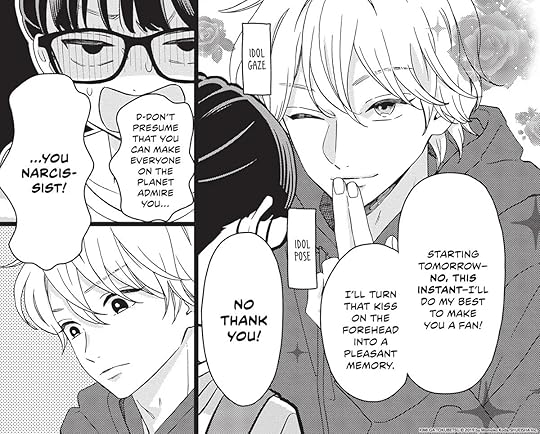
The art style is pleasant to the eyes, but the story is not so new for me. 😅
The art style is pleasant to the eyes, but the story is not so new for me. 😅

January 2, 2026
I felt likeeee... so-so, leaning towards bad about this one. I think our FL is very understandable because it is so, so humiliating to have a public rejection. That can mess with your self-esteem for so many years after that -- it's traumatic. She feels like a real teenage girl to me, in that she's rough around the edges but very good-natured, and she's clearly just in an awkward stage where she's trying to feel things out. She was a pretty well-written character, I thought, even if I found her to be sometimes unlikable.
But at the same time... I just can't get over how much this feels like "I woke up one morning and my mom sold me to One Direction". Literally every normal person x idol story feels like that to me and it makes it so hard for me to enjoy, because I can't suspend my disbelief whatsoever!! It's so wish-fulfillment-y that I can't take it seriously. Not that that's an inherently bad thing whatsoever, but I find these sorts of stories hard to get into personally because that's not a personal wish of mine. It's not a trope I can insert myself into.
Also, they never really confirm the characters' ages I don't think, but they definitely have an age gap (and an obvious life experience gap) that makes me find this whole thing super weird. I would assume that she's 14-15 and he must be at least 20 (he orders a lager from the diner at the beginning of the book, look at me being a detective!). Why is this guy hanging around this girl in high school so much and inviting her over to his condo!? Why is he crying that a high school girl doesn't like him, a grown man!? It's creepy!!! She has homework bro, back off!!!!
Spoilers about the last couple pages of the book:
Final verdict: this isn't necessarily offensively horrible or anything, but I think this story just isn't for me, and the age gap is a problem for me. I actually started this review at a 3-star rating but as I wrote and thought about it more I realized that I actually really didn't like a lot of went on in this. XD
But at the same time... I just can't get over how much this feels like "I woke up one morning and my mom sold me to One Direction". Literally every normal person x idol story feels like that to me and it makes it so hard for me to enjoy, because I can't suspend my disbelief whatsoever!! It's so wish-fulfillment-y that I can't take it seriously. Not that that's an inherently bad thing whatsoever, but I find these sorts of stories hard to get into personally because that's not a personal wish of mine. It's not a trope I can insert myself into.
Also, they never really confirm the characters' ages I don't think, but they definitely have an age gap (and an obvious life experience gap) that makes me find this whole thing super weird. I would assume that she's 14-15 and he must be at least 20 (he orders a lager from the diner at the beginning of the book, look at me being a detective!). Why is this guy hanging around this girl in high school so much and inviting her over to his condo!? Why is he crying that a high school girl doesn't like him, a grown man!? It's creepy!!! She has homework bro, back off!!!!
Spoilers about the last couple pages of the book:
Final verdict: this isn't necessarily offensively horrible or anything, but I think this story just isn't for me, and the age gap is a problem for me. I actually started this review at a 3-star rating but as I wrote and thought about it more I realized that I actually really didn't like a lot of went on in this. XD

December 17, 2022
I received an e-copy of this volume from Netgalley in exchange for an honest review.
So here it is!
This is pretty cute. The synopsis is actually what caught my attention when I was cruising for a new book. See, Sahoko Wakaume made her first (and only) love confession to a beautiful boy back in middle school. He completely and soundly rejected her and she was humiliated. After that she vowed to live her life alone and never fall in love again. Very tween of her. lol Up until she meets Kouta she's kept that vow, often cursing beautiful men, mostly in general, to become fat and bald.
But Kouta Kirigaya is no ordinary beautiful guy. He's part of one of Japan's top boy band, Like Legend and his goal in life is to make everyone smile. So Sahoko inadvertently gets on his radar when she tells him off in her family's diner. But Sahoko is doing her best to keep her defenses up against his shining efforts to win her over. He comes in with albums, concert dvds, etc in an attempt to win her over. He even gives her two tickets to his next concert. and slowly he starts to chip away at her armor...
What did I think?
Well I must say at first I thought Sahoko was still stuck in her middle school mentality, hating pretty boys because one rejected you is a very childish thing to do. But as she moves through this volume I started to think that maybe she was just so incredibly naïve that she didn't know how else to move on from the rejection. Someone literally has to point out another alternative to her trauma and it's like a small revolution happens in her brain. Suddenly she can move forward. Kinda a huh moment for me.
Kouta is the ultimate Asian popstar. He literally will take any criticism to heart and try to change himself to better suit someone else's idea of what he should be. Maybe it's the western thinking I was brought up in, but it annoyed me how he would let an offhanded jeer from a total stranger alter who he is as a person. It's like he's trying to be putty for everyone to mold to keep them happy instead of just trying to be a better person because that's what he wants for himself. He wants to make everyone else smile (or he said something to that effect). Overall that makes him a nice guy, I guess, that he's always trying to make other people happy. But how exhausting.
And then there's a minor twist at the end. I figured that one was coming.
The art itself is very well done. I liked the author's style and the pretty boys are VERY pretty. lol
Conclusion
Super cute! Great artwork. Reminds me a little of that anime about the track girl getting a job as a manager in training for the rising boy band duo...only I can't remember the name... but no matter.
I loved this and can't wait to get my hands on the next volume!
So here it is!
This is pretty cute. The synopsis is actually what caught my attention when I was cruising for a new book. See, Sahoko Wakaume made her first (and only) love confession to a beautiful boy back in middle school. He completely and soundly rejected her and she was humiliated. After that she vowed to live her life alone and never fall in love again. Very tween of her. lol Up until she meets Kouta she's kept that vow, often cursing beautiful men, mostly in general, to become fat and bald.
But Kouta Kirigaya is no ordinary beautiful guy. He's part of one of Japan's top boy band, Like Legend and his goal in life is to make everyone smile. So Sahoko inadvertently gets on his radar when she tells him off in her family's diner. But Sahoko is doing her best to keep her defenses up against his shining efforts to win her over. He comes in with albums, concert dvds, etc in an attempt to win her over. He even gives her two tickets to his next concert. and slowly he starts to chip away at her armor...
What did I think?
Well I must say at first I thought Sahoko was still stuck in her middle school mentality, hating pretty boys because one rejected you is a very childish thing to do. But as she moves through this volume I started to think that maybe she was just so incredibly naïve that she didn't know how else to move on from the rejection. Someone literally has to point out another alternative to her trauma and it's like a small revolution happens in her brain. Suddenly she can move forward. Kinda a huh moment for me.
Kouta is the ultimate Asian popstar. He literally will take any criticism to heart and try to change himself to better suit someone else's idea of what he should be. Maybe it's the western thinking I was brought up in, but it annoyed me how he would let an offhanded jeer from a total stranger alter who he is as a person. It's like he's trying to be putty for everyone to mold to keep them happy instead of just trying to be a better person because that's what he wants for himself. He wants to make everyone else smile (or he said something to that effect). Overall that makes him a nice guy, I guess, that he's always trying to make other people happy. But how exhausting.
And then there's a minor twist at the end. I figured that one was coming.
The art itself is very well done. I liked the author's style and the pretty boys are VERY pretty. lol
Conclusion
Super cute! Great artwork. Reminds me a little of that anime about the track girl getting a job as a manager in training for the rising boy band duo...only I can't remember the name... but no matter.
I loved this and can't wait to get my hands on the next volume!

November 12, 2023
Bufff un shojo d'institut amb una premissa un pèl problemàtica i poc interessant al meu parer... Una noia amb un trauma amorós que li ha provocat un odi visceral cap als homes atractius (perquè els considera superficials i privilegiats) està decidida a no enamorar-se ni ser fan de cap idol. Tot canvia quan el líder del grup preferit de la seva amiga apareix al restaurant familiar i mostra una actitud propera i amable. El noi li intenta fer veure que és bona persona, ella se n'acaba enamorant i al final ell acaba repetint les paraules que deia la noia al principi, és a dir, que no s'enamorarà mai de ningú. Em sembla un final patillero per allargar el xiclet, del tot incongruent amb el comportament dels personatges... Passo de continuar :/

February 18, 2023
Thank you Netgalley and Viz Media for the ARC! My Special One is a romantic comedy about Sahoko Wakaume, a high schooler who has sworn off love and Kouta Kirigaya the JPop star who shakes up her world and her heart. This is a sweet series sure to please romance shojo fans. The first volume gives just a taste of the romance and complications sure to come.

January 3, 2023
I received an eARC courtesy of VIZ Media LLC via NetGalley in exchange for my honest review.
As entertaining as I would expect from this genre. Predictable? Yes. Charming? Yes.
For Libraries: Would undoubtedly find some fans that are looking for more Shojo manga. YA suitable
As entertaining as I would expect from this genre. Predictable? Yes. Charming? Yes.
For Libraries: Would undoubtedly find some fans that are looking for more Shojo manga. YA suitable

January 10, 2024
A story that seems like a common trope! But actually runs a bit deeper than that.
This manga was complicated, and left me shocked multiple times. It moved quickly, which fit the narrative and also was a pleasing pace.
I would remove a star because I feel like in a few areas it wasn’t realistic, and was a bit unbelievable? But I think it all makes for a good story nonetheless! Definitely left a strong cliffhanger and I can’t wait to dive into volume 2!!
This manga was complicated, and left me shocked multiple times. It moved quickly, which fit the narrative and also was a pleasing pace.
I would remove a star because I feel like in a few areas it wasn’t realistic, and was a bit unbelievable? But I think it all makes for a good story nonetheless! Definitely left a strong cliffhanger and I can’t wait to dive into volume 2!!
September 29, 2024
I really liked My Special One. It was sweet, a little cringy (and wouldn’t happen) but I liked how the two main characters interacted with each other. The MC is relatable and you want to cheer on.
A nice break from other reading. I probably will read more of the series.
A nice break from other reading. I probably will read more of the series.

December 19, 2023
ahhhh this was so cute! It was such a great start to a new series! I can't wait to read more!!
January 29, 2024
Very good set up. Like the character’s vibes! Although, at times there were cliches I would recommend for a fun and cutesy read. 😊

February 25, 2024
cute! might read more, might skip it and spoil the ending!

September 6, 2024
I didn't like that there was so much miscommunication in this volume.

April 25, 2025
Is this your 10/10 shōjo manga like yona of the dawn, basara or queen's quality? Hell no. However, let's be real. Remember our prime teenage days? That one boyband you were totally into, and that one guy in that band you read fanfics about? No one? Just me? Oh well this is giving me all the nostalgia to those self insert fanfic days and i am here for it.
May 13, 2023
this is the one!!!
Wow!!! Mangaka Momoko Koda is a legend!!! She’s so talented and not afraid to really dig deep into her characters flaws and what truly motivates them. All I can say is that I’m loving this series so far. It’s funny. It’s smart. It has two very endearing main characters and likable secondary characters as well. Sahoko is probably my favorite type of character. She’s a pessimist who is very self aware, but she’s still just a teenage girl. She’s gonna eventually crush again and crush hard! I love how she prays for all handsome and arrogant men to become fat and bald lol!!!
Kyouto is really really cute!! He’s adorable. He makes me smile and laugh. His emotions are so BIG!!! Can’t wait to see what his backstory is. I really like Sahoko’s bestie so I’m hoping Yuko plays a bigger role in the next volume. Also Kyouto’s band mate Kanato is a hoot!! I had so many favorite lines from this entire volume, but my most favorite one was when Kanato tells Sahoko “I’m bored of messing with you. Nap time!” And then proceeds to fall asleep lol!!!
There’s definitely something going on with our two leads. Even though Kyouto is a national icon he seems to always go out of his way for Sahoko. Giving her the push she needs to do her best. But she wants to do her best at getting him to see her as a love interest not as a fan.
These two are so funny when they’re on the same page together. Their banter and chemistry is fantastic!!! Not gonna lie, that little turn at the end of this volume that took this story from funny and pretty lighthearted to a dark somber tone was jaw dropping and I’m officially hooked folks. Cause I gotta know what happened!!!! Just this mangaka is so good at what she does!!!!
Wow!!! Mangaka Momoko Koda is a legend!!! She’s so talented and not afraid to really dig deep into her characters flaws and what truly motivates them. All I can say is that I’m loving this series so far. It’s funny. It’s smart. It has two very endearing main characters and likable secondary characters as well. Sahoko is probably my favorite type of character. She’s a pessimist who is very self aware, but she’s still just a teenage girl. She’s gonna eventually crush again and crush hard! I love how she prays for all handsome and arrogant men to become fat and bald lol!!!
Kyouto is really really cute!! He’s adorable. He makes me smile and laugh. His emotions are so BIG!!! Can’t wait to see what his backstory is. I really like Sahoko’s bestie so I’m hoping Yuko plays a bigger role in the next volume. Also Kyouto’s band mate Kanato is a hoot!! I had so many favorite lines from this entire volume, but my most favorite one was when Kanato tells Sahoko “I’m bored of messing with you. Nap time!” And then proceeds to fall asleep lol!!!
There’s definitely something going on with our two leads. Even though Kyouto is a national icon he seems to always go out of his way for Sahoko. Giving her the push she needs to do her best. But she wants to do her best at getting him to see her as a love interest not as a fan.
These two are so funny when they’re on the same page together. Their banter and chemistry is fantastic!!! Not gonna lie, that little turn at the end of this volume that took this story from funny and pretty lighthearted to a dark somber tone was jaw dropping and I’m officially hooked folks. Cause I gotta know what happened!!!! Just this mangaka is so good at what she does!!!!

February 22, 2023
I was looking forward to this one, it just sounded really cute and fun. But after reading it, I’m not sure what my feelings on it are. I do like the main girl, although for someone who had a bad experience with a pretty boy and swore them off for life, fell in love the idol too quickly. It was in either chapter 2 or 3 (can’t remember which). The idol boy reminds me of Tamaki Suoh from Ouran High School Host Club. I never hated him but he wasn’t my favourite host club member, so while I don’t hate him and while I do respect some of the things he does, he’s not one of my favourite shojo male leads. I really liked Sahoko’s best friend. She’s so supportive and seems like a fun person to be around. I was having fun with the story but then the ending was a downer and now I’m not in a hurry to read vol. 2 when it comes out. I will probably read it but not anytime soon.
Overall, it sounded like a fun idea but the execution wasn’t 100% what I was hoping for. I still had fun during some parts but like I said above, I’m not sure how I feel about this volume, which is why I rated it 3 stars. I really wanted to buy the book because the cover looked so cute but now I’m not too sure.
Blog: nazreads.ca
Twitter: Naz_readsanime
Instagram: nazreads01, nazcosplay, nradesigns, charmedanimegirl01
Overall, it sounded like a fun idea but the execution wasn’t 100% what I was hoping for. I still had fun during some parts but like I said above, I’m not sure how I feel about this volume, which is why I rated it 3 stars. I really wanted to buy the book because the cover looked so cute but now I’m not too sure.
Blog: nazreads.ca
Twitter: Naz_readsanime
Instagram: nazreads01, nazcosplay, nradesigns, charmedanimegirl01

June 2, 2023
This is a romance manga that's in a hurry. Sure, it's obvious that the grumpy main character is going to eventually change her mind about romance and fall in love with the sunny pop idol, but did it have to happen halfway through the first volume? She goes from wishing baldness on every attractive guy in the world at the beginning of the book to a heartfelt declaration of love at the end, and this is not a long volume. Aside from feeling rushed, both of the main characters left a bad taste in my mouth. She's not just cynical about love, she's downright meanspirited. He's not just sunny, he has a nearly pathological need to be liked. They both come across as dangerously unstable, and it's very shaky ground for any kind of romance.

September 26, 2025
Ahh this was so fun to me. She was HILARIOUS in parts. When her new years wish was that hot guys get bald and get ugly. Chefs kiss. Then she immediately falls for a hot guy. Has one of my fav micro troupes, the nose bled cause person is so hot.
She does become a little cryie I prefer her over the top ridiculousness and I kind of wish he fell first butttt I liked it. On to borrow more from the library.
3.5
She does become a little cryie I prefer her over the top ridiculousness and I kind of wish he fell first butttt I liked it. On to borrow more from the library.
3.5

August 3, 2023
Sahoko is adorable, and I feel so sad for her with what happened to her previously with a relationship. Kouta is way too nice, like it seems he's flirting, but he's just super nice. So far, I've really enjoyed it, and the ending really adds such drama and intruege for the next volume!

August 14, 2023
I really struggled with this one, it just wasn't my cup of tea at all and I thought the main character fell in love way too quick and she wasn't the best person to be honest. I don't think I'll continue the series.

March 9, 2023
Another generic shoujo series. This time the main character says she hates all men and will never fall in love yet she fall in love with an idol super quickly about halfway through this book!
Displaying 1 - 30 of 135 reviews