A story of four lost souls - the beautiful Roslyn who has never belonged to anyone or anthything, and three other misfits who roam the open land existing on the little money made from riding in rodeos - who meet in Reno to discover that freedom has its price, and the heart its rules.
Works of American playwright Arthur Asher Miller include Death of a Salesman (1949), for which he won a Pulitzer Prize, and The Crucible (1953).
This essayist, a prominent figure in literature and cinema for over 61 years, composed a wide variety, such as celebrated A View from the Bridge and All My Sons, still studied and performed worldwide. Miller often in the public eye most famously refused to give evidence to the un-American activities committee of the House of Representatives, received award for drama, and married Marilyn Monroe. People at the time considered the greatest Miller.
É uma história concebida como um filme e todas as suas palavras têm o fim de indicar à câmara de filmar o que deve ver e aos actores o que têm a dizer.
Depois de terminada a leitura, acho que valerá muito mais ver o filme com Clark Gable e Marilyn Monroe.
Ezek a fickók jól megértenék magukat Móricz pusztai csámborgóival. Állnának egymás mellett, arcuk szélről-naptól cserzett, ráncaikba belegyógyult már a por. Néha mondanának egymásnak valamit a marhákról, a lovakról vagy az esőről, de különben hallgatnának nagyokat. Elnéznének a messzeségbe, és arról elmélkednének magukban, hogy azok a városi nők, nos, azok huncut egy fajták. Nem lehet megérteni őket, de a szaguk: az jó. És időnként egymásra sandítanának, hogy a másik is ugyanarra a városi nőre gondol-e. Ez a pillanat, ez az egymásra tekintés - alighanem ez a konfliktus.
(Van az a szabály, hogy ha egy könyvborítón van egy pisztoly, akkor annak el is kell sülnie. Tegyük hozzá, ez a szabály a RaRe sorozat esetében nem feltétlenül érvényes. A RaRe sorozat könyvborítói ugyanis alkalmasint olyan borítótervezők produktumai, akik túl sokat ittak gyógyszerre, és ezért elkezdték kortárs montázsművésznek tekinteni magukat.)
Always loved the John Huston film of the same name. The characters here are abit flat at times so I do think the film is better, but I still love the story.
Description: A story of four lost souls - the beautiful Roslyn who has never belonged to anyone or anthything, and three other misfits who roam the open land existing on the little money made from riding in rodeos - who meet in Reno to discover that freedom has its price, and the heart its rules.
Because of this wonderful enounter, I had a real urge to watch the full film.
”Accidenti a tutto. È tutto cambiato. Tutto quanto distorto. Hanno sporcato tutto di sangue, lo hanno trasformato in denaro e merda come tutto il resto. Lo sai tu e lo so io, Guido. È come prendere al laccio un sogno, ormai.” Il mito fondativo del sogno americano si sgretola e trascina con sé ruoli e identità; i grandi spazi, la libertà, la natura, sono entità addomesticate e ormai illusorie, e può essere la fragilità di Roslyn-Monroe a diventare la voce interiore che mette in crisi senza offrire alternative, se non un po’ di umanità. Gran libro, che sa essere anche molto duro e spietato. La post-fazione di Nicola Manuppelli aggiunge spunti interessanti per inquadrare l’opera.
Awful. Only read it to the end because I'm stubborn. At least I can now say that I don't like cowboy stories. Should have read The Crucible as that was the Arthur Miller script I'd heard people harp on about the most.
I found the characters hard to relate to, the descriptions clichéd and the story as a whole a bit wet.
Reno, Nevada is where marriages go to die. In effect, part of the divorcees' lives die as well. This novella/script is about broken people trying desperately to find matching parts to feel whole again.
If you didn't know, The Misfits was written for the screen by Arthur Miller for his then wife Marilyn Monroe to star in. But there's more. Miller was bored and married when he first met Monroe at a Hollywood party; smitten, he obsessed over Monoroe when he went back to his wife to continue his dull life. After an unpleasant divorce, Miller, the lucky bastard, married Monroe. While Miller was finishing The Misfits, it became apparent Monroe's severe behavior was beyond repair and divorce would inevitable. Thus, there's a layer of doom coating almost all of the story.
Unsurprisingly, the writing is great. It's a strange brew of a play with elements of both a novel and film-making notes. The story follows Roslyn (Monroe) freshly divorced in Reno and meeting three men: Gay (yep, that's his name), an old cowboy who has little use for long-term relationships, but swears he's found a match in Roslyn (though Roslyn is unsure she sees it in him). Guido, a desperate lonely old man everyone presumes is an innocent grandfatherly type. Perce, a young rebellious cowboy heading down Gay's road in life, unless Roslyn is his fork in the road.
The methodical character revelations and clashes are the soul of the story. At times the symbolism (the lonely house in the barren desert, the "misfit" mares of no use) are heavy-handed. Maybe I read too much frustrating literature like Faulkner, but I really enjoyed picking up on metaphorical clues easily for once in my life.
I've never been through a divorce, but if (or "when," knowing me!) I would consider The Misfits as therapeutic reading. It's important in a historical sense given AM and MM's lasting legacy. It's maybe the only part novella/script/play in existence. Plus, you can compare it to the esteemed film. All that in a cozy 100 pages.
On a pure reading of “The Misfits”, it doesn’t particularly stand out, especially when placed in Arthur Miller’s impressive catalogue. But read in its context, it is perhaps one of his most fascinating pieces of work in his career.
First and foremost, it is not a play, nor was it ever intended to be one. “The Misfits” was a screenplay written specifically by Miller for his then-wife Marilyn Monroe during a metamorphic turn in her career to become something more than the blonde-bombshell roles she was known for during the 1950s. This screenplay however was expanded by Miller to fill in the gaps with descriptions and emotion that would’ve otherwise been left unsaid initially in a screenplay. The result is this amalgamation of a novel that doesn’t read like a novel, nor as a screenplay; and at times, this alloy of a story hinders its momentum and things might not have meshed as well as it could have done.
Individual aspects of the story though were quite stellar. Lost misfits wander in the confluence of societal capitalism and the untamed wild in search for meaning to their lives, with the use of pathetic fallacy being particularly poignant. Roslyn and Gay each had strong arcs, but when you know that they were Marilyn Monroe’s and Clark Gable’s final roles, it generates a tinge of tragedy to their characters’ final journey. If you’re a fan of either Monroe or Gable, go watch the final scene of the movie as a fond farewell to these great actors.
Favourite quote? “Roslyn: “How do you find your way back in the dark? Gay nods, indicating the sky before them: “Just head for that big star straight on. The highway’s under it; takes us right home.””
Favourite moment? Roslyn’s emotional outburst and calling them out.
Since it's a novalisation of a movie, it does take a few pages to get a grip with the way it's written. It's a mixture between script, a novel, and extensive description. But once you do, it's amazing!! It's definitely one of those books that while I was reading it, I thought it would be perfect for Alevel students. There's so much to analyse !
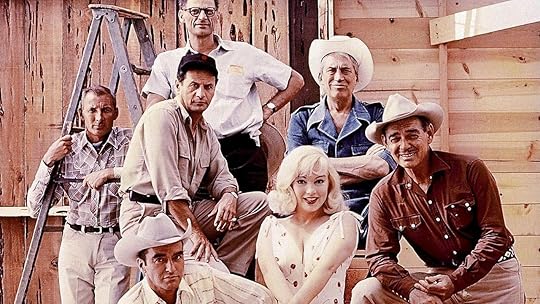
I just recently discovered this book., and I am so glad I did. It's the story of the making of the film "The Misfits" by Arthur Miller and Serge Toubiana. "The Misfits" has been my favorite film for many years. It is also the last completed film with Marilyn Monroe and Clark Gable, who had a heart attack the day after shooting was complete. The making of the film was photographed by world renowned photographers working for Magnum Studios under an exclusive agreement with the producer, Frank Taylor. This alone was very unusual and contributes to the mystique of this film.
This is a very engaging book about a classic film that was documented with fascinating photos. A very haunting film that was produced in black and white when most major films were in color. This was Marilyn's chance to prove herself as a dramatic actress, and she succeeded brilliantly at great cost to herself and her marriage to Arthur Miller. Clark Gable considered this his best performance.
invoking a cliché expression but it's the best way to describe this story: so bleak but so beautiful!
a western 'noir' of sorts, miller's story of atomised souls clawing (or more accurately, fumbling) in the dark for a chance of attaining the ever elusive concept of 'freedom' amidst the backdrop of a society dominated by the continued threat of "wages" (wage labour) is striking memorable. miller delves deep into the lives of people who resist the the undesirable normalcy mandated by capitalism—however, the famous cowboy trio (and roslyn) are not painted not as heroes, villains or anti-heroes like we see in the traditional western mythos, but merely as people without a place in the frenetic onslaught that is capitalist life. there's a deceptive simplicity to this story, an elegiac undertone to the lazy unfolding of quotidian events (and most notably by the haunting stare of montgomery clift in the film).
i do prefer how the film focuses more on roslyn's perspective, and find it to be more fascinating overall, but this is a still a great short story from miller.
I'm not sure what came first, the movie or this piece. "The Misfits" isn't exactly a novel, it is more of an enhanced screen treatment. Reading it is like being a camera where all is shown and heard without a singular point of view in terms of character but rather in terms of a lens eye. It took some getting used to.
The action is in pre-no-fault-divorce Reno where there are still cowboys roaming around and divorcee's roaming around them. Gay is in the Sam Shepherd/Elliott role, Roslyn is the obviously Marilyn Monroe role. Two other characters serve to move the plot, Guido - a cowboy/pilot who runs around with Gay, and Pearce - a young roustabout/rodeo cowboy.
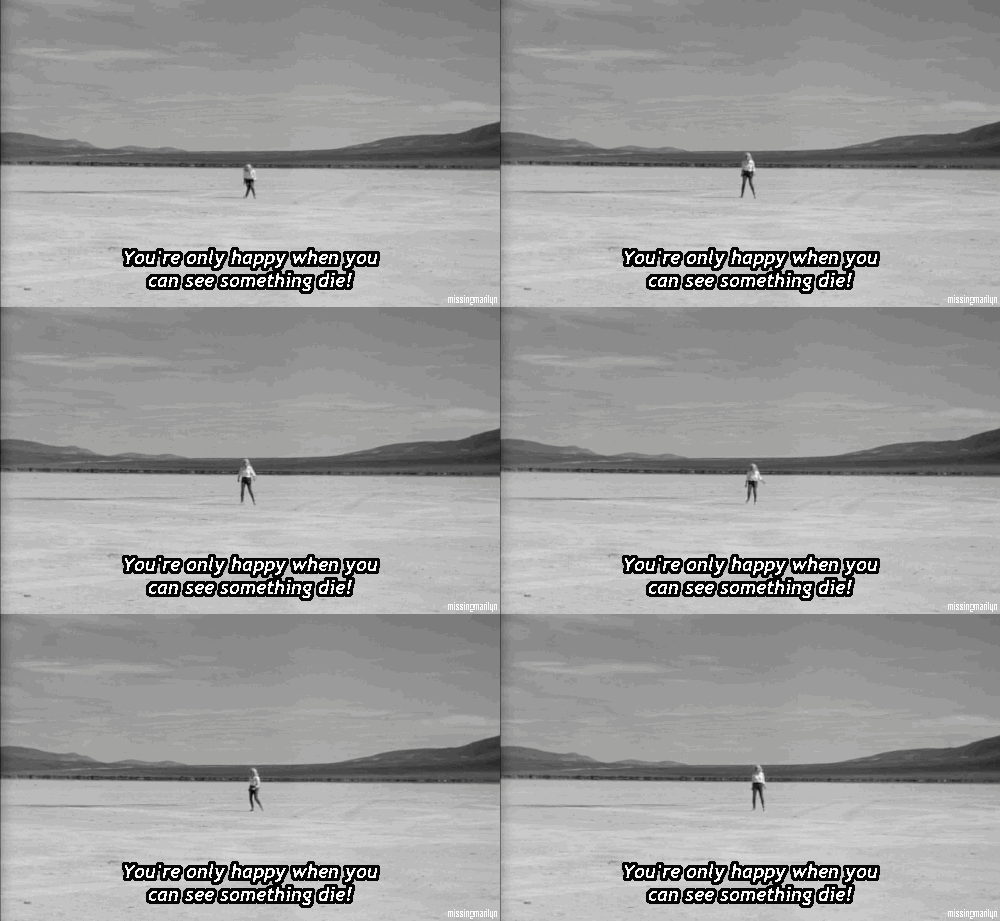
2.5 stars. Miller is upfront in his introduction that this isn’t meant to be a work of fiction, much less a play or screenplay, but rather a film scenario. As such, it’s often underdeveloped in parts, although occasionally it has some stellar descriptions and one memorable line: “Honey, nothin’ can live unless something dies.” It’s the first work I’ve read from Miller that underwhelmed. I’m glad he stuck (mostly) to writing plays. It also didn’t help that I knew the plot from seeing the film, even though it was a couple decades ago.
Miller scrisse questo testo appositamente per Marilyn, per darle un ruolo drammatico diverso da quelli cui lei era abituata. Sarà la sua ultima pellicola, prima di morire, il 4 agosto 1962, per un’overdose di barbiturici. Il libro non è una sceneggiatura e nemmeno un romanzo, ma è un’opera fondamentale. Dentro c’è il grande conflitto uomo-natura, ribellione-sicurezza, familiarità-estraneità della letteratura americana ed è espresso ad altissimo livello. Racconta un modo di essere, selvaggi, spostati, vagabondi, ultimi di un branco, desolati, solitari, in cerca di amore e affetto nella vita.
Roslyn: "You sure know a lot, don't you, Pilot?" Perce shakes his head. Guido: "Oh, astronomy's all in the library books. Nothin' to it but reading." Roslyn looks up at the sky. "Still, it's wonderful to know things." "You got something a lot more important." "What?" Guido, glancing up at the sky: "That big connection. You're really hooked in; whatever happens to anybody, it happens to you. That's a blessing." Roslyn, laughing: "People say I'm just nervous." "If there hadn't been some nervous people in the world, we'd still be eating each other."
Es interesante cómo cada personaje tiene motivaciones distintas pero los une un afán de libertad. Me gustó la trama, los diálogos y los personajes pero el final, ¿por qué ese final?
I chose to read this book as Marilyn Monroe is an iconic figure I love, but also because I love the band the Misfits (I got to see them play live this year in April!) and the frontman took the name of the band from this film, so I figured as a fan I'd read it and watch it.
I somehow managed to read the first half of the book very quickly (one day), but the rest of the book just dragged for me, and I'd read a few pages per day because I'd get so bored with it. I didn't see the point of the story, and perhaps, it will be better as a film as this was written with the intention of being translated into film rather than as a novel to be read, but I've also heard that the film was not successful (not that that necessarily means anything, as many things of a creative nature weren't successful for their time but are now!). Still, I'll be watching this soon, and I hope hope hope it exceeds my expectations, because gosh darn the book sucked.
Yes, I guess "The Misfits" is a decent story (the movie is terrific) but the only reason I can think of to read this book is for his short story, "Please Don't Kill Anything," which is apparently about Marilyn. Short, simple, sad, and indelible.
Miller writes lovingly about the frailty and humanity of his wife, MM. Too bad that the marriage was over before they could finish the film. He goes on to find love and happiness while MM od's soon afterward. Very sad.
An vielen Stellen hat man gemerkt, dass Arthur Miller es als Film im Kopf hatte, weil es sich oft liest wie ein Drehbuch mit Regieanweisungen. Roslyn, den Kopf lachend zurück werfend: "Oh Gay...!" Guido weiß, dass es vorbei ist. Er hat den Blick eines Mannes, der das Ende vor Auge hat. Etc. Normalerweise bevorzuge ich mehr Show und weniger Tell und das Buch ist eigentlich 100% Tell. Aber ich fand es sehr interessant und auch nicht störend, weil man es dadurch wirklich wie einen Film im Kopf hatte. Man ist irgendwann sehr unmittelbar und abrupt darin. Die Geschichte fand ich in der zweiten Hälfte sehr verstörend. Das Rodeo, die Mustangjagd, und wie kaputt Perce gemacht wird... Roslyns andauernder Schockzustand, Guidos unangenehme Annäherungsversuche, die um sich schlagenden Pferde und Gays zunehmende Hilflosigkeit und Desillusionierung mit seinem ganzen Leben. Das raue, harte und vor allem vollkommen zynische abgestumpfte Leben der Cowboys fand ich am schlimmsten. Das alle einem Ideal nacheifern, was es gar nicht mehr gibt (und auch vermutlich nie gegeben hat) und am Ende einfach grobe, abgestumpfte Typen sind, deren Körper zerschlagen sind, die die meiste Zeit besoffen, verletzt und obdachlos zubringen und die brutal mit Tieren umgehen. Roslyn wirkte dazwischen wirklich wie eine unglaublich zarte, empfindsame Blume, die einfach... zerquetscht und desillusioniert wird und ich wollte sie ganz oft einfach nur in eine Decke wicken und weit wegbringen.
Ich bin etwas zwiegespalten was die Beziehung zwischen Gay und Roslyn angeht, weil mir die Auflösung ihres eigentlich doch unüberwindbaren Konfliktes einfach zu schnell ging.
Außerdem fand ich interessant, dass Perce so eindeutig "schwul" kodiert wird - also ohne dass es je explizit gesagt wird, natürlich, das Buch ist immerhin aus den frühen 60ern. Aber es wird so oft betont wie er und Roslyn bonden, weil sie Gay beide "gleich" ansehen, und es wird von seiner "widerspenstigen Zärtlichkeit" gegenüber dem älteren Mann geredet etc. Und er betet Roslyn ganz offensichtlich an und sie findet ihn auch ganz entzückend, aber es ist von vorne herein super platonisch und es wird nie auch nur angedeutet, dass da andere Gefühle sein könnten. Gay ist ja auch auf jeden Mann eifersüchtig, der in ihrer Nähe ist - aber nicht auf Perce. Was ein krasser Kontrast ist zu allen anderen Männern der Geschichte, die Roslyn ALLE begehren. Er war so eine unglaublich kaputte Seele und ich hätte gerne gewusst was am Ende aus ihm wird. (Aber der Komik, dass der raue, grobe, ultramännliche Gay eben "Gay" heißt und dann nennt er seinen Sohn auch noch "Gaylord" konnte ich mich nicht ganz entziehen.)
Insgesamt ein faszinierendes, aber auch sehr deprimierendes Buch, trotz des "Happy Ends" was irgendwie sehr ... erzwungen war. Ich hätte es passender gefunden wenn am Ende alle einsam und desillusioniert auseinander gehen.
"The Misfits" by Arthur Miller is a timeless exploration of human frailty and the search for connection in a world that often feels disconnected and chaotic. Set against the backdrop of the Nevada desert, Miller crafts a poignant narrative that delves deep into the hearts and minds of his characters, exposing their vulnerabilities and desires with raw honesty.
At its core, "The Misfits" is a character study, focusing on a group of individuals who, despite their outward toughness, are struggling to find their place in the world. From the emotionally scarred divorcee Roslyn to the aging cowboy Gay Langland, each character grapples with their own demons, searching for meaning and redemption in a world that seems intent on crushing their spirits.
Miller's writing is both lyrical and haunting, capturing the harsh beauty of the desert landscape while also delving into the inner turmoil of his characters. Through their interactions and conflicts, he explores themes of loneliness, alienation, and the desperate need for human connection.
One of the most striking aspects of "The Misfits" is its portrayal of gender dynamics and the ways in which societal expectations shape the lives of its characters. Roslyn, in particular, emerges as a symbol of female empowerment, challenging traditional gender roles and asserting her independence in a male-dominated world.
But beneath its surface, "The Misfits" also grapples with deeper existential questions about the nature of existence and the search for meaning in a seemingly indifferent universe. As the characters confront their own mortality and grapple with the futility of their actions, Miller forces us to confront our own existential anxieties and the fleeting nature of human existence.
Ultimately, "The Misfits" is a powerful meditation on the human condition, exploring the complexities of love, loss, and the struggle to find meaning in a world that often feels meaningless. Miller's masterful storytelling and rich character development make it a timeless classic that continues to resonate with readers today.
'Benvenuti a Reno, la più grande piccola città del mondo' - Insegna sulla Main Street
'Brindiamo al Nevada, lo stato del 'lascia'. Hai dei quattrini per fare scommesse? Li lasci qui. Hai una moglie di cui vuoi sbarazzarti? La molli qui. Hai una bomba atomica in più? La fai scoppiare qui. A nessuno importa un accidente' - Isabelle / Thelma Ritter
'Quei cavalli non sono altro che degli spostati, dei vagabondi, una razza destinata a sparire, ecco tutto, tesoro' - Gay /Clark Gable
- Stringe i pugni, urla verso i loro volti: "bugiardi!" [..] "Voi sapete tutto tranne che cosa significa essere vivi" ' - Roslyn / Marilyn Monroe
I don’t think I’m objective when talking about Arthur Miller writing. It’s interesting while looking at his relationship with Marilyn and the character of Roslyn. It’s was a bit hard at the start and I found the writing a bit unbalanced. But with the help of the movie my curiosity was up. I advice reading the book and watch the movie at the same time. The book give some insight maybe not translated by the acting. And the movies gives an overall view and does help make sense of everything going on. It’s dated, both in the movie and book. It’s definitely from it’s time. Overall I think I only like some tiny things here and there. The only highlight are made by the link of Marilyn Monroe.
Labai daug pirmų kartų sutelpančių tokioje mažoje knygelėje - JAV, kaubojai ir 60-ieji. Labai įdomi sintaksė, nes visgi knyga parašyta Amerikoje, kuomet viskas buvo daug kitaip. Istorijoje ryškiai jaučiama lyčių nelygybė, bendras subjektyvumas, minimos (istorinės?) akimirkos, kurios, darau prielaidą, jau retenybė šiandienos Amerikoje. Teko internete ieškoti kelių žodžių reikšmę, net šiuolaikinėje kalboje jie yra pakeisti į kitus žodžius. Nežinojau nieko apie knygą, apie rašytoją, apie filmą, kaip čia susipina Marilyn Monroe, tačiau leidau sau pradžiai perskaityti filmą ir tik dabar žiūrėti filmą, kad vizualiai suprasčiau kuo gyveno visi šie žmonės tuo metu.
Pretty chuffed to now own a copy of this Penguin Books, first edition of Arthur Miller's haunting classic, The Misfits (1957). Miller wrote the short story and subsequent screenplay for the 1961 film of the same name, staring his wife Marilyn Monroe. Ironically the themes of disillusionment, loneliness, and failed individuality perfectly mirror the lives of the films three major stars at the time of filming: Monroe, Clark Gable, and Montgomery Clift still healing from his devastating car crash. The making of this film is a story in and of itself, the crux of which Miller based his final play, Finishing the Picture (2004).
Millers own thoughts with those of the official photographers on the set of the film. Pictures telling stories beyond the words of the troubled shoot and final film. The long shadows of Monroe, Gable and Huston dominate.