UNA NOVELA GRÁFICA SOBRE LA INFANCIA DE BEETHOVEN Y SU PECULIAR FAMILIA.
Ludwig van Beethoven fue un artista hecho a sí mismo, creador de una música que, a día de hoy, sigue conmoviéndonos. Pero ¿quién fue el joven Ludwig, antes de convertirse en Beethoven? Nacido en el seno de una familia humilde de Bonn, el pequeño “Luddi” tiene que afrontar desde tierna edad una vida difícil, dirigida con ritmo despótico por un padre alcohólico y endeudado, que quiere sacar partido de su talento en bruto y le exige una y otra vez que deje de componer sus propias piezas, y que toque al piano únicamente lo que se espera de él... Mikael Ross ha imaginado al joven genio tomando como referencia los diarios reales que escribieron los Fischer, los vecinos de los Beethoven en Bonn, que ofrecen un retrato atípico de la disfuncional familia que habitaba la vivienda de arriba y que sin embargo alumbró a uno de los mayores genios de la Historia. El resultado es una experiencia inmersiva y fascinante, a medio camino entre el drama social y el humor.
Mikaël Ross is as great a writer as he is an artist. Beethoven's younger years were rough, and yet Ross manages to inject his script with the exact right amount of comedy and pathos. His art can be cartoony, but works perfectly to illustrate the story. Beethoven's face is perpetually grumpy, making him both sweet and arrogant at the same time - a child with genius-level talent.
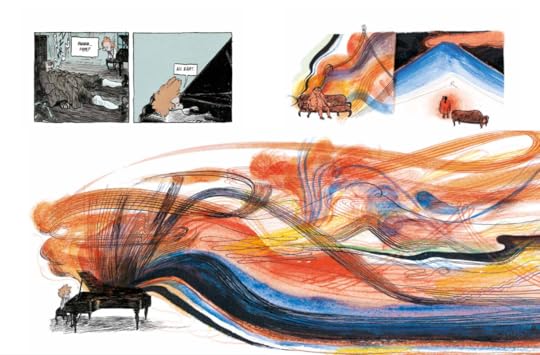
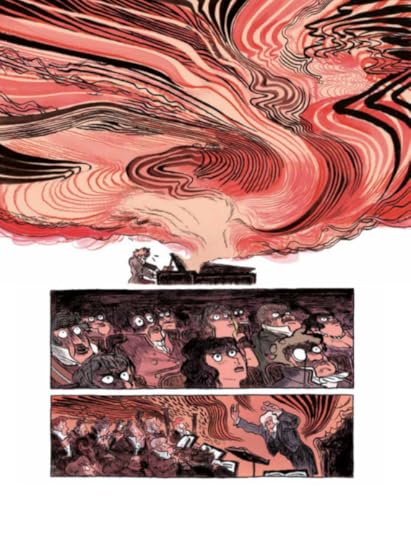
It's also one of the few books on music, that finds a satisfying way to depict the stunning music.
Highly, and I mean highly, recommended.
(Thanks to Fantagraphics for providing me with an ARC through Edelweiss)
Golden Boy is a warts and all portrayal of Beethoven's childhood up to the point that his first piece is performed before an adoring crowd. As he is taking a well-earned bow, Mikael Ross portrays the aggrieved buzzing in Beethoven's ears - and then the book ends. That's sort of an example of the entire experience of Golden Boy: each good thing in Beethoven's life is accompanied by a burden.
It's remarkable that he composed anything worthwhile, at least based on this book. It's a great read, though, often fun and fascinating, even when it's gloomy and shocking. The art in particular, while not gorgeous, exactly matches the rushed, uncomfortable life that Beethoven leads. Not five stars (because I suspect it won't stick with me), but close.
Update: I'm still thinking about this book a few weeks later - let's give it five stars.
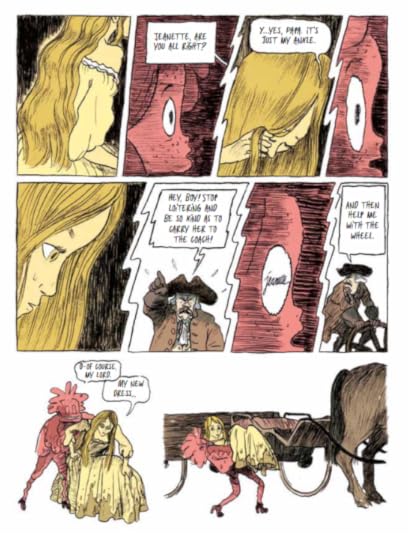
Ne vous attendez pas ici à une biographie de Beethoven, ou à une sorte d’hommage exhaustif, mais bien à une plongée fascinante et immersive, entrecoupée d’ellipses temporelles, dans la vie d’un enfant prodigue devenu un artiste en proie aux doutes, et à un mal-être physique et mental parfaitement saisi et illustré par Mikael Ross. Un auteur/illustrateur possédant un style fougueux très expressif et quasi caricatural, un peu à la Joann Sfar, que l’on appréciera ou non, mais qui ne laissera personne indifférent, à l’image du très grand Ludwig van Beethoven, qui, grâce à sa passion, réussira à réconcilier Ludwig avec Beethoven.
So, generally speaking, I have a bit of a bone to pick with comics about famous artists/people/events because it’s a bit of a crutch for a medium that struggles with ‘respectability’ to borrow said respectability from their chosen subject when they should in my opinion insist on their own respectability tout court.
That opinion notwithstanding, this book is, actually, really, really, really good. Both the writing and the art are fantastic (a rare achievement in comics where usually either one or the other is lacking), and I say that as someone who never spent much time thinking about ‘genius,’ classical music, or, indeed Beethoven himself (I’ve started listening now though!). I never thought I would enjoy this book, due to its subject matter (and because I assumed it would go down the two routes most comics biographies go which is either nauseatingly laud their genius and superduper specialness or go the annoyingly predictable edgy route and instead show what a problematic alcoholic/depressed/etc person they actually were) but Ross’ writing made me just understand and be curious about Beethoven and care about him. He is also a great cartoonist and the characters’ design, body language and acting is over the top without ever being tiring, distracting or silly (except when it’s meant to be). It only adds to the story. I found myself near or in tears a full THREE times while reading this, which very rarely happens with comics for me, and laughing out loud even more often.
Ich glaube nicht, dass das mein Lieblingscomic von Mikael Ross ist, aber umgehauen hat es mich dennoch. Was für ein Zeichner. Und auch Erzähler, dieser Comic gehört zu den besten Darstellungen von chronischer Krankheit, die ich kenne.
A singular vision that pairs a strange and humorous narrative of Beethoven's young life with an engrossing, unique style of cartoon-y art. Memorably weird.
Golden Boy written by Mikael Ross is a graphic novel of Ludwig Beethoven’s young life and his introduction to the public eye. Throughout Beeethoven’s life he endures many struggles that make his dream of becoming a composer difficult. He experiences the death of loved ones and many illnesses. Most days he would escape reality by drowning his struggles out with the music he composed. Quite often Ludwig is left to provide for his family when his father becomes a compulsive alcoholic and falls deeply into debt. The money he obtained from his music gigs payed for bills and rent. I enjoyed the novel because it tells the story of Beethoven’s life before he went deaf. It’s a common misconception that Beethoven became a great composer while he was deaf. He was actually born a music prodigy. From a young age his father tried to nurture his talent by being very strict and even abusive with him. Although I did like the story of how Beethoven’s career arose, I did not like how quickly the book moved. There are several parts of the novel where I was lost because the setting would just magically change. The majority of the book is dialogue and good illustrations, but I just wish the author included more context of what is happening. For example, the transition from page 43 to page 44 had me confused. On page 43 Ludwig is kidnapped to play a song for a mob boss in an undisclosed location. Then, on page 44 the setting is at his house where he’s found sneaking out. How did he get home? When did he get home? Is anyone aware of what happened to him? Overall, I like Ross' graphic novel of Beethoven’s life. However, I do not like how the book is structured.
This was like a Holocaust movie. A moving piece of art that I never want to read again.
So well done, super creatively illustrated, very emotive and just the right length. It really was so well-crafted. It just wasn’t enjoyable to read- I constantly felt terrible for Ludwig and all that happened to him.
4.25 stars, really. I loved this look at Beeethoven's life as a precocious prodigy. The art is fascinating and the story is compelling, hinting at the facts of Beethoven's later life, particularly the ominous buzzing in his ears throughout.
En helt vanvittig sjarmerende bok! Elsker streken, den er så morsom og leken og gir karakterene så mye liv. Koste meg masse med all humoren, den nydelige visualiseringen av musikk, og stemningen med alle fargene gjennom hele boka.
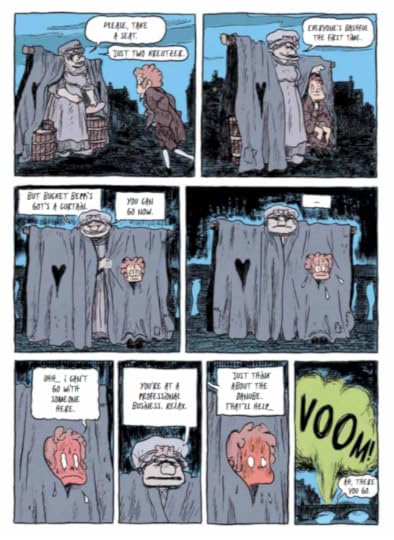
I like that Beethoven graphic novels are becoming a thing. I've read two now and I believe there's another coming out soon! However, "The Final Symphony" is still my favorite so far. There are some good things in this one -- good level of detail, good take on Beethoven's personality, wonderfully creative artistic depictions of what his music sounds like. On the other hand, it could stand to slow down now and then -- the characters all seem to be constantly rushing around at breakneck speed, and the story itself rushes along, sometimes leaving one struggling to catch up. And while I have no objection to poor Beethoven's tummy troubles being brought into the story, I don't think we need every other scene to end with a hasty exit to the commode and a violent "BOOM." Not trying to be prudish here, but it almost seems that his stomach woes get more attention than his music, throwing things severely out of balance. That aside, it's a pretty good read on the whole, but I fear that those who don't already know the story well might find themselves getting lost.
Golden Boy is a spirited journey through Beethoven's early years, executed with passion and visual audacity by the very talented Mikaël Ross. His re-telling of these pivotal years in the great composer's life is bawdy, earthy, and a little bit lustful, as the maestro rises from humble beginnings in Bonn to eventually find his destiny in the great city of Vienna, where both Mozart and Haydn await him. Ross exploits all of the possibilities of his medium to tell this story with considerable color and emotion, and the end result is a fun romp through the heady world of classical music history.
Uno de esos días que vas a teletrabajar a la biblioteca de tu pueblo y te topas cara a portada con un cómic que te llama la atención. La música clásica no es que me guste especialmente, más allá de figuras archiconocidas como La Caballé o María Callas, pero algo en esta novela gráfico me llamó.
Me ha gustado bastante conocer la infancia y la adolescencia de un genio como Beethoven: sus primeros contactos con la música, la relación con su padre y su madre y cómo se encuentra con amigos en el camino que le animan a dejar de tocar las piezas de otros y desarrollar las suyas propias. Me ha parecido muy gracioso su contacto con Mozart y la relación tan especial que cosecha con Haydn.
La historia es bastante sencilla, pero muy entretenida. Es una vida algo dura por la situación económica de la familia, los abusos y adicciones del padre y la lucha del genio contra sí mismo. Su mayor don, su mayor enfermedad.
Una de las cosas que más me ha fascinado son los colores que utiliza el ilustrador para dar más vitalidad o intensidad a las piezas que toca Beethoven, es mágico y consigue transmitir toda la fuerza de su música a través de los colores. Pocas veces me he cruzado con un cómic en el que se pudiera sentir algo así sólo con mirar.
Os recomiendo la lectura si os gusta la música, queréis adentraros en el mundo de un genio que traspasa siglos y épocas y buscáis una lectura amena y ligera.
Mikael Ross nos nuestra en este libro una representación de lo que habría sido la vida de Ludwig Beethoven entre los 6-25 años de edad; en un ambiente familiar humilde, con un padre abusivo que sabia que su hijo tenia talento, pero no sabía bien como manejarlo mas que para obtener dinero, una madre típica, preocupada por sus hijos, y 2 hermanos que no destacaban aparentemente en nada, pero que siempre estaban ahí cerca de él, para bien o para mal. Hay un poco de sus amores, la influencia de personas que lo ayudaron en el camino, su leve acercamiento a Mozart, la perdida de sus padres, sus problemas de "diarrea" y el inicio de su sordera. Tiene un estilo caricaturesco que genera ternura y risa. En los momentos en que Ludwig comienza a tocar el piano o sentir la música, las viñetas e ilustraciones se expanden junto con los sonidos y pierde las líneas que lo restringen para armar un escenario diferente y onírico, fueron mis partes favoritas, mas aun leyendolo con musica de Beethoven de fondo. Me gusto mucho
This graphic novel focuses on Beethoven's early years through his 20s. I picked it up thinking my middle school students would possibly like it, but I would recommend for high school age and up.
Ludwig did not have an easy childhood - his father was a drunk and the family always seemed close to eviction and financial ruin. Although he taught Ludwig the basics of piano, he also did not encourage any of Ludwig's natural creativity expressed through his own compositions. Ludwig did catch a few breaks - he was befriended by a noble family, and eventually was taught by Haydn.
The style of the artwork is full of movement. My favorite pieces are those that show what Beethoven was imagining while he was composing and playing.
Мікаель Росс - комікс про молодого Бетховена «Golden Boy». Умовно охоплює період від дитинства до початку втрати слуху. Що ж, саме з цього коміксу я свого часу почав знайомство з Россом.
Автор неймовірно добре оповідає історію, контрастуючи комічністю та патосом. Одночасно всі персонажі мають свою родзинку. Неймовірна передача міміки та гримас. Мультяшність додає коміксу шарму.
Що ж до самої історії то вона сповнена колоритними подіями тут у нас одночасно може переплітатись і любовна історія, і чума, і шматочок війни, і, вибачте, знайомство з Моцартом на всиральнику, і прийоми при дворі. Але все органічно.
P.S. Акомпанувала на фоні композиція Бетховена «Крейцерова Соната». І щось я так захопився, що тепер захотів передивитись фільм з Ґері Олдменом.
Packed with humor, with each panel a comedic masterpiece. Li’l Luddie Beethoven is a cranky hoot, and the depiction of his complicated relationship with his feuding parents and dopey siblings is priceless. How he uses these childhood experiences as inspiration for his original music, coupled with his prodigious talent, is a joy to read.
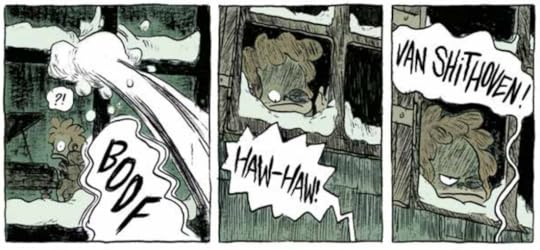
Ross’ technique to depict Ludwig’s revolutionary music is dazzling. The art smacks of Bloom County; the humor is Calvin and Hobbes-if Calvin had little pesky brothers other than a stuffed tiger to taunt.
Best of all, the historical adaptation of young Beethoven’s life is great. Even Schroeder would give thumbs up.
Auch wenn Ludwig van Beethoven nicht unbedingt eine Persönlichkeit ist über die ich mehr erfahren musste hat mich diese Graphic Novel doch sehr gut unterhalten. Die Bilder sind sehr ansprechend und die Visualisierung der Musik ist eindringlich. Es kommt einem so vor, als würde man die Stücke wirklich hören. Auch die diversen Krankheiten und Leiden Beethovens sind mehr als anschaulich dargestellt. In diesem Band werden nur die Jugendjahre des Goldjungen behandelt - einen weiteren Band zur Fortsetzung könnte ich mir allerdings auch gut vorstellen.
Este cómic es uno de esos hallazgos inesperados en la biblioteca. Lo saqué sin grandes expectativas, pero lo he disfrutado muchísimo. Como su título indica, nos cuenta la historia de Ludwig van Beethoven durante sus primeros años.
No conocía mucho más allá de su música y algunos datos generales que todos hemos escuchado, así que me encantó descubrir más sobre él de una manera tan divertida y entretenida. La forma en que se narra su vida me ha gustado, pero lo que realmente me ha deslumbrado ha sido el dibujo y el color de esta obra.
La manera en que se plasman las emociones de Ludwig, especialmente en los momentos en que aparece su música, es una verdadera preciosidad. Aunque el nivel de caricaturización puede parecer excesivo en ciertas partes, esto no me ha impedido disfrutar de cada página de la historia. Hay un equilibrio perfecto entre drama y comedia. Sin duda, es un cómic recomendado.
It is as all translations for youth generally go-- not quite sure who the actual audience would be to enjoy it because it really won't be teens in my library because even I wasn't able to hold my interest. It seems bombastic and crude and a little hazy about what was happening. All I really knew was that it was supposed to be about Beethoven's youth. So it was a no-go for me. And it was probably, pun intended, lost in translation.
The narrative is a little manic - and the cartooning even more so! - but it’s a wonderful way to show the creative genius of Beethoven buzzing wildly around him in his youth, waiting to come out properly. The art is gorgeous, with possibly the best evocation of the experience of listening to music I’ve ever seen on the page, and for all its earthiness it’s a book that celebrates beauty and art to its fullest extent
Ross has quickly become one of my favorite visual artists. His books easily stand out amongst a sea of new graphic publications and this book is my favorite of his so far. While the writing is punchy and full of heart, so much of the storytelling happens visually in this book. The colors, the expressive lines, the repeated visual motifs, it's all done so well. I plan to return to this again and again.
I had been meaning to read this graphic novel for quite some time and was NOT disappointed. This fictionalized retelling of Beethoven's youth (age 6-adolescence) was gripping. I loved watching his coming of age in an era with Haydn and Mozart. What a thrilling time to watch a composer's influence on the world and music!
I enjoyed this for learning about Beethoven. There is quite a bit of vulgarity, so I wouldn’t put this in a kids hands. But it definitely made me intrigued to learn more about this composer. Graphic novels are my favorite way to learn about nonfiction that I’m not necessarily up for a longer form book on.
Graphic novels are hard for me, but this felt especially difficult to follow. The timeline was not easy to follow, as some jumps in time were aided by the year being written at the top of the page, while other jumps did not have that same help. The art was beautiful, but did not aide in the storytelling. It just felt strange as a whole.
Mikaël Ross dépeint l'enfance et l'adolescence mouvementée de Beethoven avec une pointe d'humour, et de façon poétique (les grandes 'traînées' de couleurs quand il joue au piano sont une excellente idée !). Mais j'aurais préféré que cela soit plus long ou découpé autrement. Les dialogues sont également peu profonds...
The reason I gave it 4 and not 5 stars is because it was a bit difficult to read at times and I was confused as to Beethoven's age.... but the illustrations of Beethoven playing his own compositions was magnificent.
Una biografía de los primeros años de Beethoven aparentemente ligera e infantil pero con una sorprendente profundidad narrativa. Un personaje complejo, a veces engreído, inseguro, enfermizo y marcado por la desgracia con un dibujo agil y caricaturesco nos descubre a Beethoven y su mundo.