John Hoyer Updike was an American writer. Updike's most famous work is his Rabbit series (Rabbit, Run; Rabbit Redux; Rabbit Is Rich; Rabbit At Rest; and Rabbit Remembered). Rabbit is Rich and Rabbit at Rest both won Pulitzer Prizes for Updike. Describing his subject as "the American small town, Protestant middle class," Updike is well known for his careful craftsmanship and prolific writing, having published 22 novels and more than a dozen short story collections as well as poetry, literary criticism and children's books. Hundreds of his stories, reviews, and poems have appeared in The New Yorker since the 1950s. His works often explore sex, faith, and death, and their inter-relationships.
John Updike has taught me so much about the art of writing, it only follows that he also teach me about fine art.
I had no idea this delightful thing even existed. I stumbled on it at my (teeny) library's (meagre) book sale. Imagine my ecstasy when I found this gorgeous collection, substantial and hard covered, filled with not only John Updike's words, but also countless beautiful colourful reproductions of art pieces, for a stunning TWO DOLLARS. My heart simply rejoiced and I greedily snatched my treasure and hastened to the counter to pay for it before the librarian realized her grave error and changed her mind.
I don't often (to my own loss, I'm sure) read essays. I also don't often read poetry, but John Updike has compelled me to read both, because I'm just so enamoured of him. What can I say? I'm sure I've bored the kindly Goodreads community to death with my continual gushing over him, and I do apologize. I can't help it, friends. It's been a tough year. I need my comforts, and this is one of them. Thanks for putting up with me.
Anyway, here I am again, nigh orgasmic over Mr. U's brilliance. Over the twenty-three essays, he walked me through various works by well known artists like Degas, Renoir, Vermeer and John Singer Sargent. Also, an essay on illustrators featured in children's literature and one on The New Yorker cartoonist Ralph Barton. Each essay features first class commentary, communicated in elegant, seemingly effortless style, peppered with observations true to what I've come to expect from him.
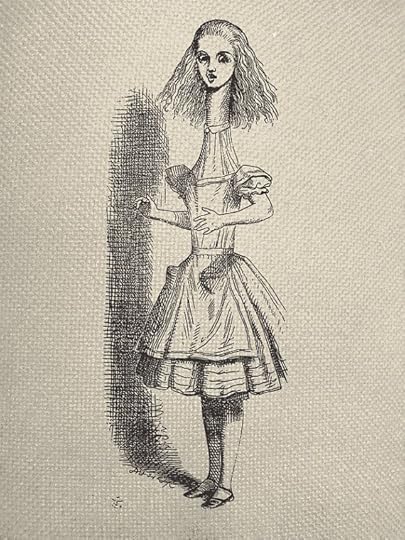
Only Updike would suggest John Tenniel's 1865 depiction of Alice's elongated neck is phallic!
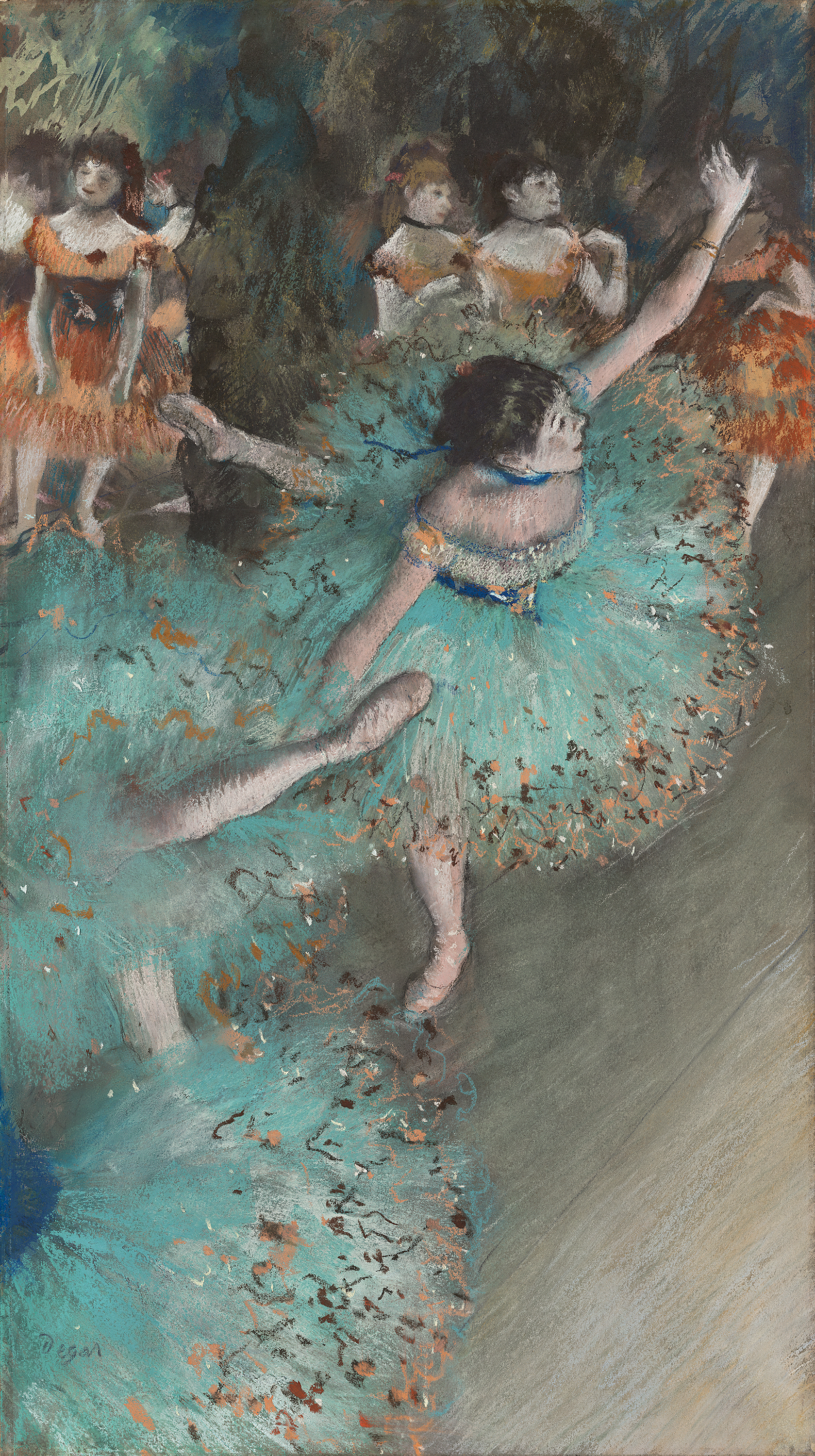
Only he would feel it necessary to mention that Degas was thought to be impotent. Well, Degas certainly didn't have a saggy paintbrush:
The Green Dancer, c. 1880
Similarly, though, when riffing on Diebenkorn's paintings, only John Updike can express with authority and eloquence illuminating nuggets such as "Abstract Expressionism has the effect of glamorizing the painter, of making him, rather than the sitter or the landscape or the Virgin, the star." Of course! Now why hadn't I thought about it that way before? And why, now that I've read your essay, Mr. U, am I suddenly seeing a seascape when before they were just pleasant blocks of colour?
Ocean Park No. 79, 1975
Another gift: he opened my eyes to new-to-me artists. The strange, arresting nude sculptures by French artist Jean Ipousteguy. Richard Estes' dazzling and reflective Telephone Booths. Andrew Wyeth's paintings of his neighbour (and secret lover), Helga. Oh, to be seen like this:
Overflow, 1976
At the end of the day, all admirers of art are "just looking", but some have a special sight, and I'm thrilled to have benefited from John Updike's.
This is quite unlike most of the books I read. It's not fiction, which is the vast majority, or a focused non-fiction. It's a collection of essays about art and artists, written by a man best known for his literature. (I have only read Rabbit, Run, and I can't say I loved it.) I know very little about art. At all.
Note: The rest of this review has been withheld due to the changes in Goodreads policy and enforcement. You can read why I came to this decision here.
In the meantime, you can read the entire review at Smorgasbook
I'm breaking up with John Updike. We met in a Dublin used bookstore in 1986. The paperback cover of his Rabbit is Rich bore a Pulitzer Prize notice, also a title so literal and a color illustration of the main character so paunchy and unforgiving that I was intrigued. No lofty and abstract literature here, this was a real story and I was sucked in during my Irish, Scottish and English train and bus rides of the next week. Sex, money and aging, written with such thrilling precision. A night of wife-swapping fascinated me.
But now I see the WASPy sexism and casual racism and the male-centered view and it just seems dated. For every didactic truism like "The tinted volumes that confront the outer eye--that most vulnerable of body parts, where our brain interfaces with the world--are imitated by those dramatic spaces the inner eye creates, as theaters for thoughts and fantasies," there is a painful "the brushstrokes turn greasier, the colors rawer, the drawing vaguer. In the end the people all look Mexican" (of Renoir.) All talk of nudes is a private conversation with other white heterosexual males: "The glossy and lewd Sien tactile (Tactile Breast, 1968) (by French sculpture Jean Ipousteguy) but emphasizes the tactility that pervades his creation; we wish to touch his works, much as we itch to touch other bodies, because their textures are not monotonous but responsive and various." White patriarchy at its finest.
My favorites of these twenty-three essays on art and artists are the ones where Updike includes himself in his observations, as when he writes about catching fireflies in his youth (“Little Lightnings”) or finding parking and queuing with crowds at a Renoir show in Boston (“Is Art Worth It?”). The book is loaded with well-reproduced photos of sketches, sculptures, paintings, and even several drawings by the author himself. It’s also in Just Looking where you’ll find the Updikean zinger, “Renoir’s homage put the fat into infatuation.”
He's not an art critic. This is the strength of this book--someone without a lot of art junk cluttering up his eyes, just looking and responding. It doesn't hurt that he's good with language, but I found these essays clear, lovely, and openly curious about visual art. He doesn't pretend to be an expert, and he certainly goes by the limits of his own tastes, but these are strengths, I think.
Updike's reviews are written with the care of an art enthusiast. His deeply personal reflections on artworks and artists takes this collection of essays out of the usual "art criticism" genre and places it into what can only be described as a conversation between the audience and the artwork. It is a lovely read for any art enthusiast.
Rather makes one want to spend rainy Tuesday afternoons wandering through the forgotten rooms of the NPG, before wandering down to the Lamb and Flag for a couple of ales by the fire. Alas not in January 2021
Updike enjoys art of all kinds and shares his acute perceptions plus researched biographical information on the artists. He combines his beautiful writing ability with his special interest in fine arts.
I can read Updike discuss art all day long. Love his insights and distinctive voice, and I was really swayed by his analysis on some artists I don't know very well at all, like Fairfield Porter.
Updike on art. Always interesting. Always smart. Always heartfelt. Always beautifully written. I do not always agree with his assessments; for instance, I hold Sargent in a higher regard. I also know I can be more sentimental and enthralled by mere prettiness than Updike. Updike is a warm and engaging cicerone. He never comes off high brow or know-it-all. In fact, he often couches his judgement in self-doubt. I miss Updike.
Since this series of books are complications of earlier exhibit reviews that appeared in news papers or magazines, many of the works he references are not accompanied by pictures. However, with ones phone they can be easily accessed via the internet. For the first of these books I read, I made a Pinterest board of the missing pictures. I have not done that for this one or I would attempt to link it here. I may yet do so.
My one complaint is the book smelled of that obnoxious, migraine inducing, inky smell glossy books often have.
Updike applies his beautiful literary style to art. He has a unique way of looking at things which makes you appreciate the pieces he's reviewing that much more.



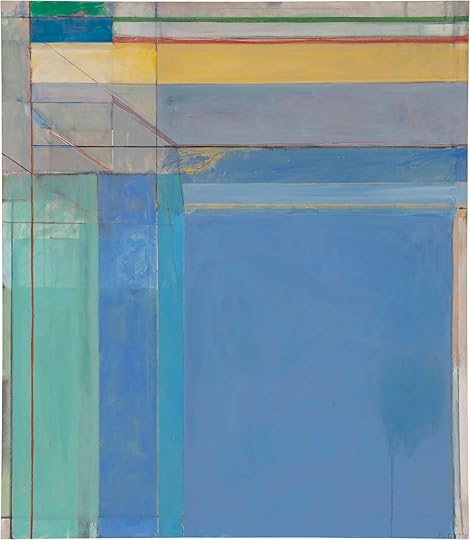 Ocean Park No. 79, 1975
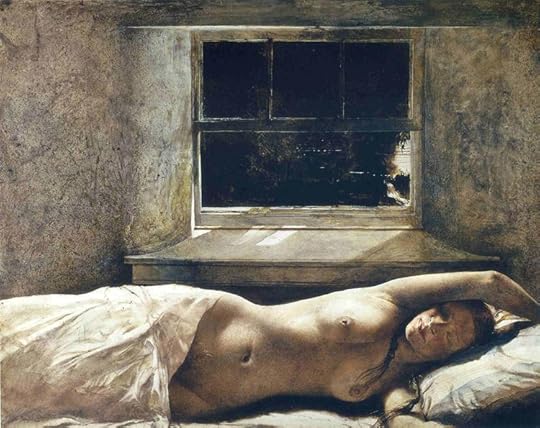 Overflow, 1976