It’s 1947, and New York City is awaiting the construction of the new United Nations building, the FBI is actively pursuing Communists and Soviet spies as the Cold War begins to build, and homosexual men have even more reasons to hide who they are.
Uptight FBI Agent Arthur Mason is so deep in the closet he doesn’t even realize he’s in one. Clueless about his own sexuality, he’s surprised at his reaction to both Hans Schmidt and his twin sister, Ada. Under pressure from work, Mason investigates Hans and his boarders, including the highly suspicious Hank Mannix, a known member of the Communist Party. Though Mason can’t seem to locate Ada, he can’t stop thinking about Hans and keeps going back to visit.
Hans Schmidt is a cross-dressing German immigrant running a boarding house for “a certain type of man,” and he wants nothing to do with Agent Mason and his ill-fitting suits and bad haircut. Until he begins to see Mason more as a man and less as a government official.
Hans enjoys dressing as a woman from time to time, and once his feelings for Arthur begin to change, he realizes he needs to share his Ada persona if they are to have a future together.
Secrets on both sides must be revealed and cherished beliefs challenged if these two men are to find the love and happiness they deserve.
This story can be read on its own; however, characters from book one, Dublin Bay, play a prominent role as secondary characters, so it’s recommended to read that first.
John Patrick spends much of his time in the Berkshire Hills of Massachusetts, where he is supported in his writing by his husband and their terriers, who are convinced they could do battle with the bears that come through the woods on occasion (the terriers, that is, not the husband).
John is an introvert and can often be found doing introverted things like reading or writing, cooking, and thinking deep, contemplative thoughts (his husband might call this napping). He loves to spend time in nature—“forest bathing” is the Japanese term for it—feeling connected with the universe. But he also loathes heat and humidity, bugs of any sort, and unsteady footing in the form of rocks, mud, tree roots, snow, or ice. So, his love of nature is tempered; he’s complicated that way.
John and his husband enjoy traveling and have visited over a dozen countries, meeting new people, exploring new cultures, and—most importantly—discovering new foods.
4.5/5 stars. An FBI agent in post-WWII New York investigates the proprietor of a gay boardinghouse. This book is primarily a sexuality awakening story, as Agent Mason slowly comes to terms with his identity and learns to accept the gay community as a whole, even those who aren’t like him. Mason’s journey is handled sensitively, and I appreciated that the book never treated him as foolish for not figuring things out sooner (as is often the case in sexuality awakening stories). There are many stages on his journey from barely even knowing what homosexuality is to fully embracing his identity, and these are paralleled by the steps on his journey from enthusiastic FBI agent to questioning whether he believes in what the agency is doing at all. Mason is sympathetic even when he stumbles, and it’s satisfying to watch him overcome the prejudices that have been ingrained in him from childhood without his realizing it.
Compared to Mason, Hans is less accessible as a character, and his feelings and experiences sometimes take a backseat to Mason’s. It works for the story, though, because the focus on Mason’s journey of identity is compelling and Hans never feels like he’s merely a tool for telling Mason’s story. The book is always respectful of Hans’ feelings and never requires him to explain or justify his own identity to anyone, which I appreciated. It’s Mason’s responsibility to work through his own discomfort and the book doesn’t ignore that even when it might’ve been easier to write.
There are a number of prominent side characters in this book, all of whom are meaningful to the story and create a supportive and authentic-feeling friendship group for the MCs. The side characters are skillfully woven into the main narrative and never feel like a distraction. I enjoyed seeing the major characters from book one, especially because they had an important role to play in this book and didn’t feel like unnecessary cameos.
The author appears to have done a lot of research and does an excellent job establishing the late 1940s New York setting. Details like the telephone operators’ strike and Hans’ friends getting their first TV give this book a level of realism that many historical romances lack. I loved exploring the city with the characters and imagining how things must have looked.
This is book two in the series, and although it can be read as a standalone, I recommend reading the first book (Dublin Bay) first, because it introduces Hans and several of the prominent side characters in this book.
Highly recommended to historical romance fans, especially those looking for a book set in a time period that’s uncommon in the genre.
I received an ARC of this book in exchange for my review.
This was an odd mix. First, I didn't remember Hans from the first book at all. I actually had to check Dublin Bay to verify he'd been in it. 🙈 But that's not the book's fault, and it does a decent job in recapping the relevant bits.
I did really like Hans, and his boarder Mannix was a hoot. Mason and Cordero were threw me for a bit. They're FBI agents, so I expect them to be a little faster on the uptake, but this is a time when the lives of gays were very much kept under wrap and away from the public eye, so it made sense that Mason was missing relevant hints and jumping to the wrong conclusions. It had a hint of comedy of errors a time or two. Cordero though...I never quite got a fix on him, and I was a bit weirded out that he and Mannix were said to look so much alike, and they ended up together. Seems a bit egotistical to fall for someone who could be mistaken for your twin, lol.
As for Hans and Mason, too much of their developing relationship happened off-page. It was one thing for that to be the case with Mannix and Cordero, but to do that to your POV characters too didn't make much sense, and I ended up not really being all that invested in their relationship. Which isn't to say I wasn't invested in them as individuals, because I was. But there was so much going on in this that the relationship development got overlooked. That said, I did really like how Mason's character grew over the course of the book. I think this is the first time I've seen this particular brand of "in the closet" character. He's kinda sorta aware of his attraction to men, but he so casually dismisses it that it's almost like he doesn't really understand what's going on, either. So watching him become aware of himself and learning to accept himself was a special treat.
Still, it was especially disheartening to read about this time period, the big scare over Communism, which quickly morphed into a big scare over Communism and homosexuality, while our current administration is once again spiraling into paranoia and actively taking away civil rights from trans people and vilifying all LGBT+ as well as minorities and women. How did we go backwards? 😢
Set several years on since the events of the first book, with German escapee Hans being the focus / MC, readers will be pleased to know that Otto, James, Bella and Howard are definitely around and about - and providing much of the humor/levity to a M-M romance set in the start of the Red Scare era. Irrepressible Hans proved to be a lovable character but it took much more effort to warm up to the deeply conflicted/closeted Arthur.
The author is fast becoming an autobuy for me - I just love his writing style and his well-crafted characters. However, I don't (yet) see a third book in the offing for this series but I'm hoping it will be set in Havana during the Cuban Missile crisis years and starring that irascible duo Hank and Tony - pretty please Mr Patrick! 4.5 stars for another highly entertaining read.
Turtle Bay is yet another 5-Star MUST READ adventure/romance novel from John Patrick.
It’s particularly satisfying when the second book in a series lives up to the high standard set by the first, and that’s exactly the case with this book.
Quite different in tone, time, and place from Dublin Bay, the first book in Patrick’s ‘Tides of Change’ series, Turtle Bay is equally captivating in its own right.
While Turtle Bay can be read as a stand alone novel, it certainly helped to have read Dublin Bay first. Many of the principal characters from Dublin Bay reappear as important secondary characters in this new volume.
Among those are the now partnered couple of James Brennan and Otto Werner; James’s sister, Bella, and her husband the Reverend Howard Fulman who had personally been involved in the Unitarian Church’s efforts to rescue European Jews; and Clara, the young woman who helped them all escape from Ireland as the Germans invaded their homeland.
A secondary character in Dublin Bay, Hans Schmidt, a gay cross-dressing German concentration camp escapee, is one of the protagonists in Turtle Bay. The thirty-year old Hans has immigrated to New York City where he’s currently running a small boarding house for “a certain type of man.”
The other Turtle Bay protagonist is Arthur Mason, an uptight FBI Agent who is clueless about his own sexuality.
Most of Patrick’s characters have settled in Turtle Bay, a Manhattan neighborhood that houses, among other things, the slaughter yards along the East River that are being razed to make way for the soon to be constructed United Nations Building. James and Otto, though, are living on the West Side of Manhattan in Hells Kitchen.
Patrick’s descriptions of time and place are truly evocative of both a changing neighborhood and a nation’s changing habits - from candlestick telephones with operators who had to place calls for you (for those fortunate enough to even have a phone), and paper coffee cups with butterfly handles used in the FBI’s Manhattan offices.
In 1947, Turtle Bay was rife with Communists, homosexuals, FBI agents, Nazi spies, blackmailers, con artists, drug dealers, murderers, and cross dressers. It’s important to remember how different the nation’s understanding of identities and behaviors was 75 years ago, when various characters in the book seem so naive to what’s happening around them.
A third major character in Turtle Bay is Hank Mannix, an actor, male model, and known Communist Party member from L..A. who is living in the boarding house that Hans manages. It’s only when Arthur Mason and his partner, Agent Tony Cordero, are assigned to “investigate” Mannix, that two journeys of discovery of a very different kind begin for these FBI agents.
While I’ve never understood the desire of some individuals to engage in cross dressing, it does seem to be far more common than many believe - including, if reports and rumors are correct - even by J. Edgar Hoover the longtime controversial FBI Director himself.
But to paraphrase what Revered Fulman tells one of his congregants, cross dressers - referred to derisively at the time as inverted - are happiest and complete when freely being able to enjoy themselves from time to time by wearing clothes of the opposite sex. And, Fulman continues, isn’t happiness all anyone can wish for those he cares about?
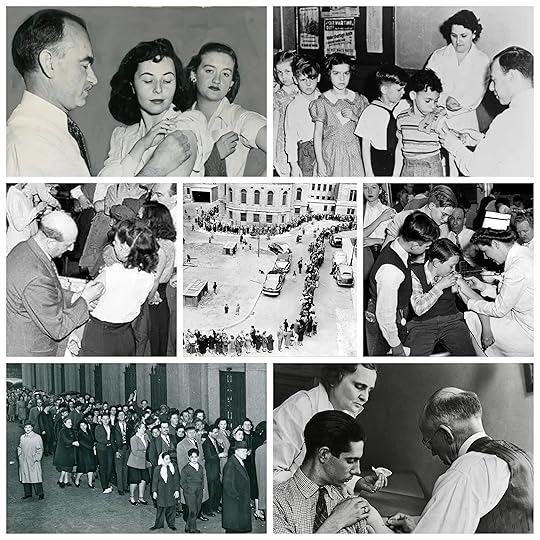
Painstakingly researched, Patrick has woven actual events of the time into his narrative. One of the more memorable examples, channeling today’s COVID pandemic, is how he uses the waiting lines of the largest mass vaccination effort ever conducted against smallpox in America to forward his plot.
In March and April of 1947 New York City experienced a smallpox outbreak. Within three weeks of the discovery of the outbreak, the U.S. Public Health Service, in conjunction with New York City health officials, had procured the smallpox vaccine and inoculated over 6,350,000 adults and children; 5,000,000 of those had been vaccinated within the first two weeks. Their rapid response was credited with limiting the outbreak to 12 people, 10 of whom recovered, while only two died.
Another example of change at the time was the humorous confusion created in the minds of FBI Agents over a developing new ‘language’ among gay men. Agents misinterpreted the question, “Are you a friend of Dorothy?”, to be code for members of the Communist Party rather than a question from one man to another asking the second man if he too is gay.
In yet another turn of events, today’s readers will enjoy thinking that
I received a copy of this book from Gay Romance Reviews and this is my honest review.
Do yourself a great favor - sit down right now and read both John Patrick’s Dublin Bay and Turtle Bay in that order. You’ll be glad you did.
And while Patrick gives no indication at the moment that he plans a third book in his ‘Tides of Change’ series, the final chapter could easily lead to an upcoming volume perhaps entitled Havana Bay . We can certainly hope that’s exactly what will happen.
If (like me) you wanted to hear more about Hans Schmidt, the gay refugee from Dublin Bay, this is his book.
We find Hans running a boardinghouse for "homosexual" men in the NYC neighborhood of Turtle Bay. We also find him and one of his tenants under investigation by the FBI, because of how communism is a deadly threat to the USA etc. etc.; it's 1947 (and, to be fair, Stalin was still running the Soviet Union, so not really the kind of political leader you want to help out in any way if you can avoid it). Fortunately for Hans, not only is one of the FBI agents assigned to the case a closeted gay man (but who could resist Hans?), but the other is, er, sexually flexible and also beginning to question the political direction the FBI is taking.
Also, fortunately for all concerned, James and Otto from Dublin Bay now live in Hell's Kitchen (TBH I think that neighborhood might've been a bit rough for them in the late 40s, but whatever), and of course Howard and Bella live in New York (with their enormous brood). Oh, and hello, Clara -- remember Clara? Bless John Patrick, he found room for everybody we might want to see again.
So. There's a lot to like here. For starters, as with Dublin Bay the historical background is so deeply researched, & John Patrick has so thoroughly assimilated it, that I don't think there's even a single infodump. His characters move through the NYC of 1947, and that's all there is to it.
I loved Hans, who is as tough and brave as we already knew, and also patient, kind, emotional, and apparently somewhat afraid of babies. (Me too, Hans, me too.) I love his attentive building of his feminine persona and his nurturing of the baby drag queen he rescues from an ill-advised plan in the book's opening scene. But there's an important part of his history that ... well, let's just say that it would almost have to have Obviously there's no moral problem with Hans's act, but I wish, wish, wish that the author had reached for that aspect of his story and shown him dealing with it on page. Hans is such a good person, and
I have other criticisms, as well.
-- Really, that many non-straight FBI agents in one office, two of them partnered and one just happening to have his desk nearby? -- Do not be telling me that a New Yorker of long standing doesn't know how to tell whether he's going east or west in the Manhattan street grid. -- -- Once Agent Arthur Mason comes out, he instantly becomes a fount of emotional articulateness and openness. I mean. It's nice! Not saying it's not nice for him that he's all of a sudden so insightful! I guess he did all the work to enable that while he was figuring out that he didn't only want to hold Hans's hand? IDK, it was a stretch for me.
All that sounds, I guess, as if I didn't much like the book ... but I did. On top of being well-written and vividly evoking the NYC of that era, Turtle Bay is so good-hearted! And I don't mean that to damn with faint praise. I was happy to spend more time with Hans and his friends, and John Patrick has a serious gift for comedy. (Lester the drag queen too lazy to do more than put on a bathrobe! Hans et al. attempt to watch the first game of the World Series on James and Otto's new TV!) I just wish JP had dug deeper here and there.
I received a free ARC and am voluntarily leaving this review.
What a great continuation of the first book! Hans was a side character and I was really interested in his story so was glad to pick this one up. Arthur seemed like a great counterpart for him and also allowed for really frank talks about gender exploration and expression, especially in a time period when it most definitely was not a safe way to live. This book felt extremely historically accurate and gave a glimpse into what it may have been like to live as a gay man post world war 2. It was very sweet at times, while also not painting the time as all good things. I just really enjoyed the characters and their stories and would not hesitate to pick up a book by this author in the future.
This fantastic piece of writing is set in New York after WW2 when small pox erupted the states and that the early stages of McCathyism/ The Red Scare. This is the second book of ‘The Tides of Change’ by John Patrick and was a fantastic continuation from ‘Dublin Bay.’
It tells the tale of Hans, who we were originally introduced to in Dublin bay. He know manages a boarding house for specific men and finds that this is a way to give back to strangers, after he himself were saved by strangers. There is also Mason, an FBI agent who is set on a path of self-discovery, while being charged by government to investigate communism activists and sympathisers.
I must say, I really enjoyed this novel and it has opened my eyes to the world at that time. The fact that homosexuals of that time had to hide from society and made me look at how far the world as come in acceptance and diversity – but still a bit to go yet! Having to rely on code words to avoid any sort of danger from homophobia that is still used today – ‘Are you a friend of Dorothy’s?’ When reading this, I was very fond of the main characters, especially Hans and how far his has come from Dublin Bay. He shows a very strong sense of bravery, patience and understanding. From enjoying his time as Ada by helping Mason discover himself and his feelings.
I love the fact John Patrick kept the main characters of Dublin Bay in this novel, showing a HAE for them and how they have all grown together as a family. Also with the introduction of new characters, like Cordero and Mannix.
I feel that to enjoy the full potential of this book, you need to read Dublin Bay first to know the backstory and fully appreciate that full story of Turtle Bay. But it is worth stating that it can be read as a standalone.
I have given this a worthy 5 stars and think that it would be enjoyed by many readers. Especially one with a keen interest in historical romance theme.
(I received a copy of this book from Gay Romance Reviews, and this is my honest review.)
What I love about John Patrick's writing, is that he makes you feel like you've been to the places the characters occupy. I feel like I've visited New York after reading Turtle Bay.
Turtle Bay follows the characters in Dublin Bay. We do get to hear from James and Otto, but Turtle Bay is primarily about Hans. Hans runs a boarding house for other 'alternative' men coming to live in New York. He wishes to create a safe space for people like him, especially after what he experienced.
Hans ends up meeting Arthur, an FBI agent investigating communists. The two end up getting closer whilst Hans keeps Anna a secret, and Arthur navigates his sexuality.
What I love about Patrick's writing, is that we don't strictly get gay men. He introduced men who liked to dress up as women just because they enjoy it. Others may wish they were a woman. It helps to highlight the notion that people like Hans have always existed. This isn't something new to the 21st century.
In comparison to Dublin Bay, I didn't feel as invested in Hans and Arthur's relationship as I did with James and Otto. I felt that Turtle Bay was more to do with acceptance and growth rather than their relationship. The main difference may be that James and Otto were in the same house most of the time so there was an opportunity to have them together.
I really enjoy Patrick's writing. If another 'Bay' comes out, I will definitely read it!
This entire review has been hidden because of spoilers.
“Turtle Bay” is the second installment from John Patricks “Tides of Change” series. This story picks up in 1947 a few years after WWII ended. Otto Werner and James Brennan had escaped from the Germans and left Ireland in 1942. Along with Howard and Bella Fulman and Hans Schmidt, they made their way to America.
Its 1947 and New York City is now home for Otto and James. Otto has done well and has invested in property which gives Hans a small boarding house to manage. Otto has plans for a much larger facility. The Schmidt’s Boarding House is a special place. It’s a home for those young men who have come from the war and are homosexuals. The Boarding house provides a safe place to stay and a place that will give them a new start at a better life.
Times are still dangerous, as the government is investigating those who show any signs of being a member of the Communist Party. The government and FBI leaned especially hard on the entertainment industry. Many belonged to the actors union in Hollywood and Congress believed they were Communists. Congress was against Communists but It was very dangerous for homosexuals because Congress hated them more. They claimed it was easier for homosexuals to become spies because they could easily be blackmailed because of their homosexuality.
Two NYC FBI agents Arthur Mason and his partner Anthony Cordero start to take on cases involving suspicions of Communism. Even though Mason and Cordero are very different, they do eventually agree that these investigations are wrong. Cordero is outgoing, very attractive, and tries to get Mason to have some fun. Mason is thirty-five and is somewhat of a loner, he does crosswords and reads a lot. He really want’s to make friends with Cordero but he’s unsure of his feelings and what exactly he is feeling about himself.
When Cordero and Mason pick up a file Hank Mannix becomes a suspect and Mason heads to Han Schmidt’s Boarding House to investigate. Hans’ boarding house only has a handful of men staying in residence. Several of them prefer to dress as women at times, it’s just who they are. Hank Mannix is another very outgoing individual but he is not one to dress up. Being from California he is a member of the Communist Party but it’s mainly because of being in the entertainment business in Hollywood. He’s a model, actor and also very attractive just like Cordero.
As Mason and Han’s become friends, Mason finds himself soul searching. He learns and watches from the connection between Cordero and Mannix. The deeper he and Hans’ get emotionally involved he accepts that he’s gay. But Mason, still at times makes mistakes and one slip has devastated the relationship between him and Hans.
When Mason and Cordero find that Mannix is in trouble they head to the boarding house to do what they can and secrets are revealed and chaos resumes. Choices have to be made. Will there be any chance in finding a safe haven?
John Patrick captures me every time I read one of his novels. Once again, he brings an important time in history and melds it with fiction. With the ending of WWII, the author brings the trials of Congress searching for spies in the Communist Party. But the trials really were an act of prejudice and hate as they singled out different ethnicity’s, homosexuals and ruined lives of many innocent people. It especially hit many of the famous people in entertainment: actors, producers, writers and more. This again, is a very important time in history and there’s aspects of it that are still going on in the government today.
John Patrick not only writes a meaningful story, but brings back some very wonderful characters. Otto Werner and James Brennan which started this journey in the first book “Dublin Bay”. James’ sister Bella and husband Reverend Howard Fulman and their growing family. Clara who also made the trip to America and works at the Schmidts Boarding House.
Hans Schmidt and Arthur Mason are a delightful couple. Even with Hans’ past, he is so understanding and nurturing. Arthur at times confused, really learns to accept who he is and to accept others for who they are.
I also have to mention: FBI agent Anthony Cordero and Hank Mannix they really added many fun moments to the novel. Johnny Herrick, new to the boarding house and FBI agent Stedman, who gave up so much.
“Turtle Bay” is a novel worth reading, it’s well written and a page-turner, filled with so many enjoyable moments. I am very invested in the “Tides of Change” series and I can’t wait to read the next book from John Patrick!
I was intrigued when reading the synopsis and decided to give it a try. I was glad I did because I’m usually not a fan of anything WWII related of stories. This one was a real good reading! I thought it would be more about the building of the United Nations in NYC but it was simply a backdrop. I’ve read stories about the “Red Scare” and whatnot so I was somewhat versed with that theme. However, this one was a good “historical fiction” story without all these sexual activities. I appreciate John Patrick’s writing style. He made the story interesting for me!
The story focuses on Hans, a Gay German immigrant who runs a boarding house establishment owned by his friends. The house caters to guys who dresses like ladies. Hans would be Ada, a very gorgeous lady. Guys would give her a second look because he definitely looks like a lady! There was a guy who resides at the boarding house and he is being looked into by the FBI due to a possibility of being a member of the Communist Party. Arthur Mason is the FBI agent being assigned to this case so he checks the boarding house. He was met by Hans who was reluctant to let him in without a warrant. He thought he was being investigated due to something in his past that he’d like to forget about. Arthur was struggling with his affinity in creating ladies hats in the past so when he notices things very gay-like, he would think it was wrong. However, the more he hangs out with Hans, the ideology clashes. That’s where I’m going to stop and have you pick up the book and read to find out more! There’s more to it!!!
FBI Agent Arthur Mason is investigating possible Communist activists & ends up in Hans Schmidt’s boarding house. He doesn’t get much info here. As he continues to dig, though, he comes across the first woman he’s ever had an attraction to before. Her name is Ada, & Hans describes her as his twin sister. What Arthur doesn’t know is that Ada is Hans when he dresses up as a woman. Hans & Arthur become great friends, quite close really.
I’m not a history expert, but the few things I’ve looked up related to this book are accurate (using “Dorothy” as a code word, for example).
I loved seeing some of the old characters from Dublin Bay, too, like Otto & James. Hans & Otto talking about the prostrate gland was hilarious, & brought back a great memory from the first book, too. (Although I have to say, reading the first book is not a requirement for enjoying this book.)
After Hans & Arthur’s first kiss, I was a tad disappointed how what happened next wasn’t described, the description jumped to them some time later, skipping over their time alone together. This continued in all the scenes where they were getting physically close.
When Howard & Arthur were talking near the end, the “totally gay/optimistic” comment? Hilarious!
Plus the repeated question about feathers at the end made me laugh.
This was a nice story to read, a G-rated MM romance.
I received this free ARC in exchange for an honest review.
There is really no overstating how good this book is. Set in post-WWII NYC, it follows the life of Hans, the young German man who escaped persecution in Bk 1 in the series. Now, five years later, he is living in the US and managing a boarding house renting to gay men for James and Otto (MCs in Bk 1).
The FBI is charged with investigating one of Hans' boarders and Hans comes in contact with Arthur, an agent. Hans and Arthur feel a buzz of attraction from the beginning, but Arthur is deeply in denial of his own nature. Over time, the two men develop a beautiful friendship. Still, danger lurks all around during the months building up to the Red Scare. Many are suspected of being communists and homosexuality is lumped in with the witch hunts. Arthur and his fellow agent are becoming more suspicious that their work is meaningless, harassing, and destructive to the lives ruined by the insinuations. When the accusations begin to enter Hans' world, Arthur must have his own personal reckoning about his work, his feelings for Hans, and his own true nature.
This book has an incredible amount of historical detail, to the point that the reader feels a part of the world. It has great follow-up to other characters introduced in Bk 1. The love between Arthur and Hans is truly moving.
For me, this book really shone in a few different ways, each of which contributed to the overall luster of the story. There’s the wealth of historical detail and the way the time and place (a neighborhood in post WW II New York) come alive in vivid and deeply atmospheric ways. There’s the careful, thoughtful, and compelling character development that makes Arthur Mason in particular impossible to look away from— his understanding of himself, personally and professionally, evolves dramatically over the course of the narrative, but that dramatic evolution nonetheless feels nuanced and realistic. Hans, too, is compelling, and even in the moments when he feels like less of the focus of the story he’s still a strong and interesting presence within it. It’s not strictly necessary to enjoy this book, but I’d recommend the first one in the series as well— some characters in it will be familiar here, and it also makes for an immersive and moving read.
*I voluntarily reviewed a complimentary copy of this book.
Arthur Mason is an FBI agent after World War 2. Hans runs a boarding house that is home to young homosexuals and "inverts". This book is a fascinating insight into America in the forties with its pursuit of Communists and Gays by Hoover and his FBI. Its shocking and horrifying to read of the prejudice, invasions of privacy and persecutions in that time period and to realize its still a truth for many people today. There is a sweet romance underneath as Arthur slowly realizes he is gay and loves Hans. I really was absorbed in the story-line and anxiously read through the book to its resolution. Though light on the sexy times, it seems very historical, factual and captures the love and fear of a culture and it's subsets. Great writing by a new author for me, John! I received a copy of this book from Gay Romance Reviews and this is my honest opinion.
...so the problem with getting a free copy in exchange for an honest review is that you are obliged to read it, and provide an honest review.
On rare occasions I get an ARC that I find so deeply loathsome from page 1, that I contact the review people and say I'm not reading or reviewing it because it's so dreadful.
This is not quite that. I asked for this book because the story looked interesting. And it is! Unfortunately I did not like writing. The narration is weirdly distanced from the characters, and I never connected with any of them.
Yes, the story in this book, and the previous one is interesting. It's worth trying the sample and seeing if you enjoy the prose style.
James Otto and Hans from Dublin Bay are all here, safe and sound in NYC, for the time being. Hans is running a boarding house, a lifeline for those who have to live in secret. The FBI are just starting under Hoover, so reading is with a sense of doom- you something not good is going to happen at somepoint. We also have agents Mason and Cordero, who become friends, allies and even a lover, as they investigate the men in Hans’ house. I liked how we see Mason and Cordero slowly become aware of how stupid what they have to do in their jobs is. Also seeing new technology come in (phones!). Never quite got to what Hank and Mannix are to each other
I love this two, they're so different but the chemistry are very powerfull.
I don't know if I love more this or the first book, the character are so different and the age too. Love to see how the first couple love each other and are so strong together.
I have a little preference for Mason, how can I say, I love so much the "awakening" and the road to know better herself. Waiting for other of this talented autor... Maybe on my holiday wrote a full review for italia blog, thanks GRR for the copy.
This is the story of Arthur and Hans, it is the 2nd book in the Tides of Change series. You do not have to read the first book but I would recommend that you do. If you are a fan of history in the 1940's (which have been portrayed wonderfully and quite accurately), then this book is for you. The story is written beautifully and with great sensitivity. The main and secondary characters are amazing. The moments of laughter makes you fly through the story. Definitely recommended.
I received this book as an Arc and I am happily reviewing it.
I love the depth of characterization and the sense of the historical time and place this author has brought to this novel. We care about these men and can fully appreciate the danger they are in both from their homosexuality and for the immigrants from the Communist party sympathies or simply the suspicion of such leanings. We see things from the point of view of the FBI agents and their concerns about their own government and from the immigrants. An amazing historical read.
The second of TIDES OF CHANGE trilogy changes the tone of the first. It's almost a farce, with comic mishaps, mistaken identities, confused heroes, and gender fluidity (forties style). Once again, John Patrick writes with assurance, easily evoking another time with choice details.
Characters from DUBLIN BAY reappear, with Hans, a secondary character in that novel, moved to the foreground.
I enjoyed finding about what happened to Hans after he boarded the ship to the United States at the end of the novel "Dublin Bay" in which he was a minor character. The protagonist of this book is also Mason, a very closeted and confused gay man that comes to terms with his sexuality and "inverts" (as drag queens and cross-dressers are called back then). He is a sign of his times in the oppressive post-war years. It's a "coming of age" book even though he is in his mid-thirties.
This book focuses on Hans (boarding house proprietor) and Arthur (FBI agent Mason), but we do see the characters from the first book as well. It's a beautiful story with all the feels. The actual romance between Hans and Arthur is a slow-burn with some miscommunications along the way. I really like seeing their story play out.
The political and personal intrigues continue in this book, the second in the series. Following the stories of the refugees both foreign and domestic as they make their lives in what they imagine is the anonymity of NYC. But the 1950s bring fear of Communism, and no one is safe from the FBI. As an aside I couldn't help but think about our political climate now, and wonder.
The Cold War is having a huge effect on a lot of people especially those who are gay. He is so far in the closet, he doesn’t know he is in a closet. He will meet a man who may just bring him out. Will he risk it? See how they deal with life in a Cold War while hiding who they truly are
This is a page-turning sequel to Dublin Bay. Fascinating period piece of 1950s New York gay world with intriguing insider view of FBI and the hunt for communists andhomosexuals. Can’t wait to read the next book.




 to be code for members of the Communist Party rather than a question from one man to another asking the second man if he too is gay.