Jump to ratings and reviews
Rate this book

After

Rate this book
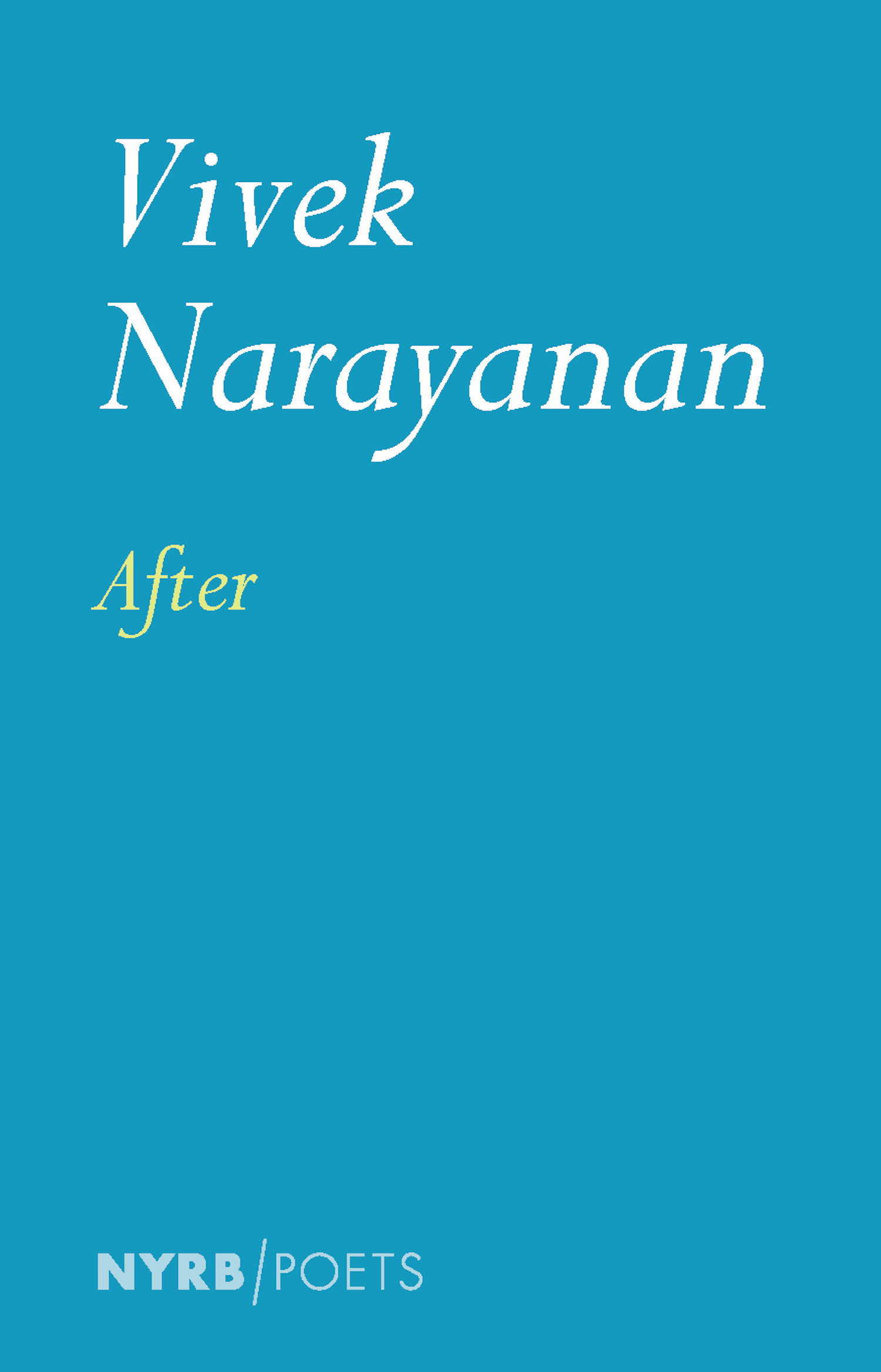
After is a collection of poems inspired by Valmiki’s Ramayana, one of Asia’s foundational epic poems and a story cycle of incalculable historical importance. But After does not just come after the Ramayana. On each successive page, Vivek Narayanan brings the resources of contemporary English poetry to bear on the Sanskrit epic. In a work that warrants comparison with Christopher Logue’s and Alice Oswald’s reshapings of Homer, and Anne Carson’s Autobiography of Red, Narayanan allows the ancient voice of the poem to engage with modern experience, initiating a transformative conversation across time.

624 pages, Paperback

Published July 19, 2022

6 people are currently reading
112 people want to read

About the author

Vivek Narayanan

5 books3 followers

Ratings & Reviews

What do you think?
Rate this book

Friends & Following

Create a free account to discover what your friends think of this book!

Community Reviews

5 stars
15 (55%)
4 stars
6 (22%)
3 stars
2 (7%)
2 stars
3 (11%)
1 star
1 (3%)
Displaying 1 - 9 of 9 reviews
Profile Image for Caroline.
915 reviews312 followers
February 28, 2023
It’s hard to know how to review this book. It tackles so much. I have only read it once because it’s due back at the library on ILL, but it would repay much longer study.

Narayanan writes beautiful modern versions of sections of the original poem. But he also uses the Ramayana as a jumping off point for exploring dozens of issues affecting India today. My knowledge of India is very limited, so what follows should be taken as impressions rather than educated commentary. I may have misunderstood or misremembered more than a little of the work.

I would say that, after spending the first half of the book on the monumental task of creating a wonderful modern impression of the epic, the most serious and pervasive part of his project in the second half is to portray extreme Hindu nationalism and attacks on Muslims as an echo of the violence of the Ramayana. He does this by setting the extreme violence of the war between Ravana and Rama against long lists of violent attacks on Muslim groups and individuals. He extends the relationship by discussing skin color in graphic versions of the Ramayana as it relates to caste and regional racism in India today. (Although he also notes the anomaly of dark-skinned deities upending this comparison.)

Narayanan also tackles the misogyny of the treatment of Sita at length. No one can read the Ramayana today without being repulsed by both Ravana’s and Rama’s actions regarding her. Narayanan describes his own disgust, and explores what Valmiki might have been trying to do.

In other sections Narayanan spins off in all kinds of directions. He walks through the existing parkland that is the presumed location of the forest Rama, Lakshmana, and Sita live in for many years, and becomes disoriented. He visits the site of the Babri Masjid mosque that was attacked in 1992, noting that its city Ayodhya, the presumed birthplace of the Hindu deity Rama, is now a ghost city. He visits a site full of Hindu shrines as pilgrims visit just before it is shut down for the season. He discusses his father’s last days. Each reflection is linked to the epic.

Yet the whole thing rests on the power of the Ramayana. The pulse beats throughout. Back and back he comes to create a modern version of the epic. It is a conundrum we know well in the West, as our culture draws time and again on the violence and misogyny of Homer and Virgil and Beowulf, and we are both horrified and in awe of the poetry and story.

Narayanan works mostly on the retelling in the first half of the book, and does the branching out in the second half. That is my recollection, at least, as I read it over three or four weeks. The poetry is beautiful, so it is worth reading simply for the language. I have been trying to find a brief description of the prosody that governs Sanskrit poetry like the Ramayana, but I can’t. I have to assume that Narayanan’s run on sentences and the caesuras follow tradition at least in part. I plan on buying a copy and rereading it just to savor the poetry. But I also hope to pick up more of the threads of his contemporary project and to read more of the work cited in the notes in the back. These are designed to help readers unfamiliar with the context of both the epic and his modern issues.

Recommended.

Ravana
Radiating gloom. Like an asteroid with designs on a star
Like night’s curved shadow that swims across the Earth
Like the darkness of our Sun in its deepest explosions…
Like the planet Budhan about to take hold of Rohini…


They Saw No Longer the Battlefield

and then like the blindness of fury in WAR
a solid rising column of iron-coloured dirt &
skin & blood & hair & pollen & chondrite

buffeted in the ten directions both
(Simiarakshsasa) sides. All
beings tossed in it----

and they saw no longer the battlefield

only nebulas of dust. Red rust
or white. Whiter than white people or
the white of silk. Then nothing
not limb nor cloth nor banner
nor horse nor blade
nor chariot nor bow. In
that wretched dreck
the sound of the roaring ones & the attacking ones
split the ears


To Shaheen Bagh, In absentia

[includes this translation of a song by Chandrasekharendra Saraswati, sung at the U.N. in 1966]
Grow friendship at the heart
See other souls as you see your own
Give up war. Give up competition
Give up the acquisition or occupation by force
Invent. Thrash out & make real
The three da’s:
damayata dattu dayadhvam
--restraint charity mercy—
& prosperity for all the peoples
Profile Image for Romita Mukherjee.
488 reviews14 followers
December 25, 2022
Even though I have read several retellings of the epic Ramayana from the perspective of different characters, I have never really read the actual work, or even a translated one, written by Valmiki. And that is the reason why this book, “after” by Vivek Narayanan, which is a collection of poetry inspired by Ramayana written by Valmiki, grabbed my attention so much.

Lyrical and all-encompassing, these poetic verses are a means through which the author has tried to channel the classic literary depth of the epic tale, giving it a contemporary edge throughout.

For literary enthusiasts reveling in the complexity of classical and modern literature, this collection of poetry would be an enthralling read. However, it proved to be a difficult piece of literature to comprehend for me. In general. I enjoy reading poetry a lot but somehow, I couldn’t bring myself to go through this book in its entirety without feeling overwhelmed halfway.

 I gave it a try again after a few days but still couldn’t grasp the meaning behind those lines and finally, I decided that this book is not for me.

I wouldn’t suggest this book to amateur poetry lovers but if you are a literary enthusiast of complex poetic representations, then you can definitely give this book a go.
Profile Image for Aaron.
234 reviews33 followers
October 16, 2025
I hope to circle back with a longer review when I have time, but let me just say: this book is incredible, far better than I could have imagined when I picked it up on a whim. If you're considering reading this, because you like poetry, or classics, or have a specific interest in the Ramayana, or you're just openminded and curious about the world - absolutely do it. I can't recommend this highly enough.

If I were somehow asked to teach a poetry course (unlikely in this lifetime), I could easily spend a semester focused on this book alone. So much to unpack, and every layer is breathtaking. For a book ostensibly retelling a foundational epic poem, the depth of invention is astonishing. We have straightforward narrative poetry, more or less retelling and translating the Ramayana through a proper poetic lens; we have experimental visual poems; works of erasure drawing from modern sources; detours into something like confessional poetry; juxtapositions between ancient and modern history; and stunning lyric poetry. Beyond what this book is - which is a behemoth assemblage of ideas, stories, myths, and more - the language is musical, inventive, playful, horrifying, heartfelt, all of it.

The third book focused on "War", and in particular the long segment within called "The Poem Without Beginning or End", is unbelievably powerful, haunting in the most visceral sense. By the time you get to the final section, "After", you've experienced an entire world, and you're treated to a fascinating comedown as the long-parted characters struggle to reconnect, spurn one another (despite all the fighting, loss and pain that led here), and eventually, awkwardly, come back together. Despite the epic scope, these characters of legend are still human and small, just as we all are.

I read this slowly to savor the individual pieces, but I could have just as easily torn through it like an experimental novel, despite the length.

Read it, share it, then come back and read it again. I plan to. I've already begun hunting down more of Narayanan's poetry, and I've started accumulating some of the source materials he drew from (I lucked upon a rare English-language copy of Magadh by Shrikant Verma, and it's beautiful). There is an entire world inside this book, and it will lead you to other worlds.
Profile Image for Mohit Rathore.
196 reviews2 followers
October 31, 2022
🖋 Don't get confused between this and the famous After Wattpad book series. This is a poetry book written by Vivek Narayanan.

🖋 This book by Vivek mostly contains poems inspired by Valmiki's Ramayana. It just doesn't have that. It also has many poems full of incalculable emotions, pain, and many other feelings from historical events. 

🖋 The language of the poems, the writing, the design, and the pages vividly illustrated are just amazing work. Yes, in a few of the poems it would be hard to understand what was happening if you didn't read the info about the type of the poems. The places, the things, the people, everyone here has a poem of their own.

🖋 This is definitely not for a beginner. You should read a few poetry books before going to this one.

🖋 In a work that warrants comparison with Christopher Logue’s and Alice Oswald’s reshapings of Homer and Anne Carson’s Autobiography of Red, the author Narayanan allows the ancient voice of the poem to engage with modern experience, initiating a transformative conversation across time. 

🖋 The author has mostly used English in the book, but Sanskrit has also been used, but you wouldn't have a problem there as English of those words or lines is also written with them.

🖋 Overall, from the point of view of a poetry book, this was a great work. The research, the words, the author has filled the lines with great emotions.
Profile Image for Reagan Ferris.
29 reviews1 follower
October 22, 2025
While I admire the ambition placed into this work, the extensive research, the experimental styles, I just couldn’t enjoy it. The poems would occasionally have a vivid, gripping line, but more often they were just prose placed into disjointed lines. It’s frustrating when you can tell so much thought was placed into something and to have it feel in many ways thoughtless. My ignorance is probably on full display in this post, but I think it should be possible to appreciate the aesthetics of poems even without fully grasping the context.
14 reviews1 follower
February 16, 2025
This seems like a brilliant book, which I didn’t have the level of background knowledge needed to appreciate it. But if I began to dig more into either modern poetry, or the Ramayana, or possibly even modern Indian politics, I would come back to this again. I’d recommend it for someone knowledgeable or interested in any of those!
Profile Image for Emma Reilly.
382 reviews2 followers
March 23, 2025
i would try to warn you about shiva but nothing could prepare you for that poem
Displaying 1 - 9 of 9 reviews

Can't find what you're looking for?

Get help and learn more about the design.