

What do you think?
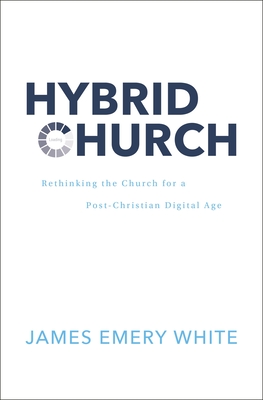
Hybrid Church: Rethinking the Church for a Post-Christian Digital Age
We live our lives in both physical and digital community. We need to do ministry the same way. Because of COVID-19, nearly every church in the US was forced to adapt to a quarantine and adopt new ministry strategies, including digital technologies they may have avoided before. When services began to be offered in-person once more, many church leaders said they hoped they'd never have to "live stream" again for the rest of their lives. But then came the people didn't return in droves, and declining attendance steepened. The pandemic had only accelerated the profound cultural changes that were already marginalizing the church and reducing its relevance. In Hybrid Church , James Emery White argues that the post-pandemic church must commit to a hybrid strategy as the only means to reach a post-Christian culture in a digital age. This book will help you rethink the church's approach and stretch you to move beyond the mentality of "that's the way we've always done it." First outlining the dynamics and depths of the new realities we face, White then walks you through major ways of rethinking digital community, strategic thinking, discipleship, and outreach—tackling practical topics Hybrid Church is written to enable pastors and church leaders to see the positive opportunities in the radical changes of the day and to help model a dynamic new approach to ministry.
- GenresLeadership
240 pages, Hardcover
Published February 28, 2023
About the author
James Emery White
32 books55 followersJames Emery White is the founding and senior pastor of Mecklenburg Community Church in Charlotte, North Carolina; president of Serious Times, a ministry that explores the intersection of faith and culture. Dr. White is an adjunctive professor of theology and culture at Gordon-Conwell Theological Seminary, where he also served as their fourth president; and author of more than twenty books.
Ratings & Reviews
Friends & Following
Create a free account to discover what your friends think of this book!
Community Reviews
Displaying 1 - 11 of 11 reviews

September 27, 2025
I think pastors should read and wrestle with this book, however in the end I strongly disagree with White's conclusions. In summary here are my issues with his book:
1. This book's primary motivator is pragmatism. The main metric by which White judges the success of his "online campus" is through engagement, clicks, salvations, etc. This approach is subtly poisonous, because on the surface what looks like success ignores the shallow nature of what lies beneath.
2. This book assumes that the problem is the solution. While White acknowledges the loneliness, technological addiction, and lack of commitment of our world he assumes that a greater church presence in digital space is the solution to these problems. There is much evidence that the cause of many of these problems is the abundance of digital interconnectedness and the lack of physical connection, yet White argues that a digital solution can solve the issues created by the digital.
3. This book has a very "adapt or die" approach that pervades the arguments. White claims that we must evaluate and change how we do church and that the church cannot simply do what we've always done, because we are now in a post-Christian culture. While methods can and should change, we should always when evaluating a new methodology question not only "what will we gain?", but also "what will we lose?". Alarmism often drives to action, before we can thoroughly evaluate, and that seems to be the case here as well.
On page 133 White proposes three truisms:
"1)we cannot bury our heads in the sand as if there are no new questions being posed to the doctrine of the church,
2)we cannot march blindly forward into the digital world as if theology doesn't matter,and
3)we cannot restrain ecclesiastical innovation as if there hasn't been a digital revolution."
Let me propose my own:
1)A lack of techno-optimism isn't intentional ignorance.
2)We must be theologically intentional with what we do and accept.
3)God is bigger and more powerful than any human revolution and He has promised to build His church.
Read with caution.
1. This book's primary motivator is pragmatism. The main metric by which White judges the success of his "online campus" is through engagement, clicks, salvations, etc. This approach is subtly poisonous, because on the surface what looks like success ignores the shallow nature of what lies beneath.
2. This book assumes that the problem is the solution. While White acknowledges the loneliness, technological addiction, and lack of commitment of our world he assumes that a greater church presence in digital space is the solution to these problems. There is much evidence that the cause of many of these problems is the abundance of digital interconnectedness and the lack of physical connection, yet White argues that a digital solution can solve the issues created by the digital.
3. This book has a very "adapt or die" approach that pervades the arguments. White claims that we must evaluate and change how we do church and that the church cannot simply do what we've always done, because we are now in a post-Christian culture. While methods can and should change, we should always when evaluating a new methodology question not only "what will we gain?", but also "what will we lose?". Alarmism often drives to action, before we can thoroughly evaluate, and that seems to be the case here as well.
On page 133 White proposes three truisms:
"1)we cannot bury our heads in the sand as if there are no new questions being posed to the doctrine of the church,
2)we cannot march blindly forward into the digital world as if theology doesn't matter,and
3)we cannot restrain ecclesiastical innovation as if there hasn't been a digital revolution."
Let me propose my own:
1)A lack of techno-optimism isn't intentional ignorance.
2)We must be theologically intentional with what we do and accept.
3)God is bigger and more powerful than any human revolution and He has promised to build His church.
Read with caution.

January 22, 2025
A contemporary take at what it looks like to open the digital front door of the church. Many helpful elements are presented, especially for those who are digitally lagging. White's approach to the use of media will be a little too left leaning for most, but he does offer helpful and practical ideas that any church could implement in their media strategy.

June 19, 2025
This book is very frustrating to me. There were so many points I was in agreement with but I was let down. I also feel like the book was not organized well and it could have been a little shorter.
March 13, 2023
We are in a post Christian culture that is running away from God as fast as it can. How do you engage a world that is doing that. You do so by moving onto their turf, the internet, and begin to engage there. As we look to find new ways to reach a lost world, we need to realize that the old way, may still work, but there are other ways out there. It was refreshing to see someone who was forced to take the plunge into a world I have been working in for 20 years, the digital world. I struggled to get the company I was working for to turn from analog to digital all of those years. But during that time, the church remained analog. The firm I left is now truly digital, the church though, still insists on “legacy” ways of doing things. Those ways indeed do work, but wouldn’t it be great to expand and see even more come to a knowledge of Christ? Moving to a hybrid digital/legacy world for church is a logical place to go. WE are right back to where I was when we first introduced music with a beat to church. May the Lord continue to add to His church.

September 5, 2024
As a member of Jim’s church (Meck), I have been witness not only to the transition into a hybrid church in the digital world, but also to the immense humility and servant leadership he offers and lives out on a daily basis. The overlying concept of staying true to the church’s strategy (sharing Christ with a world that does not know Him) rather than staying married to tactics (the ways this has been accomplished in the past) is paramount. If we are going to reach people in a broken world, we must be willing to go where they are.

May 19, 2023
Maybe I'm more educated on this topic than I thought, but just didn't learn much more than I already knew on the topic. This books is a cursory primer of the need for churches to be digital churches with a physical location. Good content. Good ideas. I was just hoping for more. If you're new to the topic and are not yet convinced that the church needs to function differently going forward, then this book is a great place to start.

June 12, 2023
This book and approach speaks to a very specific type of Church (mainly large, heavily resourced and large staff churches). Every church could benefit by implementing some of what White speaks to in this book, but most churches do not have the time, resources, or money to accomplish what White proposed. For those who can, go for it.

February 28, 2024
Fascinating and optimistic. Some concerns around certain elements and pragmatism over theology on occasion. Also a sense of mission as central rather than as effect, but generally worth reading.

July 24, 2024
Read this as a staff for work, interesting to think about and discuss!

January 8, 2025
Helpful background information on the move into the technological age; church 3.0. White summarizes a lot of authors/book/articles so that I don't have to. However, some of his suggested solutions are not helpful in my setting. I do not have a studio to film YouTube course work. I do not have a social media team to manage my content. I haven't given up on the book (yet) but I'm setting it aside for a while. I hope the solutions/suggestions become more practical...

December 12, 2023
The pandemic has forever changed the world, including how one finds and connects with the church. In the "Hybrid Church", James Emery White is not afraid to face the elephant in the room about this post-pandemic and post-Christian digital age in which we live. While many churches could not wait to return to business as usual, White acknowledges and explores that one of our largest group of unchurched individuals can be reached digitally. In fact, it is imperative that churches use digital means as part of their outreach. Can a church have both a physical and an online campus? That is exactly what White's church has done. Be prepared to reconsider deep ideas you may have about how people "should be churched" as White takes you on the journey to the digital church, where barriers are broken down and access is everything the church is willing to make it. This book should be required reading church leaders and those who lead Christian education.
Displaying 1 - 11 of 11 reviews