

What do you think?

The End of All Skies
A tyrant’s cruel reign comes to an end in a mythical Southeast Asian Sultanate where the powerless rise up against gods and monsters
The final days of Sun Girna Ginar have arrived.
The old witch in the marketplace knows it, but no one believes her. How could the Sultanate fall when the God-Sultan rules over the earth and Skyworld? How could anyone ever defeat General Marandang,
the giant slayer, and the city’s champion, Lam-Ang? Entering into a wager with the gods, the old witch promises to destroy the city. And by granting the most insignificant the ability to make their dreams come true, it all comes to pass. We witness the fall of the Sultan’s great city through their the hunter who seeks revenge, the one-handed thief who wants justice, and the exiled datu searching for redemption. Together, they bring about the destruction of the city of Sun Girna Ginar. Its walls are breached by the six-headed giant of Gawi-Gawen as fire consumes the Palace and the never-ending rain swallows the city in flood.
The End of All Skies is a story of reclaimed myths, but it is also a mirror of recent history, of today. It revisits our lost past and entreats us to never forget the sins committed against us, while reminding us of the power and humanity
each of us possesses.
The final days of Sun Girna Ginar have arrived.
The old witch in the marketplace knows it, but no one believes her. How could the Sultanate fall when the God-Sultan rules over the earth and Skyworld? How could anyone ever defeat General Marandang,
the giant slayer, and the city’s champion, Lam-Ang? Entering into a wager with the gods, the old witch promises to destroy the city. And by granting the most insignificant the ability to make their dreams come true, it all comes to pass. We witness the fall of the Sultan’s great city through their the hunter who seeks revenge, the one-handed thief who wants justice, and the exiled datu searching for redemption. Together, they bring about the destruction of the city of Sun Girna Ginar. Its walls are breached by the six-headed giant of Gawi-Gawen as fire consumes the Palace and the never-ending rain swallows the city in flood.
The End of All Skies is a story of reclaimed myths, but it is also a mirror of recent history, of today. It revisits our lost past and entreats us to never forget the sins committed against us, while reminding us of the power and humanity
each of us possesses.
262 pages, Paperback
Published November 15, 2022
About the author
Vincent C. Sales
3 books5 followersVincent C. Sales has been a writer for over twenty-five years. He began his career as an advertising copywriter and spent a decade in the industry. As a journalist, he was editor-in-chief of a leading consumer electronics magazine. In recent years, he has been a content creator for several Asian online platforms.
He is the author of several books: The End of All Skies, published by Penguin Random House SEA, Children in Exile, a self-published anthology of short fiction, as well as a trilogy of best-selling genre novels.
He is the author of several books: The End of All Skies, published by Penguin Random House SEA, Children in Exile, a self-published anthology of short fiction, as well as a trilogy of best-selling genre novels.
Ratings & Reviews
Friends & Following
Create a free account to discover what your friends think of this book!
Community Reviews
Displaying 1 - 28 of 28 reviews

August 16, 2022
The End of All Skies by Vincent C. Sales📚
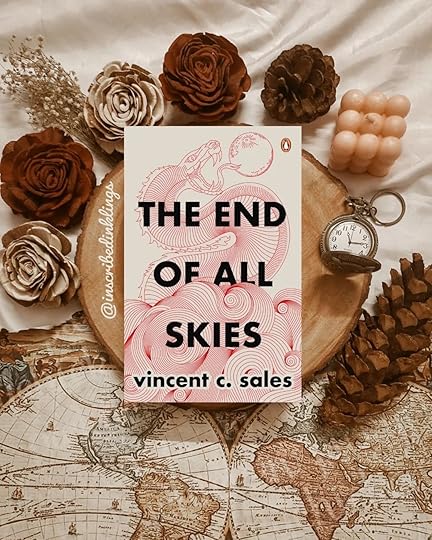
The End of All Skies was an explosive tale based on Filipino mythology. It was my first try on an Asian mythology. It was a rare experience for me. I am always partial to the fantasy genre and trying something new it got me excited. But I did find the writing to be a smidgen hard to comprehend.
The way it flitted between so many different narrations made the text incohesive. I loved the feminist undertone of the story. The whole vision of the good vs evil was played perfectly here. The characters were all quirky and interesting. The plot was fast paced and engaging. The writing style was discursive and ornate. The tone of the book was earnest and nostalgic.
The story was about the city of Sun Girna Ginar which was ruled by a tyrant Sultan. The old Skyworld with the Gods have all but vanished. The few God's hiding about are really furious about the things that the Sultan had done. I really loved the character of the witch doling out dreams in bottles. Her wager with the Gods was so interesting to read about. If you love Asian fantasy/mythology, you must read this one!
Rating- ⭐⭐⭐⭐
- Afreen Khalil
The End of All Skies was an explosive tale based on Filipino mythology. It was my first try on an Asian mythology. It was a rare experience for me. I am always partial to the fantasy genre and trying something new it got me excited. But I did find the writing to be a smidgen hard to comprehend.
The way it flitted between so many different narrations made the text incohesive. I loved the feminist undertone of the story. The whole vision of the good vs evil was played perfectly here. The characters were all quirky and interesting. The plot was fast paced and engaging. The writing style was discursive and ornate. The tone of the book was earnest and nostalgic.
The story was about the city of Sun Girna Ginar which was ruled by a tyrant Sultan. The old Skyworld with the Gods have all but vanished. The few God's hiding about are really furious about the things that the Sultan had done. I really loved the character of the witch doling out dreams in bottles. Her wager with the Gods was so interesting to read about. If you love Asian fantasy/mythology, you must read this one!
Rating- ⭐⭐⭐⭐
- Afreen Khalil

October 12, 2022
2.5 stars
First, I want to thank Penguin Random House SEA for reaching out to me about reviewing one of their books. When I got the list and saw “The End of All Skies” I was intrigued; a story about a rising rebellion set on taking down an evil sorcerer? And Giants? Sign me up! However, it only took about 20 pages for me to realize that this book is not for me.
⭐️
Let me paint a picture: this book is 250 pages with 47 chapters and is told from 19 perspectives. NINETEEN POVS IN 250 PAGES. So naturally, there is little to no character development and I found it very hard to tell many of the characters apart. On top of that, of these 19, 14 are men while 5 are women. And almost every woman POV chapter made me uncomfortable (I don’t want to say men can’t write women but if you know you know).
⭐️
Therein lies the issue for me; I’m a character driven story type of person and this book is definitely more on the plot heavy side. I found myself thinking that if I was watching this as an anime I would be fine, not my fave but still a good story, but as a narrative it was frustrating. If it was only told from our main three heros and the witch? Definitely would be better but then you still run into the problem of the writing style which just wasn’t to my tastes.
⭐️
Overall I can definitely see that some people will be into this book - but for me, I’m just glad I made it through it without DNFing.
First, I want to thank Penguin Random House SEA for reaching out to me about reviewing one of their books. When I got the list and saw “The End of All Skies” I was intrigued; a story about a rising rebellion set on taking down an evil sorcerer? And Giants? Sign me up! However, it only took about 20 pages for me to realize that this book is not for me.
⭐️
Let me paint a picture: this book is 250 pages with 47 chapters and is told from 19 perspectives. NINETEEN POVS IN 250 PAGES. So naturally, there is little to no character development and I found it very hard to tell many of the characters apart. On top of that, of these 19, 14 are men while 5 are women. And almost every woman POV chapter made me uncomfortable (I don’t want to say men can’t write women but if you know you know).
⭐️
Therein lies the issue for me; I’m a character driven story type of person and this book is definitely more on the plot heavy side. I found myself thinking that if I was watching this as an anime I would be fine, not my fave but still a good story, but as a narrative it was frustrating. If it was only told from our main three heros and the witch? Definitely would be better but then you still run into the problem of the writing style which just wasn’t to my tastes.
⭐️
Overall I can definitely see that some people will be into this book - but for me, I’m just glad I made it through it without DNFing.

August 11, 2022
"Stories begin as truths, though they resemble lies and they grow to become much greater."
- 'The End of All Skies' by Vincent C. Sales
'The End of All Skies' is a an elaborate tale based on Filippino Mythology. This novel is an intermingling of several worlds of pre-colonial Philippines.There is the Skyworld inhabited by the gods, the city of Sun Girna Ginar under the Sultanate. There are dragons, giants including the sux headed giant - Gawi-Gawen, witches and Filippino ghost-like elements like the tikibalang, giant birds, Betkakang (the giant ancient fish), head hunters, etc.It speaks of a time when gods and humans mixed.
The Sultan who rules Sun Girna Ginar is considered as a God by his people. He had enslaved a god, Kalaon from whom the Sultan derives his power.There are many who hopes for the Sultan's destruction for one reason or the other. There are a multitude for characters in this book with their own story - Baligat (God of rain), Magat, Adlao, Sakandal, Tagkan, Lam-Ang, Aponi-Tolau, Humitau, Imugan and others - each story explaining why they are how they are! And, linking every story is an old woman witch who sells dreams. She uses her power to influence humans to destroy the city of Sun Girna Ginar. A God comes to know of her plans and stands against it. Does she succeed?
This novel is not only a fun and fast paced magical realistic tale, it is intelligent work and asks a lot of existential questions.It incorporates elemenst like time travel, karma, acceptance, love, loss, immortality, memory, and the like.
A favourite part of the narration is the author's feminist retelling of an age old Filippino mythical story of Aponi-Tolau and Humitau, daughter of the sea God;and the mighty flood.
With this work the author interwove myth,history and modern thoughts to create a brilliant novel which is very intriguing and at the same time gives the reader glimpses of Filippino oral traditions.I highly recommend this book.Looking forward to reading works by the author and other novels from the Philippines.
Many thanks to Penguin SEA for the e-ARC. This book will be released on the 6th of September, '22.
- 'The End of All Skies' by Vincent C. Sales
'The End of All Skies' is a an elaborate tale based on Filippino Mythology. This novel is an intermingling of several worlds of pre-colonial Philippines.There is the Skyworld inhabited by the gods, the city of Sun Girna Ginar under the Sultanate. There are dragons, giants including the sux headed giant - Gawi-Gawen, witches and Filippino ghost-like elements like the tikibalang, giant birds, Betkakang (the giant ancient fish), head hunters, etc.It speaks of a time when gods and humans mixed.
The Sultan who rules Sun Girna Ginar is considered as a God by his people. He had enslaved a god, Kalaon from whom the Sultan derives his power.There are many who hopes for the Sultan's destruction for one reason or the other. There are a multitude for characters in this book with their own story - Baligat (God of rain), Magat, Adlao, Sakandal, Tagkan, Lam-Ang, Aponi-Tolau, Humitau, Imugan and others - each story explaining why they are how they are! And, linking every story is an old woman witch who sells dreams. She uses her power to influence humans to destroy the city of Sun Girna Ginar. A God comes to know of her plans and stands against it. Does she succeed?
This novel is not only a fun and fast paced magical realistic tale, it is intelligent work and asks a lot of existential questions.It incorporates elemenst like time travel, karma, acceptance, love, loss, immortality, memory, and the like.
A favourite part of the narration is the author's feminist retelling of an age old Filippino mythical story of Aponi-Tolau and Humitau, daughter of the sea God;and the mighty flood.
With this work the author interwove myth,history and modern thoughts to create a brilliant novel which is very intriguing and at the same time gives the reader glimpses of Filippino oral traditions.I highly recommend this book.Looking forward to reading works by the author and other novels from the Philippines.
Many thanks to Penguin SEA for the e-ARC. This book will be released on the 6th of September, '22.

August 21, 2022
A huge shout-out to Penguin Books SEA for this e-Arc copy of The End of All Skies by Vincent C. Sales! If you're interested, this book will be released on September 6th 2022! So, keep your eyes peeled!
Many years ago, on telly, we had this show called The Legends of the Ring of Fire on Disney Channel. I loved that show because it recounts stories from Asian folklore that were passed down from genration to genration. At that time, the animation was high quality and spot on. When I first picked this book up, it felt nostalgic like I was transported back to my childhood days, sitting in front of telly and watching that amazing show. Thats how I felt about the book. It was simply amazing.
Based on the Filipino mythology, this book was beautifully constructed with several fantastical elements such as the tikbalang, the six headed giant Gawi-Gawen, head hunters and etc.
But what I adore most about the book is the city Sun Girna Ginar that is centered around the story. A place that I can already picture it clearly in my head. Oh, and lets not forget about Skyworld too, a place inhabited by the gods.
I am not usually a fan of fantasy and magical realism stories, but this book is worth reading! It's fast-paced and the story just captivates you! I love reading about mythologies from different countries and this was something new yet similar for me. Again, one of my favourite books of the year!
Many years ago, on telly, we had this show called The Legends of the Ring of Fire on Disney Channel. I loved that show because it recounts stories from Asian folklore that were passed down from genration to genration. At that time, the animation was high quality and spot on. When I first picked this book up, it felt nostalgic like I was transported back to my childhood days, sitting in front of telly and watching that amazing show. Thats how I felt about the book. It was simply amazing.
Based on the Filipino mythology, this book was beautifully constructed with several fantastical elements such as the tikbalang, the six headed giant Gawi-Gawen, head hunters and etc.
But what I adore most about the book is the city Sun Girna Ginar that is centered around the story. A place that I can already picture it clearly in my head. Oh, and lets not forget about Skyworld too, a place inhabited by the gods.
I am not usually a fan of fantasy and magical realism stories, but this book is worth reading! It's fast-paced and the story just captivates you! I love reading about mythologies from different countries and this was something new yet similar for me. Again, one of my favourite books of the year!

September 15, 2022
— review to come —

November 22, 2022
The End Of The Skies talks about a time where humans and gods used to live with each other. There’s a Skyworld, ruled by the gods and the city of Sun Girna Girnar ruled by the Sultanate.
Sun Girna Girnar, was on the verge of destruction but no one believed since it was impossible to defeat the god Sultan. Most of the people in the city wanted to destroy the Sultan because of their own personal reasons and the one linkage between all of them was an old witch. The witch had entered into a wager with the gods and has promised to destroy the city.
Would she be able to consume and swallow the city of The Sun Girna Ginar?
Beautifully written, the author takes us on the
journey of Filipino Mythology. With mystical beings and hidden stories, I absolutely enjoyed reading the book. One thing that I really liked was how the different character stories were interwoven in the end. Fast paced and with easy narration, I’ll definitely recommend it.
My Rating: 4/5 🌟
Sun Girna Girnar, was on the verge of destruction but no one believed since it was impossible to defeat the god Sultan. Most of the people in the city wanted to destroy the Sultan because of their own personal reasons and the one linkage between all of them was an old witch. The witch had entered into a wager with the gods and has promised to destroy the city.
Would she be able to consume and swallow the city of The Sun Girna Ginar?
Beautifully written, the author takes us on the
journey of Filipino Mythology. With mystical beings and hidden stories, I absolutely enjoyed reading the book. One thing that I really liked was how the different character stories were interwoven in the end. Fast paced and with easy narration, I’ll definitely recommend it.
My Rating: 4/5 🌟

September 14, 2022
After reading this book, it still felt surreal to me.
It was a bit hard for me to grasp every terminology used in this story as I'm not really familiar of Filipino mythology but as I went along, I could get the hang of it.
I wish the author would explore a little bit more on every character mentioned. Too bad some of the characters were left unexplained bcs their stories were really great to begin with (such as Aya and Balingkat).
It was a bit hard for me to grasp every terminology used in this story as I'm not really familiar of Filipino mythology but as I went along, I could get the hang of it.
I wish the author would explore a little bit more on every character mentioned. Too bad some of the characters were left unexplained bcs their stories were really great to begin with (such as Aya and Balingkat).

January 1, 2023
My review on : www.instagram.com/trulybynia

January 1, 2023
It begins with the story of an old witch who sells dreams in glass bottles with various shapes. The old witch knows the magnificent city of Sun Girna Ginar will fall and be forgotten. Of course no one believe her for the city is protected by General Marandang, the giant slayer, and God-Sultan rules over earth and Skyworld. The fate of the city was told from the beginning but how it came unfolded will keep you on your toes till the end.
We are introduced to a lot of characters, A LOT! 😂, and each has their own dream. There's simple dream of seeing loved ones once more, dream of power, dream of family, any dream, intermingle, and without they know, is a part of something bigger. We see their growth and the short glimpses of their struggles towards their end goal and, with that, I cannot help for rooting them all for every dream matters. The fast paced tales will make you intrigued and cannot stop.
As any great fantasy stories, it also talks more than a tale. It incorporates elements like time travel, karma, acceptance, love, loss, immortality, memory, and the like. Vincent C. Sales brilliantly interwove myth, history and modern thoughts in this novel. Yes, there is the Skyworld inhabited by the gods and mixed with human, there are dragons, giants, witches, and mythical creatures. It's also imbued with social commentary on power, tyranny, class & gender. You will find how woman in the stories held important parts and how people power hold much greater strength. I love how the good vs evil was told, everything is not always black or white.
As a reader who began to love books because of amazing fantasy stories, and mostly western, reading this book gave me comfort. The strange world full of magical and mythical creatures feels so familiar and close. It gives us a glimpse of the richness of Southeast Asian oral traditions, especially Filippino. Somehow it's kind of refreshing.
It's definitely a tale you need to read.
We are introduced to a lot of characters, A LOT! 😂, and each has their own dream. There's simple dream of seeing loved ones once more, dream of power, dream of family, any dream, intermingle, and without they know, is a part of something bigger. We see their growth and the short glimpses of their struggles towards their end goal and, with that, I cannot help for rooting them all for every dream matters. The fast paced tales will make you intrigued and cannot stop.
As any great fantasy stories, it also talks more than a tale. It incorporates elements like time travel, karma, acceptance, love, loss, immortality, memory, and the like. Vincent C. Sales brilliantly interwove myth, history and modern thoughts in this novel. Yes, there is the Skyworld inhabited by the gods and mixed with human, there are dragons, giants, witches, and mythical creatures. It's also imbued with social commentary on power, tyranny, class & gender. You will find how woman in the stories held important parts and how people power hold much greater strength. I love how the good vs evil was told, everything is not always black or white.
As a reader who began to love books because of amazing fantasy stories, and mostly western, reading this book gave me comfort. The strange world full of magical and mythical creatures feels so familiar and close. It gives us a glimpse of the richness of Southeast Asian oral traditions, especially Filippino. Somehow it's kind of refreshing.
It's definitely a tale you need to read.

September 14, 2022
“And with every re-telling of my story, the voice of the truth will become stronger until all the lies have been silenced.”
Thank you Penguin Books SEA for the #ARC copy in return for honest reviews.
“The End of All Skies” by Vincent C. Sales, is the next Asian Fantasy you need to have on your shelves! It's magical, adorned with the classic fantastical elements—Witches, Dragons, Giants & Gods but there's much more to what meets the eyes.
The city of ‘Sun Girna Ginar’ is ruled by a Tyrant Sultan who draws his power from the God of Destruction, Kalaon; but just like the cycle of Life, Sun Girna Ginar will also meets its destruction & this destruction won't be fought in the battlefields but will bloom in the dreams of the common folk; from the fires of The Witch's bottle of Dreams, who dreams of the city's end.
The End of All Skies welcomes you to one epic adventure, where the destiny is drawn out to you from the beginning but the desire to see it run its course will keep you on your toes till the end.
We are introduced to a lot of characters & we see their growth behind the lens and even though a lot of effort isn't invested on carving their tumultuous journey, we still feel their sheer will flowing in every words & the short glimpses of their struggles towards their end goal grips your heart.
The author craftly orchestrates his story, setting up the chess pieces on the board, until he finally calls out checkmate.
The non-linear narrative & too many characters with their own arc might take some time to adjust if you aren't acquainted with the style but once you find a common ground the book will keep you intrigued.
I loved the short chapters & it was pretty fast paced. Though I didn't necessarily form a deep connection with the characters except for one or two, I did empathise with all & the ripple they set in the motion.
I have only got a byte sized knowledge of Fillipino Mythology but after reading this book I'm definitely intrigued to explore the culture.
I really enjoyed the essence of this read & its social themes of power, tyranny, class & gender divide, destruction & a new beginning. The power of people & calling upon their longings might seem weak to many but holds much greater strength than one can fathom & this message, especially in the current times we're living in is a powerful rendition.
This was definitely a different read than most of the Fantasy books I get recommended but it's much more special. I know I'll be coming back to it.
I'm definitely recommending this to y'all! 🤌 Save it up Fantasy lovers.
Thank you Penguin Books SEA for the #ARC copy in return for honest reviews.
“The End of All Skies” by Vincent C. Sales, is the next Asian Fantasy you need to have on your shelves! It's magical, adorned with the classic fantastical elements—Witches, Dragons, Giants & Gods but there's much more to what meets the eyes.
The city of ‘Sun Girna Ginar’ is ruled by a Tyrant Sultan who draws his power from the God of Destruction, Kalaon; but just like the cycle of Life, Sun Girna Ginar will also meets its destruction & this destruction won't be fought in the battlefields but will bloom in the dreams of the common folk; from the fires of The Witch's bottle of Dreams, who dreams of the city's end.
The End of All Skies welcomes you to one epic adventure, where the destiny is drawn out to you from the beginning but the desire to see it run its course will keep you on your toes till the end.
We are introduced to a lot of characters & we see their growth behind the lens and even though a lot of effort isn't invested on carving their tumultuous journey, we still feel their sheer will flowing in every words & the short glimpses of their struggles towards their end goal grips your heart.
The author craftly orchestrates his story, setting up the chess pieces on the board, until he finally calls out checkmate.
The non-linear narrative & too many characters with their own arc might take some time to adjust if you aren't acquainted with the style but once you find a common ground the book will keep you intrigued.
I loved the short chapters & it was pretty fast paced. Though I didn't necessarily form a deep connection with the characters except for one or two, I did empathise with all & the ripple they set in the motion.
I have only got a byte sized knowledge of Fillipino Mythology but after reading this book I'm definitely intrigued to explore the culture.
I really enjoyed the essence of this read & its social themes of power, tyranny, class & gender divide, destruction & a new beginning. The power of people & calling upon their longings might seem weak to many but holds much greater strength than one can fathom & this message, especially in the current times we're living in is a powerful rendition.
This was definitely a different read than most of the Fantasy books I get recommended but it's much more special. I know I'll be coming back to it.
I'm definitely recommending this to y'all! 🤌 Save it up Fantasy lovers.

September 3, 2022
What do you think of dreams being sold in a bottle by an old witch down the market lane? Sounds pretty interesting right?
End of All Skies is based on Filipino mythology. Set in the mythical city of Sun Girna Ginar where cruel Sultan reigns. In a wager with the gods, the old witch promises to destroy the city.
Well, she sells a dream to each - A revenge seeking hunter, A thief with just one hand, An exiled Datu (ruler/chief) searching for redemption.
These are her heroes and how they bring down the mighty Sultan, makes the most of the story.
There is also a six headed Giant involved!
🌿
Even though, I am not an avid reader of fantasy genre... I was excited to know what this book has to offer. I won't say that it was the best experience but it wasn't the worst either. The book took a lot of time (for my personal liking) in setting up the characters and world building that by the time things started to take their course with the story, I wanted to get over with it ASAP! And that's no way to read a book so I took some time off it.
🌿
I picked it up again and started with part 2 of the book. Things got interesting as I progressed through pages. The grand schemes of different characters that come into play and how they intersected with each other was engrossing.
🌿
The writing is fairly strong with interwoven questions of what's good or bad, ethics and morals, karma; placed subtly throughout the tale. The entire story had a feminist undertone and I value that. The author has done a decent job of giving a modern twist to an age old story.
🌿
To sum it all for you, if you maintain your patience with the first half of the book, it pays off well in the end. Although, I would suggest you keep a track of different characters separately in your notes as it has many and you would not appreciate being confused about who was whom.
End of All Skies is based on Filipino mythology. Set in the mythical city of Sun Girna Ginar where cruel Sultan reigns. In a wager with the gods, the old witch promises to destroy the city.
Well, she sells a dream to each - A revenge seeking hunter, A thief with just one hand, An exiled Datu (ruler/chief) searching for redemption.
These are her heroes and how they bring down the mighty Sultan, makes the most of the story.
There is also a six headed Giant involved!
🌿
Even though, I am not an avid reader of fantasy genre... I was excited to know what this book has to offer. I won't say that it was the best experience but it wasn't the worst either. The book took a lot of time (for my personal liking) in setting up the characters and world building that by the time things started to take their course with the story, I wanted to get over with it ASAP! And that's no way to read a book so I took some time off it.
🌿
I picked it up again and started with part 2 of the book. Things got interesting as I progressed through pages. The grand schemes of different characters that come into play and how they intersected with each other was engrossing.
🌿
The writing is fairly strong with interwoven questions of what's good or bad, ethics and morals, karma; placed subtly throughout the tale. The entire story had a feminist undertone and I value that. The author has done a decent job of giving a modern twist to an age old story.
🌿
To sum it all for you, if you maintain your patience with the first half of the book, it pays off well in the end. Although, I would suggest you keep a track of different characters separately in your notes as it has many and you would not appreciate being confused about who was whom.

September 22, 2022
In a magnificent city, known as Sun Girna Girnar, there is much oppression, from the Sultan, who has captured a God and harnesses his power to mete an unhappy rule to residents.
.
This city was once at harmony with what we imagine as heaven, when gods walked equally among men and vice versa. The agenda against the sultan is strong in thoughts and dreams but in reality they fall short. In the shabby corners of a market, a witch however sells trinkets - personalized potions to make dreams come true. Her heart filled with memories of the past wants the rule of the Sultan and the city of Sun Girna Girnar destroyed.
.
When the tales of many combine, the narrative shows us the hearts of a spurned man, a thief, a six headed giant, daughter of a sea God, ghosts, and a few others leading to dreams coming true.
.
The ending is known but how it comes about, how dreams come in, how even the princess gets her wish of freedom is what has to be read.
.
The narrative in this book of 7 parts is flowing but the multiple characters and their agenda s and combining them all together in the big picture took some time but it is commendable on the authors part to have left no loose ends and how the beginning absolutely came together into the end. The yearnings of the characters and issues such as class, gender discrimination has been well camouflaged in the story. I found quite a few terms similar to ones we use in hindi - such as diwata ( devta for us) representing God and thats when I traced back to the South East Asian connection in this more!
.
Thanks @penguinbookssea for an e-arc in exchange for an honest review. This book is out now for all!
.
This city was once at harmony with what we imagine as heaven, when gods walked equally among men and vice versa. The agenda against the sultan is strong in thoughts and dreams but in reality they fall short. In the shabby corners of a market, a witch however sells trinkets - personalized potions to make dreams come true. Her heart filled with memories of the past wants the rule of the Sultan and the city of Sun Girna Girnar destroyed.
.
When the tales of many combine, the narrative shows us the hearts of a spurned man, a thief, a six headed giant, daughter of a sea God, ghosts, and a few others leading to dreams coming true.
.
The ending is known but how it comes about, how dreams come in, how even the princess gets her wish of freedom is what has to be read.
.
The narrative in this book of 7 parts is flowing but the multiple characters and their agenda s and combining them all together in the big picture took some time but it is commendable on the authors part to have left no loose ends and how the beginning absolutely came together into the end. The yearnings of the characters and issues such as class, gender discrimination has been well camouflaged in the story. I found quite a few terms similar to ones we use in hindi - such as diwata ( devta for us) representing God and thats when I traced back to the South East Asian connection in this more!
.
Thanks @penguinbookssea for an e-arc in exchange for an honest review. This book is out now for all!
This entire review has been hidden because of spoilers.

September 19, 2022
I received a free advanced reviewers' copy (ARC) from Penguin Random House SEA in exchange of an honest review
Rating: 4/5 stars
"The children will create their own world... they are the hope for the future, not this instrument of death." -Vincent C. Sales
This book revolves around a fictional city of Sun Girna Ginar ruled by a tyrant Sultan in its final days before gods and monsters threaten to destroy it. This is heavily inspired by Filipino folklores and mythological characters and creatures.
The End of All Skies is a fantastic read from beginning to end. The book is not short of fantastical elements and characters - a dragon, a giant, a ghost - you name it. However, I was overwhelmed by the sheer number of POVs (8-10?) that I wished the author could explore their significance the readers could connect (and perhaps love) them especially helpful for non-Filipino readers like myself. By the time I was two-third done, I just surrendered on remembering the names and their respective stories, and just continued on. But despite the multi-POV, I found the story flowed quite nicely and it's resolved beautifully.
I am certain scholars can draw important issues particularly the social injustices touched upon in this novel, like the rich-poor, men-women, good-evil divide. I definitely appreciate that. Overall, an above average read.
"'Take heart, Lam-Ang,' the oracle said. 'They sing songs about you! That will never die." -Vincent C. Sales
Rating: 4/5 stars
"The children will create their own world... they are the hope for the future, not this instrument of death." -Vincent C. Sales
This book revolves around a fictional city of Sun Girna Ginar ruled by a tyrant Sultan in its final days before gods and monsters threaten to destroy it. This is heavily inspired by Filipino folklores and mythological characters and creatures.
The End of All Skies is a fantastic read from beginning to end. The book is not short of fantastical elements and characters - a dragon, a giant, a ghost - you name it. However, I was overwhelmed by the sheer number of POVs (8-10?) that I wished the author could explore their significance the readers could connect (and perhaps love) them especially helpful for non-Filipino readers like myself. By the time I was two-third done, I just surrendered on remembering the names and their respective stories, and just continued on. But despite the multi-POV, I found the story flowed quite nicely and it's resolved beautifully.
I am certain scholars can draw important issues particularly the social injustices touched upon in this novel, like the rich-poor, men-women, good-evil divide. I definitely appreciate that. Overall, an above average read.
"'Take heart, Lam-Ang,' the oracle said. 'They sing songs about you! That will never die." -Vincent C. Sales

January 25, 2023
Literally hard for me to continue this book. Im so sorry. This book aint for me 🥺

April 25, 2025
A grand tale that centers around an old woman who sells dreams in the palengke. It’s through the lens of so many individuals making it a kaleidoscope of perspectives that capture the vastness of the grand ancient city that Vincent C Sales is depicting. Felt like a modern folktale yet it had echoes of old stories and creatures. I loved the mystical elements. Magical in a uniquely Filipino way too. Would recommend!

October 3, 2023
I have read the reviews and learned about the several POV’s I didn’t care to count. I didn’t want that to hinder me by overwhelming me so I read each chapter/POV like a short story.
Most of the Filipino terms used here were explained within the story, save for one, I think, which I appreciated and foreigners probably do as well without the hassle of turning to the glossary page.
Parts of the story moved forward too fast and some were flashbacks, yet they’re easily understandable as long as I grasped what was currently happening. There’s also the time thing that seemed like the grandfather paradox.
There were characters that were never mentioned again and somehow I wondered what became of them.
Over all, it was interesting and exciting with all the magic and a bit of romance. The ending was all right and a little sad, but not quite a cliffhanger.
Most of the Filipino terms used here were explained within the story, save for one, I think, which I appreciated and foreigners probably do as well without the hassle of turning to the glossary page.
Parts of the story moved forward too fast and some were flashbacks, yet they’re easily understandable as long as I grasped what was currently happening. There’s also the time thing that seemed like the grandfather paradox.
There were characters that were never mentioned again and somehow I wondered what became of them.
Over all, it was interesting and exciting with all the magic and a bit of romance. The ending was all right and a little sad, but not quite a cliffhanger.

October 7, 2023
Nice to see a book using older Filipino mythology!
Loooved the world and elements. Was a bit confusing (because there were a lot of POVs) but it came together eventually.
Definitely read it for something fresh and mystical.
Loooved the world and elements. Was a bit confusing (because there were a lot of POVs) but it came together eventually.
Definitely read it for something fresh and mystical.
September 20, 2022
Wouldn't it be amazing to have dreams to be sold in little bottles and all you would have to do to achieve those would be either to drink the potion in the bottle or put it on something/somewhere where it can grow to be a reality?
If you answered with a yes to that, then this fantasy fiction will have you on your tips to know what happens next.
"𝘼𝙡𝙡 𝙩𝙝𝙚𝙨𝙚 𝙢𝙚𝙣 𝙖𝙣𝙙 𝙬𝙤𝙢𝙚𝙣 - 𝙩𝙝𝙚𝙮 𝙖𝙧𝙚 𝙩𝙝𝙚 𝙞𝙣𝙨𝙩𝙧𝙪𝙢𝙚𝙣𝙩𝙨 𝙤𝙛 𝙢𝙮 𝙙𝙚𝙨𝙩𝙧𝙪𝙘𝙩𝙞𝙤𝙣."
The End of All Skies revolves around the ruler of Sun Girna Ginar - the Sultan, Baligat, Magat, Adlao, Sakandal, Tagkan, Lam-Ang, Aponi-Tolau, Humitau, Imugan, Aya and of course the witch who sells dreams. The witch is forming her army by using her power to get a hold of humans to destroy the city of Sun Girna Ginar by selling those dreams that come in a bottle. Now the question is, does she succeed? (I will leave this as a question for you to unravel)
Although I had a little tough time getting used to the terms in the book and remembering the names of the characters, what got me hooked to it was how fast paced the setting was. A complete page turner. Having said that, this book also questions the divide between the good and the bad, the men and the women and at times the rich and the poor. Apart from that the storyline also covers a variety of themes based on love, karma, trust, acceptance, loss to name a few.
This was probably my first time reading an Asian Fantasy Fiction, and I would say I enjoyed it. The narration and the language are quite easy once you get a hold of them and also, I will say have patience to get past the first two parts, the story picks up and in no time you will get lost in the world of Skyworld and Sun Girna Ginar.
Thank you @penguinbookssea for sending this e-ARC✨
If you answered with a yes to that, then this fantasy fiction will have you on your tips to know what happens next.
"𝘼𝙡𝙡 𝙩𝙝𝙚𝙨𝙚 𝙢𝙚𝙣 𝙖𝙣𝙙 𝙬𝙤𝙢𝙚𝙣 - 𝙩𝙝𝙚𝙮 𝙖𝙧𝙚 𝙩𝙝𝙚 𝙞𝙣𝙨𝙩𝙧𝙪𝙢𝙚𝙣𝙩𝙨 𝙤𝙛 𝙢𝙮 𝙙𝙚𝙨𝙩𝙧𝙪𝙘𝙩𝙞𝙤𝙣."
The End of All Skies revolves around the ruler of Sun Girna Ginar - the Sultan, Baligat, Magat, Adlao, Sakandal, Tagkan, Lam-Ang, Aponi-Tolau, Humitau, Imugan, Aya and of course the witch who sells dreams. The witch is forming her army by using her power to get a hold of humans to destroy the city of Sun Girna Ginar by selling those dreams that come in a bottle. Now the question is, does she succeed? (I will leave this as a question for you to unravel)
Although I had a little tough time getting used to the terms in the book and remembering the names of the characters, what got me hooked to it was how fast paced the setting was. A complete page turner. Having said that, this book also questions the divide between the good and the bad, the men and the women and at times the rich and the poor. Apart from that the storyline also covers a variety of themes based on love, karma, trust, acceptance, loss to name a few.
This was probably my first time reading an Asian Fantasy Fiction, and I would say I enjoyed it. The narration and the language are quite easy once you get a hold of them and also, I will say have patience to get past the first two parts, the story picks up and in no time you will get lost in the world of Skyworld and Sun Girna Ginar.
Thank you @penguinbookssea for sending this e-ARC✨
September 13, 2022
The End of all Skies is based on Asian Mythology, specifically that of the Philippines. This is a blend of fantasy and mythology, which made this book more enjoyable.
The book talks about different mankind societies linked up with each other and their tactics to conquer the country. The main story revolves around the city of Sun Girna Ginar which is ruled by the Sultan and the skyworld which was inhabited by gods. Most of the gods of the skyworld have vanished because of the Sultan and the remaining are cursing him for the destruction. There are so many people who are seeking some ideas to destroy Sultan.
There are a lot of characters such as Magat, Baligat, Hamitau, Adlao and many more telling their problems. And there is one old witch who knows that the city will be destroyed soon and she uses her power to influence humans to destroy the city of Sun Girna Ginar by selling dreams. Isn’t this part interesting? I was hooked right from here and couldn’t stop.
This novel is fast-paced with many magical creatures such as tikibalang, giant birds, Betkakang, Gawi- Gawen. With everything in the story, the book also leaves an impression of karma, acceptance, love, loss and eternal life.
This was my first filipino folklore, and i loved reading it so much. I love Knowing more about other cultures and lifestyles. The reason I read read this book was the title.
I don’t know whether I have used the right words to justify this beautiful book but it was amazing and something unique.
The book talks about different mankind societies linked up with each other and their tactics to conquer the country. The main story revolves around the city of Sun Girna Ginar which is ruled by the Sultan and the skyworld which was inhabited by gods. Most of the gods of the skyworld have vanished because of the Sultan and the remaining are cursing him for the destruction. There are so many people who are seeking some ideas to destroy Sultan.
There are a lot of characters such as Magat, Baligat, Hamitau, Adlao and many more telling their problems. And there is one old witch who knows that the city will be destroyed soon and she uses her power to influence humans to destroy the city of Sun Girna Ginar by selling dreams. Isn’t this part interesting? I was hooked right from here and couldn’t stop.
This novel is fast-paced with many magical creatures such as tikibalang, giant birds, Betkakang, Gawi- Gawen. With everything in the story, the book also leaves an impression of karma, acceptance, love, loss and eternal life.
This was my first filipino folklore, and i loved reading it so much. I love Knowing more about other cultures and lifestyles. The reason I read read this book was the title.
I don’t know whether I have used the right words to justify this beautiful book but it was amazing and something unique.

September 24, 2022
Full review on the blog:
https://dexteroustotalus.wordpress.co...
Here's a sneak peek!
"At the outset, the book exposes the underbelly of Sun Girna Ginar’s tight clutch to power anchored on the very backs of its people whom it has taken lives and liberty from. The Sultan is worshipped as a god but is at the same time its tyrant. On the one side, its people celebrate glory to wit."
"In this offering, Sales presented stories that are both familiar and refreshing. I am proud that the Philippines have these tales to boast of which he masterfully reshaped into this cohesive fantastical landscape.
"The many themes tackled in this book predominantly aligns with contemporary struggles and the country’s current political climate. As these characters paint the backdrop in good and evil, there is another plethora of individuals equally troubled in the raking clashes."
"The End of All Skies stands a proud representative of Southeast Asian fantasy in our bid to promote our culture and our bountiful talents. Sales is triumphant in weaving this multi-layered story that bring our culture and identity to the fore."
https://dexteroustotalus.wordpress.co...
Here's a sneak peek!
"At the outset, the book exposes the underbelly of Sun Girna Ginar’s tight clutch to power anchored on the very backs of its people whom it has taken lives and liberty from. The Sultan is worshipped as a god but is at the same time its tyrant. On the one side, its people celebrate glory to wit."
"In this offering, Sales presented stories that are both familiar and refreshing. I am proud that the Philippines have these tales to boast of which he masterfully reshaped into this cohesive fantastical landscape.
"The many themes tackled in this book predominantly aligns with contemporary struggles and the country’s current political climate. As these characters paint the backdrop in good and evil, there is another plethora of individuals equally troubled in the raking clashes."
"The End of All Skies stands a proud representative of Southeast Asian fantasy in our bid to promote our culture and our bountiful talents. Sales is triumphant in weaving this multi-layered story that bring our culture and identity to the fore."

September 18, 2022
This is a story heavily inspired by Filipino mythology which was a great way to be reminded of how rich our legends and myths are.
This is a perfect read for fans of short chapters! We were introduced to different characters per chapter as well but in the end, they all tied up real nice. The book has an interesting storytelling. Not similar to most books I’ve read, which made the experience a lot interesting.
Although the story is fantasy, it did reflect a lot of realities in our society. My greatest takeaway is to cherish and to hold on to whatever dream you have. No single person can tell you if your dream matters or not. It’s yours to own and to work hard for.
Thank you so much to penguinsea for sending me a review copy!
verdict: highly recommended ☕️
This is a perfect read for fans of short chapters! We were introduced to different characters per chapter as well but in the end, they all tied up real nice. The book has an interesting storytelling. Not similar to most books I’ve read, which made the experience a lot interesting.
Although the story is fantasy, it did reflect a lot of realities in our society. My greatest takeaway is to cherish and to hold on to whatever dream you have. No single person can tell you if your dream matters or not. It’s yours to own and to work hard for.
Thank you so much to penguinsea for sending me a review copy!
verdict: highly recommended ☕️

November 14, 2022
I received this from Penguin Random House SEA, check out more thoughts in this vlog: https://youtu.be/6uAVJQEL56s

September 22, 2024
I think it was fitting that I finished reading The End of All Skies by Vincent C. Sales (published by Penguin Random House SEA) on September 21, the birthday of a dead tyrant, Ferdinand Marcos Sr. But let me backtrack. The book started out with the fantastical, with the larger-than-life depiction of the great kingdom of Sun Girna Ginar. The palace itself was so large that several giants could fit in it. The god cannon was so loud that it would bring people to their feet. Gods like Bagilat and heroes like Lam-ang walked on the Earth and did fantastic things. We got tales of the six-headed giant, Gawi Gawen, the wily tikbalang Saragnayan, and the crocodile god Isarog. I did not think that forgetfulness would be my biggest takeaway from the book.
I was hoping for some kind of redemption for the people of Sun Girna Girnar, particularly for the ordinary people, the slaves, who were in the background, living simple lives or starving stoically. That hope was planted when the witch in the market sold dreams that every person could afford, dreams of love, of revenge, of greatness. I’m reminded of the idiom, be careful what you wish for because wishes can turn into something else especially a deluge of them.
As I was reading, I could not help seeing the parallelisms between the events in the mythical Sun Girna Ginar and recent history. This was deliberate on the part of the author and you’ll even find it on the blurb, “The End of All Skies is a story of reclaimed myths, but it is also a mirror of recent history, of today.” The sultan in the story is renamed The Tyrant by one of the characters, Datu Adlao. “We name him instead. We call him Tyrant. We call him Lord of Lies. False Prophet, Murderer.” From the 1970s to the 1980s, there was a revolution brewing in the Philippines and the name that was used at that time was Dictator. The very same Ferdinand Marcos Sr. in my first paragraph. There are thinly veiled descriptions of the equivalent of Marcos’ rival, Benigno Aquino Jr., as Datu Adlao, of how he was exiled, how he returned, and how, after he was assassinated, he went “beyond death” for a sultan “cannot kill an idea.”
There is no triumph, though, in this book. We only see glimpses of it. What we have is forgetfulness. I think the author did not mean for it to be an excuse, an explanation, or a way out. He simply painted a picture of what was and what is. It’s more painful for me, a Filipino, to read this story. But there it is. There we have it. We have an endless case of amnesia. In place of an ousted Dictator, the country installed his son as president in 2022.
The antidote is anamnesis, a remembering, a calling to account. But that is another story yet to be told.
Go read The End of All Skies. It will break your heart, but not before showing you an epic, breathtaking, magical view. What we once were and what we may have been if only we remembered.
I was hoping for some kind of redemption for the people of Sun Girna Girnar, particularly for the ordinary people, the slaves, who were in the background, living simple lives or starving stoically. That hope was planted when the witch in the market sold dreams that every person could afford, dreams of love, of revenge, of greatness. I’m reminded of the idiom, be careful what you wish for because wishes can turn into something else especially a deluge of them.
As I was reading, I could not help seeing the parallelisms between the events in the mythical Sun Girna Ginar and recent history. This was deliberate on the part of the author and you’ll even find it on the blurb, “The End of All Skies is a story of reclaimed myths, but it is also a mirror of recent history, of today.” The sultan in the story is renamed The Tyrant by one of the characters, Datu Adlao. “We name him instead. We call him Tyrant. We call him Lord of Lies. False Prophet, Murderer.” From the 1970s to the 1980s, there was a revolution brewing in the Philippines and the name that was used at that time was Dictator. The very same Ferdinand Marcos Sr. in my first paragraph. There are thinly veiled descriptions of the equivalent of Marcos’ rival, Benigno Aquino Jr., as Datu Adlao, of how he was exiled, how he returned, and how, after he was assassinated, he went “beyond death” for a sultan “cannot kill an idea.”
There is no triumph, though, in this book. We only see glimpses of it. What we have is forgetfulness. I think the author did not mean for it to be an excuse, an explanation, or a way out. He simply painted a picture of what was and what is. It’s more painful for me, a Filipino, to read this story. But there it is. There we have it. We have an endless case of amnesia. In place of an ousted Dictator, the country installed his son as president in 2022.
The antidote is anamnesis, a remembering, a calling to account. But that is another story yet to be told.
Go read The End of All Skies. It will break your heart, but not before showing you an epic, breathtaking, magical view. What we once were and what we may have been if only we remembered.

January 28, 2023
First, a disclaimer: the author is my husband but this book review is unbiased as a wife but biased as a Filipino.
I started reading The End Of All Skies just before the holidays. This unique novel is about how dreams big and small by people big and small can achieve something great and terrible. I say it's unique because of the way it's told - from many points of view. It takes getting used to. It takes focus! It's best to read it in one sitting. That's why it took me a while to finish because of the holiday rush.
I understood some chapters in that the storytelling is very cultural, very Filipino, and how we all have our version of the story. The destruction of Sun Girna Ginar is coming and we see it unfolding from all these characters whose lives were affected by this great city. Whose story is real? Whose story matters? In the end, I realized each story is important because each one, no matter how short or fleeting, contributed to the downfall of Sun Girna Ginar.
Here is the biased part - as a Filipino, the story resonated with me deeply. I think peoples that were colonized, who struggled with dictators and corrupt governments, who deal with a slave/alipin mentality and have forgotten their greatness will have a more profound connection with the story.
I was moved to tears a few times, when I read about heroes who believed the people are worth dying for, about the downtrodden who finally realized they too have power inside them rose up and overthrew a powerful tyrant, about ordinary people who cleverly faced mythical creatures like tikbalangs and gigantes to achieve their goals.
It's a fascinating read! It's difficult to get into especially when you're used to just one point of view. And if you've never been in a position where imperialists and traitors stole everything from your country. But I think it's a worthy read if you're up for something new and different. And powerful and true.
The language is so beautiful, too. Proud of this #FilipinoNovel. Proud of the Filipino story. May we #NeverForget who we are!
I started reading The End Of All Skies just before the holidays. This unique novel is about how dreams big and small by people big and small can achieve something great and terrible. I say it's unique because of the way it's told - from many points of view. It takes getting used to. It takes focus! It's best to read it in one sitting. That's why it took me a while to finish because of the holiday rush.
I understood some chapters in that the storytelling is very cultural, very Filipino, and how we all have our version of the story. The destruction of Sun Girna Ginar is coming and we see it unfolding from all these characters whose lives were affected by this great city. Whose story is real? Whose story matters? In the end, I realized each story is important because each one, no matter how short or fleeting, contributed to the downfall of Sun Girna Ginar.
Here is the biased part - as a Filipino, the story resonated with me deeply. I think peoples that were colonized, who struggled with dictators and corrupt governments, who deal with a slave/alipin mentality and have forgotten their greatness will have a more profound connection with the story.
I was moved to tears a few times, when I read about heroes who believed the people are worth dying for, about the downtrodden who finally realized they too have power inside them rose up and overthrew a powerful tyrant, about ordinary people who cleverly faced mythical creatures like tikbalangs and gigantes to achieve their goals.
It's a fascinating read! It's difficult to get into especially when you're used to just one point of view. And if you've never been in a position where imperialists and traitors stole everything from your country. But I think it's a worthy read if you're up for something new and different. And powerful and true.
The language is so beautiful, too. Proud of this #FilipinoNovel. Proud of the Filipino story. May we #NeverForget who we are!

May 3, 2025
this was a really fun read! the chapters are short and the overall book is just super easy to fly through.
i feel that this reads more like a compilation of short stories— there is no one particular main character except for the old witch, and we are just reading snippets of the lives of the people that are part of the city’s destruction.
i really liked the setting and exploring this mythological world but i wish we had a more in depth discussion about it, that would be really great.
i do love the characters, though! my favourites are 100% Sakandal, the old witch Imugen, Yumina and Lumawig. i feel like it’s such a shame that we met Yumina and Lumawig so late into the book because i loved them so much!! i wish they found their happy ending together <33
some of the character stories do end with an open ending. or at least that is how i interpret it—which really makes me crave more! i want to know if they made it out alive, if they become who they dreamed to be, etc! (i’m 100% talking about Sakandal here)
i feel that this reads more like a compilation of short stories— there is no one particular main character except for the old witch, and we are just reading snippets of the lives of the people that are part of the city’s destruction.
i really liked the setting and exploring this mythological world but i wish we had a more in depth discussion about it, that would be really great.
i do love the characters, though! my favourites are 100% Sakandal, the old witch Imugen, Yumina and Lumawig. i feel like it’s such a shame that we met Yumina and Lumawig so late into the book because i loved them so much!! i wish they found their happy ending together <33
some of the character stories do end with an open ending. or at least that is how i interpret it—which really makes me crave more! i want to know if they made it out alive, if they become who they dreamed to be, etc! (i’m 100% talking about Sakandal here)

March 9, 2023
It was good, but it was also confusing. Too many times I had to flip back and see if I knew this character and which one they were. I liked that we were seeing how the city came to ruin and I liked the non-linear timeline, but I wished there were a few characters we followed all the way through instead of ten.

Read
October 3, 2024forgot to mark this as read and honestly i wamted to say stuff about it but my mood has waned.... might come back to this later
June 18, 2023
This was exactly the book for me. Short, sweet, with an interesting magic system
Displaying 1 - 28 of 28 reviews