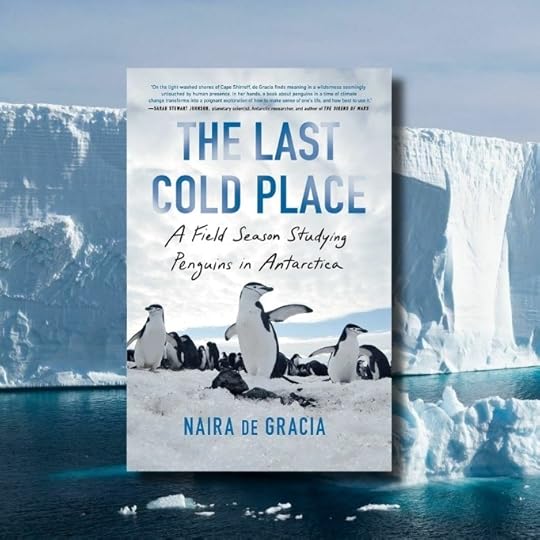
Lab Girl meets Why Fish Don’t Exist in this “compelling blend of memoir, environmental writing, and scientific exploration” (Kirkus Reviews) from a young scientist studying penguins in Antarctica—a firsthand account of the beauty and brutality of this remote climate, the direct effects of climate change on animals, and the challenges of fieldwork.
Offering a dramatic, captivating window into a once-in-a-lifetime experience, The Last Cold Place details Naira de Gracia’s time living and working in a remote outpost in Antarctica alongside seals, penguins, and a small crew of fellow field workers. In one of the most inhospitable environments in the world (for humans, anyway), Naira follows a generation of chinstrap penguins from their parents’ return to shore to build nests from pebbles until the chicks themselves are old enough to head out to sea.
Naira describes the life cycle of a funny, engaging colony of chinstrap penguins whose food source (krill, or small crustaceans) is powerfully affected by the changing ocean in lively and entertaining anecdotes. Weaving together the history of Antarctic exploration with climate science, field observations, and her own personal journey of growth and reflection, The Last Cold Place illuminates the complex place that Antarctica holds in our cultural imagination—and offers a rare glimpse into life on this uninhabited continent.
The Last Cold Place is a brief, but heartfelt memoir of the author's first year of field research studying wildlife (primarily different species of penguins, but also other birds as well as seals) in Antarctica. She and a small team were there to collect data during the breeding season, which takes place during the Antarctic summer. How many nests are there? How many are viable? How many chicks are lost to predators (this is heartbreaking, be forewarned)? How many make it long enough to return to the nest site as juveniles the next year? These are the types of questions that their five-month-long data collection sought to answer.
The author talks about daily life in this brutally cold climate and the work they were doing. But since they're so isolated, questions about her place in the world and what she, as a young person, wanted to do with the rest of her life, unsurprisingly popped up.
I thought it was a really nice, immersive, but quick read that was great to cozy up with during winter.
If a penguin stood on my foot and slapped me silly, I might rethink my plan. For Naira de Gracia, this is just part of the job. In her autobiography, she recounts five months she spent at Cape Shirreff in Antarctica with four other researchers and field workers as part of an ecosystem-monitoring program run by NOAA. The information they gather will impact global krill-fishing regulations. These tiny shrimp-like creatures are an engine for carbon capture and a keystone species in the ocean’s food web.
Since penguins are an indicator species, Naira and her coworker Matt will sort through regurgitated penguin food, install geolocators and time-depth recorders, tag and band, peek under penguin tails, weigh and measure, count and record, then climb rocky spires to study the predatory skua. Their days are spent covered in bright pink penguin excrement smelling like fermented shrimp, but Naira is in heaven.
Gracia describes her days on this remote and parsimonious corner of the world with prose that is as lovely and measured as the ocean tides. Living among wild things in a wild place rubs her heart raw with its beauty, she says. Interspersed with descriptions of her daily chores and conversations with Matt, she reflects on things that are weighty such as the struggle to form a lasting romantic connection, her childhood, and what is next for her. She infuses humor and insight into her descriptions of life in a freezing outpost with no modern conveniences and little privacy. In this book, we see a rare combination of scientific inquiry and beautiful prose. Gracia’s autobiography will appeal to nature lovers, adventurers, environmentalists, and anyone who might enjoy learning more about a daring young woman who takes in stride being chased through a poop encrusted penguin colony by a raging fur seal, sharp canines bared.
Many thanks to Scribner and NetGalley for providing this eArc.
For those reading my review, I apologize for my tangent. I don’t know if the author herself reads her reviews but I hope she reads mine.
I am a wildlife biologist and most of my career has been in the middle of no where with few people collecting data for higher up scientists. I have recently finished my masters and am now pursuing a PhD. (Which I never thought I would do) But onto my review!
This book, holy cow! I have never read a book with amazing scientific facts as well as a book that perfectly captures what it’s like to do the work we do. It is usually from the point of view of older scientists or journalists just joining scientists for a month or so. But this book PERFECTLY described everything. The love of being outside and working with animals, the fear of being replaced by technology but the upside of no longer being a disturbance, the awkward tensions of not being able to have an intimate relationship that lasts longer than a season, the blurred lines of categorizing both relationships with coworkers and the base camp, and lastly the feeling of being lost and not knowing if you will always be in field work and what the future looks like. Even the freaking detail of getting somewhere, loving it and the work but immediately searching and applying for the next field job.
Everything was perfect, I am going to read it again. I honestly just want to be Naira’s friend.
So if you, Naira, read my review. Thank you. Thank you for putting everything into words. Anyone that wants to pursue this career needs to read this book. And family members of people IN this career need to read this book. I think everyone should read it. Thank you so much.
P.S. in the beginning the author dedicated “The Last Cold Place” to the field biologists collecting data far from home. I immediately smiled because my home is in San Diego while I am living in France working on my PhD and prepping to tag hooded seals in the Arctic.
The writer Anne Fadiman says that everyone has a metaphorical “special shelf” of those books that are their particular and slightly eccentric passion. For Fadiman, it’s books on polar exploration; for me, it’s science and nature writing. Naira de Gracia’s new book, “The Last Cold Place,” about her season as a field researcher in Antarctica, deserves a place on both of these “special shelves,” as well as those of readers who love quirky memoirs, or animals, or, really, anyone who just loves a good story told well. Organized into sections by the stages of the penguin life cycle in Antarctica and broken into chapters for each month, October through March, that de Gracia spent in a tiny settlement on Cape Shireff with her team of two penguin techs (of which she was one), two seal techs and a lead researcher, “The Last Cold Place” is a fascinating account not just of, as de Gracia writes, “why, exactly, should we care about penguins”—although it’s hard not to after completing her book—but also of what it would feel like to be completely isolated at the bottom of the world, surrounded by desolate, unimaginable beauty (which de Gracia describes in gorgeous, never overblown prose) with four strangers and no privacy. Mix in some history, of both Cape Shireff and of polar exploration in general; some ecology; and some twenty-something soul-searching, all seasoned with more than a dash of humor, and the result is a book that I kept sneaking away to find time to read—in my case in front of a warm fire in December, but I could equally imagine savoring “The Last Cold Place” on a beach in the heat of August. Thoroughly enjoyed this and highly recommend it—I hope de Gracia has more writing in store for us.
Thank you to NetGalley and Scribner for providing me with an ARC of this book in return for my honest review. It was a treat.
Slapping The Only Tattoist On Antarctica. This was an excellent blend of memoir, science, humor, and reality from someone living a very isolated life for several months at a time - living with a handful of people, a lot of wild animals, and with no chance of resupply for weeks on end, no matter what. Referencing the relevant histories (as a Gen Z college student would, anyway) and combining them in ways very familiar with similar campaign memoirs of both soldiers and scientists of old and new - everything from Captain Shackleton and his expedition (whose story is summarized here) to Nathaniel Fick to International Space Station Commanders Scott Kelly (whose book, Endurance, also references the doomed Shackleton expedition) and Chris Hadfield. The exact science of penguin biology isn't covered as precisely as in say Lloyd Spencer Davis' 2019 text A Polar Affair, and yet the practicalities of collecting the data the science relies on *are* covered in much more depth here - more akin to Kelly and Hadfields' descriptions of life on the ISS. Overall an interesting tale of a life few will ever get to live, and a fascinating look at Antarctic science and the lives of the technicians gathering the data in some of the harshest climates on Earth. The only thing I can really knock this text over is the dearth of its bibliography, coming in at less than 10% of the text when even 20% is much more usual, even for more memoir based books such as this. Still, truly a fascinating and quick read, and very much recommended.
I enjoyed de Gracia's intelligently written, easy to read memoir about 6 months spent living on a field station in Antarctica with 3-5 other people, studying penguins. She takes the reader through her field work and what it was like, getting up each day and working outside, monitoring and measuring penguins, skuas (sea birds), and seals. De Gracia is introspective and ponders what she'll do next in life as well as the implications of changes to the antarctic ecosystem.
Because of my own seasonal lifestyle working in the wilderness, I connected with Naira’s story right away. That rhythm of showing up to a wild place, throwing yourself completely into the work, building a temporary little community, and then packing it all up at the end of the season — it does something to you. It’s its own quiet kind of coming-of-age, and she captures that feeling so well.
I was a little worried the book might get repetitive since it follows the different stages of the penguins’ lives, but it never did. Each part of the season felt fresh and different, with its own challenges and small wonders. It actually mirrors field life pretty perfectly — the days blur together, but somehow they’re never the same.
There’s one line that really stopped me, p62
“On the very occasional windless day, I bathed in the silence. It felt like the pause between an inhalation and an exhalation, like the empty space between words, like stillness between wing beats.”
That’s exactly what true wilderness silence feels like, and I’ve felt that same thing in the backcountry. She absolutely nails it.
Her writing is brilliant. It’s simple, observant, and quietly beautiful without trying too hard. I just enjoyed being in this world with her.
I greatly enjoyed this scientific memoir. If you have ever thought of working in a remote location doing wildlife counts (number of eggs, hatch dates, number of each species, etc) then read this book first. The author absolutely loved what she was doing but also acknowledges this work is not for everyone. Learning more about Antarctica and it's crucial role for our planet was interesting, too.
I loved this book so much. Fast paced, entertaining, and informative. The authors relationship with science and the natural world was wonderfully stated and a joy to read. An incredibly honest description of what field work is like, and with the rare perspective of what a field season in Antarctica entails. As someone who hopes to make it to Antarctica, but may never, I am incredibly grateful to the author for sharing her experiences:)
What a wild job?! I have a new appreciation for the effort and expense of climate change and ecological monitoring. I thought we just look at satellite images and occasionally send a drone out. People literally risk their lives and the animals’ lives to collect this data so we can have a long term perspective.
I felt wholeheartedly fascinated by the author’s experience on this field study. I loved how she was able to impart so many aspects of deep scientific study as it is immersive to a scientists life.
The field study itself… the focus, hard work… really hard work in a difficult climate, the pink penguin guano, the constant watching and recording and hiking in ice and sub Zero temps and raging wind and tracking and monitoring. The dedication to do this is rather mind blowing.
Then thinking of the living quarters when day one began with no functioning oven, buckets for toilets, no showering minimal clothes washing, constantly atop other scientists, eeking out meals etc… that in itself could put one over the edge!
Her honest deep thoughts about field studies in general, descriptions of her past scientific forays to all manner of places, her ruminating on inner feelings about living such an isolationist life were all incredibly interesting to me.
I loved the reflections on previous arctic and Antarctic explorations from the 19th and 20th centuries-many she described or read about are ones I have read and marveled on so I loved hearing her amazement on those folks who have a desire to do those things while overcoming and surviving unheard of situations.
The pacing and overall length were just right for my taste. I really enjoyed this peek into a lifestyle that I would never otherwise have known about and so different from my own there is no comparison!
Reading this I was thinking about friends who are attracted to reality tv… (I despise reality tv in just about every form and concept) and I realize that this voyeristic peek into a scientific/field study life and experience so different from anything personally know is kind of my “reality read” obsession.
Really enjoyed this!
PS… and screw the folks who now don’t allow any future study groups to even have wine/margaritas in their beverage supply!
Sometimes poetic, often grueling, always interesting. I have overall praise for this book, a well-written memoir about a season spent as a field researcher in Antarctica. She seems to have taken excellent notes because the book is detailed and often feels like you're right there with her, at the current time and in the thick of melting slop, penguin muck, mold and goo, infinite goo. In fact, the only thing I wished she'd done differently is to capture the fun a little more. She mentions the fun times but doesn't dwell on them like she does the minutiae and the misery.
If you're interested in this sort of thing, and especially if you've ever wanted to do it, this book is highly recommended. But if you're just looking to share someone else's adventure in a far-away place, like I was, not so much. As much as I enjoyed it--parts of it--by the end I was ready for it to be over. Sorry to admit that; it's probably just me.
I loved reading this beautifully written memoir about a young scientist’s experience studying penguins in Antarctica. This book came at a particularly good time in my life as I just visited the continent this year and was lucky enough to witness firsthand the penguins, seals, and birds mentioned in this book. I could really picture Naira’s experience and loved being fully immersed back to Antarctica.
I enjoyed this book a great deal, and that’s despite the fact that I had to forgive the author for referring to social sciences as “softer sciences.” (Tell me you don’t understand the methodologies used in other sciences without telling me you don’t understand them, Ms. De Gracia 😉) Nevertheless, I highly recommend this one…and I realllllly want to visit Antarctica!!
Eh it was not that eloquently written (I am coming off reading Educated). And being a merchant mariner I already live a similar life so it wasn’t that drastic or eye opening. Low key thought there would be more information about penguins.
I liked this book. Super interesting for me to read about field work because I would want to do something like this. So exciting. Great to learn about Antarctica too.
I apologize in advance for the length and tone of this review.
I want to think this book is the result of something rigorous and time consuming, but I think it was the result of a several month long millennial/pseudo-frat party in the Antarctic. I'm actually quite surprised how often the author informs her readers how much the 'team' drank while they were in a hut, on the bottom of the earth, studying penguins and seals. Really, quite amazing. Or her subtle hints about their sex lives. Or their amazing nights sitting around, suffering as it were, telling stories about the glories of being a glorified bean counter ('data collector', 'research assistant, whatever).
And of course there was the requisite millennial whining about Donald Trump being elected president and how much damage would come to the Antarctic ice, to the penguins, to the seals, and to these poor, long-suffering people who only want to save nature after that happened. (This is, I think, the third book in a row where the author has felt compelled, for no other reason than what appears to be laying out their liberal credentials, to mention the former president. I sincerely cannot imagine my life being driven to such ups and downs by what moron occupies that big white house in D.C. But apparently that's how real science is done these days. That is, first and foremost, affirm your loyalty to gods who write the checks and might give you a booster seat at the table.)
What's amazing to me, however, is how much damage to nature scientists do. She tells story after story about how penguins and seals have to be captured so data can be collected or how they must invade their nests or breeding grounds to count or observe or tag or band or tranquilize or weigh or whatever. She even told a story about her own practice of defecating in the Antarctic environment when she missed her morning bucket run. She tells about the practice of the researchers forcing penguins to regurgitate their meals so the researchers could count the amount of krill that had been eaten. Not to mention disrupting the environment simply by being present. To observe is to change. It seems to me that the best way to protect the Antarctic environment, to protect the penguins, to protect the seals, to protect the krill and so and so forth is for the scientists to simply leave it all alone. Not sure about most people, but I've never been to the Antarctic; no desire to either. So who is causing the problems down there? (Hmmm...)
We have a local animal guy who takes his animals around and teaches school groups and church groups and whatnot. I'll never forget his lesson from 25 or so years ago: "Look at it; learn about it; leave it alone." It is my practice to look at animals, read books about them, take pictures of them, but to do nothing to at all disrupt their lives. Not so with big-science. Big science has to invade, disrupt, tag, band, and often kill their subjects. Interestingly, at least one of the penguins died after being hung upside down and forced to regurgitate it's dinner (they forced water into the penguins as part of the process.) But they were literally crying because of a man being elected president. I submit that people like de Gracia and her cohort are a more significant threat to our environments than any politician. (She did inform her readers in an epilogue that this practice has now been banned. We can be thankful for that.)
I think the problem is that de Gracia believes in her heart of hearts that she is an Emerson or Thoreau or Dillard--trying to write the next big 'hey I went out in the woods and found myself' kind of book. These are the musings of a young woman who has lived all over the world who has probably, in all likelihood, never had a moment of struggle in her life, but now that she has made penguins puke and now that she took a crap on a glacier, she can tell us all about how rough life is and how much she struggles to find herself while she flies from continent to continent hanging out with friends or hooking up with former co-workers in the field. She is as pretentious (she even mentions she went to a school that everyone thought was pretentious) as she is narcissistic. I picked up a book at the library thinking I would be reading about penguins and their lives (because I love birds and bird books) and I ended up reading a 4th grade 'here's what I did over the summer' back to school paper.
One more thing I have to say before my screed comes to it's not soon enough conclusion. It has to do with what is currently called 'climate change.' Science and those who practice it have very, very little imagination. Everything that is wrong with the world, whether it is birds not knowing where to navigate or there not being enough krill for the penguins to eat, is blamed on climate change. Apparently there are no other solutions. Frankly, it is getting old. She does mention that there is a big krill fishing industry going on in the Antarctic and even informs us there is very little human interest in eating the stuff, and yet, here we are still fishing the Antarctic ocean for it. Why do humans have to eat every damn thing there is on earth? Is there nothing we cannot just leave be? Must everything be exploited for profit? Well, I suppose the answer is yes. Everything must be exploited because if it's not then what will we write about in our whiney books? Scientists go out looking for a problem with the belief that 'climate change' is the problem. They find a dead penguin. They find few krill. They find reduced ice shelfs. Climate change melted the ice which killed the krill that need ice to reproduce which killed the penguin which eats the krill which killed the leopard seal which eats the penguin. Because Trump. Or 'conservatives.'
Science needs to grow up and start looking at its own impact on nature and the birds we love. Science is a profoundly invasive species.
Science needs to come up with some new theories and develop some more imagination. And, frankly, I see no reason whatsoever for there to be humans in that part of the world. Scientists need to leave the penguins and seals and skuas and krill and ice alone and just see what happens. I'm willing to bet that without their 'intervention' the world might get along a lot better.
This is a terrible book. I gave it 2 stars only because I did get to learn a tiny bit about penguins and seals. Otherwise, the book is fairly useless as literature--scientific or otherwise.
I selected this memoir-style nonfiction book to listen to with my 12 year old because he is very interested in penguins. We're running out of time before the audiobook will go back to the library, so he is finishing on his own (he can listen at 2x or more...I'm a 1.25x max kind of listener!). I was finding this book to be "ok" and I wouldn't have necessarily minded finishing had our schedule been different. He is liking it quite a bit and gives it 5 stars.
In general, I think he is a bit "young" for this book - it is clearly for adults and there is some very colorful language. (F word once in the first half of the book when the scientist accidentally breaks a penguin egg, a few instances of sh*t). The 12 year old is not very inclined to imitate bad language and has certainly heard it before, hence allowing him to continue with the book. There are also a few colorful but probably accurate metaphors about animal reproduction.
I think would have preferred a more straight forward non fiction book about the subject, rather than the somewhat rambling personal thoughts mixed with the descriptions of what the scientists were doing in Antarctica.
I received this 1st edt. hardcover from Goodreads Giveaway contest on 3/27/2023. This book was a pleasure to read. The author has a very comfortable style of writing and a good grasp of her subject which kept my interest through the entire book. Ms. de Gracia is passionate and able to make the reader see and feel that same passion. As science related memoir this is a great story and I enjoyed it very much. The only negative I offer is the lack of illustrations. This story would have benefited greatly with some maps and photos defining the distances and stark landscapes and the amazing life which abounds in this region. Overall a very good book.
Naira de Gracia relates her time as a field researcher studying penguins in Antarctica with compassion, humor, insight and a bit of nostalgia. She muses on climate change, lowered funding, the state of the ecosystems, love, isolation and much more while also describing the practicalities of monitoring hatching penguins and their chicks in one of the coldest climates on earth. It is a really interesting insight into a very niche, but important, job.
What a wonderful book! It's not profound or incisive enough to get 5 stars but it really has no flaws and is very engaging from start to finish. The author is informative, descriptive, puts things in large contexts: historical, ecological and personal. That's covering a lot of ground and it's all covered with a very deft and skilled touch!
This wasn’t terrible, just not what I was expecting. I was hoping to learn more about penguins and less about a 20-something trying to figure out what to do with her life.
Every figure about Antarctic marine species is the result of an enormous output of time and labor. For every single dot on a graph scientists present to clean-cut diplomats and policy-makers, there is a grimy field worker like me, stationed on an isolated island, surrounded by penguins, covered in penguin muck and smelling like fermented shrimp, writing down metrics and surveys in an equally grimy field notebook. For every long-term population trend reported in a journal article, there are decades of field biologists standing in wind and snow, monitoring penguins or penguins, hitting tally whackers with numb fingers, far from family and friends and anything resembling human civilization. Our lives are tied to the weather, the season, and the wildlife itself. It’s not glamorous work. You’re dropped on this frigid island with four other people and no privacy. Your body is buffeted by the elements. Your mind strains under the work’s demands. Your heart is rubbed raw with beauty. You live among wild things in a wild place, stand on a stark island facing your own stark nature. There are no shops, no roads, no TVs, no trails, no distractions from the machinations of your own mind. Just a handful of lonely shelters, your crew, the wind, the rocks, and the penguins.
Lab Girl meets Welcome to the Goddamn Ice Cube: Chasing Fear and Finding Home in the Great White North, with a sprinkle of Migrations. de Gracia is the daughter of journalists, but at her heart, she is a field worker — drawn to the data collection and minutiae of animal life, even if she doesn’t know anything about the animal upon arriving. (I was especially struck by this: she arrives at the camp and points at an animal in the distance, exclaiming "Look! A penguin!" because even though she is going to be doing data collection on penguins for 5 months, she doesn't know what one penguin type looks like versus another.)
de Gracia wrote this a little like a diary, weaving in her day to day, the moods of her crew and her thoughts on climate change, but also tried to make it a story about the Antarctic, weaving in tales of Shackleton, Amundsen, and other polar explorers. If you are generally interested in the Antarctic or penguins but haven't read much about them before, this is a good place to start — de Gracia writes with some poetic flair and is fairly accessible.
I think this could have used a little stricter editing, which is why this is 4 and not 5. We jump around a good amount, and I heard about her recipes and cooking a few too many separate times. And leave poor Matt alone! My goodness, this man is obviously wants a moment to himself, we didn't need to hear over and over how he secludes himself elsewhere.