Britannia, AD 117: Roman centurion Flavius Ferox is trying to live a quiet life of dignified leisure, overseeing his wife's estate and doing his best to resist the urge to murder an annoying neighbour – until someone else does it for him. Dragged back into a life of violence, Ferox finds himself chasing raiders, fighting chieftains and negotiating with kings, journeying far into the north just as war breaks out.
With the new emperor, Hadrian, sending agents from Rome, the whole world seems to be changing: old friends become enemies, enemies claim they are friends, and new and deadly threats lurk in the shadows.
When, five years later, Hadrian himself comes to Britannia to inspect his great wall, a new war erupts suddenly, dividing tribes and families. Ferox is the only one who can save the emperor – but with his family, and his own life, in danger, Ferox must first decide whose side he is on...
Adrian Goldsworthy, born in 1969, is the author of numerous acclaimed books, including biographies of Julius Caesar and Augustus. He lectures widely and consults on historical documentaries for the History Channel, National Geographic, and the BBC. He lives in the UK.
What’s not to like. Times of historical fact and legend, of old gods and magic. Amazing research and knowledge of the era is demonstrated by Goldsworthy. All turned into a narrative that had you sure you were there, crouching in the dark, patient and still. Thrown back into a time when the air might have been fresher, but the dangers are many. This novel takes place as the Wall is being built, centred around Roman Centurion Flavius Ferox and his wife Claudia Enica, granddaughter of Cartimandua, would be Queen, although not yet recognised. The intricacies of the characters and tribal groups is complex as are the plots for supremacy being woven. A thing of gods or man? Hadrian’s coming to power and his subsequent actions placed their stamp on Britain. And the Wall is just beginning—a mighty witness to Rome’s might then, and today of powers rising and falling. A subtle yet searing novel filled with plots and treachery.
An Aria & Aries ARC via NetGalley. Many thanks to the author and publisher. (Opinions expressed in this review are completely my own.)
This second trilogy of Roman novels featuring the centurion Flavius Ferox has concentrated on sieges (in Dacia and Parthia) and on the rise of Hadrian to imperial power. This final novel begins with Hadrian's succession and ends with the building of his most famous structure, the Roman Wall across northern Britain.
All the elements of a successful Goldsworthy novel are here: the characters Ferox and his wife Claudia Enica, now queen of the Brigantes, sardonic Vindex and the rest of the lads, scheming Hadrian and his spy Sosius, Caledonian and Pictish enemies, as well as enemies closer to home. In other words a rip-roaring adventure filled with battles, raids, plots, conspiracies and betrayals.
Maybe a bit too much plot. It doesn't always seem to hang together entirely successfully, but the narrative fairly powers along, and as such the joins don't really show.
The Wall is the chunky but absorbing final book in the City of Victory series, the follow-up to The Fort, which I read when it was first published in 2021, and The City, published in 2022 which has been on my wishlist ever since then. Although The Wall can be read as a standalone, I found I missed not having witnessed the exploits of Flavius Ferox in the previous book so my recommendation would be to read the series from the beginning. (I suspect the author would like that as well.) If you want to go back even further, Ferox first appeared in the author’s earlier ‘Vindolanda’ trilogy comprising Vindolanda, The Encircling Sea and Brigantia. True to form I’ve only read the first one, have the second one in my TBR pile and the third on my wishlist.
As a renowned historian of Ancient Rome, it will come as no surprise that the book is crammed full of detail about Roman army structure, weaponry and military strategy that just oozes authenticity. (An extensive glossary is provided for those who don’t know their spatha from their pilum, or want to learn some Roman army slang.) I would also recommend reading the Historical Note in which the author sets out the many gaps in the historical record which he has filled with a combination of invention and reasoned speculation based on his extensive knowledge of the period.
The Wall has everything that fans of Roman age historical fiction could desire. There are intense, bloody and bone-crunching battle scenes. ‘Shield thumped against shield. There were grunts of effort, rage and fear, rare clashes of sword on sword, more of iron biting into flesh.’ As usual, Ferox is often one step ahead of everyone else thanks to that instinct for which he has become renowned, but even he can sometimes be caught napping and there are some narrow escapes. An element of mystery – and mysticism – is introduced by means of a fanatical warrior who has a very personal vendetta. And there are those who, for reasons of personal gain, aim to create havoc by pitting one tribe against the other or disrupt the fragile peace that has existed between some tribes and Rome. There are also those who are just plain deluded about their own abilities which might not be so bad if it weren’t for the fact they’re responsible for the lives of thousands of others.
The book is set after the death of Trajan as the new Emperor Hadrian is consolidating his position, involving some strategic getting rid of people, and settling into the role of governing an empire whose borders are fraying at the edges. Although supreme power has its rewards, Hadrian learns it’s also a burden, ‘an endless task, like Sisyphus and his boulder’. The scenes involving the building of Hadrian’s Wall are absolutely fascinating and the author manages to weave in some exciting skirmishes alongside the technical detail of its construction, which, as he acknowledges in the Historical Note, are still the subject of discussion among historians.
Characters from previous books return, including Vindex, Ferox’s faithful companion. I loved that we get an insight into the personal relationship between Ferox and the woman who is now his wife, and mother of his children, Claudia Enica, who also happens to be Queen of the Brigantes and a skilled warrior in her own right. Having your sleep disturbed by someone who hogs the bed covers or snores is possibly something we can all identify with. As perhaps befits the last book in a series, there’s plenty of settling of scores in often bloody ways, and quite a few of the characters won’t make it to the last page.
The Wall is a terrific finale to a hugely enjoyable series.
An overall disappointing capstone to a great 2 trilogies. The book reads well, it’s just very focused on higher-level events and telling the story of the building of the wall. The main characters are there on and off, but not integrated overly well into the overarching narrative…they seem almost like afterthought inclusions to the story, rather than the mainstays around which a clever narrative was built.
Adrian Goldsworthy is a historian and this novel is gritty and highly entertaining but it's also an excellent way to learn more about Roman military organisation and Hadrian. I found it fascinating, intriguing and informative. I learned and had fun. Highly recommended. Many thanks to the publisher for this ARC, all opinions are mine
The story starts with a lot of action and never lets up. Flavius Ferox and Claudia Enica are caught up in the power struggles among various tribes in Britain and the Roman empire. We are thrust into murders, deceptions, supernatural operators, and treachery. Friends become enemies and enemies become friends. This is one exciting read and a worthy conclusion to the trilogy!
With Goldsworthy's expertise in ancient Roman history, we also get a full picture of life in second century C.E. Britain, the tribes and their disputes, and the effect that Roman culture and its military have had on Britain. It is also very clear that Britain was not "Britain," meaning that it was an island of many tribes that did not consider themselves a united people, which made things rather challenging for Rome.
My only "complaint" about the book is that Ferox is getting older and we may not see him in action again. He is an exciting and fully fleshed character, and I will miss reading about his exploits and the Roman Empire of his time.
Third book of the second story arc City of Victory of Goldsworthy’s Flavius Ferox Roman historical, military fiction series. Roman centurion Flavius Ferox returns to kith and kin in Britain after a long absence working for now Emperor Hadrian to become involved in Roman-tribal political struggles and the construction of Hadrian's Wall.
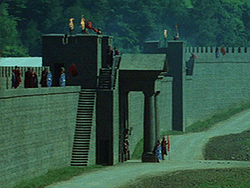
Hadrian’s Wall Gatehouse (Roman-side view) to allow trade with the friendly tribes immediately north of the barrier.
My dead pixels copy was a moderate 471-pages with a 2023 UK copyright. This book includes: a map, a Historical Note, and a Glossary. There was no Characters List included as in the previous book. Its highly recommend to read the Historical Note at the end before closing the covers for the last time.
Adrian Goldsworthy is a British historian and author of both fiction and non-fiction. He has written more than ten novels in several series. That includes his Flavius Ferox series starting with the Vindolanda trilogy set in 1st Century Roman Britain. This is the final book of the 2nd story arc of his Ferox series. The last book of his I read was The City (City of Victory #2)) (my review).
Reading any of the books of the City of Victory trilogy is recommended, but not strictly necessary. However, reading the books of the 1st Vindolandia trilogy is strongly recommended to make this book more understandable.
This is the sixth book in the historically accurate, Roman-era, Sword 'n Sandal historical fiction by an accredited Roman historian. I have had a keen interest in Roman history since reading Edward N. Luttwak’s The Grand Strategy of the Roman Empire: From the First Century Ce to the Third at uni. (Luttwak has since strayed off into Fringe theory.) I have since read many non-fiction and fiction books on the period. The books in Goldsworthy’s Ferox series have some of the more recent information from the literature and Roman-era, archeological record built-in to them. They’re very high-quality, historical fiction, Edu-tainment. In particular, in addition to the clash of swords on shields, the series includes many mundane aspects of Roman life. For example, how Roman indoor plumbing worked. This book also includes: a detective mystery; Roman political thriller; sword wielding, Celtic, warrior women; and the Druidic supernatural.
This story was set a short time after The City. The series’ protagonist, Flavius Ferox, is back in Britain. He had become deeply involved in the machinations of the now emperor Hadrian and unwillingly served as one of Hadrian's agents for a decade in the eastern empire. He did it to ensure the safety and political fortunes of his family in Britain. Back in Britain, despite being well past middle-age, and having lived a hard, active life for a 1st Century Roman retirement was not for Ferox. He becomes involved in the Roman-tribal political struggles of his wife’s royal house's Brigantian clans in what is now North Yorkshire. He eventually marches off with a legion to fight tribesmen living in now Southern Scotland.
Prose was good, Goldsworthy loses some of his academic stiffness with each work of fiction. The author’s Oxford education shows in the precision of his writing. He has almost perfect punctuation. Action sequences were well wrought. However, the dialog, particularly between Ferox and his wife needed work. This book contains five (5) POVs. Switching between them was good. Five was a manageable number for 450+ page book. There are enough pages that plotlines don’t get starved with each change in context. In addition, Ferox, Claudia Enica (Ferox’s wife) and the Hadrian characters did not receive any development. (A benefit of serial fiction for authors, a disappointment for serious readers.) That conserved word count.
The author heavily leveraged the characters from the earlier Vindolandia and the start of the City of Victory story arcs. Ferox was the nominal protagonist. He reprises his role as: legionary Centurion, commando, and hardboiled detective. Vindex, Ferox’s native Briton, ‘rough cut’, wingman; and Bran his wife’s liege man, attached to him by his wife appeared. Crispinus Atilius, a senatorial political intriguer, a series regular likewise reappears. The emperor, Hadrian always the Manipulative Bastard of this story arc appears as an antagonist, although not overtly so. The immediate antagonist is Ferox’s unnamed nephew. He with the help of druidic magic was fomenting native unrest in the tribes of what is now Southern Scotland. The story’s POVs were provided by: Ferox, Hadrian, Claudia Enica, Senuna (Ferox and, Claudia Enica’s youngest daughter) and Ferox’s nephew. Oddly, the nephew was unnamed until almost the very end of the book.
A failing I continue see in this series was that the characters only somewhat act like ancients. The legionaries act and speak more like British Red Coats. They were also frequently Red Shirts too. The Roman leadership act and speak like the 18th Century English peerage; frequently ignoble. However, the characters are moderns emulating 18th Century Englishmen and women in Roman clothes. Ancient men and women were quite different from modern men and women. One example was their belief in mysticism was almost universal. (Few moderns believe in it.) Goldsworthy’s characters were more recognizable as modern Brits with a Roman veneer.
Plotting was OK, but needed work. Goldsworthy had a problem tying-up the major subplots shy of 500 pages. Fewer POVs would have helped? The military fiction (his first love) plot consumed too many pages. This resulted in a bums rush to the end with the remainder. Hanging plots were tied-up too neatly and quickly. The story also ended with a too sweet HFN ending with Ferox and Claudia Enica holding hands and watching the sun set. It doesn't take an oracle to foretell another story arc.
The story contained sex, drugs and violence. Sex was abstracted in the fade to black manner. Rape was threatened and occurred in conjunction with pillage. Alcohol was consumed, primarily beer and wine. Ferox, true to the modern hardboiled detective stereotype, although a recovering alcoholic drinks his wine well watered.
Note this was military fiction. There was a lot of violence in this story. It was: physical, edged-weapon, and projectile weapons inflicted. There was more than enough sword, shield, ax and spear work to keep a sword ‘n sandal reader happy. The violence was also rather graphic, in the blood spurting from arterial wounds way. As I have in past books, I found myself again getting fatigued by the bloodletting. I’ve become desensitized to the carnage and bloodletting of the frequent edged-weapons combats of the series. Annoyingly, the protagonists in the story have miraculous recovery powers. Everyone quickly recovers from series blade cuts that would cripple or maim a human being. Also, nobody dies horribly from tetanus poisoning.
Taking place in Britain, it was most similar to the original Vindolandia story arc. This story was substantially a Sword ‘n Shield story, and only incidentally a detective/political thriller.
The military fiction extended episode described was a classic example of a Meeting Engagement. From a military history aspect, Goldsworthy does a good job with his descriptions. He interleaves descriptions from the literature and uses the best modern, speculation on how it likely occurred. For example, ancient historical conflicts typically inflate the number of combatants involved, beyond what was either practical or conceivable for the times. Large ancient battles were actually small affairs compared to modern warfare.
In addition, there was a great deal of exposition on the design, construction and strategic usage of Hadrian’s Wall. It was an unusual piece of ancient, western military infrastructure. I have an interest in the implementation of major infrastructure projects. I read the description of work with rapt attention. Some readers may find them tedious. I thought Goldsworthy may have assumed too much Classical familiarity with modern Project Management techniques in his descriptions? However, the strategic analysis of the barrier was solid.
One thing I enjoyed in this story was the intervention of the supernatural. The first trilogy had a lot of the Druidic supernatural involved. This story resumed that missing bit of plot. Briton and Roman gods intervened on both sides with a fair bit of magic being credited for events in the story. However, there wasn’t anything really new to it from the Vindolandia stories. This supernatural plot was a red-headed stepchild to the military fiction.
As in all previous books, Ferox had several related murders on his mind, as well as murderous northern tribesman at swords length. Like the Supernatural plot the murder mysteries have not been the most important to the plot of the latest trilogy. In the end the author had to resort to his typical The Reveal for me to get it. The hardboiled detective plot is the twin to the red-headed stepchild of the supernatural in this book.
The political thriller aspects of this story were a bit better than previous stories. However, it was borrowed from British colonial history. It reminded me of a mid-1800’s British East India Company episode with the addition of modern embellishments, like a false flag attack. The general theme was the westernized Roman’s (British_, extending their suzerainty over the oriental subcontinent (Isle of Britain). In this case, the Indians were the Northern Briton tribes settled in Cumberland, Northumberland and Southern Scotland. However, this was simpler scenario for a modern reader to understand.
World building was on par with all the books in the series. Goldsworthy’s attention to historical detail has always been a strong point of this series. I found the modern analysis of the importance of a supply of pack animals to support legionary operations to be really interesting. Oxen, mules (the preferred pack animal) and ponies all have different load bearing and maintenance profiles. In this book, Goldsworthy backs away from the story arc’s assertion that life was 'Nasty, brutish and short' in ancient times. I note that Ferox and his cronies are 'old' by 1st Century Roman demographics. Still they perform like much younger men. Although, he did put some grey on their muzzles in the descriptive prose. Note that the author expects readers to have learned something about the mundanities of Roman life from the previous books. However there is a Glossary.
This book moved the venue of the story back to where it started in Britain. The archeological and historical record for the UK is better than for the Eastern part of empire used in the first two books. In addition, many readers, including Goldsworthy British and anglophile fans will we more familiar with the geography. However, the author points out that details of 1st Century Britain are still sketchy compared with the 3rd Century.
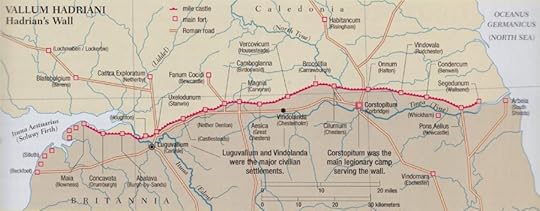
Hadrian’s Wall Map
Finally, the Historical Note at the end of the book cannot be ignored. If you consider yourself an armchair Roman historian, the Note is a must read. Goldsworthy describes how he wove the historical record into the story. I have found the Historical Note this to be the single most important chapter of all the books. It has showed how ‘the writer writes’. I also note the the ‘Main Characters’ list was missing from this book. It has a convenient crutch for me. Keeping track of the numerous Roman characters, with complex, similar sounding, and unfamiliar names can be difficult.
This book only added only a little to what I knew about 1st Century Roman Britain. However, I’ve read the entire series and more. Returning the series’ obligatory: Roman, political conspiracies; murders and warfare to familiar Britain was very welcome. However, this story leveraged the characters and most of the backstory of the Vindolanda trilogy. Except of the long-term plotline of Hadrian pulling Ferox’s strings, the last two books of the series could be ignored. History-wise this book introduced the reader to some famous Roman architecture in Britain. Story-wise, it packed-up and almost forgot the long-term plotlines from the previous two books in the trilogy. Frankly, it could easily have been a fourth book of the original Vinlandia story arc. This is still the best historical Edu-tainment on the period, but not a milestone for amateur Roman military historians.
Excellent finale. A bit long winded in places with narrative not really contributing to the story but covering historic (or potential) actions or events.
As expected, another excellent narrative with the characters from previous novels. Always exciting and comprehensive in terms of the Roman experience in England for me this author is just that much more sophisticated than other authors in this genre. May he continue to write more and more !
As expected from previous two in the series another excellent read good characters, combat and intrigue in the time just before the creation of hadrian s wall.
Britannia AD 117 and Flavius Ferox has returned to the scene of his earlier exploits in the series of novels by the historian, Adrian Goldsworthy.
The border between the Roman province and the northern tribes is unsettled and a major raid from the North draws in a Roman army intent on establishing Roman control in the area. However, the army is defeated and it becomes clear that new thinking is needed in the situation. The new Emperor, Hadrian orders the building of a permanent solid barrier across the island of Britain and makes his way to the province to monitor progress in construction. Ferox is in the midst of this situation, with his loyal companion Vindex and his wife, the Queen of the Brigantes. Ferox’s nephew is at the heart of the tribal conflict and is planning a direct attack on the Emperor, hoping this will lead to another major uprising by the tribes of Britain.
Goldsworthy brings his depth of knowledge and research to these novels and in his notes shows how he has used the limited historical evidence from the time to construct a thoughtful reconstruction of the events surrounding the building of Hadrian’s Wall. He creates fascinating characters and believable events to create a brilliant historical narrative. This is the sixth book featuring Flavius Ferox; I hope it’s not the last?
This entire review has been hidden because of spoilers.
Roman historical fiction is a crowded place – there are many good writers who inhabit this genre and Adrian Goldsworthy is as good as any of them. He comes from an academic background but uses his academic skills to enrich his novels and not overwhelm it as some are prone do. This is the second trilogy of novels featuring the centurion Flavius Ferox and his wife Claudia Enica. This one concentrates on the emperor Hadrian coming to power through to work commencing on the famous wall. Ferox and Claudia Enica are caught up in power struggles between what is viewed as a declining and disinterested Roman Empire and the northern tribes of Britain who see their chance to grab land, cattle and slaves. The Empire’s apparent decline and disinterest in northern Britain has some merit – many of the troops nominally allocated to defend northern Britain nave been sent to flight other wars in other countries and consequently defences are stretched very thin. The new emperor is not one to allow a few rebel tribesmen to make fools of the mighty empire and soon proposes a giant wall, many feet high, to stretch right across northern Britain to keep the rebels out. This is when the plotting and intrigue really begin! A very enjoyable read.
So I have finished the "City of Victory" trilogy — all very "Boys Own" and enjoyable if you are a fan of Roman history and the legions, whose construction and pageantry Goldsworthy evidently knows well. I don't know why I only gave "The Wall" four stars. Perhaps I had become blasé about the formula even though the book is set back in Britannia, the Northern provinces, Vindolanda with more verbal and physical intercourse between Flavius Ferox (the never promoted centurion) and his wife, Claudia Enica, the (unrecognised) queen of the Brigantes than in the previous books. Perhaps it was because it covered so much with so many complex and intricate characters involved (Britons, Picts, Caledonians and Romans) that it covered so many events over quite a long span of time (the fateful march North and subsequent defeat of the legions, Hadrian's building of the wall, and so many tricky tricks and deceptions, led of course by the Emperor himself, who is portrayed by the author as both hero and villain. Anyway, jolly good adventure reading.
This is the third in the current Flavius Ferox series and follows on from the previous book but it can be read as a standalone story. In this installment there is trouble and plotting in the North following the accession of Hadrian as Emperor. Hadrian visits Britannia and has a great idea of building a wall across the province, meanwhile a Roman army is in trouble far to the north with Ferox in the thick of it, the action culminates in a plot to murder the emperor which may not be all that it seems...
All in all this is a fine Roman romp and recommended
The, hopefully temporarily, final installment of the Ferox tales by Goldsworthy builds on the other stories, culminating in a well written finale. Although the book counts well over 400 pages, it doesn't seem to explain the plot in a satisfying manner. Multiple plot holes remain unanswered, in my opinion, and couls do with more explaining. Nevertheless, I enjoyed this double trilogy massively and hope for more to come.
Bloody, violent soldiering- we’re back In Britannia, Ferox is here from Chapter 1 so it’s almost inevitable. Trouble finds the man and vice versa. This is my favourite of the trilogy because there is more character interaction and therefore more involvement. Where there’s Rome ,there’s politics and scheming. Hadrian is a masterful conniving principa and the book is a very fitting conclusion. Adrian Goldsworthy brings the Roman Empire soldiering vividly to life and gives an enthralling read.
Adrian Goldsworthy is a great writer whose historian's knowledge and expertise give depth and realism to his stories. His characters seem real. I'm not ready to let go of Ferox and Vindex. I know they're getting into middle age but I really hope Mr Goldsworthy has at least another trilogy in the works.
Se termina la trilogía de las aventuras de Flavio Ferox en la provincia romana de Britania, en el siglo II DC. Una historia donde nos narra la dura vida de esa época, el ambiente existente entre los pueblos conquistados y los rebeldes, los peligros y traiciones a la orden del día. Una extensa investigación arqueológica e histórica para construir una historia llena de acción y suspenso
I thought this would be fun to read while visiting Hadrian’s Wall. Sadly it was anything but fun. I found it turgid and confusing. I kept going for about a quarter of the book, but then gave up the struggle.
The third part of the city of victory trilogy and to my mind the best book. Romped through tribal raids in the north Britain, a failed Roman attempt to punish the tribes and then an attempt on the life of Emperor Hadrian.