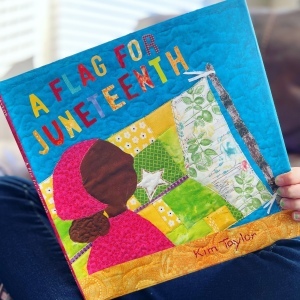
Expert quilter Kim Taylor shares a unique and powerful story of the celebration of the first Juneteenth, from the perspective of a young girl.
On June 19, 1865, in Galveston, General Gordon Granger of the Union Army delivered the message that African Americans in Texas were free. Since then, Juneteenth, as the day has come to be known, has steadily gained recognition throughout the United States. ln 2020, a powerful wave of protests and demonstrations calling for racial justice and equality brought new awareness to the significance of the holiday.
A Flag for Juneteenth depicts a close-knit community of enslaved African Americans on a plantation in Texas, the day before the announcement is to be made that all enslaved people are free. Young Huldah, who is preparing to celebrate her tenth birthday, can’t possibly anticipate how much her life will change that Juneteenth morning. The story follows Huldah and her community as they process the news of their freedom and celebrate together by creating a community freedom flag.
Debut author and artist Kim Taylor sets this story apart by applying her skills as an expert quilter. Each of the illustrations has been lovingly hand sewn and quilted, giving the book a homespun, tactile quality that is altogether unique.
This is a story of how one family and their little girl observed Juneteenth on the very day it was announced. There is some history of Juneteenth. But the fantastic part of this title is the illustrations all rendered by the debut author/ illustrator Kim Taylor. Her technique is quilting and appliqué and these illustrations contain very expressive people as well as motion in the illustrations. Although it is early in the year I am hoping this will receive attention for the Caldecott award and/or the Coretta Scott King award for 2024. Also included in the title is a page about the author/ illustrator’s process to the final finished product. Would love to see that in more picture books as for me it adds depth to understanding what I am reading and enjoying.
“A Flag for Juneteenth” is a debut book for author/ illustrator, Kim Taylor.
The artwork is unique. Expert quilter, Kim Taylor took a year to make a Juneteenth quilt. The art was created with “fabric collage using raw edge appliqué and free motion quilting.” Each page of this book is a photo of one of the quilt squares. I love her creativity.
The story is about an enslaved family. It is Huldah’s tenth birthday (June 19, 1865) when a US Union army rides up.
“Dusty soldiers crowded into the little corner of the Texas plantation where we lived. A man with a beard jumped down from his horse and held a paper up high for all to see. With a booming voice he read,
‘The people of Texas are informed that, in accordance with a proclamation from the President of the United States, all slaves are free.’
“I held my breath. No one said a word. Then cheers, louder than the loudest thunder!”
There were angry plantation owners… Newly free people prayed, sang, and cried tears of joy. Women began stitching freedom flags, and a day of Jubilee was declared. Children gathered sticks for poles, and men smoothed and carved them with beautiful designs and freedom symbols.
Huldah quietly celebrates her special birthday by catching a sunbeam and saving it in a jar. When she returns, she receives her own freedom flag as gift from all of her people for her birthday.
Later, in the woods, Hudah’s family have their own celebration:
“We looked up at the moonlit sky as the tall trees smiled down at us. Mama and Papa wrapped baby in my beautiful flag. They held her high, and together, we owned our freedom.”
This picture book is unique in that each page is made from the photograph of a quilt square. It is the story of a girl, Huldah whose 10th birthday coincides with the first Juneteenth. The book shows what Juneteenth is and why it is important. I would have liked a little more information about why people made flags to wave (is that what was traditional for jubilees?).
This is a beautiful book perfect for explaining the meaning of Juneteenth to the littles! The story itself is very moving and I absolutely loved the quilting illustrations throughout. Perfect for a read-aloud.
Review: A Flag for Juneteenth, By: Kim Taylor, author, and illustrator. A hardcover picture book published by Neal Porter Books, January 3, 2023.
Taylor has created a powerful founding or origin story for Juneteenth. Heavy in the use of symbolism, from the name of her ten-year-old narrator, Huldah, to teacakes, to the carved Fawohodie in the stick flagpoles, Taylor immortalizes the first Juneteenth with her exquisite, hand-sewn, quilted storyboard.
Special, delightful smells waft through the cabin on a fine June night in 1865. “Teacakes,” thinks Huldah. Her mother urges her to go to bed as tomorrow, June 19th, is her 10th birthday. Huldah and her parents are awakened at dawn by the sound of horses; they peer through the window and see a dusty detachment of United States soldiers. The War Between the States had effectively ended several months previously on April 9, 1865, when Robert E. Lee surrendered his North Virginia Army to Union Gen. Ulysses S. Grant.
“A man with a beard jumped down from his horse and held a paper up high for all to see. With a booming voice he read, “The people of Texas are informed that in accordance with a proclamation from the President of the United States, all slaves are free.”
With this re-imagined reenactment of Union General Gordon Granger and his troops traveling to Galveston, Texas to announce General Order No. 3 on June 19th, 1865, Taylor begins her compelling founding story of Juneteenth, which became a federal holiday in 2021. The story is narrated by ten-year-old Huldah. The name Huldah is significant as she is mentioned in the Hebrew Bible as a Prophetess who authenticates a document as being God’s word that gives it sanctity, establishing it as a canonical text.
Taylor traces the African American story from Africa through enslavement and emancipation with her quilted illustrations. She follows in a long tradition of African-American women quilters: the most famous being Lizzie Hobbs Beckley and Harriet Powers – both were born into slavery. Modern folklore intimates that quilts may have contained codes or messages for escaped slaves traveling along the Underground Railroad.
After the auspicious announcement, Huldah’s village (the other slaves living in cabins on an unnamed Texas Plantation) send up loud cheers, prayers, tears and sing songs of freedom. The Emancipation Proclamation was actually more than two years old (Jan.1, 1963.) In fact, the 13th Amendment to the Constitution had already been passed by the Senate, and the House and was signed by President Lincoln before his assassination on April 15, 1865. It would be ratified by the year’s end. The village women immediately began to sew patchwork quilted freedom flags. Jacob Menard, the oldest man on the plantation, proclaims, “Today is a Jubilee!! A day to celebrate our freedom!” Again, as with the name Huldah, Taylor ties this story to the Bible and the story of the Israelites. Jacob renamed Israel is one of the founding fathers of Israel and the use of the word Jubilee has a particular biblical meaning: “proclaim liberty throughout the land to all its inhabitants. It shall be a jubilee to you, and each of you shall return to his own property, and each of you shall return to his family.” In short, all slaves are freed in the year of the Jubilee. Enslaved like the Hebrews, historically, African-American slaves have identified with the Hebrews as God’s chosen people. They too will be led to the Promised Land. This connection is evidenced in their spirituals like, Go down Moses. The men of the plantation and the children look for sticks to make flag poles for the freedom flags. The men then carve intricate designs into them like the Fawohodie which literally means “grab yours” signifying freedom, emancipation, independence, and self-determination. Symbolizing various proverbs, these adinkra symbols originate in Ghana.
Huldah remembers it’s her birthday so she wanders around the plantation and woods until comes to her favorite tree. She climbs the tree as to look into the future. Sunbeams shine on her and she gathers one in a small jar; the sunbeam illuminates, provides clarity, and symbolizes hope. Huldah returns home where she puts on special clothes for her birthday and her mother tells her the people of her village have made her a surprise. She sits in the middle of a circle surrounded by her neighbors and they give her a freedom flag. They had made a patchwork green and yellow flag with a purple horizontal line bisecting it as a horizon. Huldah’s mother gives her a white star to sew on the quilt. She adds the golden sunbeam she has collected: “I placed the star so that it rose from the purple strips like a sunrise. I sewed in the sunbeam so that it could help guide me wherever I might take it.”
After the first day of freedom, Huldah and her parents walk toward the woods. Her parents wrap baby Eve (the first woman) in the Freedom flag and raise her high toward the heavens. The book ends with a Ghanaian outdoors naming ceremony popularized by Roots and later the Lion King. The symbolism seems to say this baby Eve will be the mother of a new nation of free people. The baby will never know life as a slave. “They raised her high, and together, we owned our freedom.”
The only flaws found in the Flag for Juneteenth are several anachronisms- the smell of nutmeg and vanilla from the teacakes and the fine, brightly colored African dress and head wraps. Nutmeg was rationed during the Civil War and vanilla was too dear to be had by slaves. Slave clothing was mostly unbleached coarsely woven or homespun cotton, pale calico or blue and white checked cotton, and some denim. Rather than Taylor mistakenly adding anachronisms, maybe she has found a way to turn the arrow of time so it points in both directions. Time is no longer asymmetrical but is symmetrical flowing from future to past as easily as past to future. Taylor has written a very compelling and credible founding or origin story for Juneteenth that provides a solid cornerstone to support the new holiday. Many places have little experience celebrating Juneteenth while other southern towns have over a hundred years of traditions to draw upon.
It would not be surprising for this book to make the Caldecott Short List and win the Coretta Scott King Book Award.
This Library Guild selection has had rave reviews from impressive sources, but I dare say the highest praise I can offer is that my ancestors would love and admire it. The quilting quality and design on these pages had me convinced that Taylor had learned to quilt as a small child, as my mother had. The author/artist's notes in back indicate that she had never quilted until the inauguration of Barack Obama as President of the United States. It was then that she considered that the major media option for storytelling among enslaved people was quilting. Their products were even more mismatched and bit-patched than the quilts of my youth. Batting for plantation quilts was a greater struggle, too, sometimes filled with newspapers, dried leaves, or sun-dried straw. The stories and culture stitched into them were as essential to survival as the warmth they provided. Taylor set out to learn to quilt (intimidating, right?). Her first story quilt, FULL CIRCLE, A HISTORY was created to celebrate that impressive circle of Black history in this country, from enslavement to the presidency. Some time later, Taylor attended a Juneteenth celebration and learned the history of this occasion as an adult. She set out with a plan to incorporate the story of the first Juneteenth into a story quilt. Her mission was to share the story with young people, wanting them to become aware of this important history while still children, not as adults, as she had been.
This project, naturally, required even more time than the already mindful and time-ful task of picture book illustration. In fact, it was not until she was satisfied with a design that told the story well that she could apply her growing skills to the production/quilting task. Within that design and eventual result she incorporated her characteristic faces without features, rendering the pictured individuals expressive in body posture and action, but open to being inhabited by the viewer, allowing us to immerse ourselves in the emotions and history.
Only when that story quilt was complete could she begin visiting schools and other gatherings, using the quilt as her media for sharing the story of Juneteenth. Those events, with adjustments along the way, eventually became this picture book, A FLAG FOR JUNETEENTH.
Although Juneteenth has FINALLY been officially designated as a federal holiday, its story will be unfamiliar to many until they hold this book in their hands. Told through the first person voice of a young enslaved girl living with family on a Texas plantation, each quilted page and image spread conveys the life of this young person, one who anticipates the joyful celebration of her tenth birthday tomorrow, June 19th, 1865.
She is frightened when Yankee soldiers arrive to issue a proclamation, announcing that TWO YEARS PRIOR the President of the United States, Abraham Lincoln, had signed the Emancipation Proclamation, ending slavery. (Texas slave owners had refused to inform the people of this, illegally retaining enslavement in Texas far beyond the rest of the country.)
Images of radiant jubilation pair with the observant girl, holding her baby sister, joyous but somewhat overwhelmed by what had been said. Plantation owners were furious, but could do nothing about it. Women snatched up needles, thread, and fabric to stitch freedom flags while children collected long, straight branches for flagpoles. Men carved cultural symbols of freedom and independence into the flagpoles.
The jubilee takes on special significance when the community presents the young birthday girl with her very own jubilee freedom flag, but one that is not quite complete. She sews her own star onto its strong horizon line, stitching in the sunshine she had captured from a visit to the treetops. Wrapped in the celebratory grace of freedom, her small family visits the night for a special cultural experience of their own. From the opening with quilted, steaming hotcakes to that final spread, this is a masterpiece of storytelling, visual strength, and fiber artistry.
The stitch patterns throughout as well as the artful choices for illustration (figures, placement, clothing, scenes, and swirl pattern choices on white text backgrounds) made me return repeatedly to page after page. Each time I would note additional elements from color tones to leaf patterns to angles and connections. I recommend this book highly.
This review was originally written for The Baby Bookworm. Visit us for new picture books reviews daily!
Hello, friends! Our book today is A Flag for Juneteenth by Kim Taylor, a stunning tale of emancipation and hope told through a unique medium.
The morning of June 19, 1865, young Huldah, an enslaved Texan, wakes up with anticipation; she is eager to have the teacakes her family made to celebrate her tenth birthday. However, their morning is shaken when a large group of soldiers rides into the plantation housing area, and a uniformed man jumps down to make a shocking decree: by order of the president, all slaves are free, and have been for two years. Huldah’s family and her neighbors burst into cheering, singing, crying, and prayers, and declare the day to be a jubilee. They get to work sewing freedom flags and carving flagpoles, all while Huldah observes. Her birthday has taken on new meaning, as it is now the birth of something else: her family’s freedom.
Powerful. The first thing that readers of this title will likely notice is the outstanding art style, in which the scenes are created through quilted collage, echoing the craftwork of the impromptu freedom flags. Taylor’s master craftwork is striking, managing to create atmosphere and emotion through her featureless characters. The story is likewise skillfully created, with immaculate pacing in particular; Taylor intersperses moments of quiet contemplation and explosive energy in a way that allows the reader to better connect to Huldah’s emotions. This is not a comprehensive overview of Juneteenth, but gives an intimate perspective from a child’s point of view that readers, especially young ones, will undoubtedly connect with. The length is fine for a storytime, and JJ and I both really enjoyed this one. Absolutely worth the read, and it’s Baby Bookworm approved!
(Note: A copy of this book was provided to the Baby Bookworm by the publisher in exchange for an honest review.)
Book provided by publisher in exchange for an honest review
Juneteenth, also known as Juneteenth Independence Day or Freedom Day, is a holiday celebrated on June 19th in the United States to commemorate the end of slavery. In 1865, Union General Gordon Granger arrived in Galveston, Texas, and announced that all enslaved people in Texas were now free, more than two years after the Emancipation Proclamation was issued by President Abraham Lincoln. Juneteenth is also considered the oldest known celebration commemorating the ending of slavery in the United States.
A Flag for Juneteenth is about a community of slaves who celebrate Juneteenth after Union soldiers announce that all slaves are free. Huldah, a young girl in the community, is excited about her birthday which happens to be around the same time that Juneteenth is announced. The community celebrates by creating a flag with a white star with designates freedom for all enslaved people.
I loved the unique way A Flag for Juneteenth is illustrated with cross-stitch quilts. Each page maintains the integrity of a quilt but with different scenes and quotes from the characters celebrating their freedom. The characters don’t have faces but are created in a way that you can deduce their feelings by studying their body language. Hands are raised in the air, Huldah cuddles her baby sister, and the women of the community rest comfortably on the ground as Huldah opens her birthday present. It’s a beautiful way to present these characters who are all shades of brown.
This picture book tells the story of Juneteenth through the eyes of a young girl named Huldah, who learns about the holiday and its significance from her family and community. With beautiful illustrations and a heartwarming story, this book is the perfect way to introduce children to the meaning and importance of Juneteenth.
I liked this book, though it made me wonder. Suppose the scene from the book did occur as they said it did. What came next? If you were a formerly enslaved person and soldiers had come to declare that two years prior you'd been freed by the president of the country that your former owners had just fought a war against and then the soldiers left, where would that leave you? I feel like I'd be more worried than jubilant. What would be the next step? Wouldn't people be living on their former owner's land? Would they be evicted? Who would hire them so they could support themselves and their families in such a hostile environment? If they wanted to leave to start somewhere new, where would they go and how would they afford to get there? Was there a plan in place that facilitated societal integration for the newly freed people? Slavery wasn't a good system, but if one system ends, a new system needs to replace it if everyone is going to survive the transition. Did the soldiers do anything to ensure that the formerly enslaved people had a means for transitioning into free life and that disgruntled former slave owners couldn't retaliate against their former slaves for their loss of legal control over them? These are the questions that I wish this book helped to answer. What I learned about the reconstruction-era South in school doesn't paint the next chapter in a positive light, but I'd like to know more.
Picture book. Since the holiday of Juneteenth has been made a federal holiday, there have been several books on the topic. This is the most beautiful one I have seen. The illustrations are scans of an actual quilt, so the pages look as if they are stitched together. The text is from the point of view of Huldah, a young slave girl celebrating her birthday on the day that would become Juneteenth. As soldier announces the news, suddenly the whole community has a lot to celebrate. They start celebrating; making their own freedom flags then gathering and carving sticks to serve as flagpoles. But they still celebrate Huldah, working together to create a flag for her as well, which she gets to add the finishing touch to.
This story focuses on celebration, so it does not dive into what being a slave actually meant. This allows the adult reader to share that with a child or for the book to be paired with others on the topic.
Expert quilter Kim Taylor shares a unique and powerful story of the celebration of the first Juneteenth, from the perspective of a young girl.
On June 19, 1865, in Galveston, General Gordon Granger of the Union Army delivered the message that African Americans in Texas were free. Since then, Juneteenth, as the day has come to be known, has steadily gained recognition throughout the United States. ln 2020, a powerful wave of protests and demonstrations calling for racial justice and equality brought new awareness to the significance of the holiday. It has a note from the author in the back.
Juneteenth was a holiday that was not nationally celebrated until 2021. This book provides information about the holiday and why it is a now a national holiday. I would read this book during circle/large group reading time for Black History Month, when the curriculum focus is on African Americans, or when we are exploring holidays that are not yet considered a traditional holiday.
Illustrated with photos of the author’s quilts. The medium is perfect for telling the story (I was just grumping this morning about verse novels that don’t bother to justify why they’re in verse. This book makes SENSE as a story quilt. Quilting is a plot point and an element of the narrative!) I could see A Flag for Juneteenth as a great starting point for making Jubilee flags and story quilts with kids. (For a strife qult lesson you could of course pair it with Faith Ringgold’s Tar Beach.) The language is quiet and lovely. I do wish the characters had faces, though I appreciated the back matter in which the author explains why leaving faces blank is a signature of her work. And I wish the terms Jubilee and fawohodie and the role of flags in African American culture were addressed in the back matter. Quibbles! It’s a terrific book.
GREAT to have a picture book that depicts Juneteenth! And the quilted artwork is beautiful, detailed, stunning, and so fitting!! Just gorgeous to look at and helps to tell the story. I especially love the page when the people are celebrating and waking the baby. Yet for some reason, I didn't feel emotionally pulled into this story. Was it because I couldn't see the character's faces and expressions? The author explains in the note in the back that this was her intentional choice; this may have made a difference for me. In the author's note, she also references "quilts with embedded codes to lead others to freedom along the Underground Railroad;" I have read other articles and research that claim that there is NOT evidence that codes in quilts were used to communicate in this way; so I remain confused. But, a beautiful book!
Excellent! This book uses unique illustrations made from appliquéd and quilted fabric to tell the story of a family learning that they are free on what is now the holiday of Juneteenth. This book approaches the painful subject of injustice and slavery in a gentle way that is both accessible to young children, while also demonstrating the truth of the wrongness of what was done to people. Telling it from the point of view of a young child and using faceless characters helps kids to relate to the story, and put themselves in the shoes of the people who lived through that moment in history.
Juneteenth was not a holiday I had heard of until recently, but I am so glad it is a new Federal holiday so we can have these important conversations and remember our history.
Quilted illustrations tell the story of Juneteenth from the perspective of Huldah who is turning 10 on June 19, 1865. Celebrating community, family and love, this is an uplifting story about enduring despite slavery. It is quite possible this book with its unique illustrations may make an appearance on at least one year-end list. With Juneteenth recently (June 2021) becoming a National Federal holiday and over half of the 50 states recognizing it as a public holiday, this book also has a chance at standing the test of time and being enjoyed and shared in the years to come.
It's Black History Month and I borrowed 8 children's books written by black authors from my library in showing my support.
A Flag for Juneteenth is the story about a little girl on June 19th, 1865 celebrating her 10th birthday and how Juneteenth came about.
Soldiers arrive on the plantation declaring President Abraham Lincoln proclaimed, "all slaves are free". Not news to the plantation owners since they knew about it 2 years prior when it happened, but to every slave who didn't know they were free people. The women decide to celebrate by sewing freedom flags. What is unique about the illustrations in this book are, they are told by the quilts the author made 2 years to complete. They are absolutely gorgeous!
"Enslaved people had been free since then, but the plantation owners chose not to tell us." I appreciate that Taylor uses "enslaved people" and is transparent about why they did not know they were free. Unlike other books that tell the story of June 19, 1865, this book is told from the perspective of a child whose tenth birthday happens to be that day. After learning of her freedom, along with everyone else, she supposedly puts a sunbeam in a jar and then sews it into her freedom flag "so that it could help to guide me wherever [she] might take it." Not the most helpful book when explaining Juneteenth to young readers, unfortunately. However, the quilted illustration style is interesting.
Age: Kindergarten-3rd grade History: United States Emancipation, Juneteeth Art: Needlework, Quilting
A joyous moment in history is experienced through the eyes of a slave girl celebrating freedom and her birthday with a beautiful, symbolic present from her community: a quilted flag.
Not only is the quilted artwork unique and staged beautifully, but the writing style and flow are appealing for the age it is written. An incredible contribution to African American historical documentation, to a national holiday, and to children's literature.
A story quilt about a close-knit enslaved community on a plantation in Texas, the day before the announcement is made that all enslaved people are free. Young Huldah, who is preparing to celebrate her tenth birthday, cannot possibly anticipate how much her life will change that Juneteenth morning. The story follows Huldah and her community as they process the news of their freedom and celebrate together by creating a community freedom flag. The illustrations quilted by Taylor display strong use of color, texture, movement, stitching, and symbols.
This well-crafted tale is artfully illustrated with beautiful story quilt depicting the coincidence of a slave girl’s birthday celebration and Jubilee Day for her community on an isolated plantation in West Texas, which arrived by messenger a full two years after President Lincoln issued the Emancipation Proclamation on June 19, 1865. The Author’s Note provides more background about the history of Juneteenth, her inspiration for the story, and how she created the remarkable quilt work. Let the freedom flags fly!
Gorgeous artwork here. All the illustrations are pictures of real quilt work. Just lovely.
This is about a tiny Texas plantation in 1865, June 19, two years after the emancipation proclamation. The plantation owners hadn't told their slaves they were free for two whole years. A battalion of soldiers came into the plantation and announced to the slaves that they were free.
The now free people celebrate and make flags to commemorate the occasion. It's with this story that I understand the importance of the day and it is a day we should celebrate. What a day!
What a unique book! All of the illustrations were quilted by the author and they are just gorgeous. I hope it gets the Caldecott Award! The story was informative and had a tone of hope and celebration. I will definitely be purchasing this book for my school library and might even consider using it for a Read Across America Week pick.
I think this is one of the best books I've read on the history of Juneteenth. Told in a fictional story, it brings to life the deep joy that this event brought to thousands of slaves. The illustrations in this book are astounding! They are all applique on quilts. It took the author/illustrator (who is also an expert quilter) over a year to complete these illustrations. It is visually stunning!
This is the story of an enslaved girl in Texas. Her birthday is June 19... and on her 10th birthday, she gets the news that she and her family are free. She and the people make a flag to celebrate. (It is NOT the "official" Juneteenth flag)
The art in this story is made up of quilts that the author created. It is beautiful.
This book offers poignant imagery through the engaging prose and the beautiful illustrations, which are quilts by the author! A brilliant book that will enlighten and inspire the young reader. I highly recommend it for all ages!
Fine details and exquisite quilting patterns will make this book stand out as one of the most unique picture book illustrations for this year. The scans are so high quality that I almost thought the pages were fabric themselves.