What’s wrong with our thinking has much to do with what’s right
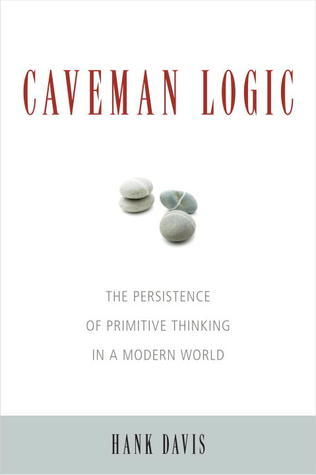
Hank Davis, in this overview of all the foibles, fallacies, and biases that infect the reasoning abilities of our species, lays out a strong argument that although we have imperfect cognitive equipment given to us by evolution, we can overcome them with judicious use of critical thinking, science, and intellectual honesty. While Davis specifically dwells on the supernatural phantoms that people accept as part of their lives from ghosts and spirits to deities and angels, he also delves into the purely secular arenas of fallacious thinking from gambling to the incomplete way we often evaluate data in everyday situations. Several books on this topic have been written of late such as Bruce Hood’s Supersense, but Davis’s seems to have a welcome clarity and plain-spoken characteristic.
The primary thesis of Caveman Logic comes back to the fact that for all of the pre-disposed ways of human thought that work well, the areas in which we are particularly bad at stem from the misapplication of the strengths. One of the ways that this occurs is through the over-extension of one way of thinking into another domain that it was not designed by natural selection for, and more importantly, is demonstrably bad at.
This comes to bear in Davis’s critique of supernatural beliefs where such mental tools as agent detection (which is a very good skill to have) is applied to reasoning about natural occurrences. We see this happen all the time when our low-brow religious mouthpieces such as Pat Robertson blame natural disasters on the agency of God (as with hurricane Katrina). In Davis’s estimation, which seems right on target, such a superstition is developed and utilized (and is successfully convincing to a large number of people) since it offers a social understanding of events and avoids that dreaded thing that humans have little tolerance for—ambiguity and meaninglessness. By adding an agent into the equation of explaining a natural disaster, an illusory form of meaning can be gained. Not only that, but it places the event into a social context—something humans are already very good at understanding and interpreting events within.
For all the strengths of the book, I did have a few objections. The book doesn’t seem to have a clear audience in mind. At one moment it seems to be a clear exposition of our “caveman logic” and therefore aimed at readers like me looking for a nice refresher and synthesis of the subject. But at others (particularly the last chapter) it can seem almost preachy. While I understand and completely agree with the author that this is an issue of vital importance, the rhetoric seemed to not match the intended goal. If his goal was to provide a good synthesis to readers like me, he didn’t need the last chapter (at least in its current form—it did broach new information that would certainly want to be included in any edition). But if his goal was to persuade readers who might hold beliefs he considers irrational, then the sometimes blunt rhetoric may just serve to alienate them.
That minor objection aside, the substance of the book is rewarding and certainly needful. I know it’s cliché to say, but this book does deserve a very wide audience.