Jump to ratings and reviews
Rate this book

The Zimmermann Telegram

Rate this book
The Proud Tower, the Pulitzer Prize–winning The Guns of August, and The Zimmermann Telegram comprise Barbara W. Tuchman’s classic histories of the First World War era
 
In January 1917, the war in Europe was, at best, a tragic standoff. Britain knew that all was lost unless the United States joined the war, but President Wilson was unshakable in his neutrality. At just this moment, a crack team of British decoders in a quiet office known as Room 40 intercepted a document that would change history. The Zimmermann telegram was a top-secret message to the president of Mexico, inviting him to join Germany and Japan in an invasion of the United States. How Britain managed to inform the American government without revealing that the German codes had been broken makes for an incredible story of espionage and intrigue as only Barbara W. Tuchman could tell it.
 
Praise for The Zimmermann Telegram
 
“A true, lucid thriller . . . a tremendous tale of hushed and unhushed uproars in the linked fields of war and diplomacy . . . Tuchman makes the most of it with a creative writer’s sense of drama and a scholar’s obeisance to the evidence.”The New York Times
 
“The tale has most of the ingredients of an Eric Ambler spy thriller.”Saturday Review

244 pages, Paperback

First published February 17, 1958

140 people are currently reading
7084 people want to read

About the author

Barbara W. Tuchman

42 books2,384 followers
Barbara Wertheim Tuchman, historian, won a Pulitzer Prize for The Guns of August (1962) and for Stilwell and the American Experience in China (1971).

As an author, Tuchman focused on popular production. Her clear, dramatic storytelling covered topics as diverse as the 14th century and World War I and sold millions of copies.

https://en.wikipedia.org/wiki/Barbara...

Ratings & Reviews

What do you think?
Rate this book

Friends & Following

Create a free account to discover what your friends think of this book!

Community Reviews

5 stars
1,735 (33%)
4 stars
2,210 (42%)
3 stars
1,009 (19%)
2 stars
147 (2%)
1 star
51 (<1%)
Displaying 1 - 30 of 448 reviews
Profile Image for Matt.
1,052 reviews31.1k followers
February 17, 2023
“The first message of the morning watch plopped out of the pneumatic tube into the wire basket with no more premonitory rattle than usual. The duty officer at British Naval Intelligence twisted open the cartridge and examined the German wireless intercept it contained without noticing anything of unusual significance. When a glance showed him that the message was in non-naval code, he sent it in to the Political Section in the inner room and thought no more about it. The date was January 17, 1917, past the halfway mark of a war that had already ground through thirty months of reckless carnage and no gain…”
- Barbara Tuchman, The Zimmermann Telegram

There is probably a super long, super descriptive German word to describe Germany’s foreign policy in the First World War. After all, that policy was an improbable blend of unmatched confidence leavened by a persecution complex, unbelievable arrogance, absolute certainty, and breathtaking stupidity masquerading as cleverness. It deserves such a word.

Unlike the Second World War, Germany is not entirely to blame for the First. Nevertheless, Germany consistently managed to undercut any moral underpinnings in their conduct, meaning that in the court of world opinion – chiefly, the neutral United States of America – they repeatedly shot themselves in the foot.

The Zimmermann Telegram was not the worst of Germany’s blunders – that would be the torpedoing of the Lusitania, killing hundreds of noncombatant men, women and children out of pique – but it proved to be the last, nudging America off the fence, into a European conflict, and onto its controversial destiny as a superpower.

Frankly, you don’t need an entire book to tell you about the Zimmermann Telegram, an event of questionable importance given the immense context in which it occurred. In short, it was a cable authored by German Foreign Secretary Arthur Zimmermann, which cordially invited Mexico to join Germany and Japan in sticking it to the Yanks. Specifically, Zimmermann encouraged Mexican President Venustiano Carranza to invade the American southwest, thereby regaining territory lost during the nineteenth century. This message was intercepted by the British, decrypted in the famed Room 40, and then carefully provided to the United States. When it became public, Zimmermann foolishly admitted its validity, and President Woodrow Wilson received the final nudge he needed to ask for a declaration of war.

You can safely live your life knowing that and nothing more about the Zimmermann Telegram. In fact, you’ll probably be all right knowing less. The joy of Barbara Tuchman’s The Zimmermann Telegram is not in discovering an event a grand world-historical importance – the U.S. likely would’ve entered the First World War upon Germany’s resumption of unrestricted submarine warfare, telegram or not – but from reading the work of a gifted storyteller. The Zimmermann Telegram is worth picking up because Tuchman wrote it.

***

Structurally, The Zimmermann Telegram unfolds chronologically, with a minor exception. The first chapter puts you in Room 40, when the intercepted telegram comes to the attention of Rear-Admiral Sir William Reginald Hall. Once decoded, Admiral Hall, holding the hottest of propaganda potatoes, had to figure out how to get it to the Americans without making it seem like something the British had concocted themselves, and without tipping off the Germans that the British were reading their mail.

Following this intro, Tuchman then loops back in time to provide the full story of Zimmermann’s bungle. This background includes a quick primer on the ongoing Mexican Revolution, which had strained relations with the United States, especially following Pancho Villa’s raid on Columbus, New Mexico, and the subsequent and ill-starred Punitive Expedition. With conditions ripe for a border war, Zimmermann tried to light the match by urging President Carranza to hit America with German support. This, Zimmermann believed, would distract the Americans enough to keep them out of Europe, or at least slow their crossing enough so that Germany’s submarines could strangle the Allies. Japan would be asked to join the party, since – after jumping into the war to steal Germany’s colonial possessions – they were now a Pacific power headed for a showdown with the U.S. anyway.

Having detailed Zimmermann’s inspired bit of genius, Tuchman gets into the somewhat tangled tale of how the British managed to get hold of it. This involves them figuring out how Germany managed to communicate without a transatlantic cable – which Britain had cut at the outbreak of war – then figuring out how to capture these messages, and finally being able to solve the messages themselves, hidden behind a code and wrapped in a cipher.

The Zimmermann Telegram ends with the fateful cable reaching President Wilson’s hands, and its contents landing in the midst of an American public always ready to overreact to any hint of violated sovereignty.

***

When The Zimmermann Telegram was first published in 1958, it was among the first full-length treatments of the event. Because the first one through the door always gets hit, some of Tuchman’s narrative details and conclusions came under fire. Indeed, my edition of the book has a 1966 author’s note in which she acknowledges the disputes, and the fact that new evidence had come to light. According to Tuchman, much of this has to do with Great Britain’s cracking of the telegram itself, and how heavily they relied on purloined German code books versus how much intuitive “solving” they had to do.

There are certain historical occasions in which I am eager to know all the competing facts, sift through the various viewpoints, and reach a well-earned conclusion that I will defend at a local bar while having a pitcher of beer.

Personally, this is not one of those occasions. But if you happen to want the purest, fullest account of Arthur Zimmermann and his invasion invitation, just know that The Zimmermann Telegram is an early draft of history.

***

For me, the broad outlines are enough, and like I said above, I read The Zimmermann Telegram because Barbara Tuchman’s name is on the cover. She was one of those vanishingly rare author-historians who do both their jobs – research and writing – at the highest levels. Her prose is memorable, especially her sharp, even cutting portraits of public figures, such as the irritatingly sanctimonious President Wilson:

Shivering in trenches in blood and mud and stench, [European soldiers] resented advice from a man in a far-off white mansion who said he was “too proud to fight.” Wilson thought he saw the better path, but Europe would not take it. Had all the world been a school and Wilson its principal, he would have been the greatest statesman in history. But the world’s governments and peoples were not children obliged to obey him. The world was a little group of willful men who would not and could not be made to behave as Wilson told them they ought to. He was a seer whose achievements never equaled his aims…He held political office and would not acknowledge that politics is the art of the possible. He obeyed the injunction that a man’s reach should exceed his grasp; it was his tragedy that he reached too high…


The Zimmermann Telegram is filled with such portraiture, and is marked by incisiveness, sly wit, and marvelous phrasing. I came for the style as much as anything, and was not disappointed.

***

In high school, I had a history teacher – a PhD from Georgetown, no less – who told my class that Zimmermann’s telegram was a forgery by British intelligence. I then had to write that down in a blue book exam.

Of course, it was not a forgery, but another in a long line of head-scratching German decisions that began with the “blank check” to Austria after Archduke Franz Ferdinand’s murder, proceeded to the invasion of Belgium and the sack of Louvain, and culminated in the torpedoing of unarmed passenger vessels because they might be carrying negligible amounts of war material. The German Nation, full of incredibly intelligent people, never quite understood why the rest of the world hated them so much, even as the corpses of drowned infants were scooped out of the waters off the Old Head of Kinsale.

The Zimmermann Telegram was of a piece with Germany’s self-defeating policy choices, and assured that – when the First World War ended – they would be made to carry the entire onus of the suffering it wrought.
Profile Image for Anthony.
375 reviews153 followers
April 18, 2023
The Gamblers.

Imperial German policy and decision making immediately before and during the First World War was one of all or nothing. Self defeating and destructive, they threw a wealthy, strong and up and coming nation into a conflict they did not need to fight, all for a dying ally. Once the Schlieffen Plan failed in the autumn of 1914, so did the hope of Germany winning the war. As I have always maintained, German is not entirely to blame for the start of WWI and Kaiser Wilhelm II certainly did not desire it. Things are more complicated, than for example, Nazi Germany and WWII. However, once in Imperial Germany gambled in order to win. In the end it didn’t pay off.

The biggest mistake of the war for Germany was undoubtedly relaunching unrestricted submarine warfare in the declared war zone in British home waters on 01/02/1917. This further exacerbated President Woodrow Wilson of the USA, who although ‘neutral’ had always leaned towards France and would likely have come in on their side at some point. The sinking of the Lusitania in 1915 did not drive the American government to war, but horrified and shocked public opinion. The Zimmerman telegram on the other hand, was the final straw.

Barbara Tuchman has been the standard for history writing, influencing most historians today. I found this book better than her most famous work, The Guns of August. Shorter, succinct and on topic, Tuchman gives a clear overview of what The Zimmerman Telegram was, the background of strained relations between Japan, Mexico and the US, why it was sent and why Wilson brought America into the war. I learnt a lot from this book. It is not just a telegram was sent, for Mexico to invade the US and retake lost land, there is more to this story and years of tension which have built up. I enjoyed this context.

Germany was desperate and as I have mentioned above, believed by 1916 that they had achieve a victory or else would face revolution and a collapse of order at home. They felt they could not negotiate a peace where nothing had been achieved, even if Austria-Hungry was desperate to save itself from destruction and Germany did put out half hearted attempts to end hostilities. They thought the best way to win was to suffocate the UK by destroying the food supplies, carefully calculating how long this would take to achieve. They knew the US, would ultimately come in on the allied side, so tried to win the war before they did. They also took the hit against the practically inevitable, but trying to divert the sleeping giant’s attentions win old rivals. The thing was, because the telegraph cables in the oceans to America had been cut by the UK in August 1914, virtually no outside communication between Germany and the wider world could be made, until a wireless station was discovered and fixed in occupied Belgium. The problem, wireless communication was easy to intercept. The disaster, the British had the German code book, collected by the Russian’s from a dead German sailor in the Baltic. Room 40, was listening and interpreting. So when the desperation of Zimmerman was shown, carefully calculated, the British had stuck gold. Broken and heavily in debt, they now had the golden bullet which would finally bring the US into the war and save them.

I really enjoyed this book, which changed some of my preconceptions about the incident and had added another layer to my understanding of the conflict. It’s great.
Profile Image for Trevor.
1,523 reviews24.8k followers
May 15, 2009
There is something very strange about the First World War. I mean, surely there must be something I previously knew about it that must be true.

The $64,000 question is: what event brought the United States into the First World War…..

Before reading this book I would have said that it was the sinking of the Lusitania that brought the US into the war – but in fact, that happened two years prior to the US entry. Woodrow Wilson, following this sinking, said he was too proud to fight over something like that.

I had absolutely no idea that the thing that finally tipped the scales and got the US into the war was a intercepted telegram that the British were able to decode and that had been sent by the Germans using US telegram lines with US approval – although, obviously not for the purpose the Germans were putting them to.

And that purpose reads like the sort of story you would only read today in one of Lyndon LaRouche’s newspapers. This is the sort of conspiracy that really had to be true, as it was just too stupid for anyone to have made up with any expectation that anyone else would believe.

The Plot:

Germany needs to stop the US from supplying weapons and food to Britain so as to effectively take her out of the war. To do this Germany has decided to torpedo US ships and put a blockade on Britain that will bring her to her knees within a matter of months (you might remember from The Guns of August that Germany always seems to have expected every aspect of the war to last a matter of months). Because the US would have to take some time to get an army ready to cross the Atlantic and come to Britain’s military aid and because Britain wouldn’t be able to hold out for that long – Germany would inevitably win the war. But just to make absolutely sure – Germany also proposed getting Mexico and Japan to invade the US thereby giving the US government something to think about closer to home. Mexico was promised all of her previous territories that the US had taken from her (including Texas and New Mexico) and although the Germans didn’t really expect these countries to beat the US in a war, that wasn’t really the point or intention. The intention was to keep the US out of the real war for long enough for Germany to win and so make the rest a bit of a foregone conclusion.

Audacious, no?

So, Britain has the German message in her sweaty hands and has translated it using German codes which they have broken years before and that the Germans haven’t changed since the start of the war because the Germans are far too clever for the Allies and the Allies would never be smart enough to crack that...

But having a message and being able to use it are quite different things. What if exposing the message simultaneously gives away the fact that you know the German codes? What is worth more to you? Getting the US into the war (and given the contents of the message that seems likely in any case) or having to fight the remainder of the war without being able to listen into enemy messages?

Like I said, this is the sort of book that reads like it is all made up - sort of a cross between a history book and The 39 Steps. The fact that this telegram was actually the thing that got the US into the war and not some ship being sunk is only one of the surprises in store in this book. Thanks again Richard.

I've just realised that I've read one of her books before - The March of Folly From Troy to Vietnam - which I also really enjoyed very much.


Profile Image for Brian DiMattia.
127 reviews20 followers
January 20, 2010
I recently criticized a book on this site for trying to tell a history by jumping around, and said that it takes a very good writer to make that work. Barbara Tuchman has that skill. She tells a very complicated story with a very diverse cast, and keeps everything straight and lucid.

Now, that might be enough for four stars, but Tuchman does all this by making the whole thing sensible as well. You understand why people took the actions they did. You understand why people make the assumptions they made. And best/worst of all, you understand why the world made the huge mistake that was World War I.

Tuchman isn't just an efficient writer, she's deeply entertaining. She has an unusual writing style: old fashioned, aristocratic, but never stilted or inaccessible. It's like listening to an opinionated Aunt tell you about the family. And I do mean opinionated. Tuchman isn't an unbiased reporter, she instead seems to embrace the concept of "history will judge them" and goes right ahead and judges the men that she's writing about. You can practically "hear" her shaking her head over Woodrow Wilson and his unending attempts to bring a peace to the world that no one but him wanted.

I've been meaning to read Tuchman's "The Guns Of August" ever since it was discussed in one of my favorite historical films: "Thirteen Days." I started with this book instead and it has revolutionized my understanding of World War I. I used to be sufficiently mis-informed to believe that conflict to be mostly "European" in nature, and to be little more than a precursor to World War II. This one thin book has absolutely changed my view of history, and I'm thrilled to know I still have another, longer, pulitzer prize winning book to go!
Profile Image for Poppy.
74 reviews45 followers
July 13, 2025
Peter Hopkirk gave me the urge to discover more of the dastardly Germans and how they tried to win one over on us Brits. Ms. Tuchman adds to my understanding of their skulduggery; I think Mr Hopkirk spoilt me with his thrilling accounts of what went on. This account, although, jolly good reading that I am glad to have taken up, just didn't have the same zing about it. Maybe I'm being too finickety.

Good read. Learnt more. I'm awfully glad we was onto 'em.
Profile Image for Christopher Saunders.
1,048 reviews959 followers
September 9, 2023
Barbara Tuchman's The Zimmermann Telegram was her third book, and the first to really embrace the breakneck, character-driven narrative history form she'd master in The Guns of August and other books. Indeed, Telegram covers similar ground, focusing on the United States' road to intervening in the First World War. Woodrow Wilson, declaring himself "too proud to fight," initially espoused neutrality even though he personally favored the Allies over Germany; Germany, seeing the United States as an unannounced belligerent, seeded America with spies and saboteurs and engaged in diplomatic intrigues in Mexico and the Pacific to undermine its position. Tuchmann shows that the Zimmermann Telegram, the notorious German diplomatic note which spurred America into war, was not completely fanciful in its visions of an alliance between Germany, Mexico and Japan. Wilson had intervened repeatedly in Mexico's ongoing Revolution, to the chagrin of all sides, while longstanding fears of Japanese expansion in the Pacific (unabated by Japan joining England in capturing Germany's Pacific colonies) made many Americans fearful of a future conflict with that Empire. Modern historians tend not to be so generous towards Wilson and his motives as Tuchman, who doesn't doubt for a second the President's sincerity in wanting peace, nor the perfidy of Kaiser Wilhelm and his goose-stepping minions. The book is selective in which context it provides, for instance a dramatic chapter about the American capture of Veracruz but little about America's not-so-discreet arming of Britain and double-standard regarding the German U-Boat campaign and the Allies' starvation blockade. Still, I give the book 4 stars (maybe 3.5 would be better on a non-Goodreads scale) not because it's the last word on the subject (far from it) or because Tuchman's conclusions are irrefutable (certainly not), but because it's a compelling, highly readable narrative that provides some welcome context to an obscure chapter in American history.
Profile Image for David.
Author 20 books403 followers
December 2, 2012
I listened to this book because I have kind of an interest in cryptography and its historical impact. The Zimmerman Telegram is ostensibly about the famous telegram that was the final straw that brought America into the first World War, and how the British decoded it and then made use of it. But that turns out to be only a relatively minor part of the story. Really, most of the book is about the geopolitics of the early 20th century and the personalities of leading American, British, and German officials, diplomats, and military leaders, and how these shaped history as we know it.

The "plot" in a nutshell (and Barbara Tuchman does make this book interesting enough that it reads more like a novel plot moving from one twist to another, rather than the inevitable course of history): in 1917, Britain and the other Allied powers are getting the stuffing beaten out of them by Germany. The European front is hemorrhaging lives. What Britain wants and needs, and what Germany fears, is America entering the war. The only thing keeping Britain alive is her navy, and the German navy thinks they can starve Britain and the rest of the Allies if they commence "unrestricted" submarine warfare: meaning, even neutral ships are fair targets in the war zone. Since this largely means American ships bringing supplies to Britain, letting the U-boats loose means very likely provoking America into declaring war.

Then falls into the hands of British codebreakers, who unbeknownst to the Germans have broken their diplomatic code, a telegram from German Foreign Secretary Arthur Zimmerman to the German ambassador in Mexico. Zimmerman tells the ambassador to offer an alliance between Germany and Mexico should the U.S. enter the war (which they expect will happen since the decision has already been made to begin unrestricted submarine warfare). As part of the deal, Germany offers Mexico a great big slice of the American Southwest (basically everything the U.S. had taken from Mexico in various wars and then some), and also urges them to make an alliance with Japan to get Japan to attack the U.S. West Coast.

This is obviously political dynamite, and the British figure it's just what they need to push the U.S. into declaring war on Germany. The only problems are (1) how to reveal this in a way that will simultaneously not be dismissed by the Americans as a hoax while not revealing to the Germans that their code has been broken; (2) U.S. President Woodrow Wilson, who has been stubbornly persisting in trying to broker peace and keep the U.S. neutral, even as it becomes increasingly obvious that neither will be possible.

As I mentioned, the codebreaking stuff turns out to be a very small piece of the story. I found the characterization of President Wilson much more interesting: at times he seems naive, foolish, stubborn, and understandably his opponents even labeled him cowardly. He was adamantly opposed to entering the war, and was pushing his "peace without victory" plan even after the Germans had all but spit on it. But Tuchman's portrayal does suggest a man who was far from cowardly, and not a fool either. He genuinely wanted peace, and genuinely grieved when his orders resulted in the deaths of American servicemembers. (One might wish some of our more recent Presidents had such a personal investment in the consequences of their orders...) But he was also stubborn and prone to not listening to news and opinions he didn't like.

The other interesting part of the story is just how differently the U.S. was situated then as opposed to now. We Americans tend to think that the U.S. has been a "world power" pretty much since its founding, but really, in 1917, the U.S. was big and had a lot of industrial capacity and manpower, but had yet to really be tested on the world stage. Today we laugh at the idea that Mexico might seriously think they could invade the U.S. and carve off Texas, Arizona, and New Mexico, but it was no joke then, especially if Japan, a growing empire itself, landed troops on the West Coast, which was also a real possibility, or at least the U.S. believed it was.

World War I was when America had to actually prove itself and get bloodied. The other powers wanted America's strength on their side and feared America's strength turned against them, but probably no one had any idea of the global superpower the U.S. would become.

An interesting history full of diplomatic maneuverings and historical context that reminds us that everything leading up to World War I, like most wars, was built on things that had been happening for decades before it. A hundred years later, we mostly only remember the outcome.
Profile Image for Boudewijn.
847 reviews206 followers
January 31, 2024
Barbara Tuchman is a name I encounter often when browsing through history books, but until now I never read any books of her. One of her most well-known books is "The Guns of August," which explores the events leading up to World War I and which is often cited in a lot of books I have read about that time period. So when I stumbled upon the Zimmerman Telegram, an audio book of merely 8 hours, I decided to give it a go. Of course I knew of the Zimmerman telegram, it was the attempt of Imperial Germany to seduce Mexico to invade the US in case of a war between Germany and the US. The telegram was intercepted by the British and, with a sly smile I assume, passed on to the Americans, resulting in their declaration of war against Imperial Germany. The German defeat followed suit.

Barabara Tuchman managed to improve my knowledge to this whole episode, with a clear writing style and, not unimportant, some subtle humor. She starts off with the often difficult Mexican/US relations prior to World War I, setting the context for the subsequent events. She also made clear what on earth the Germans were thinking; the war had slogged down in the mud of Flanders and by embroiling the US in a war with Mexico the supply to the Allies would be cut off. And, if the Japanese would join Mexico in her fight against the US and ally herself to Imperial Germany, Russia would be finished. Direct telegraph transmission of the telegram was impossible because the British had cut the German international cables at the outbreak of war. Luckily, the Swedish were prepared to send it for them over British cables. Just to be sure, Germany also send the telegram via the diplomatic cables of the United States, who graciously allowed limited use of its diplomatic cables with Germany to communicate with its ambassador in Washington in order to facilitate Wilson's peace offerings. But the German code was cracked, which - true to German character - the Germans were impossible to conceive. After all, a code devised by Germans could never be dissolved by lesser minds.

The British wasted no time in capitalizing this enormous German blunder. In order to prevent the fact that the German code was being read to become known, they obtained the coded text of the telegram from the Mexican commercial telegraph office. This was the cover story they could use to give the telegram to the Americans who, in order to check the validity of the telegram, only had to check their own diplomatic cables. With this, the Americans knew enough. It didn't help that Zimmerman himself acknowledged the existence of the telegram. The game was up.

Funnily enough, it was Wilson himself who tried to keep from going to war while the American public was outraged. Tuchman portraits Wilson as the naive, stubborn president that tried to persuade the belligerents to accept his peace proposals. Up until that time, he had succeeded, but now that the American public clamored for revenge his resistance to going to war was finally overwon. As Tuchman writes, the telegram was the last drop that emptied his cup of neutrality. He had no alternative anymore and was in the grip of events. The United States was kicked into the war, and the Zimmerman Telegram provided the kick.
Profile Image for Claire Turner.
27 reviews8 followers
July 25, 2024
The truth can be more fantastic than fiction: without verified reference to the history, I wonder how many would think this was a tall-tale.

This detailed account is a great and most interesting read. The author knows her craft, although I will admit, before I'd turned that many pages, I made the decision to keep the dictionary within arms reach.

For those who know of the German Foreign Secretary, Arthur Zimmerman's decision to send a telegram to the Mexicans (President Venustiano Carranza) asking for an alliance in order to suppress the supply of goods from America to Britain, delay the arrival of American forces in Europe and speed the defeat of Britain in 'The Great War', then this is not, as it was for me, 'hot-news'.
Profile Image for Erik Graff.
5,167 reviews1,454 followers
October 12, 2023
Tuchman was quite popular amongst my closest friends in high school, her 'The Proud Tower' and 'The Guns of August' much recommended. Since then I've read several others with pleasure, but none so impressive as those two and, now, her book on the infamous German attempts to entice the Mexican and Japanese governments to war against the United States.

Back then, in high school, many of us considered ourselves history majors. The reasons were primarily threefold. First, a good history is like a good novel, but superior in that it details objective reality. Second, we were, we boys, draft meat in a time of war, all of us much concerned about the justice of America's involvement in Southeast Asia. Third, our high school, Maine South, happened to have some exceptionally good instructors.

Tuchman, like those inspiring teachers, forms her narratives around concrete personalities whose characters, motives, even appearances, are clearly presented. One can imagine the events and actions she describes. And, as characteristic of what I consider entertaining history, she tells her tales with wit, with appropriate sarcasm, even sardonicism. All-in-all, like Bruce Catton on the Civil War, Tuchman writes with heart.
Profile Image for Kenneth.
1,143 reviews65 followers
August 14, 2019
This book is the fast page-turning true story of how the United States entered the First World War in 1917 after having tried to remain neutral since its outbreak in August 1914. Tuchman covers the background of German-American relations and both countries' relations with Mexico and other nations. The short of it is that in January 1917 The German Foreign Minister, Arthur Zimmermann sent a coded telegram to Germany's ambassador in America with a proposal to be passed on to the Mexican President proposing an alliance against the U.S. in the event of the U.S. entering WWI against Germany. Mexico would be rewarded by its takeover of Texas, New Mexico & Arizona. The British intercepted the telegram, decoded it (they had previously broken Germany's codes, unbeknownst to the Germans), and forwarded it to the U.S. ambassador in London who forwarded it on to Washington. Naturally an uproar ensued across America and in April 1917, President Woodrow Wilson asked Congress for a declaration of war against Germany.
Profile Image for Matt.
4,822 reviews13.1k followers
May 19, 2024
While the world went through a great deal during the Great War, there were many moving parts. Barbara W. Tuchman, pre-eminent historian and award winner, created a trilogy surrounding the Great War, the final of which explores the German attempt to get the Americans into battle on their own front. Tuchman develops strong theses about the various perspectives of the players in the Zimmermann Telegram situation, as well as a detailed analysis of the American sentiment of neutrality. There is a great deal to unpack here, in this shortest of her three tomes on the Great War. Tuchman’s masterful portrayal of events serves as a strong introduction to the topic for the curious reader.

World sentiment surrounding the Great War proves to vary, depending on the location and the progress of events. The Germans held a strong military advantage and were preparing for significant victories, but had to ensure the Americans did not leave their neutrality perch, rushing to the aid of their allies in England or France. Tuchman seeks to explore this view, as well as the growing strains outside the European Theatre, all of which could play a significant role in furthering war efforts.

Tuchman explores the plan not only to keep the Americans out of the European Theatre, but to provide a hemisphere of distraction so that they would be too busy to look across the Atlantic, when the time was right. Growing issues with the Mexican government proved a pain for American president Woodrow Wilson, who also wanted to use growing fear of involvement to steer the country away from the bloody battles that filled newspaper headlines. Wilson saw growing problems with militaristic and democratically lacking Mexican leadership, which could explode at any moment. The Kaiser also saw this and thought that they might be able to use their diplomatic power in the region to tip the scales and push America into their own military skirmish, which would keep them from supporting the weakened European allied forces.

Using strong cyphers and a plot to pull the Mexicans into a distraction-based situation, Kaiser Wilhelm drew up the idea in a telegram to his ambassador in Mexico. Should it work, it would ensure the Americans were distracted in their own backyard, while also giving the Japanese the chance to strengthen their hold and strike on another front, thereby occupying and crippling the American effort. All of this would ensure American involvement in the European conflict was completely impossible.

As Tuchman elucidates in her tome, British preparedness for something of this nature was high, including a secret decipher team that would be able to crack the German code before the document landed at the embassy in Mexico City. Britain had their reasons to help, b it also had to keep the means by which they cracked the code from leaking, as German messages were proving effective in the war effort. This intercept proved a powerful tool, not only to allay Mexican build up, bur also flip the German narrative on its head. This changed the focus on US military strategy and left the European Theatre open for the additional presence of American troops when the need arose. The powder keg for that came from another source.

Barbara Tuchman penned not only a stunning explanation of the situation at the time, but offers curious American readers an understanding of a great ‘what if’ in world history. The detailed narrative moves swiftly, permitting the reader a glimpse at the moving parts. The exploration of events is not only effective, but captivates the gaining momentum of the larger story. Tuchman pulls no punches and uses her sensational analytical skills, placing the reader in the mix. While this tome is fairly short (in comparison with the other two in the trilogy), it is packed with information for the reader to feast upon at their leisure. Laid out with strong chapters and a clear direction, Tuchman did well once more to tell a story and keep the reader informed throughout.

Kudos, Madam Tuchman, for sharing this trilogy with me, educating this curious Canadian along the way!

Love/hate the review? An ever-growing collection of others appears at:
http://pecheyponderings.wordpress.com/
Profile Image for Poppy || Monster Lover.
1,799 reviews498 followers
April 18, 2023
I enjoy Tuchmans historical writings and feel she does a fair job in representing different points of view. Unfortunately, as this was written in the 60s, there is clear racism and not enough information was provided from the Mexican governments POV. I would have been offended about the physical descriptions of the Mexican leaders, but honestly she’s BRUTAL in how she describes everyone.
Profile Image for Genni.
275 reviews48 followers
February 18, 2023
Tuchman's argument here is not that the telegram catalysed America into war, but rather that it is what stripped Wilson of his neutrality. In this she might be correct, though it is impossible to say for certain. It is more possible to say that it stripped the American public of ITS neutrality. Whether or not one thinks this argument is terribly important, Tuchman's works are always worth reading for their impeccable research, wry humor, and subtle drama.
Profile Image for Bettie.
9,977 reviews5 followers
March 6, 2014


As it was sent from Washington to Mexico

Complete decryption and translation

4* A Distant Mirror: The Calamitous 14th Century
3* The Proud Tower: A Portrait of the World Before the War 1890-1914
CR The Zimmermann Telegram
Profile Image for Grumpus.
498 reviews304 followers
April 20, 2017
I thought that lots of information--stuff I didn't know, would translate into an interesting read. While I learned a lot, the flow was never compelling to me like other good books that "bring you there". I was never engaged. Typically, a narrator can bring the story to life, but this reader did not do that for me. I think both the author and the narrator failed me on this one. Interesting topic but this version was just OK for me.
Profile Image for Mike.
800 reviews28 followers
July 20, 2025
This is a rather old book by renowned author Barbara Tuchman. It challenged my conceptions of the Zimmerman Telegram. My previous notion was that the German's tried to entice the Mexican government into becoming an ally in WWI in exchange for the return of American territory previously belonging to Mexico. President Wilson had invaded Veracruz in 1914 and the Carranza government in Mexico was open to listening to Germany.

What I did not realize is that Germany made a serious attempt to woo Japan to their side too. Japan was supposed to invade California. Japan used the German overtures in an attempt to get the Allies to give it a freer rein in China. Bits off gossip made its way to the American press and the Western states were in an uproar over the possibility of a joint Mexican-Japanese invasion supported by Germans supplied arms. It appears that the Japanese had no real intention of invading California but one has to wonder if this helped set the stage for the Japanese internment in WWII.

The book also tells the tale of the British secret service who broke the code and their desire to hide the knowledge of their code breaking abilities from everyone, lest the Germans change their code. This was followed by a convoluted set up to make it look like the Americans had found the coded telegram and broken it on their own.

It shows how the release of the Telegram spurred a reluctant Wilson administration into war just in time to save the Allies from a negotiated peace. The book does a great job at showing the significance of the Telegram and how it was used to manipulate the American public in fully supporting the war on the side of Britain, France and Russia.
Profile Image for Peter.
1,154 reviews46 followers
April 3, 2024
This wonderful page turner of twentieth century history was eye-opening in many ways, viz:
1. Thought white American fear of Mexico is a recent phenomenon? No, it turns out that the majority of white America has always had a psychological fear of an invasion from Mexico, and persons who wanted to control America have recognized and used this for many, many years past.
2. Thought foreign enemy governments' (i.e., governments who wanted to disarm or neutralize the threat that America would interfere with their plans for conquest) sophisticated use of false news reports in the U.S. media, fake petitions, and false flag operations, was a recent function of our internet world of today? Think again. Germany used these techniques to great advantage in WWI.
3. Think DJ Trump is a buffoon of historic proportions? Kaiser Wilhelm also had trouble paying attention and wished every day were Sunday. These and other similarities are striking.
4. Thought President Wilson was a good President? At least in foreign policy, idealists do not make good presidents.
Profile Image for Mela.
2,013 reviews267 followers
October 9, 2023
Barbara W. Tuchman was a brilliant author of non-fiction/history books. I have read this 200 hundred-page piece about the politics behind the American decision to join the IWW with fascination, without feeling bored.

I admit, that I got confused many times with all those politicians, but I didn't bother much with remembering them. It didn't matter much, in my opinion.

The author stays as one of my favourite writers of non-fiction. No matter what topic, or what part of history she analyzed.

[4-4.5 stars]
Profile Image for Susan in NC.
1,080 reviews
January 16, 2023
In itself the Zimmermann telegram was only a pebble on the long road of history. But a pebble can kill a Goliath, and this one killed the American illusion, that we could go about our business happily separate from other nations. In world affairs, it was a German minister’s minor plot. In the life of the American people, it was the end of innocence.


Outstanding, entertaining, well-researched recounting of the history surrounding the Zimmerman telegram, from Germany to the president of Mexico, inviting him to join Germany and Japan in an invasion of the United States. The inducement was a promise to regain the previous Mexican territories of Texas, Arizona and New Mexico.

In January 1917, the war had ground to a devastating standoff, after years of mechanized slaughter, disease and death in the trenches; the Allies were desperate for help, but American President Woodrow Wilson was determined to remain neutral, and actually saw himself as the best chance at mediation between the two sides. Behind the scenes, diplomats, spies, soldiers and politicians jostled for opportunities to keep the U.S. out of Europe, preferably engaged in conflict in Mexico.

As always, Tuchman brings a novelist’s touch to this amazing true story - it reads like a spy thriller, chock full of fascinating characters, bizarre circumstances and unbelievable coincidences. I’ve read the other two books in her WWI trilogy, The Proud Tower: A Portrait of the World Before the War 1890-1914 and The Guns of August, and this seemed like the perfect start to a new year of nonfiction reading. As always with nonfiction, I’ve included several quotes in my reading progress, to give a taste of her lucid, witty and often humorous writing.
Profile Image for Clif Hostetler.
1,280 reviews1,033 followers
April 10, 2013
This is the history of the political and diplomatic events that caused the United States to enter World War I. Most of us have a vague recollection from our school text books that the sinking of the Lusitania had something to do with the war. But the Lusitania was torpedoed on May 7, 1915 two years prior to America entering the war in 1917. Furthermore, the Lusitania was a British ship, not American. "Remember the Lusitania" came into existence as a rallying cry after the USA had declared war.

The direction of history is always more unpredictable at the time of the events than they are for the reader of history who has knowledge of subsequent events. All readers of history today know how the story ends so it's easy to presume that there was strong support for entry into the war. Therefore it is difficult to comprehend the strength of the antiwar sentiments within the United States prior to 1917. It is true that there were a number of east coast politicians who favored entering the war. But President Wilson had won reelection in 1916 under the motto "He Kept Us Out Of War!" He won largely because of strong antiwar feelings in the midwestern and western states. As a matter of fact, my grandparents voted for the first time in their lives that year because they felt so strongly that the country should stay out of war.

Suddenly in 1917 the New York Times published the Zimmermann telegram and the mood of the country shifted. Many of the newspapers that had been staunchly antiwar up to that point then changed their positions. This book makes the case that the closest thing to a "Pearl Harbor Event" for WWI was a deciphered secret message from German Foreign Minister Arthur Zimmermann to the German Minister to Mexico, von Eckhardt, offering United States territory to Mexico in return for joining the German cause. This was a sensitive issue at the time because Mexican-American relations were quite strained. Until January 1917 the United States had nearly 5,000 troops inside Mexico and 110,000 National Guard mobilized for border service because of border violence. The Germans knew this and figured that a war with Mexico would keep the United States out of the European war.

This book tells the story of how the German communication codes were deciphered and how news about the Zimmermann telegram was released in such a way that the Germans wouldn't know that their codes had been broken. Barbara Tuchman suggests that the Germans were so sure of their intellectual superiority that they never seriously considered the possibility that their codes had been broken by others. They instead concluded that a copy of the message had been stolen after it was decoded by German embassy personnel. Tuchman also suggests that if the Germans had simply denied that they had sent the message (i.e. claim that it was a British fake) it is possible that the message wouldn't have been taken seriously. But Arthur Zimmermann decided to acknowledged that he had sent the message. (Speculation as to why he did this could make this review even longer.)

Barbara Tuchman maintains that the telegram by itself was not the cause of America entering the war, but rather it was the straw that broke the camel's back. It's true that the unrestricted submarine warfare may have eventually caused the American entry. Which raises the question, how would history have been different if the Zimmermann telegram had never existed? Tuchmann argues that without the telegram the American entry into the war would almost certainly have been delayed, and such a delay may have changed the war situation on the ground in Europe.
Profile Image for Rae.
3,957 reviews
April 22, 2011
I am fascinated by the fact that "history" often happens because of seemingly small, uneventful, accidental or coincidental events.

Tuchman, one of my favorite historian/authors, tells the story of the happenstance that got the United States into World War I--despite President Wilson's firm stance of neutrality. The British, having cracked the German code, had intercepted a telegram filled with the promise of an alliance between Mexico and Japan against America. How could the Brits let the Americans know of the plans without letting on that they had the German code? Wikileaks would have had a field day with all this intrigue! It reads like a historical thriller.

Two favorite lines:

Neither knew they were about to midwife a historic event. (3)

Villa, spoiling for a fight, with Germany whispering encouragement in his ear, danced up and down the border like an enraged rooster trying to provoke the rush of a large dog. (93)

Tuchman's conclusions:

This is not to say that Wilson wanted neutrality the day before the telegram, and belligerency the day after...It awoke that part of the country that had been undecided or indifferent before. It transformed...the apathy of the Western states into "intense hostility to Germany" and "in one day accomplished a change in sentiment and public opinion that otherwise would have required months to accomplish." It was not a theory or an issue but an unmistakable gesture that anyone could understand. It was the German boot planted upon our border. To the mass of Americans, who cared little and thought less about Europe, it meant that if they fought they would be fighting to defend America, not merely to extract Europe from its self-made quarrels...Would they have been ready without the telegram? Probably not.

Had the telegram never been intercepted or never been published, inevitably the Germans would have done something else that would have brought us in eventually. But the time was already late and, had we delayed much longer, the Allies might have been forced to negotiate. To that extent the Zimmermann telegram altered the course of history. But then, as Sir Winston Churchill has remarked, the course of history is always being altered by something or other--if not by a horseshoe nail, then by an intercepted telegram. In itself the Zimmermann telegram was only a pebble on the long road of history. But a pebble can kill a Goliath, and this one killed the American illusion that we could go about our business happily separate from other nations. In world affairs it was a German Minister's minor plot. In the lives of the American people it was the end of innocence.
(199-200)
Profile Image for Sonny.
581 reviews66 followers
October 18, 2016
While most people believe that Germany’s torpedoing of civilian ships led to America’s entry into World War I, Barbara Tuchman’s 1958 bestseller gives us other reasons for U.S. participation. “The Zimmermann Telegram” is a real-life tale of conspiracy and deceit. Zimmermann was the German Foreign Minister who sent the top-secret telegram in January 1917 to Mexico via the German ambassador in Washington, D.C. While he believed that unrestricted submarine warfare against Allied shipping had the potential to bring the war to a speedy end, he wanted to delay or prevent the United States from entering the war on the side of the Allies. The telegram was designed to tie up the U.S. on another front by inviting Mexico to join Japan in an invasion of the United States. Zimmerman offered Mexico a chance to reclaim its lost territories in Texas, Arizona, and New Mexico.

Unbeknownst to the Germans, the British had cracked the Germans' diplomatic code. Thus the telegram was one of countless messages intercepted by British Naval Intelligence, led by the legendary Admiral William Hall. This was the evidence of the Kaiser’s evil intentions that the British needed to force the reluctant Americans into the fray. The challenge was: How does Britain inform America of Germany's plan without revealing that the German codes had been broken? This makes for an incredible, true story of espionage and intrigue. This is probably the definitive work about one of the deciding events of World War I. Barbara Tuchman produced a narrative history that could equal the best fiction for pace and action.
Profile Image for Rebecca Wilson.
175 reviews14 followers
October 24, 2018
This book shocked me, for a few different reasons:

1. I had NO idea that a decoded telegram was the thing that finally drove the U.S. to join the allies in WWI.
2. I had no idea that Germany had proposed to ally with Mexico and Japan in order to return Mexico's lost territories (ie, California, Texas — little places like those).
3. The sinking of the Lusitania happened two years prior to all of this! Wilson didn't love it, but it didn't come close to driving him to war.
4. With his irrationality, disregard of basic facts, constant pandering to the Russian leader, and preponderance of hurt feelings, Kaiser Wilhelm was the proto Donald Trump. Truly, the similarities are astounding.

As always, Tuchman's breezy, rigorous, snarky tone is such a delight.
Profile Image for Gary.
300 reviews62 followers
December 4, 2015
It's a while since I read this but I will read it again some day. The story is, I believe, little known and almost incredible.

During the First World War, Germany tried to persuade Mexico to invade the USA, in order to distract the Americans and prevent them sending troops to Europe. The telegram of the title was one of many intercepted by Naval Intelligence in London and passed to Washington - the Americans were also intercepting messages I think. Either way it signaled close ties between the intelligence agencies of Britain and the USA and the development of those capabilities.

Anyway, the story unfolds into this amazing but clever concept - except that Mexico was sensible enough to decide against the plan, despite their desire to hit back at the USA after losing Texas, New Mexico and Arizona to the USA in the mid 19th century (visit the Alamo in San Antonio, Texas, for more details!)

This book lays out the history of this event in exciting and fascinating detail. It is very readable and an amazing insight into the early years of Anglo-American intelligence sharing.
Profile Image for John Mccullough.
572 reviews60 followers
June 9, 2020
Barbara Tuchmann’s histories are wonderful reading for the educated and curious public. In “The Zimmermann Telegram” she combines the qualities of the unlikely pair of Rachel Maddow and Paul Harvey to give a great and important if forgotten story, and a great background to that important story, including “The Rest of the Story.” This “story” is how the US was dragged, step by step, kicking and screaming, into The Great War, World War One.

By the middle of 1916 the war was at a stalemate. Both sides were buried in trenches and dying but the cartful. England was working to get the US into the war and Germany working to keep the US neutral and well out. Tuchmann’s book describes the efforts on both sides to maneuver the US but the knot was broken by the German chancellor, Arthur Zimmermann, who hatched a plan to distract the US from entering the war, probably on the side of Britain and her allies, by fomenting a Mexican war to recapture the US Southwest and annex it to Mexico, and to encourage the Japanese who had a hatred undisclosed by Tuchmann of the US, to establish a naval base in Baja California. It was presumed by Zimmermann that would keep the US busy and out of Europe’s troubles. The telegram is intercepted by British intelligence which had copies of the German code books and with some ingenuity eeked out a translation from the codes. The last problem for Britain was how to break the telegram to the American public – and get the Yanks into the war – without disclosing the secret that Britain had the code books.

Tuchmann’s story is a study in diplomacy, secret intelligence and the people that manipulated the words and people to achieve their aims, or fail. It reads like a mystery or a John le Carré book, writ on a national level with international intrigues. This Tuchmann volume is apparently dismissed as minor, perhaps because it is brief, certainly not because of importance of events. Need something to give the perspective of years? Try “The Zimmermann Telegram.”
Profile Image for Evan Leach.
466 reviews163 followers
February 25, 2016
”In itself, the Zimmerman telegram was only a pebble on the long road of history. But a pebble can kill a Goliath, and this one killed the American illusion that we could go about our business happily separate from other nations. In world affairs, it was a German minister’s minor plot. In the lives of the American people, it was the end of innocence.”

- Barbara Tuchman, The Zimmerman Telegram


This short book describes an incredible scheme that I knew nothing about. In 1917, after two and half years of brutal war, Germany looked to have the upper hand in Europe. But to finally crush Britain and win the war, the Germans needed to cut off England’s supply lines. This meant attacking the American ships supplying the British with much-needed weapons and supplies, which probably meant roping the U.S. into the war on the Allied side. Anticipating U.S. involvement, the Germans concocted a wild scheme where they would bring Mexico into the war as an ally, encourage Mexico (possibly with the help of the Japanese) to invade Texas, Arizona and California, and thereby keep the U.S. too busy to meddle with their war in Europe. Unfortunately for the Germans, a telegram by Foreign Secretary Arthur Zimmerman detailing this nefarious plot was intercepted by the British, turned over to the Americans, and ultimately proved to be the final straw that pushed the U.S. into the war on the Allied side.

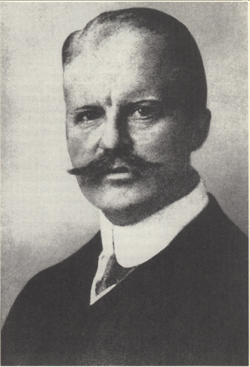
img: Arthur Zimmerman
Whoops.

Wilson & Pacifism

Along with the details of the Germans’ bizarre plan, this book spends a lot of time discussing American reluctance to get involved in what was perceived to be a European conflict. There were a lot of reasons for this: the presence of Czarist Russia on the Allied side muddied what could otherwise be seen as a battle between democracy and militaristic monarchies, pro-German sentiments among American citizens of German descent (particularly in the Midwest), and a general lack of interest in the war outside of the Atlantic seaboard, even when U.S. ships were being preyed upon by German U-boats. This isolationist attitude was personified by the U.S. President, Woodrow Wilson, who had campaigned on a pacifist platform and fought tooth and claw to keep the United States out of the war until events, specifically the Zimmerman Telegram, made military intervention unavoidable.

Wilson quite presciently believed that the only lasting peace would be a negotiated peace; if a peace treaty was dictated by the victors at gunpoint, it would go too far and breed resentment that would only lead to future conflict. Subsequent history would prove him all-too correct on this point. But Wilson’s insistence on keeping the U.S. out of the war to act as a neutral arbiter grated on contemporaries like Theodore Roosevelt, who saw the war as a clash between democracy and military totalitarianism that the U.S. could ill-afford to sit out. Also, Wilson’s determination to take the high road quite understandably infuriated parties on both sides, who viewed his attitude as incredibly patronizing and had no interest in being scolded like naughty schoolboys by the professorial Wilson. But despite the Allies’ desperation in 1917, Wilson and the majority of American citizens were not willing to get directly involved in a war that did not directly affect the United States.

Zimmerman and the Mexican Plot

In that sense, the Zimmerman Telegram was exactly what the Germans did not need. The threat of a Mexican invasion, however remote, energized the population and made it clear to the American People that the Germans were their enemy whether they liked it or not. Mexico in 1917 had even more problems than Mexico today; Pancho Villa and his revolutionaries were running around stirring up trouble, and it was not crystal clear who was in real control of the country. The Germans had no illusions of Mexico actually defeating the United States, but in 1917 the Mexican-American war was not that far distant, and they thought that Mexico would jump at the chance to recover their old territory. Because the Japanese were “of the same race” (i.e., not white), they thought they had a chance of roping them in too, with some nebulous promises of a Japanese colony in California.

I had never heard of this fantastic scheme, which sounds incredible, but the plucky Germans sent coded messages to the Mexican government using the official U.S. cable in Washington in an attempt to drum up an alliance and ensure that the U.S. could not intervene in Europe. The story of how British intelligence managed to crack the German code, intercept the telegram, and deliver it to Wilson was fascinating and made this book a lot of fun to read.

Conclusion

Once the public got wind of the plot, many simply could not believe it and thought it had to be a hoax. But when it became clear that it was all too real (thanks in large part to an inexplicable admission of guilt by Zimmerman himself), peace was no longer an option. Tuchman argues that U.S. intervention on the Allied side was pretty much an inevitability by 1917, especially once the Germans amped up their U-boat operations and started targeting more and more U.S. vessels. But without the Zimmerman Telegram, it could easily have been another six months (or more) before the stubborn Wilson finally hitched the U.S. wagon to the Allied cause. Could Britain have held out for another six months without U.S. support? It’s hard to say, but it is very possible that without the second wind the U.S. gave the Allies in early 1917, the Allies would have been forced to negotiate a peace that would have changed the face of Europe (and the history of the 20th century). For that reason, the Zimmerman Telegram was a significant historical event, and Barbara Tuchman tells its story with typical skill. 4 stars, recommended!
Profile Image for Patrick.
423 reviews2 followers
February 1, 2018
A masterpiece, one of the most entertaining, unbelievable, and beautifully written historic narratives I have ever read.
14 reviews25 followers
September 21, 2023
I'd always thought America entered the First World War as a consequence of German U Boats sinking American ships in the Atlantic. That may be from my school days, I'm not too sure.

I'd never heard of the Zimmermann Telegram.

I'd suggest this is well-written and for those that 'no nothing' off this, worth the effort.
Profile Image for John.
182 reviews40 followers
May 1, 2014
The decoding of the Zimmerman Telegram is one of the final straws to break Woodrow Wilson's policy of pacifism and isolationism. This book explores the United States position in relation to European events in WWI and the German efforts to prevent the US from joining the Allies. To this end Germany engaged in sabotage and notable attempts in funding Mexico and / or the Revolutionaries to hairy the United States border. A busy America at home can only be good for Germany as she is stuck in a quagmire of stalemate. Should Germany prevail in Europe The Kaiser promises to help Mexico regain its lost territories in southwestern U.S., by helping Mexico launch a military campaign. Germany was paying Pancho Villa. Germany is on the verge of loosing The Wolf Pack on Atlantic international shipping, no holds barred.

The trick was how to not spill the beans about England having broken the German code early in the war. Wilson had been betraying international neutrality by being friendly to Germany and letting her use our telegraph cable to send messages to their ambassador and onto further destinations ie Mexico. Britain provided us an original document of the Zimmerman message as sent to the German ambassador in the US. We in turn, located the ambassador's reworded message as forwarded on to Mexico. This was the one presented to the world. Wilson was pissed to say the least and was "Obliged to believe it".

In this treatise Japan looms large as an additional force in Mexico vying for a navel port on the Pacific coastline. These Yellow Horde fears fuel Japanese interment 35 yrs later. This was never presented in high school history class. Juicy stuff.
Displaying 1 - 30 of 448 reviews

Can't find what you're looking for?

Get help and learn more about the design.