The story is set in post-Napoleonic France when the new bourgeoisie was jostling for position alongside the old aristocracy. We meet Lucien Chardon, a young provincial who romantically aspires to be a poet, and his friend David Séchard, who struggles to manage his father’s printing shop and falls in love with Lucien’s sister Ève. The picture of provincial life that emerges is laced with greed, ambition, and duplicity.
French writer Honoré de Balzac (born Honoré Balzac), a founder of the realist school of fiction, portrayed the panorama of society in a body of works, known collectively as La comédie humaine.
Honoré de Balzac authored 19th-century novels and plays. After the fall of Napoléon in 1815, his magnum opus, a sequence of almost a hundred novels and plays, entitled, presents life in the years.
Due to keen observation of fine detail and unfiltered representation, European literature regards Balzac. He features renowned multifaceted, even complex, morally ambiguous, full lesser characters. Character well imbues inanimate objects; the city of Paris, a backdrop, takes on many qualities. He influenced many famous authors, including the novelists Marcel Proust, Émile Zola, Charles John Huffam Dickens, Gustave Flaubert, Henry James, and Jack Kerouac as well as important philosophers, such as Friedrich Engels. Many works of Balzac, made into films, continue to inspire.
An enthusiastic reader and independent thinker as a child, Balzac adapted with trouble to the teaching style of his grammar. His willful nature caused trouble throughout his life and frustrated his ambitions to succeed in the world of business. Balzac finished, and people then apprenticed him as a legal clerk, but after wearying of banal routine, he turned his back on law. He attempted a publisher, printer, businessman, critic, and politician before and during his career. He failed in these efforts From his own experience, he reflects life difficulties and includes scenes.
Possibly due to his intense schedule and from health problems, Balzac suffered throughout his life. Financial and personal drama often strained his relationship with his family, and he lost more than one friend over critical reviews. In 1850, he married Ewelina Hańska, his longtime paramour; five months later, he passed away.
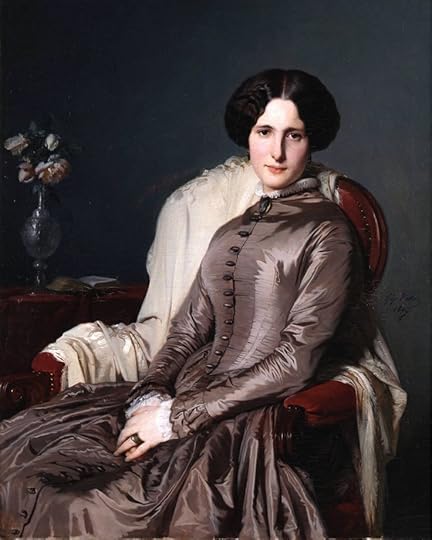
Portrait of comtesse de Bellefonds, Jean-Hégésippe Vetter (1849)
An Appointment with Destiny
Les deux poètes (1837) [The Two Poets] Balzac definitely catapults the reader into an immense world in this first part of the trilogy that makes up Illusions perduesLost Illusions. The books were published separately with several years between them. However, when translated into English they were either fused into one entity or paired up in an unusual fashion. The translation I read (Herbert Hunt's) was overall very good although at times convoluted with long sentences that didn't quite crystallize into English. It would be wonderful to read it in its original French. Ah, one of these years....
Balzac's prose is quite dense and he has a tendency to educate the reader about social customs, politics and trade while weaving his story. I think I learned more about paper, the printing press and life in a rural French village than I ever expected. However, the story that unfolds focuses on three individuals: David, Lucien and Eve. Lucien is a budding poet with the wish to find riches and fame in Paris, while David and Eve are more of a couple that wish to settle for a life in a village setting in a more traditional fashion. The novel allow us to follow the trajectories of these people under the influence of hopes, dreams, fate and chance. It is an enjoyable novel which transitions one's mind to early 19th century France. The novel kept growing on me as it progressed and its ending makes it impossible to avoid the sequel. Balzac's works are well worth exploring as they are numerous and cover so many aspects of the life, politics and history of 19th century France. Recommended for fans of French literature and the classics. I sense numerous Balzac novels in my immediate future.
Yine Balzac.. Yine ekonomik sıkıntılar.. Yine sınıfsal ayrılıklar.. Yine düzene başkaldırı.. Ama bunları işlerken yine aşk.. Üçlü serinin ilk kitabı.. hikayeye giriş bölümü gibi sanki.. Bildik olaylar Balzac farkıyla bize geliyor.. Balzac severlere mutlaka öneririm..
Two top qualifying points in a great book is splendid descriptive style when detailing the scenery and the places the reader is taken to . When I feel I’m a part of the set , it makes for an amazing piece of work . Balzac executes this so perfectly . The second is character development which he provides us with as well. I love when I am fully invested in the characters lives and feel like they are important to me enough to sink into a story . I listened to this on LibriVox. Bruce Pirie narrates this story exceptionally well. I hung onto every word , every detail . Balzac writes beautiful prose. I’m looking forward to the second in the series .
Balzac can be tedious, especially when he writes about the French countryside it seems. But if you don't like his description and characterization, he gives you the whammy at the very beginning of this book. A printer makes a tough deal with his son to take over the shop but after the son marries, he becomes more involved with inventing a new type of paper. That while his friend, now his brother-in-law, recklessly goes to Paris to become a poet. The French village is full of eccentrics and probably the most tedious but revealing section of the book has to do with a lawsuit for debts. I usually get so much out of Balzac that even when he is slow-going, I forgive the book for it. Good book!
The first of three in the Lost Illusions books by Balzac. This set up the characters for all three books. I enjoyed this book, but never will I understand greedy, miserly people......who want more more more. Do they know they can't take it with them? Do they not trust the children they brought into this world? Apparently not. Sad for them.
Balzac's Two Poets, the first of "Lost Illusions" which introduces two similar but very different men, connected in brotherly spirit. Balzac once again shows the stagnation of the provinces and the need of artist to flee to Paris for fame, money is needed to help the artist which loving family members provide hoping for the best. A frequent theme of Balzac is a young man in love with a beauty older woman and following her to his fall or rise. Lucien the young man's fate will be known as the trilogy continues and that of his family who give all for him.
I did not read this edition but from a Delphi Collection of Balzac's works, which included the synopsis below.
"This novel is the first part of a trilogy, published under the title Illusions perdues, written between 1837 and 1843. The trilogy begins in the provinces, moving to Paris and finally returning to provincial France. The work is celebrated for its realistic and unbiased portrayal of all types of social life at that time in France. "
"Les Deux poètes introduces Lucien Chardon, the son of a lower middle-class father and an impoverished mother of remote aristocratic descent, who is the pivotal figure of the trilogy. Living at Angoulême, he is handsome and ambitious, in spite of his poverty. His widowed mother, his sister Ève and his best friend, David Séchard, do nothing to lessen his high opinion of his own talents. Even as the first part of Illusions perdues begins, Lucien has already written a historical novel and a sonnet sequence, whereas David is a scientist. But both, according to Balzac, are “poets” as they creatively seek truth. "
Lucien was a self centered character, thinking of himself and not too clearly, when he decides to follow his married lover, Louise instead of attending his best friend and sister's wedding that was terrible enough but then having his poor mother and sister give all their money for his excursion, unbelievable, topping that off, he has David, his friend, sign a note for borrowed money. He changes his name to his mother's noble name, since Louise suggested it.
David is likeable, knowing his limits but trying to make good for himself and his love for the Chardons. David's father is a miser who looks to make money off his son, though he has money keeps his son in want.
Eve is likeable but her putting her love for Lucien over her lover is so sad because David gives all because he loves her and her brother but loves her more.
Louise has her husband, a sixty year old man fight a duel with a younger man who tells rumors of her being uncompromised which is basically true. I am sure she really could careless about his safety.
Louise and Lucien go to Paris while her husband unknowingly of this fact, she tells him to stay with her father in the country.
It is not clear if David and Eve are to be married soon, for their poverty is increased.
"CHARDON (Madame), nee Rubempre, wife of the preceding. The final branch of an illustrious family. Saved from the scaffold in 1793 by the army surgeon Chardon who declared her enceinte by him and who married her despite their mutual poverty. Reduced to suffering by the sudden death of her husband, she concealed her misfortunes under the name of Mme. Charlotte. She adored her two children, Eve and Lucien. Mme. Chardon died in 1827. Lost Illusions. Scenes from a Courtesan’s Life."
"CHARDON, retired surgeon of the army of the Republic; established as a druggist at Angouleme during the Empire. He was engrossed in trying to cure the gout, and he also dreamed of replacing rag-paper with paper made from vegetable fibre, after the manner of the Chinese. He died at the beginning of the Restoration at Paris, where he had come to solicit the sanction of the Academy of Science, in despair at the lack of result, leaving a wife and two children poverty-stricken. Lost Illusions. "
"CHATELET (Sixte, Baron du), born in 1776 as plain Sixte Chatelet. About 1806 he qualified for and later was made baron under the Empire. His career began with a secretaryship to an Imperial princess. Later he entered the diplomatic corps, and finally, under the Restoration, M. de Barante selected him for director of the indirect taxes at Angouleme. Here he met and married Mme. de Bargeton when she became a widow in 1821. He was the prefect of the Charente. Lost Illusions. A Distinguished Provincial at Paris. In 1824 he was count and deputy. Scenes from a Courtesan’s Life. Chatelet accompanied General Marquis Armand de Montriveau in a perilous and famous excursion into Egypt. The Thirteen. "
"CHATELET (Marie-Louise-Anais de Negrepelisse, Baronne du), born in 1785; cousin by marriage of the Marquise d’Espard; married in 1803 to M. de Bargeton of Angouleme; widow in 1821 and married to Baron Sixte du Chatelet, prefect of the Charente. Temporarily enamored of Lucien de Rubempre, she attached him to her party in a journey to Paris made necessary by provincial slanders and ambition. There she abandoned her youthful lover at the instigation of Chatelet and of Mme. d’Espard. Lost Illusions. A Distinguished Provincial at Paris. In 1824, Mme. du Chatelet attended Mme. Rabourdin’s evening reception. The Government Clerks. Under the direction of Abbe Niolant (or Niollant), Madame du Chatelet, orphaned of her mother, had been reared a little too boyishly at l’Escarbas, a small paternal estate situated near Barbezieux. Lost Illusions. "
David's father wants him to go to school so he can read which the father can not; he wants David to come back and make money off him, a partnership. The father is greedy and sees his son takeover failing; looking not to spend money to help but take what he can. Lucien Chardon, is David's school friend and looks to help him with a job at his press because the father has died and the family is poor. David falls in love with Lucien's sister, Eve and blindly looks to help the family making his attentions less to his business. Mme. de Bargeton is loved by Lucien; Lucien is invited to Mme. Bargeton because of his poetry that Chatelet introduced but too late seeing a rival. Nais is referring to the dead soldier lover. Lucien is loved by Nais but she is told of his mother being a nurse to the sick. Nais wants Lucien to take his mother's noble name and that will help find him fame. Lucien thinks twice after giving Nais an ultimatum of having David being accepted in her circle too. David and Eve love though not expressed. Lucien goes to Nais to read poetry to her friends who are not in favor of poetry but to ridicule him. David tells Eve of his fears of such a relationship. David and Eve tell about their love and coming marriage. At first Lucien was ashamed because he wanted his sister to marry someone greater. David thinks his father will say yes but I wonder. The spies say that Lucien and Nais are together and caught which Chanlet planned to defend but Nais has told her husband to have a duel with Stanlias. Nais has her husband goes to challenge Stanlais to a duel for what he said of his wife and Lucien. The duel has Stanlais injured for life. David and Eve prepare for their wedding. Nais tells Lucien that she is going to Paris and her husband to go with her father to his home. She thanks Lucien for her change. What about her, thinking it is all about her. Chatelet looks to see if Lucien is traveling with Nais, so he could catch her but David and Lucien leave before her and they visit David's father before going to meet Nais. David hears about Lucien not being at his wedding, and Eve giving her brother money that he had not know she had and the need of Lucien to have more money which he signs himself, bringing more debt for the sake of Lucien.
Balzac has been called one of the most influential writers of the 19th century. His prose, while dated, is timeless in its study of the human drama—in this case 'the human comedy.' This first book, Part I of La Comèdie Humaine acquaints you with the two main characters, Lucien and David. Lucien represents the baser aspects of the human spirit, while David the nobler. The story progresses through this tug-of-war of love and ambition.
[Expertly read by volunteer reader Bruce Pirie on LibriVox.]
This is a wonderful set-up and it really seems like I will love the next two installments but that’s really all I can say about it. No powerful thoughts or impressions. I just know I wish I were David, but in truth I am Lucien.
The trilogy is serious literature with biting descriptions of provincial life and strongly depicted characters. Balzac produces many well penned descriptions descriptions although he can be wordy.
As the first of a three-part series entitled ‘Lost Illusions,’ which in turn is part of Balzac's ‘Human Comedy’ series of vignettes and novellas, ‘Two Poets’ sets out to do little more than introduce the principal persons of the drama, and establish a mise-en-scène where the story can unfold. The principal characters are a printer, Jerome-Nicolas Sechard, commissioned by the Convention to print their decrees, David Sechard, his son, swindled by his father to buy the printing press with its outdated equipment, Lucien Chardon, David's friend and roughly his age, Mme. de Bargeton, a woman Lucien is in love with and M. de Chatelet, a diplomat and a former military adventurer. All the rest are appendages to these five people, but it would be disingenuous to dismiss them lightly.
The plot involves the sexual frustration of Mme de de Bargeton and the social and intellectual ambitions of Lucien who, at twenty two, thinks he is passionately in love with Mme de Bargeton, who is nearly twice his age. Lucien’s rival is the clever M. de Chatelet, who hopes to marry the lady when her husband is safely underground, and become the controller of her fortune. At this point, ‘The Two Poets' ends with Lucien setting off to Paris in Mme de de Bargeton’s train, while David and Eve get ready for their wedding the following day.
‘The Two Poets’ is a showcasing of Balzac's genius in portraying people, and his gimlet eyes miss nothing, not a pimple here, not a faded seam elsewhere. Lucien is spoilt by everybody because he is very good-looking and so loses touch with reality. David, the real poet in the equation, endures his father's petty chicaneries, and sets to work with a will. Both poets are in love, but while Lucien aspires high and lands a faded bluestocking/ tomboy, David keeps his feet planted firmly and looks at Lucien’s sister for a helpmeet.
The difference in class between the new aristocracy of the Restoration and the old nobility - what is left of it - of the old monarchy, between the moneyed classes of tradesmen and the poverty of the landed gentry who form a charmed inner circle from which outsiders of any stripe are jealously excluded, between the provincial Queen and the Parisian Marquise forms the background to the study of character. Social ambition without rank, descent, money or a noble profession is exposed in its naked ugliness. Yet it doesn't seem as if Balzac is condemning anybody. This is the way of the world, that is all. Innocence is not an absolute virtue, any more than worldly ambition is itself a sin.
And having set the stage, Balzac leads us into the second part of ‘Lost Illusions’ entitled 'A Distinguished Provincial at Paris,’ describing Lucien's life in Paris with a borrowed two thousand francs in his pocket.
(The Human Comedy #37 of 98) Part one of the longer (the longest Balzac wrote) work Lost Illusions. Here the story is setup in romantic fashion: a miserly father (a retired printer) constantly looking to hoodwink anyone he can to gain more money including his own son; the son, David, who is idealistic and always thinks the best of everyone but who is hoodwinked by his own father and locked into terrible financial bargains because he doesn't believe his own father would swindle him, David is a poet and taking over his father's printing business means that he can be surrounded by words and poetry; Lucien, son of a pharmacist (not the respected profession it is today), who has been spoiled rotten by his widowed mother and doting older sister, who believes himself to be a wonderful poet held back only by situation and lack of finance; Eve the doting older sister who believes her brother to be capable of great things and feeds his fantasies and his selfish ambitions.
In part one, Lucien is feted as a great poet in the local Provincial lady's household by a foppish suitor looking to ingratiate himself into the bosom of Mme de Brageton, a lady bred for Paris but stuck in the backwater Angouleme married to a bore, his plan however backfires when Mme is REALLy interested in the beautiful (but average poet) Lucien and drops the fop.
David, Eve and Eve's mother spend all their money ensuring Lucien has fine clothes and opportunity to develop his place at Court, but will Lucien remember who has sacrificed so much to give him his little leg up when scandal envelops the region of Angouleme?
For Balzac, it's an enjoyable romp, but I still feel I can only give it three stars without being unfair to other books that have got 4.
Bu kitabın girişinde Paul Morand'ın yazdığı bir önsöz bulunuyor ve muazzam. Aklınızda "klasik eserler sıkıcıdır" gibi bir klişe varsa yıkmak için Balzac mükemmel bir seçim. Balzac, yalnızca bir yazar değil çünkü yazarlık para getirmez. O, bunu fark ettiği için aynı zamanda matbaacılık, yayıncılık da yapmak isteyen, batan, sonra tekrar çıkan bir adam. Eser bir yandan tutkunun, edebi hırsların, bu konuda afili aforizmaların toplamı, bir yandan 1830 devrimleri sırasında Fransız sisteminin özeti. Kapitalizmin özü değişmiyor ve bu sistem içinde "sanatçı" olabilmek de kapitalist ilişki ağlarından bağımsız değil. İnsanlık Komedyası serisinin bence zirvesine çıktığı bu eserde Balzac edebi bir tarih anlatısı sunuyor.
Two poets — David and Lucien — best friends, more like brothers. We meet them when they are about 20. David was educated to be a printer. He is selfless, somewhat of a dreamer, truly a good guy. His father is a successful but greedy provincial printer who sells his business to his son at a price that is so high it will probably ruin him. Lucien is dirt poor; he is a talented poet. Mme. Bargeton (married to the baron) rules society in her little provincial town so there are a lot of sharpened knives ready to take her down a few pegs. She has championed Lucien (20+ years her junior) hoping to mold him into a poet of the first order to increase her stature as well. Their relationship is typical of the day with one big exception — consummation. Eve is Lucien’s sister. She has it all: looks, intelligence, steadiness of purpose, loving kindness. But she has no money, no social status. She and David have been fated by the great supernatural to be one as man and wife. This story is part 1 of a trilogy. It ends with Lucien and Mme. Bargeton escaping to Paris where their relationship will complete and Lucien’s talent will flourish. David and Eve have generously agreed to finance him for his expenses that will not be paid by Mme. Bargeton.
The first book of the trilogy Illusions perdues, which is one of Balzac's major works, and which is probably the most autobiographical section of the Comédie humaine, although neither of the major characters is exactly Balzac. The two poets are David Sechard, who like Balzac was for a time an unsuccessful printer, and Lucien de Rubempré, who like Balzac becomes the protegé of a somewhat older noblewoman. The book shows the difficulties of a beginnning writer in the highly class stratified society of Angoulème. I enjoyed the novel more than some of the other Balzac which I have read recently, but I will hold off on a real review until I've finished the other two books of the trilogy. [Not this edition, but at least it's in French.]
Kendisi de bir matbaa satın almış olan Balzac'ın, bu kitaptaki karakterlerinden biri de matbaacının oğlu David'dir. Arkadaşı Lucien'de bir eczacının oğlu olup hayalleri daha uygun fiyatlı basım yaparak birlikte çalışmaktı. O zamanlar kitap basmanın ne kadar pahalı ve zor olduğu anlatıyor. O zamanın Fransa'sında aristokrasi çok güzel yansıtılmış. Şu sözlerle anlıyoruz aslında: "Değerleri anlaşılmamış insanlar, görüşlerinin yüksekliğiyle durumlarının intikamını alırlar. Ama böylece gerçek kaderlerinin onları sürüklediği yere daha hızlı gittiklerinden, umutsuzlukları da o ölçüde daha acı olur."
Matbaanın henüz kullanılmaya başlayıp da yaygınlaşmadığı bir devirde iki şairin yaşam serüveninden kesitler daha ağırlıklı. Şiirlerinden örnekler pek yok. Şairlerin iç dünyalarından kesitler yerine yaşadıkları şartları daha çok işlemiş. Belki de devrin etkisi bunu gerektiriyordu tam anladığım söylenemez. Fakat Balzac bu eseriyle devrini çok detaylı yansıtmış diyebilirim. Bir devrin akımını anlama açısından okunabilir.
La primera parte de "Les illusions perdues" nos presenta a su protagonista, Lucien, en sus comienzos como poeta en su ciudad natal, el inicio de su historia amorosa y el sacrificio de su familia para que pueda ir a París a labrarse fortuna.
I really enjoyed this. Balzac at his best, wonderful interiors and a host of appalling provincial characters. Even his women aren't as exaggeratedly either wicked or saintly as usual/
1001 böcker Sid 42, mening 1: ”Han skulle anse sig ovärdig att bli älskad av Louise, om han inte bad henne att göra detsamma för David som hon gjorde för honom själv.”