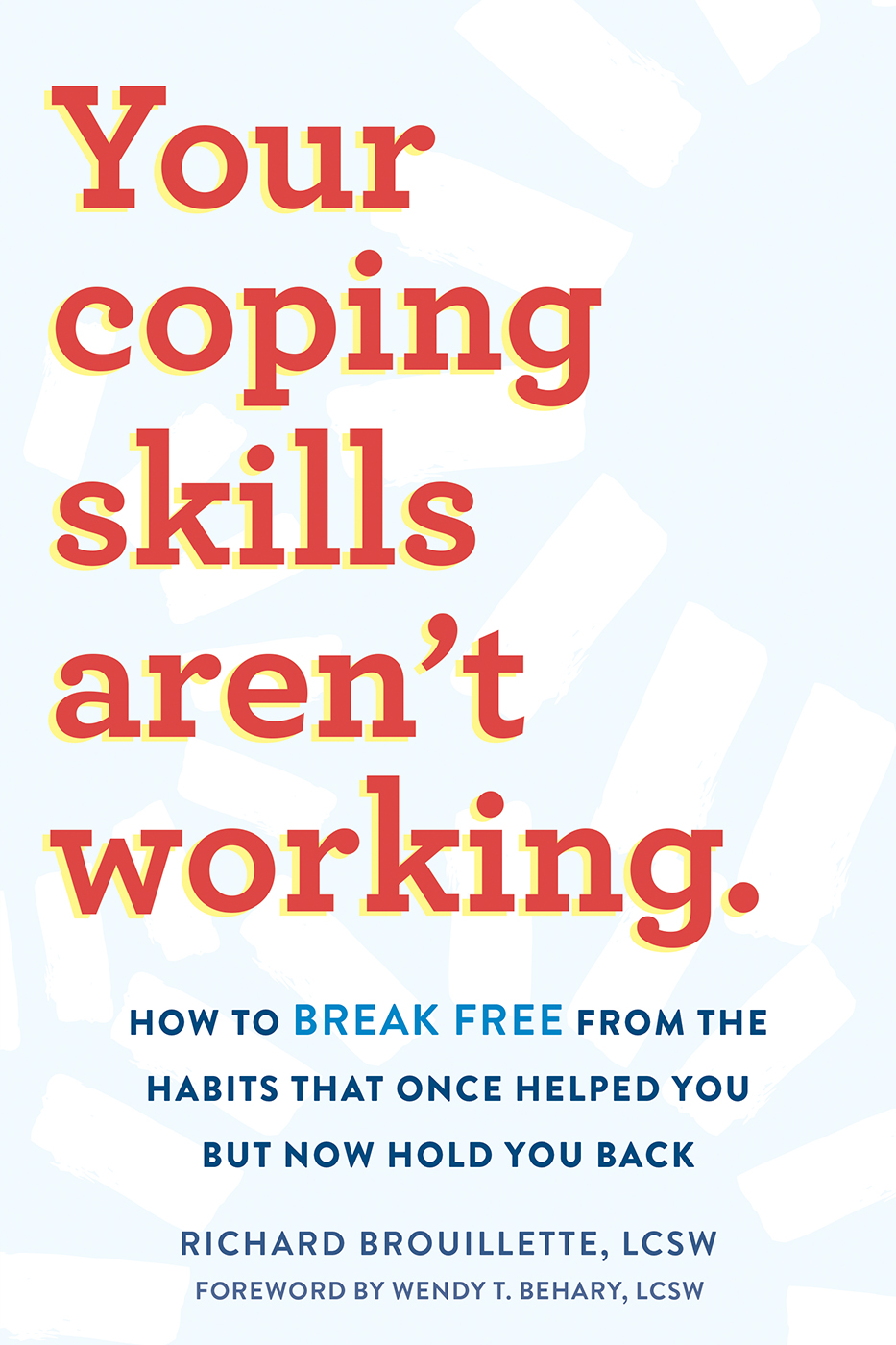
It’s time to move beyond the self-destructive coping "skills" that hold you back! The coping styles we develop in childhood are often the result of stressful or traumatic experiences. And while they once worked to keep us feeling safe, they do not serve us well in adulthood. This breakthrough guide offers an innovative and evidence-based approach grounded in cognitive behavioral therapy (CBT), schema therapy, and attachment theory to help you break free from the coping habits that keep you stuck in a cycle of self-sabotaging negative thoughts and behaviors. In this eye-opening book, you’ll identify the maladaptive coping patterns you developed in childhood, understand why you developed them, and learn how to change those destructive habits standing between you and a happier life. You’ll also discover powerful strategies to help you give voice to your unmet needs; and learn to cultivate clarity, security, and confidence in yourself and what you need. Dysfunctional coping styles are often the relics of damaging childhood experiences. But your past doesn’t need to dictate your future. With this guide, you can finally get unstuck from the habits that hinder your personal growth, get in the way of healthy relationships, and keep you from reaching your highest potential.
Richard Brouillette, LCSW is a schema therapist working with adults to address trauma, depression, and anxiety, including creatives and activists who have plateaued and are trying to overcome anxiety, find fulfillment, and improve relationships. Richard has published in The New York Times, Salon and Psych Central. He is the Psychology Today Expert Opinion blogger of Flipping Out: Changing Mindsets with Schema Therapy. He has a number of professional affiliations, and in 2020, Richard was elected Executive Board Secretary of the International Society for Schema Therapy. Now based in California, previously he worked with survivors of torture and political asylees, and in a community mental health center in The Bronx.
I read this book the whole day as I was desperately looking for a book that covers cues given by our body; discussions on emotions and cognitive with behavioural issues as a complete topic put together. I am so glad I got the advance reading copy. Thank you, New Harbinger and the author.
I like how insightful this book is starting from its guide on what to expect from the book, how to make the book practical for those who need it and the basic tools we would learn from it.
The book is based on a technique called Schema Therapy which is quite new to me. The contents explains the concept well; where and how it can be applied and which aspects it covers that could interest anyone.
This book is quite helpful for someone like me who feels tried most days but stay up late most nights trying to deal with my own emotions and making decisions on how to cope certain situations I faced so far.
Flanked with enough examples, experience and references a good read for anyone who wants to know about what our body is trying to tell us, how our emotions affect us. Spotlight on the chapter with “core emotional needs” which I find quite informative and helpful.
Quite informative and insightful, take your time. Try to know yourself better while reading this book.
I received a copy of this book in exchange for my honest review. Thank you NetGalley .
Let me start by saying that self-help style books aren't my things. I typically don't believe in what they're preaching, and to be honest, the books almost always bore me.. to the point that I DNF them. BUT the title of this one caught my eye immediately. Because you know what? You're right book man. My coping skills are not working.
While I cannot say this book blew my mind or was ground-breaking for me, I CAN say I got through the entire book in a fairly short time. AND I did learn some useful things from it.
I received an ARC in exchange for an honest review.
I had never heard of 'Schema Therapy' before reading this book, but wow am I now very interested. The author does a wonderful job diving into the subject in a gentle and easy way, introducing you to various aspects of the concept itself, and helping you get to know more about...well, you. The idea is looking within to find the hurt child from your past, and guide your current coping skills towards a more productive and healthy direction. We did what we could to deal with our traumas and troubles in our childhood, but now those methods no longer serve us as adults. The author tells us to take charge of the angers, fears, judgements, and general negativity that scream to be acknowledged, listen to them, and then become a kind healthy adult to nurture that hurt and pain within you.
The author's writing style has such appeal to me. I wasn't exactly sure what to expect going into this book, but the kindness and thoughtfulness of the author really struck me. I've read a few self-help books by now, and this is a rare one where I not only felt like the author was talking to me, but genuinely cared about me, acknowledged my pain, and wanted to help me help myself. It's very approachable and easy to understand, with bite-sized sections to read and digest. There is definitely no rush when it comes to this book, and I like that the author gives suggestions for how long to take with something.
There were plenty of examples and explanations, and the exercises really tied everything together. While the general idea of journaling and what-not isn't new or profound, it's popular for a reason--it's effective, and the author's approach of how to use your journal is certainly new to me. While you can work with this book on your own, I do, like the author, also suggest working alongside a professional if you can. The author provides a free downloadable worksheet to go along with the book, and included a few in the book as well.
If you have been accustomed to certain kinds of triggered emotions for most of your life, it can feel odd to go through your week less triggered.
There are a lot of things mentioned in here by the author that I'm so glad they address, the above being one in specific that had me screaming in my head, "YES! YES!" The author does a really great job catching little nuances that readers might be feeling at various points in the book, and I appreciate that they are covering so many bases, so more people can feel heard and validated.
I say this as a compliment--the author really holds your hand as you read through this, and I think that's so important. When people come into these topics vulnerable, it's so nice to see the patience and care given to them. The explanations and wording are very kind and thoughtful. And for any LGBT+ or BIPOC readers, there is acknowledgement of the unique struggles these communities face too. The author is very inclusive, which I appreciated. Very rarely, if ever, do I see that in general self-help books.
I was really taken aback by this book, it's very well done, and I'm grateful I had the opportunity to read it. If you're looking for a more unique approach to self-help, this one may be worth considering. :)
this book felt like a crash course on learning how to parent myself and protect myself… from myself.
i loved how it gave practical tools not just for me, but for how i’d teach my future kids to cope and respond to triggers healthily.
as someone who struggles with detachment coping (i.e. doom scrolling, avoidance), this hit home, and the sections on social isolation, subjugation, and self-sacrifice felt like they were reading me, not the other way around.
definitely will be applying what i’ve learned, and thinking about how i’m interacting with myself the next time i feel the need to respond in an unhealthy way.
Thank you to the author, publisher, and Netgalley for giving me an advance copy of this book.
This is an incredible resource for everyone. Everyone has coping skills they have developed throughout their life, especially in childhood. I found the description of different Schemas and their origins helpful and informative. It has helped me understand my self, my relationships, and communication as a whole in a better way.
“So where is the hero who comes to the rescue? This kid, Little You, is in trouble, and who’s coming to save them? You guessed it. You are.”
my psych recommended me this book as a way to better understand schema therapy and it was so helpful to read! explains everything really well, with lots of great prompts/exercises to do (i am yet to do these lol i just shut down but one day!) - so helpful with lots of examples and an accessible/easy read
schema therapy has been so life changing - it makes me so sad for teenage me that i didn’t have access to this then but glad i am starting to work through it now...
particularly liked chapter 5 and 6 - giving examples of how the healthy caring adult might talk and how to talk to the modes
also really appreciated the intersectional lens + noting things like structural racism/other bigger issues and validating these
two key things: - you can be the healthy adult and literally talk to yourself (your inner child) like you would a child - no point changing behaviours without addressing the beliefs - need to do the deeper work!!
- “But if you’re able to take a pause and step back, you may realize that you’re not as bad as you’re making yourself sound. Mean thoughts like these may be vocalizations of states of mind that ultimately, you don’t even fully agree with. ” - “Taking the problematic coping voices seriously—recognizing their purpose may have served you at one time in your life and how they’re holding you back now—and learning to talk back to those voices now that you’re an adult who’s able to cope with authority and agency.” - “Often people feel friction when trying to change a behavior because they’re trying to change the behavior without addressing the core belief that drives the behavior. The result is that the change process becomes incredibly fatiguing because by changing their behavior, they’re also trying to force themselves to act against what they believe reality is.” - “It will be up to you to talk back to these modes and explain to them that things have changed, childhood is over, and there are better ways to handle stress now.” - “The goal is to bring your healthy caring adult on stage with the inner child, kneeling down to be close, being a good parent, and taking care. This means dealing with all the other modes in ways that your child-self has never been able to, just as a parent protects a child from overwhelming challenges in the world so the child can focus on learning and facing age-appropriate growth tasks.” - “Finally, remember that these dialogues may sound like a lot, especially in the moment your mode is triggered, but the process becomes intuitive and happens a lot more quickly with practice.” - “Small behavior changes lead to changes in mindset, self-awareness, and a sense of what’s possible, and once you have different beliefs about what’s possible, you naturally start to see yourself differently.”
I was unfamiliar with the psychotherapeutic model of Scheme Therapy until I read this book. While the terminology and structural elements of the process were new to me, the techniques of expressive writing (journaling), imagery work, and dialoging with inner aspects of self were very familiar from a variety of psychological/spiritual sources and modalities. What makes the Schema model so helpful is its context and author’s clear delineation of self-administered exercises.
Basically, schemas form when some of our core emotional needs are not met between the ages of birth and 5 years old. These “snapshots” of experience become the basis for how we come to believe the world works and evolve into patterns of behavior (modes) over the next five years as we socialize. As these modes get reinforced, the coping skills fostered to protect ourselves at a tender, vulnerable age, may become increasingly problematic in our adult lives. Even when we recognize the need for change, these schemas and modes can activate internal resistance to the well-intentioned change, keeping us stuck in dysfunctional behavioral patterns.
The author outlines 18 different schema and provides a means to identify personal schema by assessing three different data points: what the inner voice says, how it is expressed in daily life, and the connection to a childhood experience. The core practice in addressing these schemas is the development of a healthy, caring adult mode; in essence creating the ability to reparent oneself to meet basic emotional needs.
The content is laid out in an easy-to-read, logical format. The exercises provide opportunities to support awareness and behavioral change. My one comment is that if one is just beginning on a journey of self- discovery, a therapeutic relationship with a professional may be needed to work through deep issues that may arise and feel overwhelming.
My thanks to the author, the publisher, and NetGalley for the privilege of reviewing this book. The opinions expressed in this review are completely my own.
This review is being posted immediately to my GoodReads account and will be posted on Amazon upon publication.
A delightful and comprehensive introduction to schema therapy with ample explanation to each concept, sufficing examples to ensure understanding, and helpful exercises at the end of each chapter to assist the reader in identifying, processing, and ultimately overcoming their obsolete coping mechanisms or schemas by exchanging their self-sabotaging behaviour for healthy coping and a better understanding of themselves. One thing that I have particularly loved about the book was the author's considerate and beginner-friendly approach to the topic. All in all, Your Coping Skills Aren't Working is an informative, well paced, and a skillfully executed book. I highly recommend.
Thank you to Netgalley and New Harbinger Publications for providing this eARC in exchange for an honest review.
Your Coping Skills Aren't Working by Richard Brouillette included great exercises and was easy to read. The author presented practical information, in-depth instructions, and thought-provoking exercises. I liked that there were links included where you could download worksheets.
The author introduced schema therapy, and the exercises and information identified the maladaptive coping patterns we have developed in childhood. The book helped the reader understand why we have developed these patterns and presented ways to learn how to change those destructive habits. The reader will discover powerful strategies to help give voice to their unmet needs and learn to cultivate clarity, security, and confidence in themselves and what they need.
It's hard to find info on Schema Therapy online, you can find all kinds of stuff on the schema's themselves, but unless you pay $300 to get a "program" you don't learn how to manage/cope/treat the actual schema's or how to make progress with them -- this book is a lot less than $300 and it really shows you how to learn about your schema's and also handle them and start making progress with them. Read this before spending the money on a "program"
Self help books are not my genre but as part of my team challenge month we included a self help book on the list of things to achieve. I picked this one and I was surprised by how insightful and helpful it was. There are exercises for you to complete and mantras to take on. As I mentioned it was very helpful in learning my coping mannerisms, the reason why they developed, the triggers, and how to manage it. Very pleased.
It helped me understand the form of therapy you do better. I have just heard about it before. However, I am a visual person. Knowing that I am a visual person, the images you created in my mind really helped me.
oh, great! so basically, I have to parent myself as if I'm not myself, but some child (my inner child) FFS as if I haven't been through enough, I now have to parent myself. honestly, at this point, just kill my inner child and be done with her.